Search results for: “vortex”

  • Titan’s Vortex

    Titan’s Vortex

    The timelapse animation above shows a swirling vortex above the south pole of Saturn’s moon Titan. It completes a full rotation in about nine hours, significantly quicker than the 16-day rotation of the moon. The vortex appears to demonstrate open cell convection, in which air sinks at the center of the cell and and rises at the edges to form clouds along the cell edges.  For the most part the dense haze of Titan’s atmosphere prevents scientists from seeing what goes on beneath the clouds, but Titan is thought to have weather cycles similar to Earth’s, except featuring methane rather than water. (Photo credit: NASA, Cassini; submitted by Adam L)

    ETA: This theme sometimes dislikes displaying .GIF images. If you don’t see the animation, click here.

  • Featured Video Play Icon

    Inky Vortex

    Ink released into water shows the swirling motion inside a vortex ring as well as its deformation and breakup upon stagnation against a wall. Although humans are known to make such vortex rings with smoke or bubbles, they are common in nature as well. Buoyant plumes often feature vortex rings at their head; dolphins and whales play with bubble rings; volcanoes blow smoke rings; and mosses use them to distribute spores.

  • Featured Video Play Icon

    Vortex Cannon

    Building a vortex cannon is a great way to demonstrate the power and longevity of vortex rings. As demonstrated here, it’s possible to create one with just a box with a round hole in it. Adding some smoke or stage fog helps visualize the rings. Vortex rings are found frequently in nature: volcanoes make them, some plants use them to distribute spores, and dolphins and whales use them to play. (submitted by @aggieastronaut)

  • Featured Video Play Icon

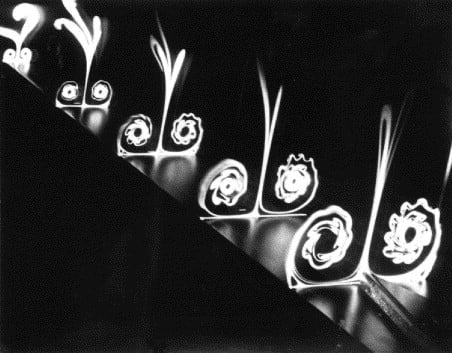
    Vortex Ring Collision

    Two vortex rings collide head-on in this video. If their vorticities and velocities are matched in magnitude and opposite in direction, their collision results in a stagnation plane–essentially a wall across which the fluid does not pass. In reality, there are slight variations that result in non-zero velocities where the vortices meet, so some mixing occurs, but the overall symmetry remains striking. The collision breaks up the vortex ring into filaments, some of which cross-link with the other vortex’s filaments, resulting in the little halo-like eddies around the perimeter. Videos of the same experiment at different Reynolds numbers can be found here. (Submitted by Charlie H; Video credit: T. Lim and T. Nickels)

  • Featured Video Play Icon

    Vortex Street Sim

    This numerical simulation shows a von Karman vortex street in the wake of a bluff body. As flow moves over the object, vortices are periodically shed off the object’s upper and lower surfaces at a steady frequency related to the velocity of the flow. The simulation takes place in a channel; note how the thickness of the boundary layers on the walls increases with downstream distance, forcing a slight constriction on the vortex street in the freestream.

  • Featured Video Play Icon

    Toroidal Vortex

    When instabilities exist in laminar flow, they do not always lead immediately to turbulence. In this video, a viscous fluid fills the space between two concentric cylinders. As the inner cylinder rotates, a linear velocity profile (as viewed from above) forms; this is known as Taylor-Couette flow. If any tiny perturbations are added to that linear profile–say there is a nick in the surface of one of the cylinders–the flow will develop an instability. In this type of flow, an exchange of stabilities will occur. Rather than transitioning to turbulence, the fluid develops a stable secondary flow–the toroidal vortex highlighted by the dye in the video. If the rotation rate is increased further other instabilities will develop.

  • Featured Video Play Icon

    The Spinning Underwater Vortex

    Vortex rings are a topic we’ve covered before with dolphins, whales, humans, volcanoes and even moss, but this video is particularly fun thanks to the addition of a bottle cap. By sticking the bottle cap next to the ring, these swimmers are able to demonstrate the forceful spinning of the fluid near the vortex. This spinning is what helps the vortex hold its shape over distances much larger than its diameter. As you can also see, though, sticking a bottle cap in the ring causes it to break up faster than it would otherwise! (submitted by Kris S)

  • Vortex Ring Collisions

    Vortex Ring Collisions

    Gorgeous color schlieren photography reveals the development and interaction of ring vortices. (Photo credit: Rebecca Ing)

    rebeccaing:

    It’s Schlier-tastic!!

    These are my invisible wonders!  Gas flows and fluid interactions.  Nothing but hot air, metho and acetone, yup, humble old nail polish remover.

    The images were captured using a colour indicating z-system schlieren optical array, an open shutter and a flash duration of 125 microseconds.

  • Featured Video Play Icon

    Vortex Shedding from a Hot Cylinder

    This numerical simulation shows vortex shedding behind a hot cylinder. The behavior is very similar to what one sees behind an unheated cylinder, until the coefficient of thermal expansion increases and the von Karman vortex street is completely distorted. Describing the particulars of the computation, jessecaps writes (links added):

    I wrote an incompressible flow solver to simulate flow past a heated cylinder. The Navier-Stokes equations are discretized on a Cartesian grid and solved explicitly in time. The pressure-Poisson equation is solved implicitly using a bi-conjugate gradient method. The Boussinesq approximation was used (density is constant everywhere except for the gravity term) to account for buoyancy. Reynolds number = 250, Froude number = 1 (gravity is pointing down). The two simulations show the effect of the coefficient of thermal expansion. Each video shows a plot of velocity and temperature.

    (submitted by jessecaps)

  • Airplane Vortex Wake

    Airplane Vortex Wake

    The wingtip vortices in the wake of a commercial airliner distort the clouds as the plane descends. Wingtip vortices form as a result of high pressure air from the underside of the wing accelerating around the wingtips to reach the low pressure on top of the wing. They can be hazardous to other (lighter) aircraft. They also contribute to downwash that decreases the effective lift of a wing. Geese use the same mechanism to their advantage when flying in a V-formation, and some snakes use it to glide.