Search results for: “vortex”

  • Vortex Impact

    Vortex Impact

    When a vortex ring impacts a solid wall (or a mirrored vortex ring), it expands and quickly breaks up. The animations above show something a little different: what happens when a vortex ring hits a water-air interface. As seen in the side view (top image), the vortex starts to expand, but its shear at the interface generates a stream of smaller vortices that disrupt the larger vortex. (They even look like a little string of Kelvin-Helmholtz vortices!) When viewed from above (bottom image), the vortex ring impact and breakdown look even more complicated. Mushroom-like structures get spat out the sides as those secondary vortices form, and the entire structure quickly breaks up into utter turbulence. There’s some remarkable visual similarities between this situation and some we’ve seen before, like a sphere meeting a wall and drop hitting a pool. (Image credit: A. Benusiglio et al., source)

  • Vortex Wake in Quebec

    Vortex Wake in Quebec

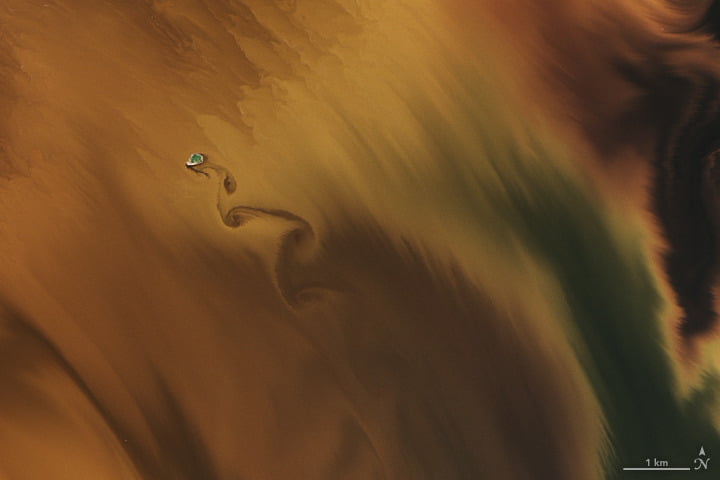
    These satellite images show Rupert Bay in northern Quebec. Sediment and tannins have stained the bay’s waters various shades of brown, which helps show the dynamic flows of the area. Rivers empty into the bay, but the tide appears to be coming in from the northwest as well. The flow is just right to create a wake of alternating vortices off a tiny island near the center of the bay. This pattern is known as a von Karman vortex street and often appears in the wake of spheres, cylinders, and, yes, islands. (Image credit: NASA Earth Observatory; submitted by Adam V.)

  • Giant Vortex Cannon

    Giant Vortex Cannon

    Playing with a vortex cannon is a ton of fun, and they are remarkably easy to make. You can knock over cups or card houses, create art, or just try your best Big Bad Wolf impression. Or you can supersize things like one group in the Czech Republic did and build a 3m vortex cannon capable of firing 100m! (Seriously, watch it in action here.) And if you’d like to learn more about how vortex rings form and why they’re useful in nature and engineering, check out my vortex ring video. (Image credit: Laborky Cz, source; via Gizmodo)

  • Vortex Ring Roll-Up

    Vortex Ring Roll-Up

    Vortex rings are endlessly fascinating, and they appear throughout nature from dolphins to volcanoes and from splashes to falling drops. One way to form them is to inject a jet into a stationary fluid. Viscosity between the fast-moving jet and the quiescent surrounding fluid slows down fluid at the jet’s edge. That slower fluid slips to the rear, only to get sucked into the faster -moving flow and pushed forward again. The result is a spinning toroid, or ring. A similar method generates vortex rings by pushing a fluid out a round orifice. In this case, interaction between the fluid and the wall provides some of the force necessary to form the vortex ring. (Image credit: Irvine Lab, source)

  • Featured Video Play Icon

    Half Vortex Rings

    Vortices are one of the most common structures in fluid dynamics. In this video, Dianna from Physics Girl explores an unusual variety of vortex you can create in a pool. Dragging a plate through the water at the surface creates a half vortex ring, which can be tracked either by the surface depressions created or by using food dye for visualization. Vortex rings are quite common, but a half vortex ring is not. The reason is that, ignoring viscous effects, a vortex filament cannot end in a fluid. The vortex must close back on itself in a loop, or, like the half vortex ring, the ends of the vortex must lie on the fluid boundary. It is possible to break vortex lines like those in smoke rings, but the lines will reattach, creating new vortex rings–just as they do in these vortex knots. (Video credit: Physics Girl; submitted by Tom)

  • Von Karman Vortex Streets

    Von Karman Vortex Streets

    The wake of a cylinder is a series of alternating vortices shed as the flow moves past. This distinctive pattern is known as a von Karman vortex street. The speed of the flow and the size of the cylinder determine how often vortices are shed. Incredibly, this pattern appears at scales ranging from the laboratory demo all the way to the wakes of islands. Von Karman vortex streets can even be seen from space. (Image credit: R. Gontijo and W. Cerqueira, source video)

  • Volcanic Vortex

    Volcanic Vortex

    This infrared image shows a kilometer-high volcanic vortex swirling over the Bardarbunga eruption. The bright red at the bottom is lava escaping the fissure, whereas the yellow and white regions show rising hot gases. Although the vortex looks similar to a tornado, it is actually more like a dust devil or a so-called fire tornado. All three of these vortices are driven by a heat source near the ground that generates buoyant updrafts of air. As the hot gases rise, cooler air flows in to replace them. Any small vorticity in that ambient air gets amplified as it’s drawn to the center, the same way an ice skater spins faster when she pulls her arms in. With the right conditions, a vortex can form. Unlike a harmless dust devil, though, this vortex is likely filled with sulphur dioxide and volcanic ash and would pose a serious hazard to aviation.  (Image credit: Nicarnica Aviation; source video; via io9)

  • Featured Video Play Icon

    Antibubble Vortex Rings

    Bubbles are familiar, but antibubbles are a bit more unusual. An antibubble typically has a liquid-air-liquid interface, with a thin shell of air separating a liquid droplet from the surrounding fluid. Although they look rather like bubbles, antibubbles behave differently. Antibubbles are, for example, very sensitive to pressure changes. A sinking antibubble like the one in the video above, experiences a higher pressure on its lower face. This pressure compresses the gas shell and thins it on the bottom. The air shell bursts at the thin point and the antibubble collapses, generating two vortex rings and a small, buoyantly rising bubble. (Video credit: S. Dorbolo et al.)

    P.S. – Hello, new followers! Where did you all come from?!

  • Tip Vortex

    Tip Vortex

    Smoke released from the end of a test blade shows the helical pattern of a tip vortex from a horizontal-axis wind turbine. Like airplane wings, wind turbine blades generate a vortex in their wake, and the vortices from each blade can interact downstream as seen in this video. These intricate wakes complicate wind turbine placement for wind farms. A turbine located downstream of one of its fellows not only has a decreased power output but also has higher fatigue loads than the upstream neighbor. In other words, the downstream turbine produces less power and will wear out sooner. Researchers visualize, measure, and simulate turbine wakes and their interactions to find ways of maximizing the wind power generated. (Photo credit: National Renewable Energy Laboratory)

  • Reader Question: Wave Vortex

    Reader Question: Wave Vortex

    Reader unquietcode asks:

    I saw this post recently and it made me wonder what’s going on. If you look in the upper right of the frame as the camera submerges, you can see a little vortex of water whirring about. Even with the awesome power of the wave rolling forward a little tornado of water seems able to stably form. Any idea what causes this phenomenon?

    This awesome clip was taken from John John Florence’s “& Again” surf video. What you’re seeing is the vortex motion of a plunging breaking wave. As ocean waves approach the shore, the water depth decreases, which amplifies the wave’s height. When the wave reaches a critical height, it breaks and begins to lose its energy to turbulence. There are multiple kinds of breaking waves, but plungers are the classic surfer’s wave. These waves become steep enough that the top of the wave  overturns and plunges into the water ahead of the wave. This generates the vortex-like tube you see in the animation. Such waves can produce complicated three-dimensional vortex structures like those seen in this video by Clark Little. Any initial variation in the main vortex gets stretched as the wave rolls on, and this spins up and strengthens the rib vortices seen wrapped around the primary vortex. (Source video: B. Kueny and J. Florence)