Search results for: “vortex”

  • Waves Over Sand Ripples

    Waves Over Sand Ripples

    Look beneath the waves on a beach or in a bay, and you’ll find ripples in the sand. Passing waves shape these sandforms and can even build them to heights that require dredging to keep waterways passable to large ships. To better understand how the sand interacts with the flow, researchers build computer models that couple the flow of the water with the behavior of individual sand grains. One recent study found that sand grains experienced the most shear stress as the flow first accelerates and then again when a vortex forms near the crest of the ripple. (Image credit: D. Hall; research credit: S. DeVoe et al.; via Eos)

    Fediverse Reactions
  • Martian Polar Spiral

    Martian Polar Spiral

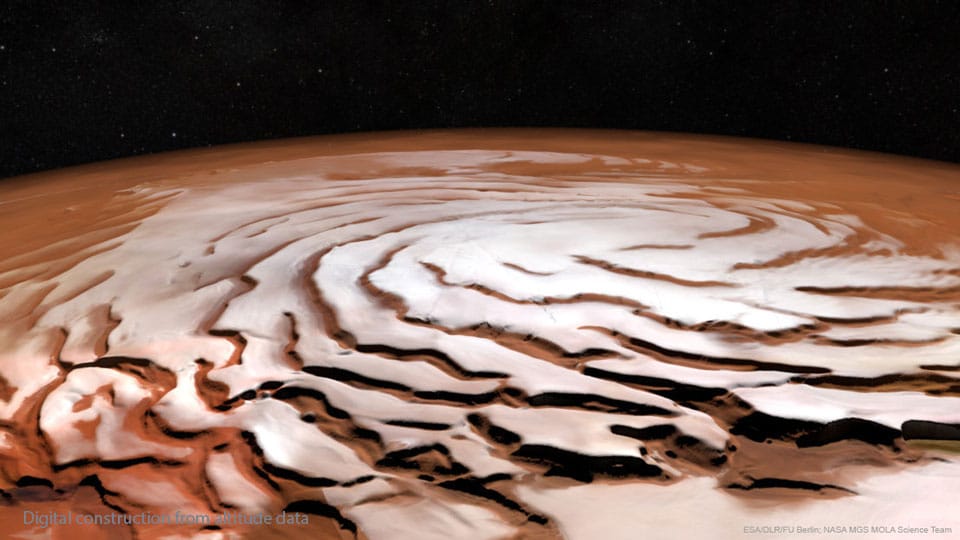
    The North Pole of Mars is a raised spiral, and each winter a new layer, roughly a meter thick, of carbon dioxide ice gets deposited over it. Strong cold winds rush down from the center of the pole. Mars’s spin creates a Coriolis effect that makes the winds spiral out as they descend. When they cross a depression in the surface, it creates a vortex that erodes the depression deeper. As the depressions deepen and merge, they form the troughs seen here. For more, see this post. (Image credit: ESA/DLR/FU BerlinNASA MGS MOLA Science Team; via APOD)

  • Cooling Tower Demolition

    Cooling Tower Demolition

    As part of the demolition of a decommissioned coal-fired power plant in Nottinghamshire, workers simultaneously demolished eight cooling towers. The video is here. As the towers collapse, smoke and dust gets blown both out of the base and up each tower. The flow details are fascinating. The plumes have rings in them, perhaps related to how the blast’s waves reflect in the tower or how the structure itself fails. Vortex rings curl up as the rising plumes mix with the surrounding air. If you’re anything like me, you’ll have to replay it several times! (Image credit: BBC; submitted by jshoer)

    Fediverse Reactions
  • A Variety of Vortices

    A Variety of Vortices

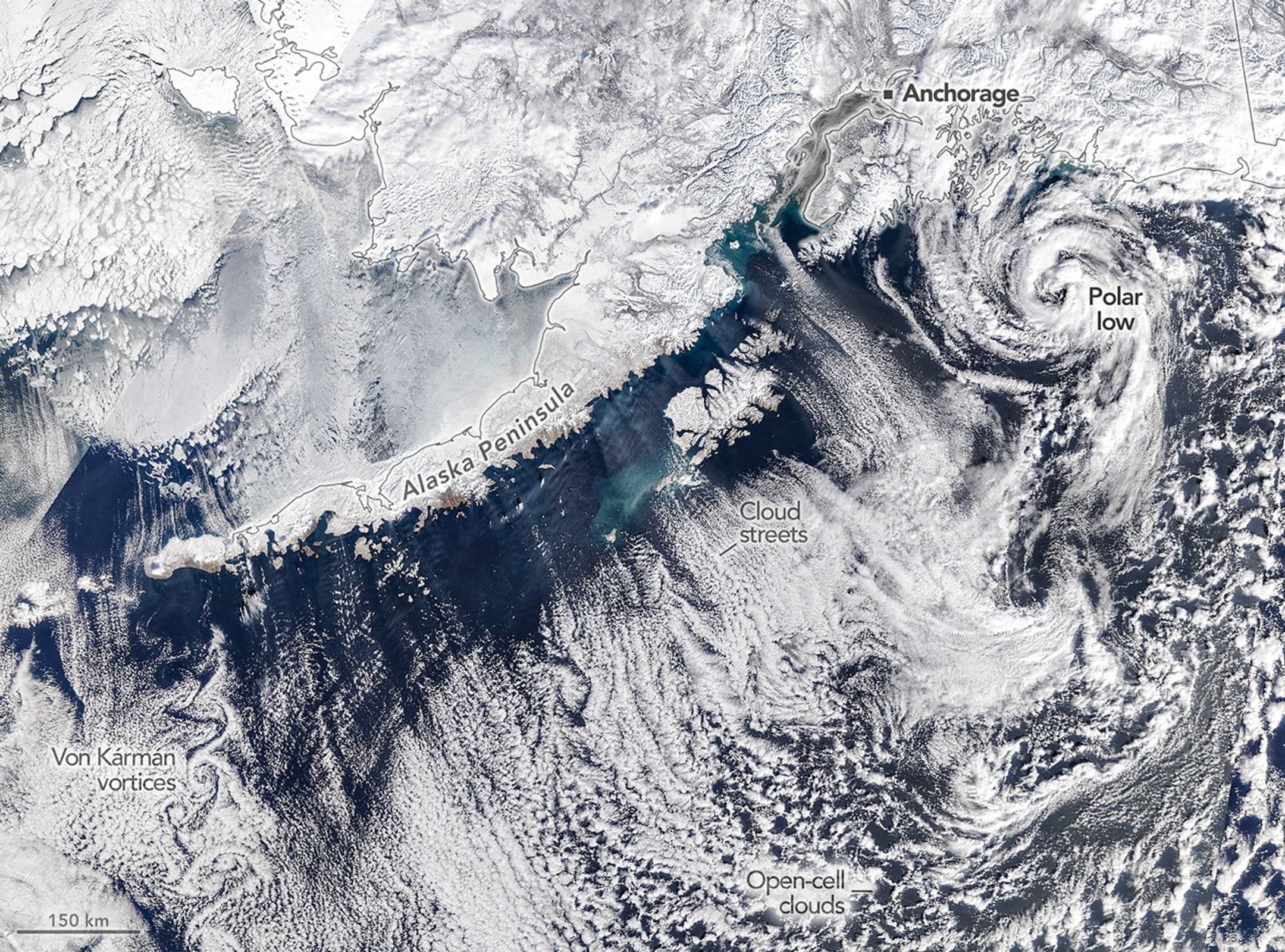
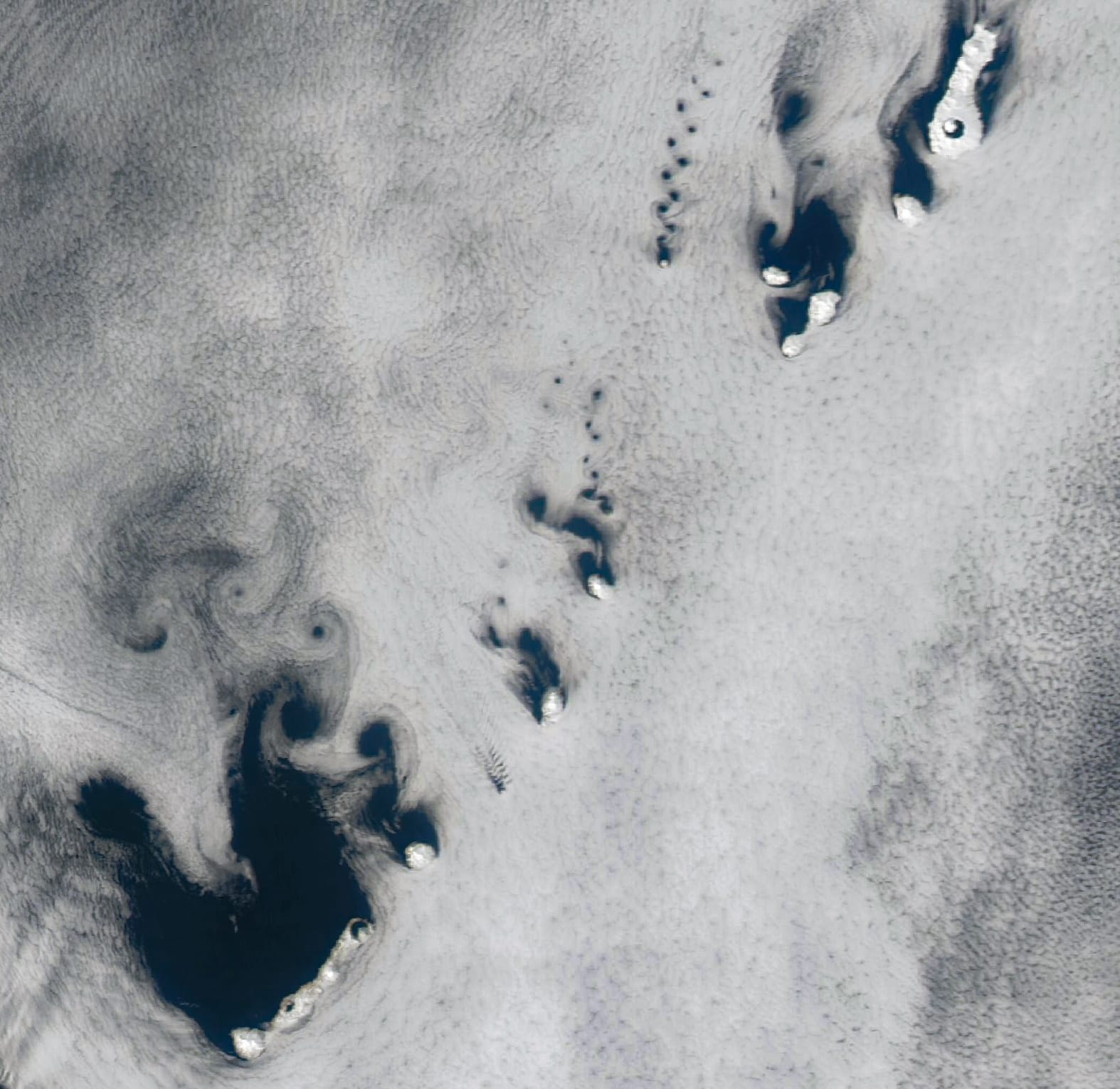
    Winds parted around the Kuril Islands and left behind a string of vortices in this satellite image from April 2025. This pattern of alternating vortices is known as a von Karman vortex street. The varying directions of the vortex streets show that winds across the islands ranged from southeasterly to southerly. Notice also that the size of the island dictates the size of the vortices. Larger islands create larger vortices, and smaller islands have smaller and more frequent vortices. (Image credit: M. Garrison; via NASA Earth Observatory)

    Fediverse Reactions
  • Flamingo Fluid Dynamics, Part 2: The Game’s a Foot

    Flamingo Fluid Dynamics, Part 2: The Game’s a Foot

    Yesterday we saw how hunting flamingos use their heads and beaks to draw out and trap various prey. Today we take another look at the same study, which shows that flamingos use their footwork, too. If you watch flamingos on a beach, in muddy waters, or in a shallow pool, you’ll see them shifting back and forth as they lift and lower their feet. In humans, we might attribute this to nervous energy, but it turns out it’s another flamingo hunting habit.

    A mechanical model of a flamingo's foot reveals how its stomping and shape change create a standing vortex.

    As a flamingo raises its foot, it draws its toes together; when it stomps down, its foot spreads outward. This morphing shape, researchers discovered, creates a standing vortex just ahead of its feet — right where it lowers its head to sample whatever hapless creatures it has caught in this swirling vortex. And the vortex, as shown below, is strong enough to trap even active swimmers, making the flamingo a hard hunter to escape. (Image credit: top – L. Yukai, others – V. Ortega-Jimenez et al.; research credit: V. Ortega-Jimenez et al.; submitted by Soh KY)

    Video showing how active swimmers can get caught in the flamingo's stomping vortex.
    Fediverse Reactions
  • Flamingo Fluid Dynamics, Part 1: A Head in the Game

    Flamingo Fluid Dynamics, Part 1: A Head in the Game

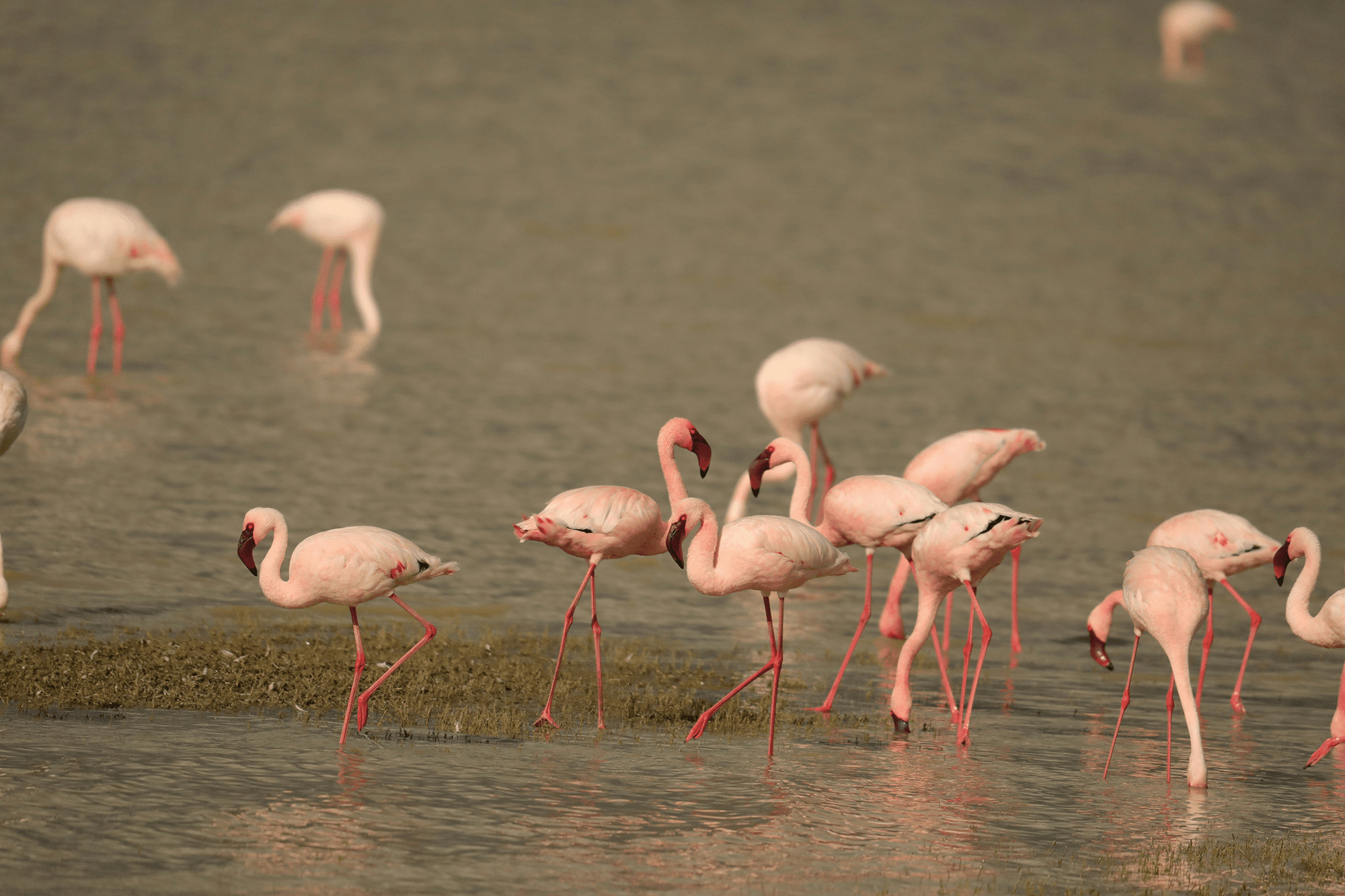
    Flamingos are unequivocally odd-looking birds with their long skinny legs, sinuous necks, and bent L-shaped beaks. They are filter-feeders, but a new study shows that they are far from passive wanderers looking for easy prey in shallow waters. Instead, flamingos are active hunters, using fluid dynamics to draw out and trap the quick-moving invertebrates they feed on. In today’s post, I’ll focus on how flamingos use their heads and beaks; next time, we’ll take a look at what they do with their feet.

    As a flamingo retracts its beak from the bottom of a water tank, a tornado-like vortex forms.

    Feeding flamingos often bob their heads out of the water. This, it turns out, is not indecision, but a strategy. Lifting its flat upper forebeak from near the bottom of a pool creates suction. That suction creates a tornado-like vortex that helps draw food particles and prey from the muddy sediment.

    As a flamingo "chatters" its mandibles, it creates suction that can pull up food.

    When feeding, flamingos will also open and close their mandibles about 12 times a second in a behavior known as chattering. This movement, as seen in the video above, creates a flow that draws particles — and even active swimmers! — toward its beak at about seven centimeters a second.

    Video showing von Karman vortices trailing from a flamingo's head when placed on the water's surface. A recirculation zone forms at the tip of its beak, enhancing capture of food.

    Staying near the surface won’t keep prey safe from flamingos, either. In slow-flowing water, the birds will set the upper surface of their forebeak on the water, tip pointed downstream. This seems counterintuitive, until you see flow visualization around the bird’s head, as above. Von Karman vortices stream off the flamingo’s head, which creates a slow-moving recirculation zone right by the tip of the bird’s beak. Brine shrimp eggs get caught in these zones, delivering themselves right to the flamingo’s mouth.

    Clearly, the flamingo is a pretty sophisticated hunter! It’s actively drawing out and trapping prey with clever fluid dynamics. Tomorrow we’ll take a look at some of its other tricks. (Image credit: top – G. Cessati, others – V. Ortega-Jimenez et al.; research credit: V. Ortega-Jimenez et al.; submitted by Soh KY)

  • Quietening Drones

    Quietening Drones

    A drone’s noisiness is one of its major downfalls. Standard drones are obnoxiously loud and disruptive for both humans and animals, one reason that they’re not allowed in many places. This flow visualization, courtesy of the Slow Mo Guys, helps show why. The image above shows a standard off-the-shelf drone rotor. As each blade passes through the smoke, it sheds a wingtip vortex. (Note that these vortices are constantly coming off the blade, but we only see them where they intersect with the smoke.) As the blades go by, a constant stream of regularly-spaced vortices marches downstream of the rotor. This regular spacing creates the dominant acoustic frequency that we hear from the drone.

    Animation of wingtip vortices coming off a drone rotor with blades of different lengths. This causes interactions between the vortices, which helps disrupt the drone's noise.
    Animation of wingtip vortices coming off a drone rotor with blades of different lengths. This causes interactions between the vortices, which helps disrupt the drone’s noise.

    To counter that, the company Wing uses a rotor with blades of different lengths (bottom image). This staggers the location of the shed vortices and causes some later vortices to spin up with their downstream neighbor. These interactions break up that regular spacing that generates the drone’s dominant acoustic frequency. Overall, that makes the drone sound quieter, likely without a large impact to the amount of lift it creates. (Image credit: The Slow Mo Guys)

    Fediverse Reactions
  • Filtering Like a Manta Ray

    Filtering Like a Manta Ray

    As manta rays swim, they’re constantly doing two important — but not necessarily compatible — things: getting oxygen to breathe and collecting plankton to eat. That requires some expert filtering to send food particles toward their stomach and oxygen-rich water to their gills. Manta rays do this with a built-in filter that resembles an industrial crossflow filter. Researchers built a filter inspired by a manta ray’s geometry, and found that it has three different flow states, based on the flow speed. At low speeds, flow moves freely down the filter’s channels; in a manta, this would carry both water and particles toward the gills. At medium speeds, vortices start to form at the entrance to the filter channels. This sends large particles downstream (toward a manta’s digestive system) while water passes down the channels. At even greater speeds, each channel entrance develops a vortex. That allows water to pass down the filter channels but keeps particles out. (Image credit: manta – N. Weldingh, filter – X. Mao et al.; research credit: X. Mao et al.; via Ars Technica)

    An animation showing three different flow states through a manta-ray-inspired filter.
    Depending on the flow speed, a manta-inspired filter can allow both water and particles in or filter particles out of the water.
    Fediverse Reactions
  • Featured Video Play Icon

    Playful Martian Dust Devils

    The Martian atmosphere lacks the density to support tornado storm systems, but vortices are nevertheless a frequent occurrence. As sun-warmed gases rise, neighboring air rushes in, bringing with it any twisted shred of vorticity it carries. Just as an ice skater pulling her arms in spins faster, the gases spin up, forming a dust devil.

    Black and white video illustrating a small Martian dust devil catching up to and getting swallowed up by a larger dust devil.

    In this recent footage from the Perseverance Rover, four dust devils move across the landscape. In the foreground, a tiny one meets up with a big 64-meter dust devil, getting swallowed up in the process. It’s hard to see the details of their crossing, but you can see other vortices meeting and reconnecting here. (Video and image credit: NASA/JPL-Caltech/LANL/CNES/CNRS/INTA-CSIC/Space Science Institute/ISAE-Supaero/University of Arizona; via Gizmodo)

  • Crowd Vortices

    Crowd Vortices

    The Feast of San Fermín in Pamplona, Spain draws crowds of thousands. Scientists recently published an analysis of the crowd motion in these dense gatherings. The team filmed the crowds at the festival from balconies overlooking the plaza in 2019, 2022, 2023, and 2024. Analyzing the footage, they discovered that at crowd densities above 4 people per square meter, the crowd begins to move in almost imperceptible eddies. In the animation below, lines trace out the path followed by single individuals in the crowd, showing the underlying “vortex.” At the plaza’s highest density — 9 people per square meter — one rotation of the vortex took about 18 seconds.

    Animation of the crowd in motion, with overlaid lines showing the circulating path followed by individual crowd members.

    The team found similar patterns in footage of the crowd at the 2010 Love Parade disaster, in which 21 people died. These patterns aren’t themselves an indicator of an unsafe crowd — none of the studied Pamplona crowds had a problem — but understanding the underlying dynamics should help planners recognize and prevent dangerous crowd behaviors before the start of a stampede. (Image credit: still – San Fermín, animation – Bartolo Lab; research credit: F. Gu et al.; via Nature)

    Fediverse Reactions