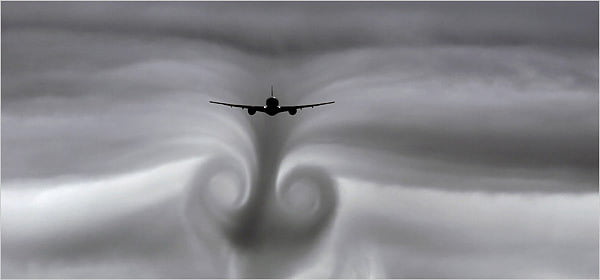
The wingtip vortices in the wake of a commercial airliner distort the clouds as the plane descends. Wingtip vortices form as a result of high pressure air from the underside of the wing accelerating around the wingtips to reach the low pressure on top of the wing. They can be hazardous to other (lighter) aircraft. They also contribute to downwash that decreases the effective lift of a wing. Geese use the same mechanism to their advantage when flying in a V-formation, and some snakes use it to glide.
Search results for: “vortex”

Island Vortex Street
The von Karman vortex street is a series of vortices shed periodically in the wake of a bluff body. Although they are commonly observed in the lab behind cylinders, they also occur in nature, as seen here in the wake of Juan Fernandez Islands near Chile. The strong equatorward wind creates steady flow over the mountainous island, creating a pattern in the clouds that stretches 10,000 times longer than vortex streets created in a laboratory. (via freshphotons)

Computational Vortex Rings
Computational fluid dynamics (CFD) sometimes gets a bad rep as “colorful fluid dynamics”, but as computers get faster and faster, more complicated and physically accurate simulations are possible. Shown here are simulations of vortex rings and wingtip vortices in stunningly gorgeous detail. Understanding the evolution of these vortices from a fundamental level helps fluid mechanicians design better methods of controlling them. As mentioned in the video, wingtip vortices are a particularly hazardous everyday example; the time it takes for one plane’s wingtip vortices to disperse determines how quickly the next airplane can take-off or land on that same runway. Being able to break down these vortices faster would allow more frequent use of existing facilities.

Vortex Street
A flow visualization behind a cylinder shows the formation of a von Karman vortex street. The frequency of vortex shedding in the wake is directly related to the speed of the airflow–the higher the velocity, the faster vortices will shed from the cylinder. This relationship is expressed in the Strouhal number, which remains constant for any cylinder. (via freshphotons)
Volcanic Vortex Rings
Plants and dolphins are not the only ones in nature creating vortex rings. Volcanoes are known to produce them as well. The vortex ring forms when gas is rapidly expelled from the volcano (much the same way as with a vortex cannon); the rings are visible in the video above because smoke has been entrained into the vortex.

Vortex Shedding
Whenever a bluff (i.e. non-aerodynamic) body is placed in a flow of sufficient Reynolds number, it will shed periodic vortices, creating a pattern known as a von Karman vortex street. The animation above shows the phenomenon in the wake of a cylinder, but vortex streets form behind many other bodies as well, including islands. Each vortex shed causes forces on the body and alternating vortices can cause the body to vibrate. This is what causes suspended power lines to “sing” in the wind. #
Spore-Spreading via Vortex
As it turns out, animals aren’t the only ones to have figured out the usefulness of vortex rings. A team of physicists and biologists have captured peat moss using vortex rings to project their spores to a height where the wind will catch and carry them further afield. #
Vortex Cannon
Ever wonder if the Big Bad Wolf could really blow those pigs’ houses down? If he’d gone with a vortex cannon, maybe he’d have a chance.
Blowing Droplets Apart


In raindrops, ink-jet printing, and spray painting, droplets get broken apart by the air flowing around them. Here, researchers investigate how a jet of fluid can push a droplet from its perch, or–with enough momentum–shatter the droplet. There are some lovely flow visualizations here; it’s especially cool to see the starting vortex ring of the jet push and deform the droplet. (Video and image credit: S. Jain et al.)
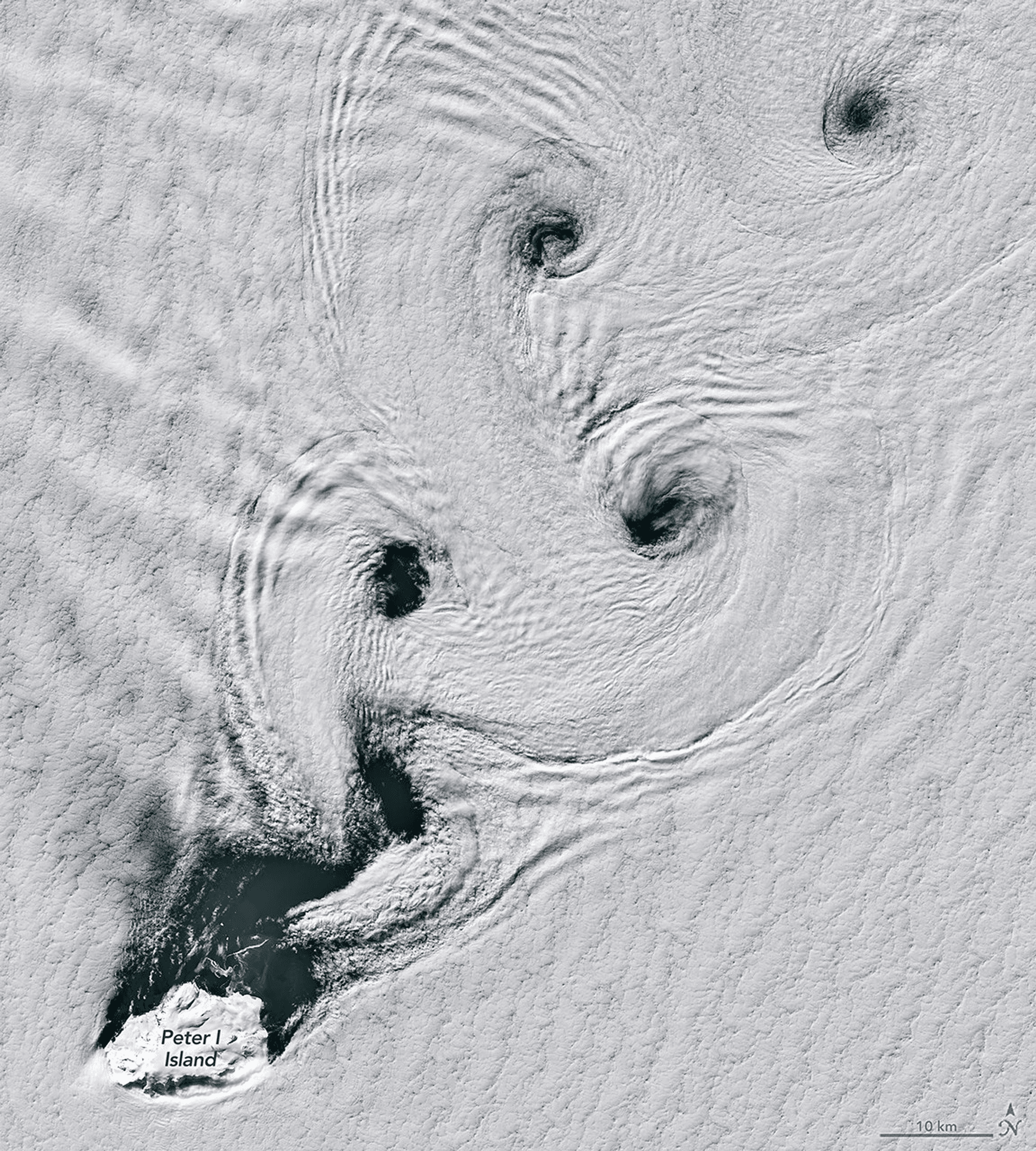
Swirls Above the Southern Ocean
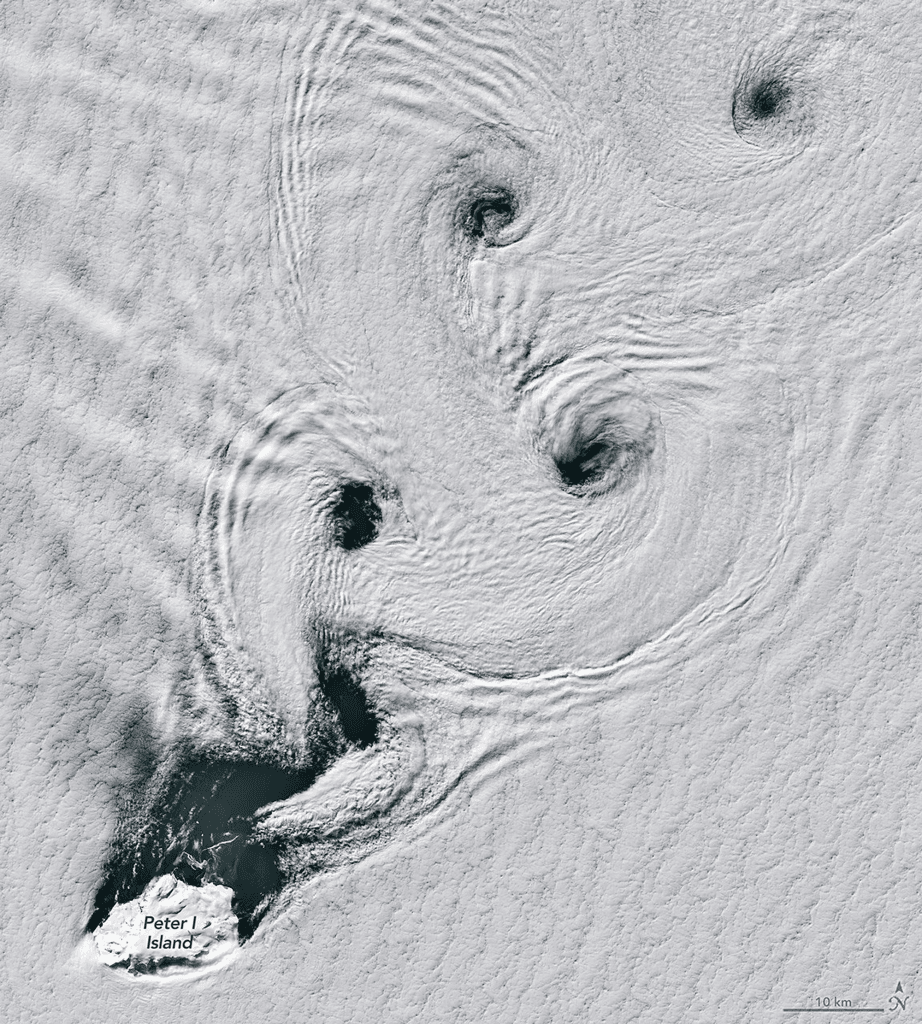
In the Southern Ocean, obstacles are sparse. But the ice-cloaked volcano of Peter I Island is tall enough at over 1600 meters to disrupt the wind. At steady wind speeds between about 18 to 54 kilometers per hour, flowing past the island creates vortices that shed from one side and then the other. The result is a von Karman vortex street like the one seen here, flowing toward the upper right.
The overlaid ripple structures in the cloud layer are reminiscent of gravity waves. Perhaps, the wind’s passage made some lee waves that the vortices distorted? (Image credit: M. Garrison; via NASA Earth Observatory)
Fediverse Reactions
-