Search results for: “vortex”

  • Forming a Vortex

    [original media no longer available]

    Vortex rings show up remarkably often in nature. In addition to being the playthings of dolphins, whales, scuba divers, humans, and swimmers, vortex rings appear in volcanic outbursts and spore-spreading peat mosses. Vortex rings even occur in blood flow through the human left ventricle in the heart. In each of these cases, the vortex ring is formed by impulsively accelerating fluid through a narrow opening, like the dolphin’s blowhole. The fluid at the edge of injected jet is slowed by friction with the quiescent surrounding fluid. The fluid at the edge of the jet then slips around the sides and into the wake of the faster-moving fluid, where it’s accelerated through the middle of the forming vortex ring. This spinning from the inside-out and back-in persists as long as the vortex is intact, and is part of what keeps the ring from dissipating. (Video credit: SeaWorld; submitted by John C.)

  • Island Vortex Street

    Island Vortex Street

    Von Karman vortex streets are a pattern of alternating vortices shed in the wake of a bluff body. They’re commonly associated with cylinders and can be demonstrated in simulation and in the lab. (They even show up in supersonic flows.) But they also show up in nature quite frequently, like in this cloud pattern off Central America. Such wakes often occur downstream of rocky, volcanic islands that rise above the smooth ocean surface and disrupt the atmosphere’s boundary layer. The same phenomenon is responsible for the “singing” of electrical lines on a windy day, and I’ve even heard it make the spokes on my bicycle wheel sing in a crosswind. (Photo credit: R. Mastracchio; via @BadAstronomer; submitted by jshoer)

  • Featured Video Play Icon

    Vortex Ring Tricks

    Vortex rings are wonderful at maintaining coherent vorticity while moving over significant distances. If you stand several meters from a foam cup and try blowing to knock it over, it’s not likely to budge. But move the air impulsively with a vortex cannon, and you can knock it over from the opposite side of the room. The same principle works underwater with added visual effect. Here an impulsive burst of air exhaled by the diver forms a bubble ring with vorticity strong enough to knock over a stack of rocks. It may look like a superpower, but this is science! Dolphins and whales are also known to play with this trick. For the non-scuba-divers among you, it’s also possible to learn to do it in a swimming pool. (Video credit: DjDeutchTv; h/t to coolsciencegifs)

  • The Vortex Under a Falling Drop

    The Vortex Under a Falling Drop

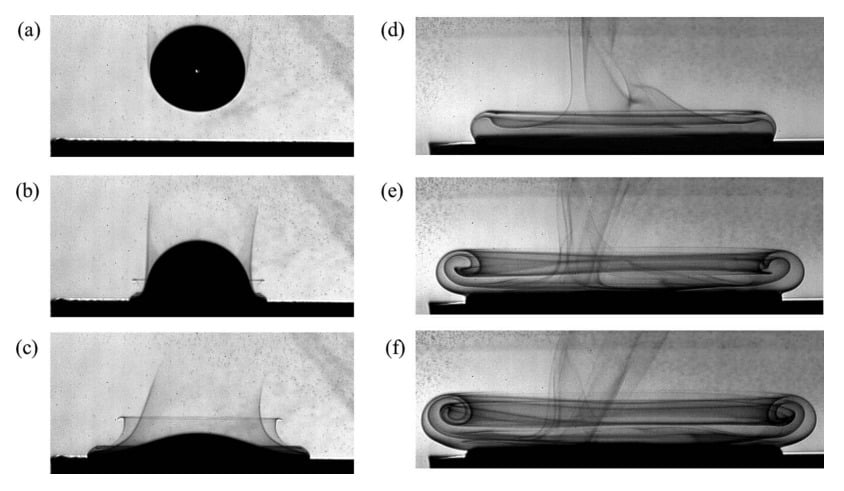
    We take for granted that drops which impact a solid surface will splash, but, in fact, drops only splash when the surrounding air pressure is high enough. When the air pressure is low enough, drops simply impact and spread, regardless of the fluid, drop height, or surface roughness. Why this is and what role the surrounding air plays remains unclear. Here researchers visualize the air flow around a droplet impact. In (a) we see the approaching drop and the air it pulls with it. Upon impact in (b) and © the drop spreads and flattens while a crown of air rises in its wake. The drop’s spread initiates a vortex ring that is pinned to the drop’s edge. In later times (d)-(f) the vortex ring detaches from the drop and rolls up. (Photo credit: I. Bischofberger et al.)

  • The Bathtub Vortex

    The Bathtub Vortex

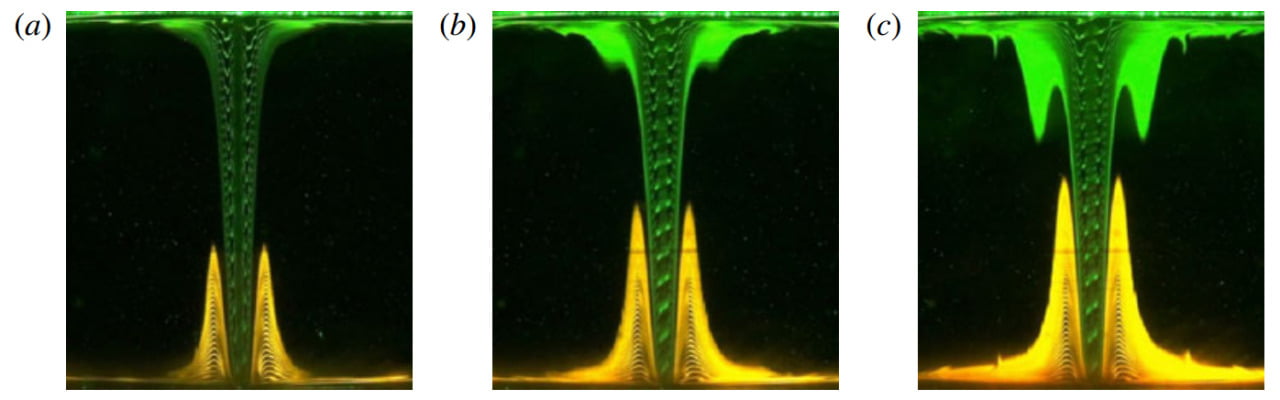
    If you’ve ever watched a swirling vortex disappear down the drain of your bathtub and wondered what was happening, you’ll appreciate these images. This dye visualization shows a one-celled bathtub vortex, created by rotating a cylindrical tank of water until all points have equal vorticity before opening a drain in the bottom of the tank. A recirculating pump feeds water back in to keep the total fluid mass constant. Once a steady vortex is established, green dye is released from the top plate of the tank and yellow dye from the bottom. The green dye quickly marks the core of the vortex. Ekman layers–similar to the boundary layers of non-rotating flows–form along the top and bottom surfaces, and the yellow dye is drawn upward in a region of upwelling driven by Ekman pumping. (Photo credit: Y. Chen et al.)

    Just a reminder for those at Texas A&M University: I will be giving a talk today Wednesday, October 2nd entitled “The Beauty of the Flow” as part of the Applied Mathematics Undergraduate Seminar series at 17:45 in BLOC 164.

  • Vortex Street in the Clouds

    Vortex Street in the Clouds

    Most objects are not particularly aerodynamic or streamlined. When air flows over such bluff bodies, they can shed regular vortices from one side and then the other. This periodic shedding creates a von Karman vortex street, like this one stretching out from Isla Socorro off western Mexico. From the wind’s perspective, the volcanic island forms a blunt disruption to the otherwise smooth ocean. This vortex shedding is seen at smaller scales, as well, in the wind tunnel, in soap films, and in water tunnels. If you’ve ever been outside on a windy day and heard the electrical lines “singing” in the wind, that’s the same phenomena, too. With the right crosswind, radial bicycle spokes will buzz for the same reason as well!  (Photo credit: MODIS/NASA Earth Observatory)

  • Featured Video Play Icon

    “Perpetual Puddle Vortex Experiment”

    Anthony Hall’s “Perpetual Puddle Vortex Experiment” is an intriguing display of several physical mechanisms. What looks like a puddle is actually a vortex constantly sucking fluid down a hole in the table. The liquid is re-circulated into the puddle so it never disappears. The table itself is treated to be hydrophobic, causing the distinctive curvature and large contact angle of the puddle’s rim. The oils mixed in float on top, creating patterns of foam that visualize the swirling motions of the fluid as the vortex pulls it in.   (Video credit and submission by: A. Hall)

  • Featured Video Play Icon

    Pancake Vortex

    In large-scale geophysical flows, rotation and density gradients often play major roles in the structures that form. Here the UCLA SPINLab demonstrates how large, essentially flat vortices–pancake vortices–form in rotating, stratified fluids. The stratification, in this case, is due to the density difference between salt water and fresh water; salt water is denser and therefore less buoyant, so it sinks toward the bottom of the tank. Note how the pancake vortex only forms when the fluid is both stratified and rotating.  If it lacks one of the two, the structures will be very different. (Video credit: O. Aubert et al./SPINLab UCLA)

  • Saturn’s Polar Vortex

    Saturn’s Polar Vortex

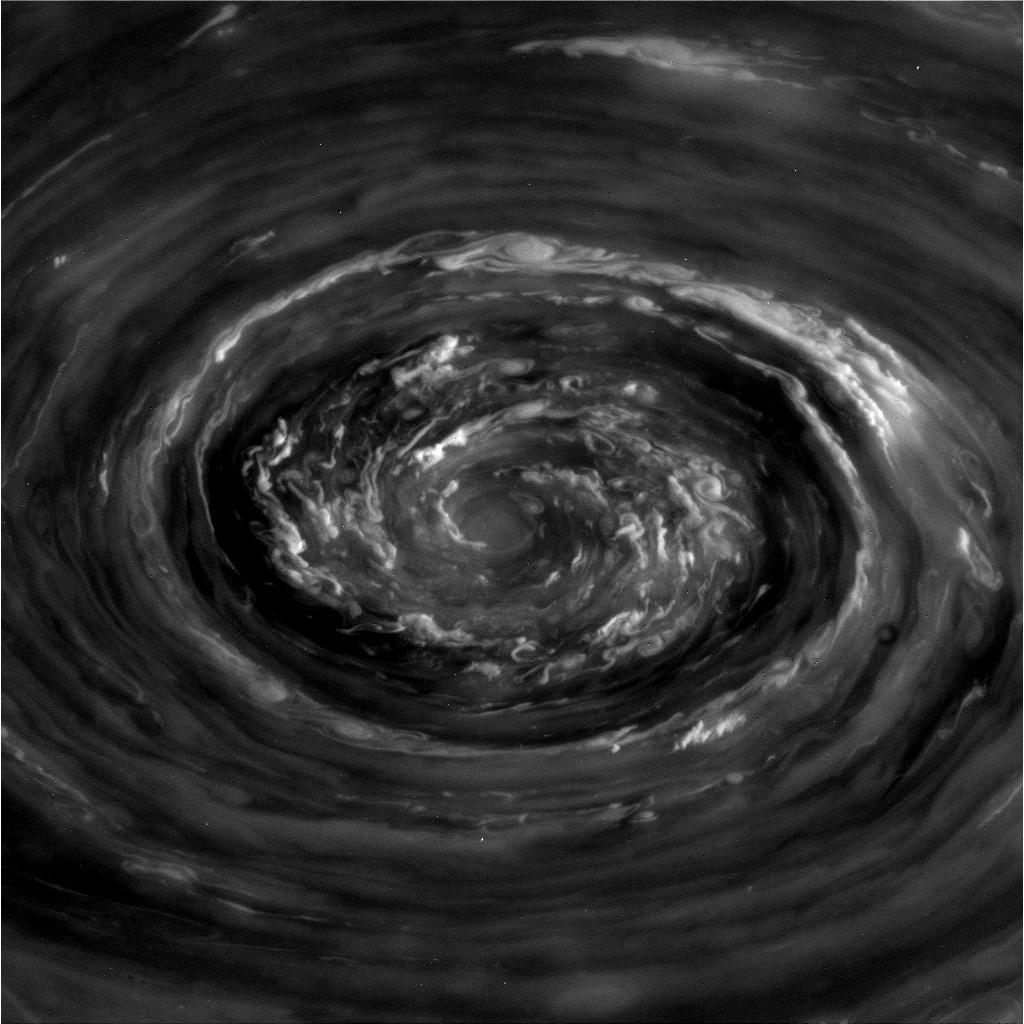
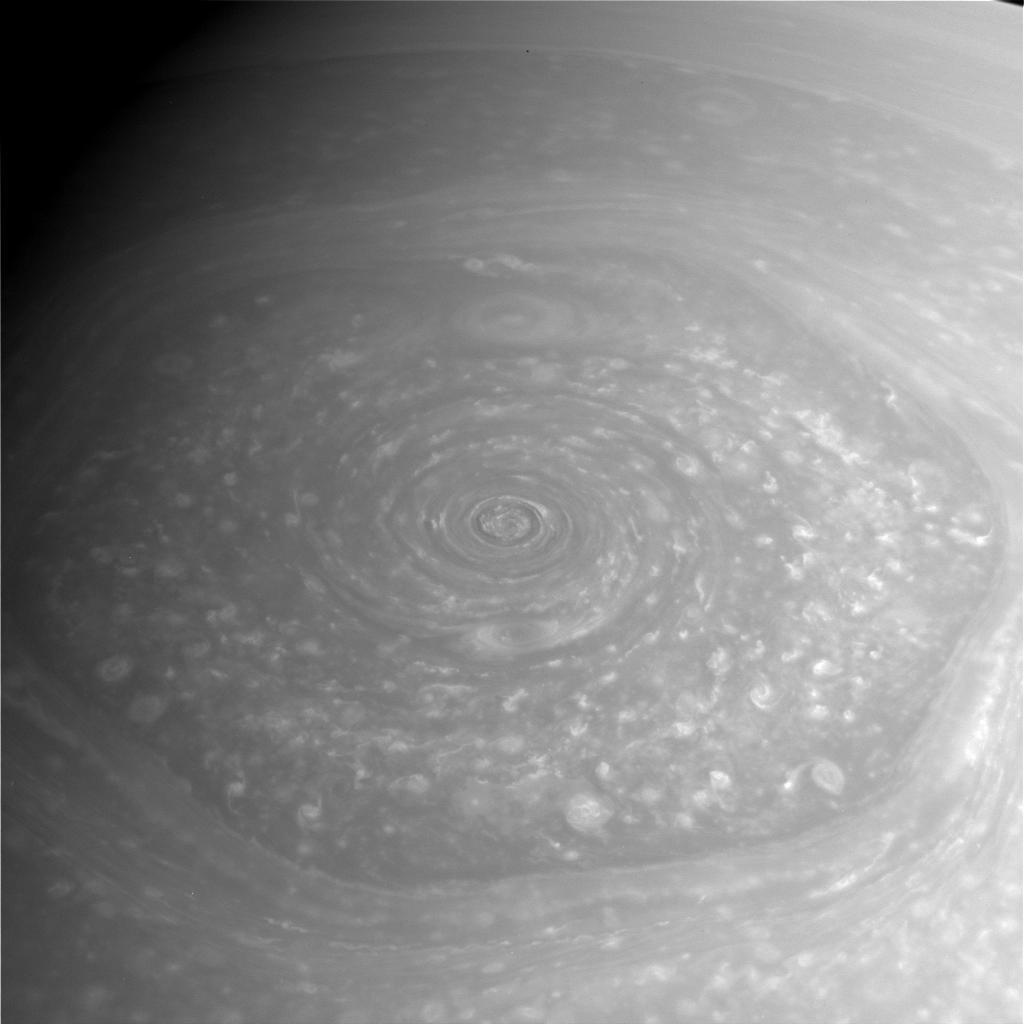
    Nothing quite compares to the beauty of fluid dynamics on astronomical scales. What you see here are raw photographs of recent storms at Saturn’s north pole. The recent change in Saturnian seasons has afforded Cassini a sunlit view of the northern pole, which had previously lain in darkness. A roiling vortex filled with clouds being twisted and sheared was revealed near the center of its famed polar hexagon. (Photo credit: NASA/JPL-Caltech/Space Science Institute; submitted by J. Shoer)

  • Vortex Cross-Sections

    Vortex Cross-Sections

    The photos above show cross-sections through the leading edge vortices on a highly swept delta wing at angle of attack.  Flow in the photos is from the upper left to lower right. Notice how the vortices grow and develop waviness as they move downstream. When perturbations enter the vortex–for example, due to the shear between the vortex fluid and the freestream–some will grow and eventually cause a break down to turbulence, as in the lower picture. (Photo credits: R. Nelson and A. Pelletier)