
When conditions are just right, the low pressure at the center of a wingtip vortex can drop the local temperature below the dew point, causing condensation to form. Here vortices are visible extending from the tips of the propellers in addition to the wingtip. Because of the spinning of the propeller and the forward motion of the airplane, the prop vortices extend backwards in a twisted spiral that will quickly break down into turbulence. The same behavior can be observed with helicopter blades. (Photo credit: benurs)
Search results for: “vortex”

Volcanic Clouds
The volcano Tungurahua erupts in a cloud of ash while molten lava flows down the mountain’s sides. Overhead a wispy lenticular cloud has formed where moist air flowing over the volcano dropped below its dew point. Volcanic eruptions have been known to produce shock waves and vortex rings as well as their distinctive turbulent plumes. (submitted by A. Jones III)
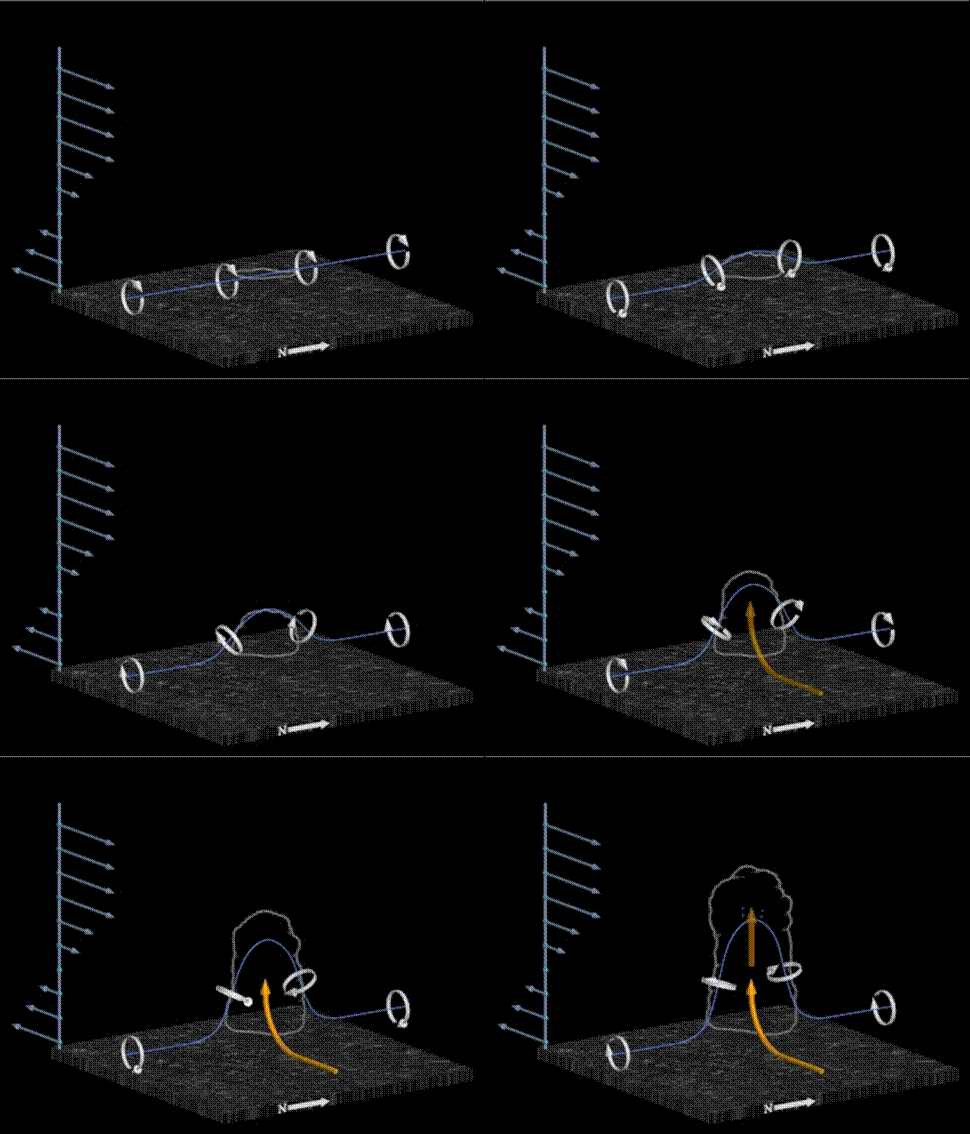
Tornadogenesis
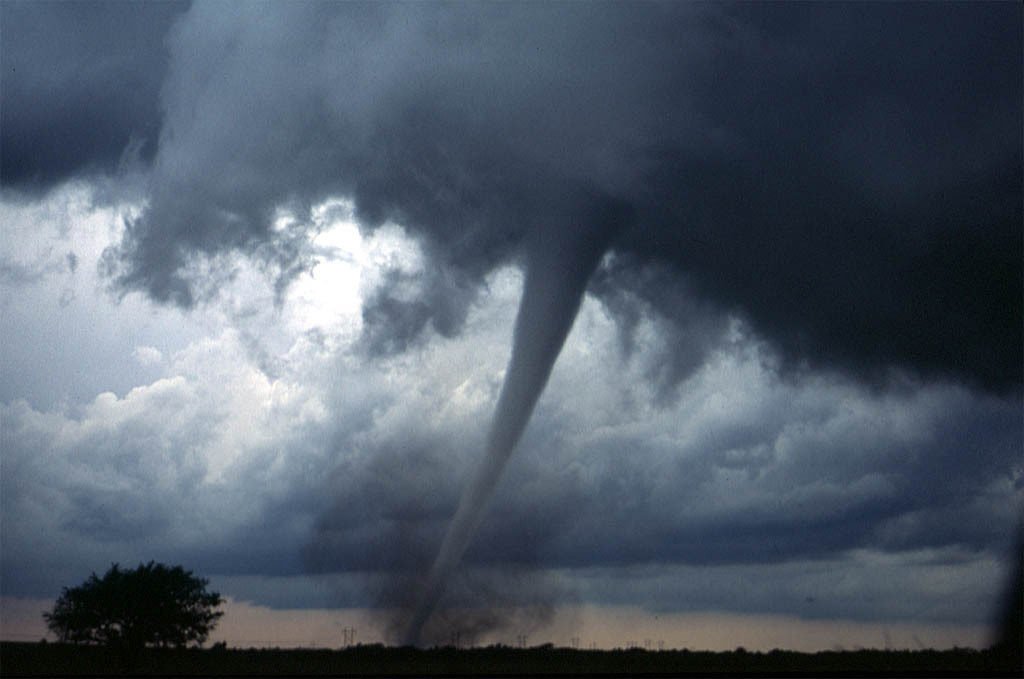
Tornadogenesis–the formation of tornadoes–remains a topic of active research as there is relatively little direct experimental data, owing to the difficulty of prediction as well as measurement. Initially, a variation of wind speed at different altitudes in the atmosphere causes shearing, which can lead to the formation of a horizontal column of rotating air–a vortex line similar to a roll cloud. Beneath a developing storm, the updraft of warm local air can pull this vortex line upwards, creating vertical rotation in the cloud, thereby birthing a supercell. Supercells do not always spawn tornadoes, and the exact causes that result in tornadic or nontornadic supercells are not fully understood. However, the formation of tornadoes within the supercell seems dependent on the downdraft of cool air within the storm as well as stretching of the vortex line, which increases its rate of rotation. For more information, check out this explanatory video and some of the talks by Paul Markowski. (Thanks to mindscrib, aggieastronaut and others for their submissions related to this topic! Photo credits: P. Markowski and D. Zaras)

Plumes Driven by Chemistry
This timelapse video shows the formation and steady-state behavior of a buoyancy-driven plume created by a chemical reaction. As the plume accelerates upward, it develops a head, which in some cases detaches from the plume in the form of a vortex ring. A new head then develops before also detaching and accelerating upwards. (Video credit: M. Rogers)
Science Off the Sphere: Liquid Lenses
Astronaut Don Pettit delivers more “Science Off The Sphere” in his latest video. Here he demonstrates diffusion and convection in a two-dimensional water film in microgravity. He notes that the viscous damping in the water is relatively low and that, left undisturbed, mixing in the film will continue for 5-10 minutes before coming to rest, which tells us that the Reynolds numbers of the flow are reasonably large. The structures formed are also intriguing; he notes that drops mix with mushroom-like shapes that are reminiscent of Rayleigh-Taylor instabilities and cross-sectional views of vortex rings. It would be interesting to compare experiments from the International Space Station with earthbound simulations of two-dimensional mixing and turbulence, given that the latter behaves so differently in 2D.
Tornado in a Bubble
In this video, a miniature tornado-like vortex is created inside a soap bubble. Here’s how it works: after the first bubble is formed and the smoke-filled bubble is attached to the outside, he blows into the main bubble, creating a weak angular velocity, before breaking the interface between the two bubbles. As the smoke mixes in the main bubble, note how it is already spinning slowly due to the free vortex he created. Then, when the top of the bubble is popped, surface tension pulls the bubble’s surface inward. Because the bubble radius is decreasing, conservation of angular momentum causes the angular velocity of the fluid inside to increase, pulling the smoke into a tight vortex, much like a spinning ice skater who pulls her arms inward.
Reader Question: Creeping Flow
[original media no longer available]
David asks:
I’m taking an undergraduate fluid dynamics course, and I’m having trouble understanding what a Creeping Flow exactly is. The only thing I understand about that is that the Re should be 0 or close to 0 for the flow… Could you post an example of a creeping flow please? Thank you!
Absolutely! Creeping flow, also called Stokes flow, is, like you said, a very low Reynolds number flow. It would be hard to say that the Reynolds number is zero because that would seem to imply no flow at all. Think of it instead as a Reynolds number much, much less than one. When the Reynolds number is very low, it means that viscous forces are dominating the flow. The video above shows creeping flow around a cylinder; notice how the streamlines stay attached all the way around the surface of the cylinder. There’s no separation, no turbulent wake, no von Karman vortex street. Viscosity is so dominant here that it’s damped out all of that inertial diffusion of momentum.
We’ve posted some other great examples of creeping flow, as well, though not by that name. There are the reversible laminar flow demos and various experiments in Hele-Shaw cells, all of which qualify as creeping flow because of their highly viscous nature. If you have the time, there’s also a great instructional video from the 1960s called “Low Reynolds Number Flow” (Parts 1, 2, 3, 4) starring G. I. Taylor (a famous fluid dynamicist) that is full of one demo after another.
Vortices on an Airliner
Wingtip vortices form on airplanes due to the finite length of their wings. In general, lift on the wings results from low-pressure, high-velocity air moving over the top of the wing and high-pressure, low-velocity air moving below the wing. Near the wingtips, the high-pressure air is able to slip around the edge to the top of the wing, generating a vortex that then trails behind the airplane. The same thing is occurring in the video above, except the edges of the wing’s control surfaces are serving as the tip of the wing. Similar vortices also exist at the wingtips, but they are not made visible by condensation as the aileron vortices are.

Cloud Swirls
Two interesting sets of clouds are featured in this satellite photo of the Canary Islands and the coast of Africa. In the upper part of the picture, closed cell stratocumulus clouds cover the ocean. As the wind drives these clouds over the islands, their pattern is disturbed by mountains that force the lower layers of air up and around, forming von Karman vortices and wakes that mingle and twist the cloud patterns to the south of the islands. (Photo credit: European Space Agency; via Wired)
Supersonic Flow Around a Cylinder
This numerical simulation shows unsteady supersonic flow (Mach 2) around a circular cylinder. On the right are contours of density, and on the left is entropy viscosity, used for stability in the computations. After the flow starts, the bow shock in front of the cylinder and its reflections off the walls and the shock waves in the cylinder’s wake relax into a steady-state condition. About halfway through the video, you will notice the von Karman vortex street of alternating vortices shed from the cylinder, much like one sees at low speeds. The simulation is inviscid to simplify the equations, which are solved using tools from the FEniCS project. (Video credit: M. Nazarov)