Cavitation occurs in moving liquids when the local pressure–in this case, at the tip of the propeller–drops below the vapor pressure. The fast-moving fluid transitions to a gas phase, creating a tip vortex of water vapor even though the propeller is completely submerged.
Search results for: “vortex”

Beluga Whale Bubble Rings
Beluga whales and dolphins in captivity have taken to blowing bubble rings to entertain themselves. You can learn how to do the same in the pool. #
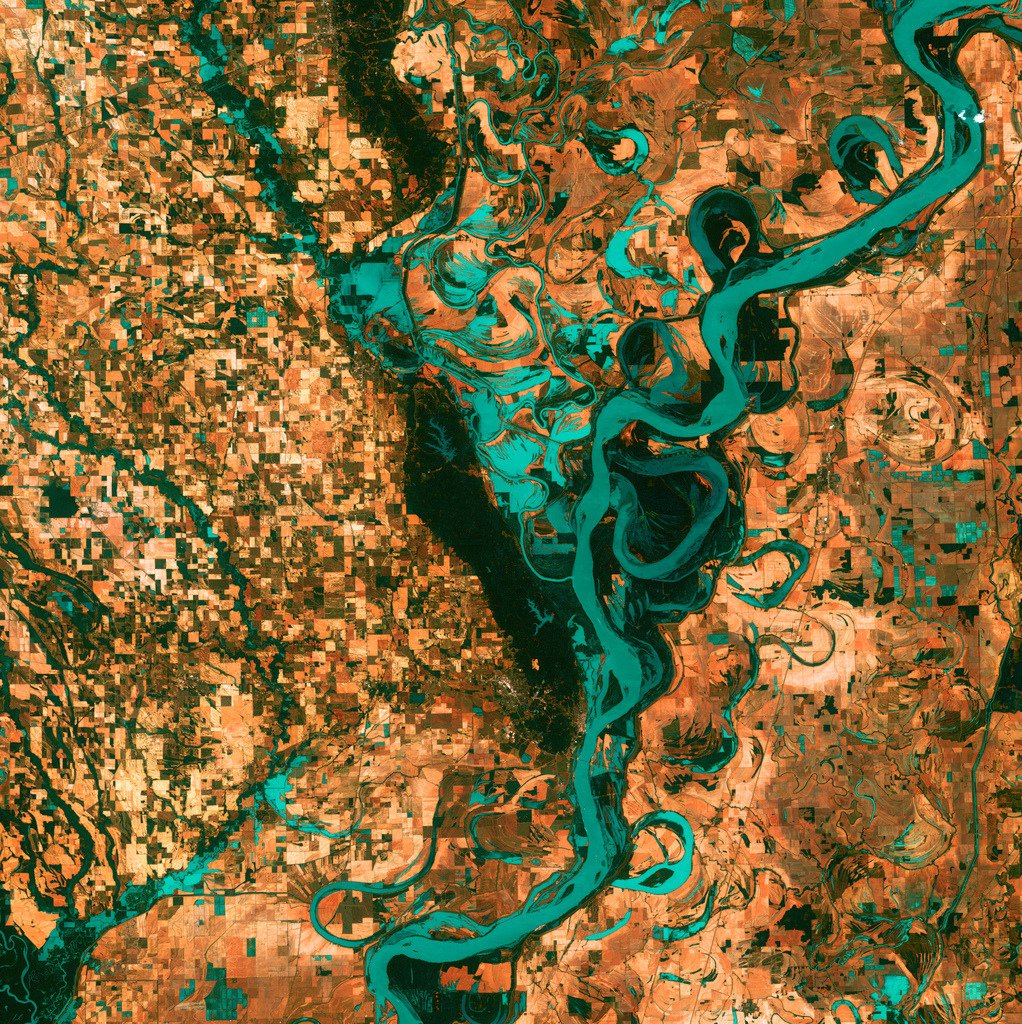
Meandering Mississippi
This satellite photo of the Mississippi River south of Memphis, TN shows how the river’s course has changed over time. When a river bends, the water near the inner bank flows faster than the water by the outer bank. This difference in speeds actually creates a vortical secondary flow in the boundary layer of the river that erodes sediment from the outer bank and deposits it on the inner bank. This increases the meander of the river bend. If this continues long enough, the river bend can get pinched off into an oxbow lake, like the ones scattered to either side of the current river path.

Earthquake-induced Whirlpool
In the wake of the 8.9-magnitude earthquake that hit Japan today, a massive whirlpool has appeared off the coast. It does not appear to have a downdraft, so it’s not a true vortex; it looks as though the residual energy released from the quake has caused circulation in this region.

Discovery Wingtip Vortices
Wingtip vortices mark the path of Discovery as she makes her final landing. Though not always visible, these vortices are generated by any lifting body planform and can be a major source of induced drag on the craft. Here the vortices are visible because the low pressure in the core of the vortex caused a local temperature drop below the dew point, thus causing condensation. Such vortices persist for significant lengths of time in the wake of aircraft; they are a major source of wake turbulence, which limits how frequently aircraft can take-off or land on a single runway. (Photo by Jen Scheer)
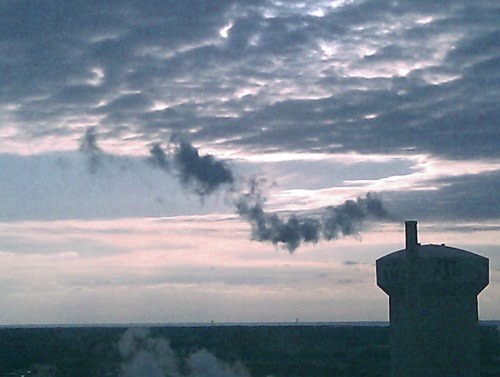
Smokestack Plumes
On a cold and windy day, the plume from a smokestack sometimes sinks downstream of the stack instead of immediately rising (Figure 1). This isn’t an effect of temperature–after all, the exhaust should be warm compared to the ambient, which would make it rise. It’s actually caused by vorticity.

Figure 2: Simple geometry (side view) In Figure 2, we see a simplified geometry. The wind is blowing from right to left, and its velocity varies with height due to the atmospheric boundary layer. Mathematically, vorticity is the curl of the velocity vector, and because we have a velocity gradient, there is positive (counterclockwise) vorticity generated.

Figure 3: Vortex lines (top view) According to Helmholtz, we can imagine this vorticity as a bunch of infinite vortex lines convecting toward the smokestack, shown in Figure 3. Those vortex lines pile up against the windward side of the smokestack–Helmholtz says that vortex lines can’t end in a fluid–and get stretched out in the wake of the stack. If we could stand upstream of the smokestack and look at the caught vortex line, we would see a downward velocity immediately behind the smokestack and an upward velocity to either side of the stack. It’s this downward velocity that pulls the smokestack’s plume downward.

Figure 4: Vortex wrapped around stack Now Helmholtz’s theories actually apply to inviscid flows and the real world has viscosity in it–slight though its effects might be–and that’s why this effect will fade. The vortex lines can’t sit against the smokestack forever; viscosity dissipates them.
Wavy Vortices
Shown above is the flow between two concentric cylinders (Taylor-Couette flow). In the laminar regime, the velocity profile between the two cylinders is linear. As the rate of rotation of the inner cylinder increases, the flow develops toroidal vortices known as Taylor vortices, seen in the video above after 9 seconds or so. This is a fluid instability exhibited by transitional flow. Increasing the rotational rate further can result in wavy Taylor vortex flow. At high enough speeds, the flow will become completely turbulent.

Oil Chandeliers
What you see above is a composite of images of an oil droplet falling into alcohol from two different heights. The top row of images is from a height of 25 mm and the bottom from a height of 50 mm. The first droplet forms an expanding vortex ring which breaks down via the Rayleigh-Taylor instability due to its greater density than the surrounding alcohol. The second droplet impacts the alcohol with greater momentum and is initially deformed by viscous shear forces. Eventually it, too, breaks down by the Rayleigh-Taylor mechanism. This image is part of the 2010 Gallery of Fluid Motion. # (PDF)
Flow Visualization
This video, created by undergraduates as part of a fluid dynamics laboratory course, shows flow visualization of a von Karman vortex street in the wake of a cylinder in comparison to a computational fluid dynamics (CFD) simulation of the same phenomenon. If you’re wondering about the black-and-white segments and the peculiar speech patterns, look no further. The students are parodying a series of videos made by MIT in the 1960s that are still used in classrooms today.
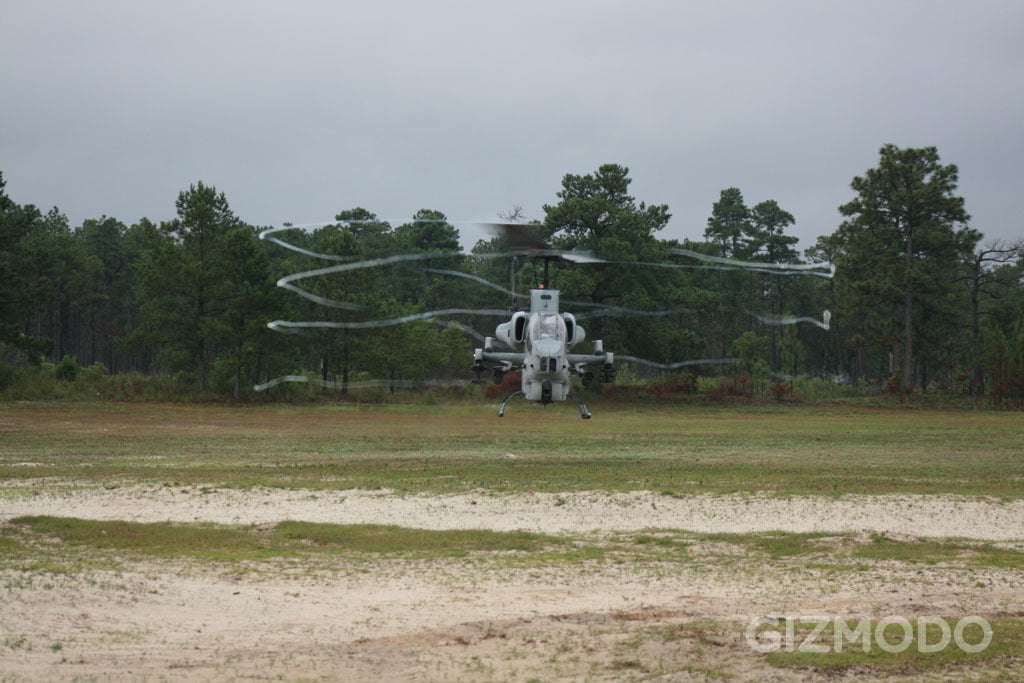
Tip Vortices
Like airplane wings, helicopter blades have tip vortices. In this photo, the air’s humidity was great enough that the acceleration caused by the passing of the blades caused a pressure drop great enough to condense the moisture, making the tip vortices visible to the naked eye. (See also Prandlt-Glauert singularity.)
Photo credit: Gizmodo.