Any finite length wing produces wingtip vortices–potentially intense regions of rotational flow downstream of the wing’s ends. These vortices are associated both with the production of lift on the wing and with unavoidable induced drag. The tabletop demonstration above shows the region of the vortices’ influence and how strong the rotation is there. Note also that the two vortices have opposite rotational senses–the left side induces a clockwise rotation, whereas the right side induces an anti-clockwise rotation. The larger an aircraft, the stronger and longer lasting its vortices; this can be a source of danger for smaller aircraft passing through the wake. If a pilot crosses one wingtip vortex and overreacts to compensate, crossing the second counter-rotating vortex can cause even greater damage.
Search results for: “vortex”
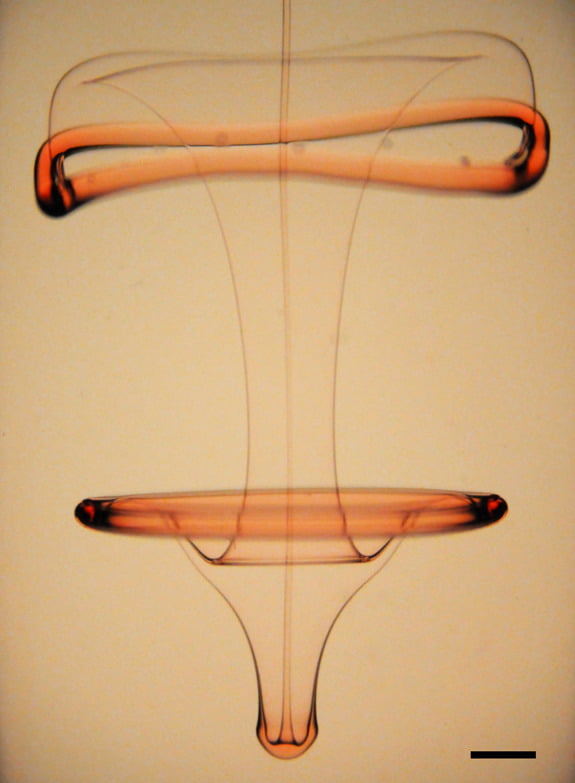
Falling Oil
A drop of silicone oil falling through a liquid with lower surface tension distorts into multiple vortex rings connected by thin films. This behavior is caused by the interaction between viscous and capillary forces and is observable for only a narrow range of oil viscosities. (Photo credit: A. Felce and T. Cubaud)

How to Escape a Whitewater Hole
One of the perils of whitewater sports is getting stuck in what paddlers call a “hole” or a “hydraulic”. This river feature forms just downstream of large obstacles like rocks or low-level dams. As water pours over the obstacle and into its shadow, the flow forms a recirculating vortex-like zone. Immediately next to the obstacle, water is pulled upstream toward the obstacle and then down toward the bottom of the river. This makes the hydraulic very dangerous and hard to escape. Note in the video how the raft is held in place by the upstream motion of the water at the surface of the hydraulic. The rafters are preventing their craft from flipping over by weighing down the side experiencing the upward flow of the vortex. Escaping a hydraulic usually requires getting near its edge, where its current is weaker. If swimming, the best way to escape is to swim toward the bottom of the river and then downstream with the current of the hydraulic rather than against it at the surface.

Flapping Flags
The flapping of flexible objects like flags have long fascinated mankind. The figure above from Shelley and Zhang 2011 shows several possible flapping states. In (a) a thread immersed in a running soap film displays the standard von Karman vortex street of shed vortices in its wake. Parts (b) and © show the thread in coherent flapping motion; (b) shows an snapshot of the flapping thread in the soap film whereas © is a timelapse of the thread showing its full range of motion. Image (d) shows the effects of a higher flow speed–the flapping motion becomes aperiodic. Image (e) shows a stiff metal wire bent into the shape of a flapping filament; note the strong boundary layer separation around the wire compared to the thread in Image (b). As one might expect, the drag on the unflapping wire is significantly greater than the drag on the flapping thread. (Image credit: M. Shelley and J. Zhang, Shelley and Zhang 2011)
How Maple Seeds Fly
Maple tree seeds flutter and spin as they descend. The above video, which shows flow visualization of a freely falling seed, demonstrates that the so-called helicopter seed’s autorotation creates a vortex along the leading edge. Watch as the seed’s “wing” sweeps through and you will notice the vortex along the upper surface. This leading edge vortex generates high lift on the maple seed, allowing it to stay in the air more effectively than other seeds, thereby increasing the maple’s reproductive range. (Video credit: D. Lentink et al.; see also Supplemental Materials)

Flapping Wakes
As a flapping object moves through a fluid, many patterns of vortices can form in its wake. The familiar von Karman vortex street, so often seen in clouds or behind cylinders, is only the beginning. In the photo above, a symmetric foil flaps in a vertical soap film; as the amplitude and frequency of the oscillation varies, the wake patterns it produces change dramatically. From left to right, a) a von Karman wake; b) an inverted von Karman wake; c) a 2P wake, in which two vortex pairs are shed with each cycle; d) a 2P+2S wake, in which two vortex pairs and two single vortices are shed per cycle; e) a 4P wake; and f) a 4P+2S wake. See some of these flows in action in these videos. (Photo credit: T. Schnipper et al.)
Fire Tornado
An artificial fire tornado makes for fascinating viewing. The box fans are positioned around a central firepit such that they impart the angular velocity needed to create a vortex. I’ve actually seen an even bigger live demonstration than this one at a fluid dynamics conference. Do not try this yourself. Fire tornadoes occur in nature, too: take a look at how they form. (submitted by acervant)

Sunset Vortices
Wingtip vortices roll up in the wake of this U.S. Coast Guard C-130J. At the edge of a wing high-pressure, low velocity air is able to creep around the edge of the wingtip toward the low-pressure, high-velocity air atop the wing. This creates a swirling vortex that trails behind each wing, made visible here by the clouds entrained in the plane’s wake. Over time, these counter-rotating vortices will sink downward and break up due to viscosity and instabilities induced by their proximity. (via Aviationist)

Volcanic Vortices
The volcanoes of the South Sandwich Islands, located in the South Atlantic, have a notable effect on cloud formation in this satellite photo. Visokoi Island, on the right, sheds a wake of large vortices that distort the cloud layer above it. On the left, Zavodovski Island’s volcano does the same, with the added effect of low-level volcanic emissions, which include aerosols. These tiny particles provide a nucleus around which water droplets form, causing an marked increase in cloud formation visible in the bright tail streaming off the island. (Photo credit: NASA, via Earth Observatory)
Antibubbles
Antibubbles–a liquid droplet surrounded by a thin film of gas and immersed in more liquid–are fragile things. This video explores how antibubbles behave when placed in proximity to a tornado-like whirl. When placed near the eye, where fluid motion is primarily vertical, the antibubble is stretched vertically. When placed in the rotating eyewall, the antibubble is distorted into a ring-like shape before it breaks down. (Video credit: D. Terwagne et al; APS Gallery of Fluid Motion 2009)
