This numerical simulation shows unsteady supersonic flow (Mach 2) around a circular cylinder. On the right are contours of density, and on the left is entropy viscosity, used for stability in the computations. After the flow starts, the bow shock in front of the cylinder and its reflections off the walls and the shock waves in the cylinder’s wake relax into a steady-state condition. About halfway through the video, you will notice the von Karman vortex street of alternating vortices shed from the cylinder, much like one sees at low speeds. The simulation is inviscid to simplify the equations, which are solved using tools from the FEniCS project. (Video credit: M. Nazarov)
Search results for: “vortex”

Circulation Around an Airfoil
As a followup to yesterday’s question about ways to explain lift on an airfoil, here’s a video that explains where the circulation around the airfoil comes from and why the velocity over the top of the wing is greater than the velocity around the bottom. Kelvin’s theorem says that the circulation within a material contour remains constant for all time for an inviscid fluid. Before the airplane moves, the circulation around the wing is zero because nothing is moving. As shown in the video, as soon as the plane moves forward, a starting vortex is shed off the airfoil. As the plane flies, our material contour must still contain the starting position and thus the starting vortex. However, in order to keep the overall circulation in the contour zero, the airfoil carries a vortex that rotates counter to the starting vortex. This is the mechanism that accelerates the air over the top of the wing and slows the air around the bottom. Now we can apply Bernoulli’s principle and say that the faster moving air over the top of the airfoil has a lower pressure than the slower moving air along the bottom, thus generating an upward force on the airfoil. (submitted by jessecaps)

Artificial Fins in Tandem
For this image, two artificial fish fins are placed side-by-side and flapped in phase. Flow in the image is upward. The wakes of the fins interact in a complicated vortex street. Researchers hope that studying such flows can help in designing the next generation of autonomous underwater vehicles. (Photo credit: B. Boschitsch, P. Dewey, and A. Smits)

Cloud Streets from Space
Cloud streets flowing south across Bristol Bay hit the Shishaldin and Pavlof volcanoes, which part the air flow into distinctive swirls called von Karman vortex streets. As air flows around the volcano, a vortex is shed first on one side, then the other. Although the usual example for this type of flow is the wake of a cylinder, vortex streets can extend behind any non-aerodynamic body immersed in a flow. The same phenomenon is responsible for the singing of power lines in the wind. As astronaut Dan Burbank observes, “It’s classic aerodynamics, but on a thousands of miles scale.” (Photo credit: Dan Burbank, NASA)

Bow Shock over a Perforated Plate
This schlieren image shows a sphere traveling at Mach 3 over a perforated plate. The bow shock in front of the sphere is clearly visible, as is its reflection off the plate. The pressure caused by the bow shock produces a series of spherical acoustic waves below the plate. A tiny vortex ring moves downward from each hole, followed at the right by a secondary ring moving upward from the holes in the plate. (Photo credit: U.S. Army Ballistic Research Laboratory; reprinted in Van Dyke’s An Album of Fluid Motion)
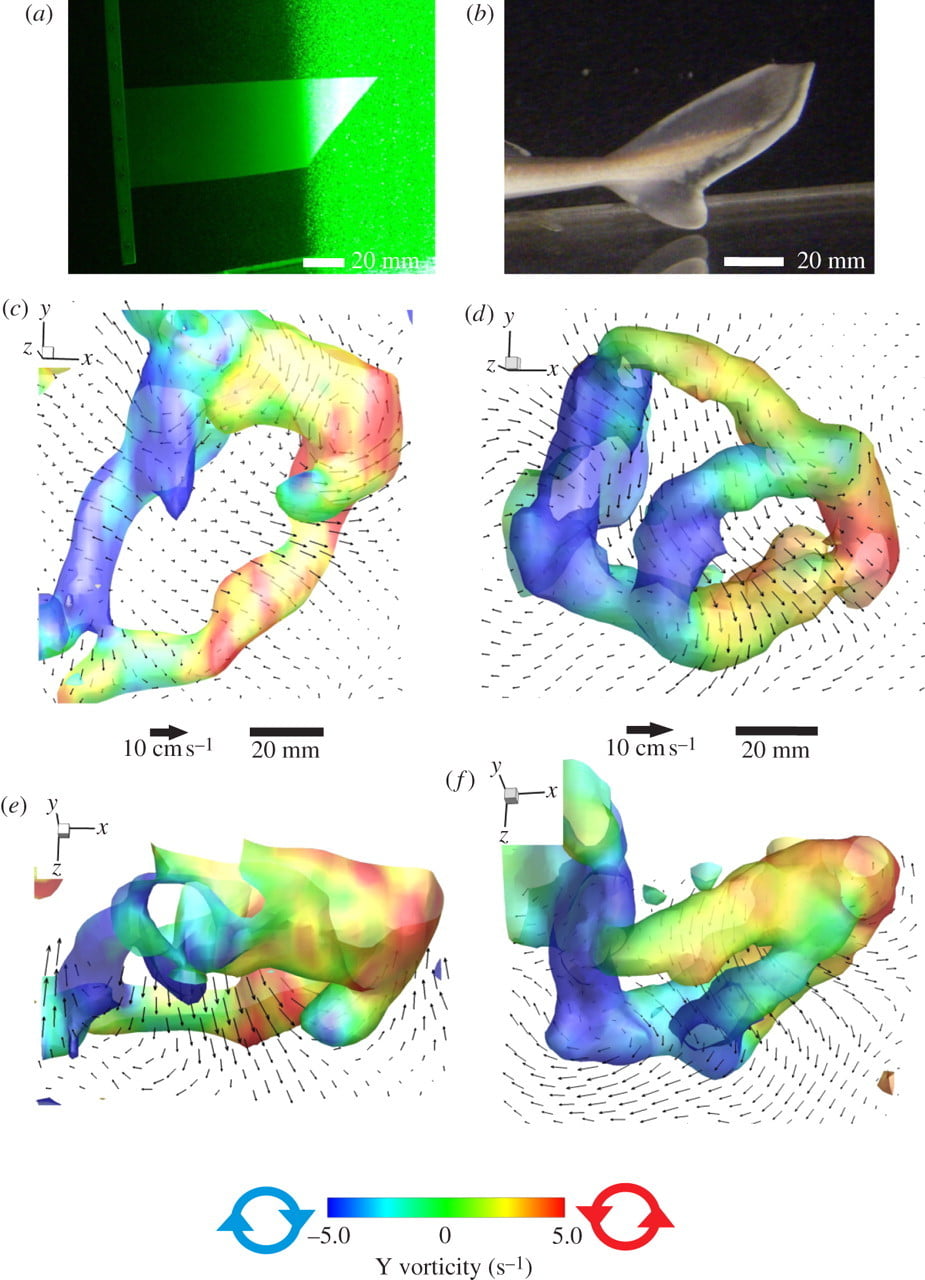
Shark Wakes
Volumetric imaging of swimming spiny dogfish, a type of shark, shows that their distinctively asymmetric tails produce a set of dual-linked vortex rings with every half beat of their tail. The figure above shows data from the actual shark on the right (b,d,f) and a similarly shaped robotic tail on the left (a,c,e). The second row contains lateral views (c,d) and the bottom row contains dorsal views (e,f) of the vorticity isosurfaces measured. The robotic tail does not demonstrate the same double vortex structure, leading scientists to suspect that the shark may be actively stiffening its tail mid-stroke to control its wake. The finding could help engineers design aquatic robots whose morphing fins help it swim more efficiently. For more, see Wired.

Pitching Plate Flow Viz
This photograph uses fluorescent dye to visualize the wake behind a rigid flat plate pitching about its leading edge. A vortex is shed from the plate twice in each cycle of oscillation. These vortices entangle, producing the structured wake above. The top photo shows a side view of the wake, the bottom photo is a top view. (Photo credit: J. Buchholz and A. Smits)

Flow Around a Delta Wing
Smoke visualization in a wind tunnel shows the vortices wrapping around and trailing behind a delta wing. As with more commonly seen rectangular or swept wings, the vortices that form around delta wings affect lift, drag, and control of an aircraft. They can also be hazardous to aircraft nearby. Note that, although delta wings are often seen on supersonic aircraft, this visualization only applies at subsonic speeds. The flow field changes drastically above the speed of sound.
Starting Vortices
Whenever a wing stops or starts in a fluid, it produces a vortex. This 2D numerical simulation shows an airfoil repeatedly starting and stopping, shedding a vortex each time. Note how the line of vortices drifts downward in the wake; this is an indication of downwash. (submitted by jessecaps)
