Search results for: “turbulence”

  • Inside an Evaporating Drop

    Inside an Evaporating Drop

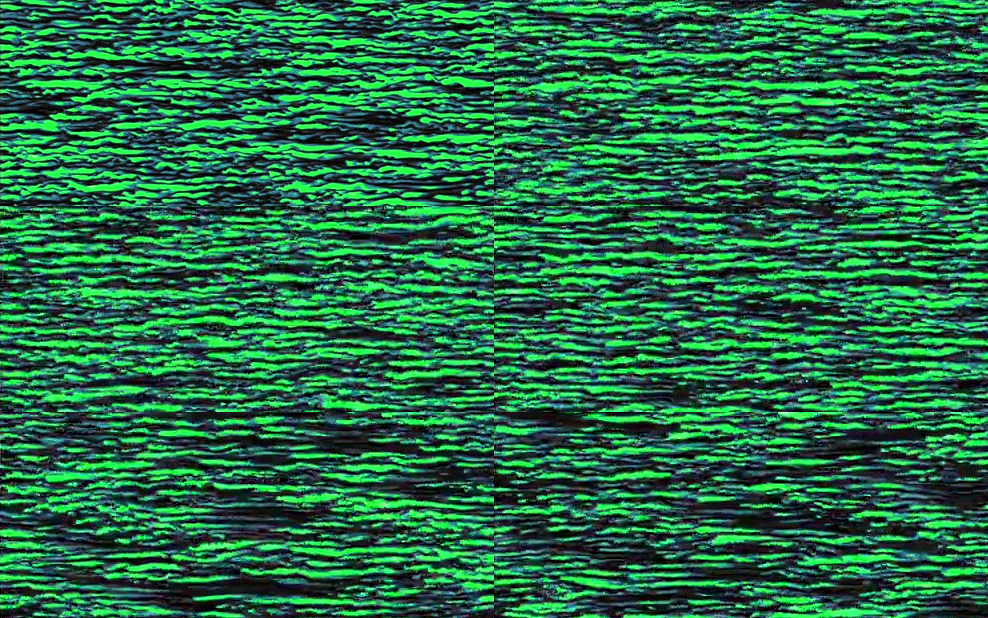
    The evaporation of a simple droplet holds far more complexity than one would expect. If you look closely at the edge of the drop, there’s a tiny, beautiful display at work. It begins with small variations in surface tension at the contact line where solid, liquid, and gas meet. These could be caused by local temperature or concentration differences; either way, the gradient in surface tension creates a flow. It starts out as a series of microjets spaced evenly around the contact line (left). 

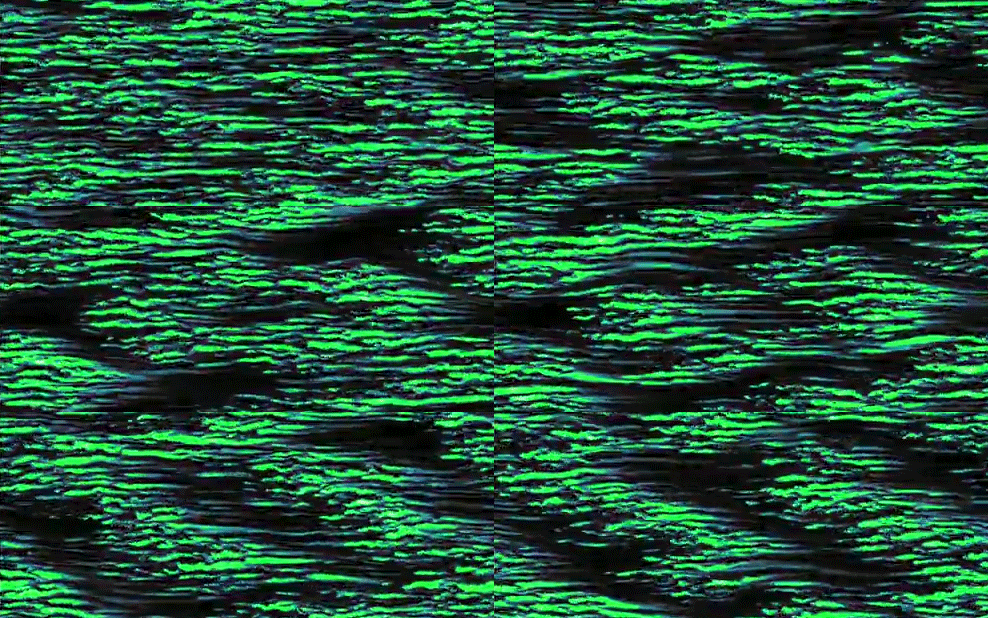
    As the microjets strengthen, they merge into larger and larger vortical structures (right). This kind of feature – large structures emerging from smaller ones – is known as an inverse cascade. Fluid dynamicists have traditionally studied the classic (turbulent) energy cascade, where kinetic energy moves from large scales into smaller ones, but researchers are beginning to recognize more situations where the inverse cascade occurs, such as in the storms of Jupiter. (Image and research credit: A. Ghasemi et al., source)

  • Featured Video Play Icon

    Hydraulic Jumps

    Chances are that you’ve seen plenty of hydraulic jumps in your life, whether they were in your kitchen sink, the whitewater of a river, or at the bottom of a spillway. Practical Engineering has a great primer on this oddity of open channel flow. 

    When water (or other liquids) flow with a surface open to the air – think like a river rather than a pipe – the flow has three important regimes: subcritical, critical, and supercritical. Which state the flow is in depends on the speed of the flow compared to the speed of a wave traveling in that flow. If the waves are faster than the flow, we call it subcritical. If the flow is faster than the waves, it’s called supercritical. (This is equivalent to subsonic or supersonic flow, where the regime depends on the flow speed compared to the speed of sound.)

    Flows can transition naturally from one state to another, and where they transition from fast, supercritical flow to slower, subcritical flow, we find hydraulic jumps – places where the kinetic energy of the supercritical flow gets changed into turbulence and potential energy through a change in height. Check out the video above to learn how civil engineers use hydraulic jumps to control water and erosion. (Video and image credit: Practical Engineering)

  • Amber Waves

    Amber Waves

    When I was a teenager, I liked riding my bike along the river boardwalk near my house. There were fields there, like those in the image above and video below, with tall grass that would bend and sway in the wind. The long stalks undulated almost like a fluid, and they were mesmerizing. This video gives you a higher vantage point, where you can see the larger patterns of motion. What you’re seeing, I think, are some of the large-scale turbulent variations in the wind. Rather than being uniform and laminar, the wind contains pockets of turbulent gusts, which the sway of the long grass reveals to the naked eye. In terms of physical mechanism, I suspect it’s similar to how wind imprints its patterns on water. (Video and image credit: N. Moore)

  • Understanding Jupiter

    Understanding Jupiter

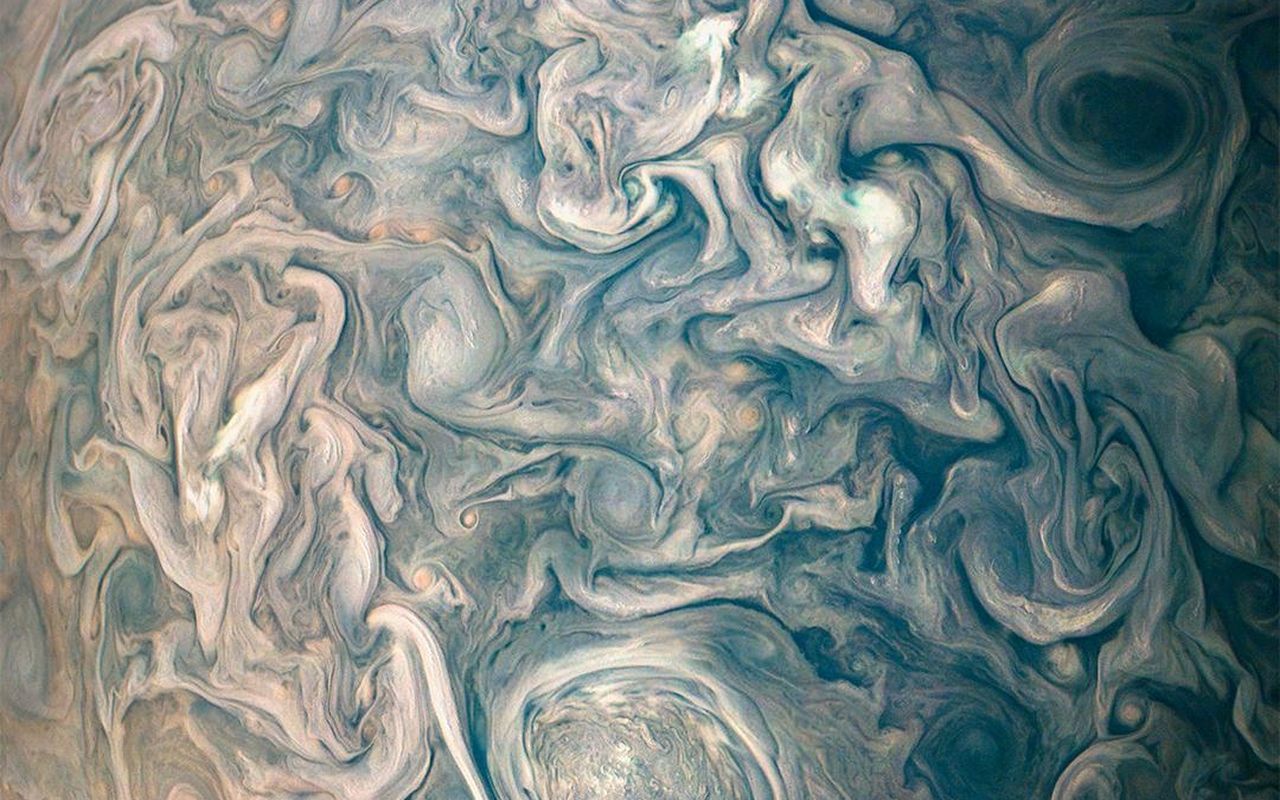
    The swirling clouds of Jupiter hide a complicated and mysterious interior. For decades, scientists have worked to puzzle out the inner dynamics of Jupiter’s atmosphere and what could be going on inside it to generate the flows we see visibly. Near Jupiter’s equator, we see strong jets that flow either east or west, depending on their latitude; this creates the stunning cloud bands we’re used to seeing on the planet. Toward the poles, though, things look more like what we see above – swirling but unbanded.

    Through theory, experiments, and simulations, scientists have tried to work out exactly what ingredients are necessary to make Jupiter look this way, but it’s pretty tough to recreate the conditions simply because Jupiter is so extreme. You need a lot of rotation, a lot of turbulence, and a way to stretch that turbulence if you want to imitate Jupiter. There’s been progress recently, though, and it suggests that the jets we see on Jupiter are far more than skin-deep. Instead, they likely stretch deep into the Jovian atmosphere at the equator and ride somewhat shallower toward the poles. (Image credit: NASA JPL; research credit: S. Cabanes et al.)

  • Vortex Dome

    Vortex Dome

    Are you staring into the eye of a hurricane or watching the spin of a simple desk toy? Part of the beauty of fluid dynamics is recognizing how similar they both are. This is high-speed footage of a toy known as a “Vortex Dome,” which contains a fluid filled with tiny mica particles that react to local forces and allow users to “see” the flow. Before the video begins, the toy has been spinning for long enough that the fluid inside rotates as if it were a solid body. Then an unseen hand sets the disk spinning in the opposite direction and we observe what happens.

    Fluid at the outer edge of the toy has to immediately change direction due to friction with the wall. That change in momentum slowly passes from the wall inward as viscosity between one layer of fluid to the next passes that signal. This creates the rolls we see in the first animation. Initially, those rolls are smooth, but they quickly roughen as disturbances in them grow into full-blown turbulence. Meanwhile, viscosity continues to pass the change in rotation inward, ultimately swallowing the entire interior of the toy. Left spinning indefinitely, the disturbances will eventually quiet out and the entire fluid will spin as one. (Image and video credit: D. van Gils)

  • Growing Droplets

    Growing Droplets

    The moisture in clouds eventually condenses into droplets that grow into raindrops and fall. Some steps in this process are well understood, but others are not. In particular, scientists have struggled with the problem of how droplets grow from about 30 microns to 80 microns, where they’re big enough to start falling and merging.

    Laboratory experiments and numerical simulations (below) have shown that turbulence can help drive small water drops together. When droplets are tiny and light, they simply follow the air flow. But when they’re a little heavier, turbulent eddies (seen in orange below) act like miniature centrifuges, flinging larger water droplets (shown in cyan below) out into clusters, where they’re more likely to collide with one another.

    Although this effect has been seen in experiments and simulation, it’s been difficult to capture in clouds themselves. But a new set of test flights (above) confirms that this mechanism is present in the wild as well! (Image credit: UCAR/NCAR Earth Observing Laboratory, P. Ireland et al., source; research credits: M. Larsen et al., P. Ireland et al.; via APS Physics; submitted by Kam-Yung Soh)

    image
  • Featured Video Play Icon

    Dinosaurs, Propellers, and Hiding Objects

    The latest FYFD/JFM video is out, and it’s all about the interactions between structures and flows! We learn about plesiosaur-inspired underwater robots, how turbulence affects air-water interfaces, and how adding a tail can help hide an object in a flow. If you missed one of the previous episodes in this series, you can find them all here. (Image and video credit: T. Crawford and N. Sharp)

  • Foam and Flow

    Foam and Flow

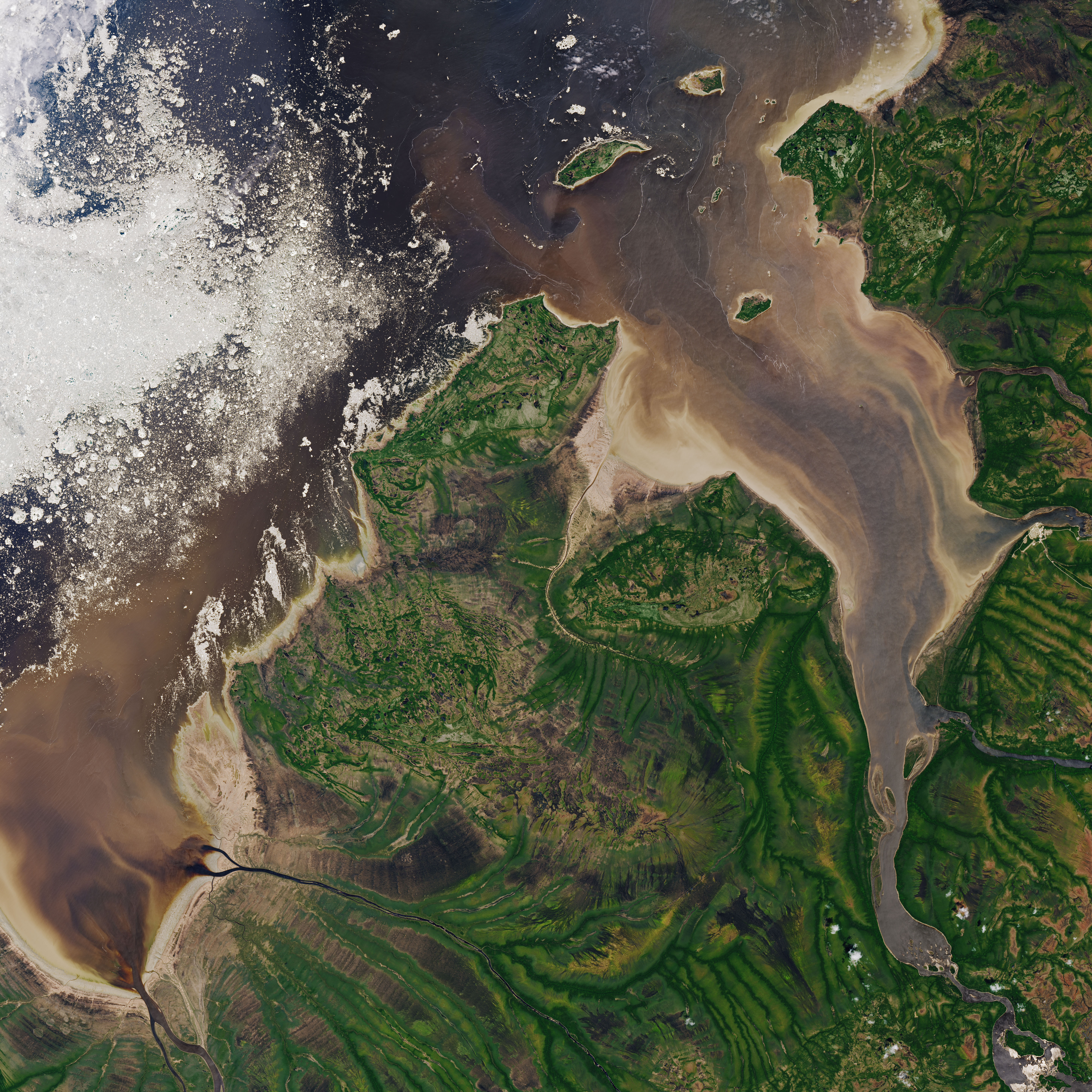
    Fluid dynamics often play out on a scale that’s difficult to appreciate from our earthbound perspective, but fortunately, we have tools to aid us. This natural-color satellite image shows Rupert Bay in Quebec, where fresh water stained with sediments and organic matter (right) flows into the saltier water of James Bay (left). White filaments at the edges of these mixing regions are likely foam floating atop the water. The turbulence caused at the intersection of the two bodies of water whips up organic films to form bubbles. The white on the far left of the image is ice chunks still floating in James Bay when the image was taken in early June. Click through to admire the high-resolution version. (Image credit: U.S. Geological Survey; via NASA Earth Observatory)

  • The Sensitivity of a Seal’s Whiskers

    The Sensitivity of a Seal’s Whiskers

    Harbor seals and their brethren have a superpower that lets them track their prey even without sight or sound. It’s their whiskers, which are sensitive enough to follow the trail left by a single fish thirty seconds earlier. The secret to the whisker’s sensitivity lies in its shape. Instead of a uniform, circular cross-section, the seal’s whisker is oval-shaped and its width varies along the length in a wavy pattern. So unlike a straight cylinder, which vibrates when towed through water, the seal’s whiskers are unperturbed by their own movement. They shed only weak vortices and do not vibrate as a result.

    But, if you expose the whiskers to any external turbulence, like the vortices trailing a fish, the whisker ‘slaloms’ back-and-forth in time with the wake. That motion gets transmitted to the nerves in the seal’s cheek, carrying potential information about both the size and speed of the wake’s originator. Researchers hope similar bio-inspired whiskers could help underwater vehicles track schools of fish or locate underwater drilling leaks. (Image credit: M. Richter; video credit: MIT; research credit: H. Beem and M. Triantafyllou; via the Economist; submitted by Russ A. and Kam-Yung Soh)

  • Pyrocumulus on the Horizon

    The Cranston wildfire in California is intense enough that it’s creating its own weather. This timelapse video shows the formation and growth of a pyrocumulus cloud, also associated with volcanoes, over the wildfire. In both instances, the extreme heat causes a massive column of hot, turbulent air to rise. Because ash and smoke are carried upward as well, there are many places for any moisture in the atmosphere to nucleate, forming the cloud we see. In timelapse, the roiling nature of the air’s motion is especially apparent. This turbulence can be dangerous, as it may contribute to high winds and even lightning, both of which can spread the fire further. (Video credit: J. Morris; via James H.)