Search results for: “turbulence”

  • Testing Waves in High Gravity

    Testing Waves in High Gravity

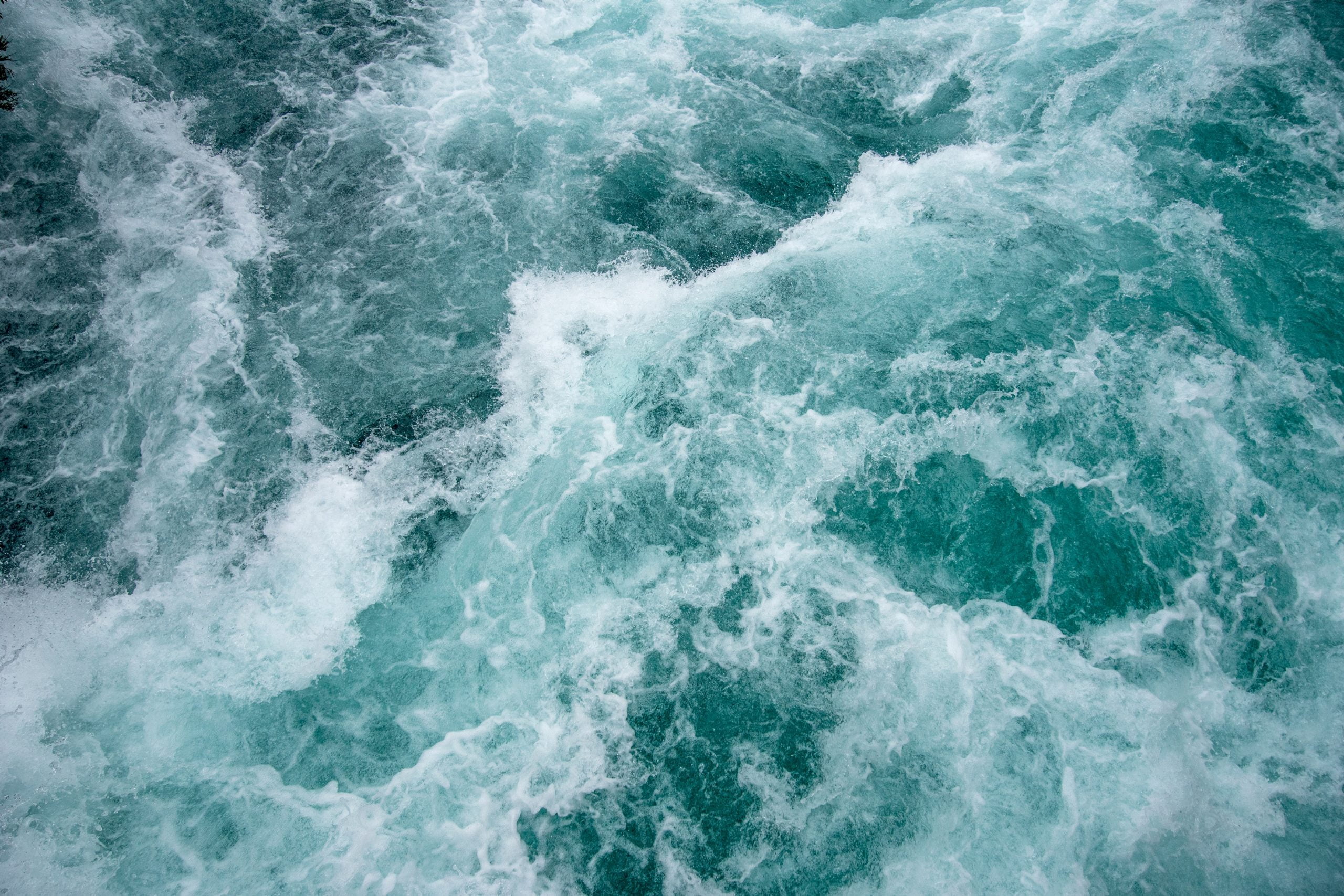
    Where waves crash and meet, turbulence is inevitable. But exactly how large waves interact — whether in the ocean, in plasma, or the atmosphere — is far from understood. A new experiment is teasing out a better physical understanding by tweaking a variable that’s been hard to change: gravity.

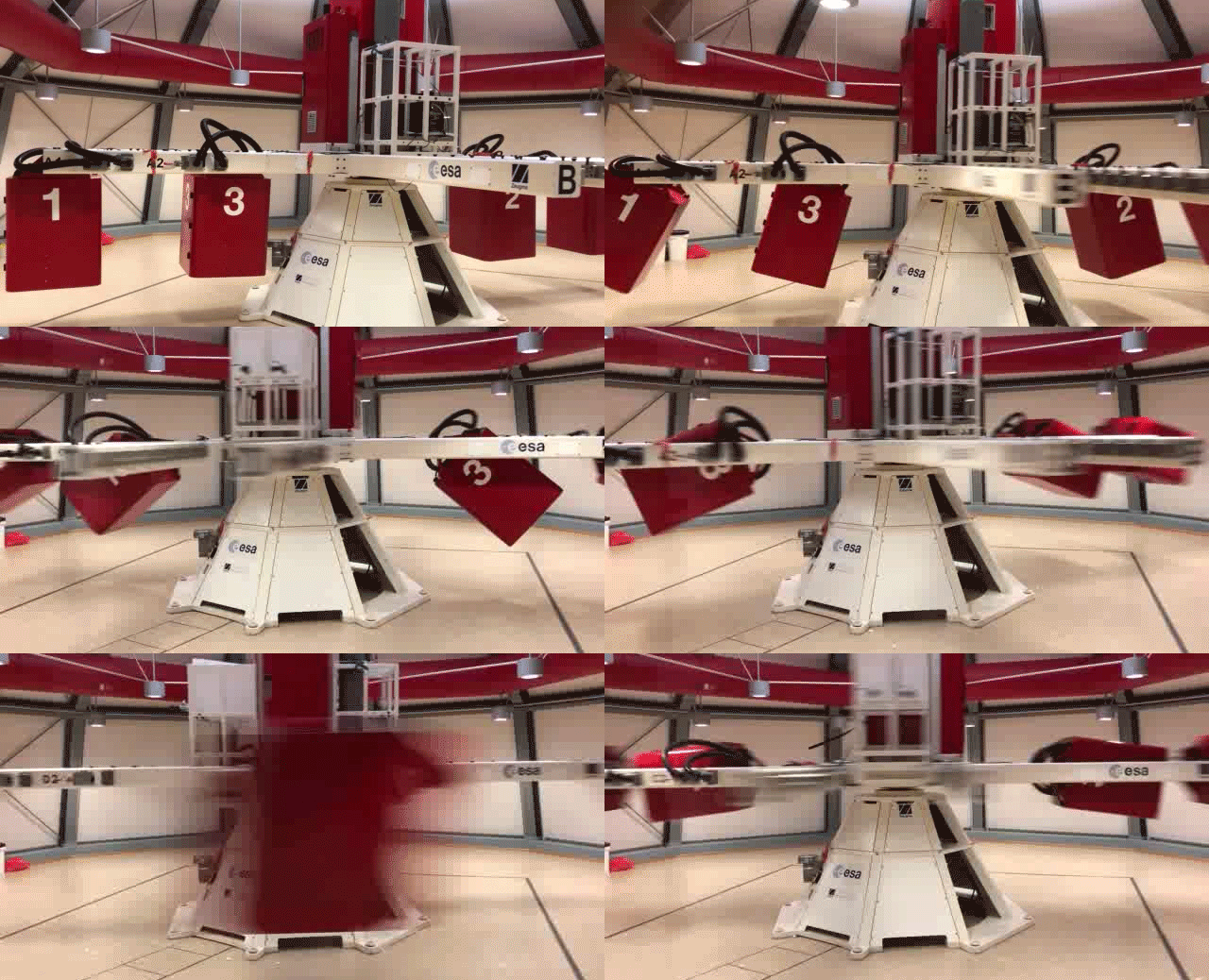
    To do so, the researchers conduct their experiments in a large-diameter centrifuge (shown above) where they can create effective gravitational forces as high as 20 times Earth’s gravity. This increases the range of frequencies where gravity-dominated waves occur by an order of magnitude.

    By studying this extended frequency range, the authors found something unexpected: the timescales of wave interactions did not depend on wave frequency, as predicted by theory. Instead, those interactions were dictated by the longest available wavelength in the system, a parameter set by the size of the container. It will be interesting to see if future work can confirm that result with even larger containers. (Image credit: ocean waves – M. Power, others – A. Cazaubiel et al.; research credit: A. Cazaubiel et al.; via APS Physics; submitted by Kam-Yung Soh)
  • Adapting to the Flow

    Adapting to the Flow

    Simulating fluid dynamics computationally is no simple task. One of the major challenges is that flows typically consist of many different lengthscales, from the very large to the extremely tiny. In theory, correctly capturing the physics of the flow requires computing all of those scales, and that means having a very close, dense grid of points at which the physics must be calculated during every time step of a simulation. Even for a relatively simple flow, this quickly balloons into a prohibitively expensive problem. It simply takes a computer far too long to calculate solutions for so many points.

    One technique that’s been developed to save time is Adaptive Mesh Refinement. You can see an example of it above. The background is a grid of points that are far from one another in places where the flow isn’t changing and are tightly spaced in areas where the rising flames are most changeable. Adaptive Mesh Refinement algorithms automatically change these grid points on the fly, adding more where they’re needed and subtracting them where they aren’t. The end result is a much faster computational result that doesn’t sacrifice accuracy. Check out the videos below for some examples of this technique in action. (Video and image credit: N. Wimer et al.)

  • Featured Video Play Icon

    “Mocean”

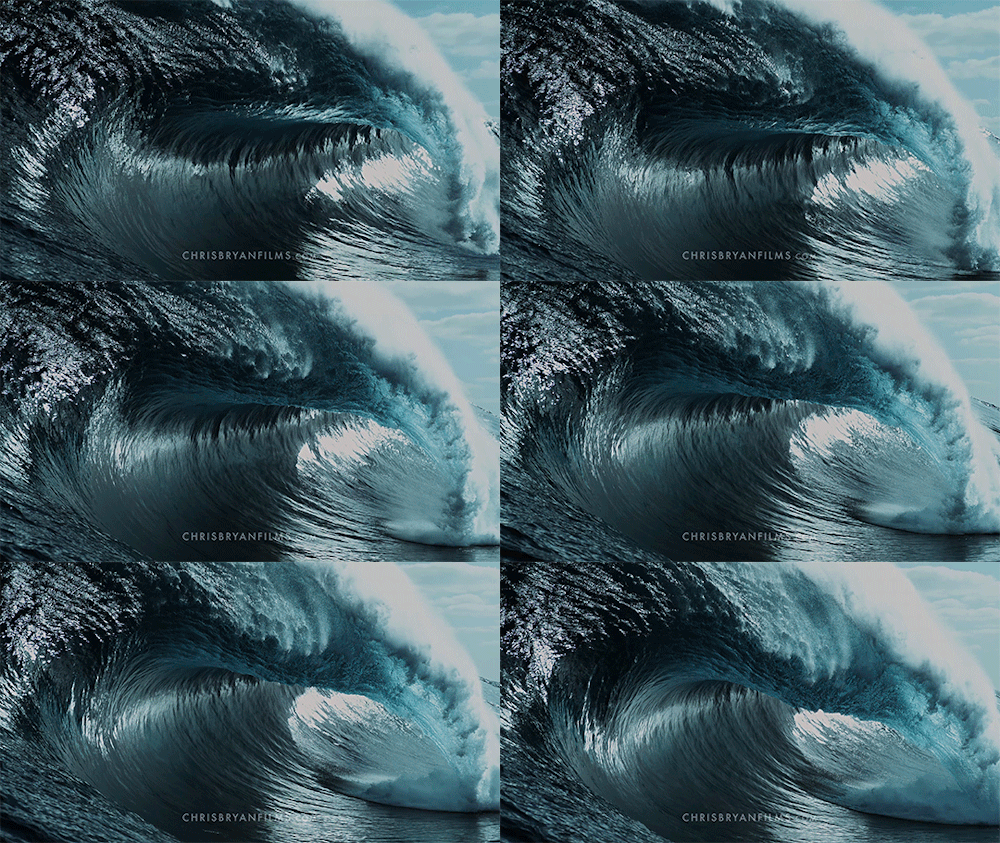
    Ocean waves are endlessly fascinating to watch. In “Mocean,” cinematographer Chris Bryan captures them in ways few ever see, thanks to his high-speed camera. Honestly, this film is so gorgeous that I don’t want to distract you with the science, so just go watch!

    All done? Pretty wonderful, right? There’s nothing quite like seeing those holes break and expand through sheets of water, tearing what looked solid into a spray of droplets that bleed salt into the atmosphere. Or how about those rib vortices underneath the waves? Or the cloud-like turbulence of the waves breaking overhead? How fortunate we are to see and capture and share such beauty! (Video and image credit: C. Bryan; via RedShark; submitted by Michael F.)

  • Resources

    I get a lot of questions from people who want to learn more about fluid dynamics, whether casually or seriously. Below are some resources that may be useful in such pursuits. Affiliate links are marked with an asterisk (*).

    Videos

    • NCFMF Fluid Mechanics Series – This series of videos date from the 1960s and is intended to teach undergraduates about fluid dynamics. They remain an incredible source of demonstrations on all kinds of subjects in fluids. They feel a bit slow, but they are well worth the time.
    • Khan Academy’s Fluids series – A twelve part video series addressing some fundamentals of fluid dynamics.
    • CrashCourse Physics – If you want to dig into fluids further, it helps to know the basics. After all, the Navier-Stokes equations are simply Newton’s Laws applied to a fluid!
    • Science Off The Sphere – This video series by astronaut Don Pettit features FD and other physics in space.
    • Physics Central – Not FD-specific, but this website features lots of great educational physics, including fluid dynamics.
    • MIT + K12 – Includes fluids-related video lessons as well as many other science subjects.

    YouTube Channels

    • Library Laboratory (LIB LAB) – This project comes from fluid dynamicist A. J. Fillo. It’s aimed toward kids but is fun for all ages. Includes fluid dynamics and other topics in physics.
    • The Lutetium Project – This channel is produced by fluid dynamicists in France in conjunction with art and music students, so it offers a great intersection of art and science. Videos are available in French and English.

    Websites

    • U of Colorado’s Flow Visualization – One of my favorite websites dedicated to FD, this interdisciplinary course features engineering and art students working together to make beautiful FD. If you are at Colorado, take this course. Seriously.
    • APS Gallery of Fluid Motion – Every year the American Physical Society’s Division of Fluid Dynamics publishes the year’s best FD photos and videos. Most of this will look familiar to FYFD readers. 
    • CFD-Online – For anyone looking to get into computational fluid dynamics (CFD), this website and forum is full of great resources and comprehensive links.
    • Learn ChemE – Full of videos, screencasts, and simulations relevant to fluid dynamics.
    • Flow Visualization Facebook group – A nice place to find links to fun FD and clouds.
    • eFluids – More pretty pictures and videos from researchers.
    • opencalculus – Not directly fluids-related, but if you want to dig further into the subject, a strong foundation in math is important (see note to undergrads below).
    • Teaching Fluid Mechanics – This website focuses on demonstrations that can be used in the classroom to help teach and illustrate fluid dynamics concepts.

    Other FD Blogs

    • FlowViz – Focuses on general FD, much like FYFD does
    • Physics in Drops – Exploring the world of microfluidics
    • Liquifun – Lots of car-related aerodynamics as well as general FD
    • Symscape – Computational fluid dynamics, for the most part, but with general FD thrown in

    Books (No Diff EQ Needed)

    • An Album of Fluid Motion(*) by Milton van Dyke – This is a classic visual guide to fluid dynamics for laymen and practitioners alike.
    • The Life and Legacy of G. I. Taylor(*) by G. K. Batchelor – A great biography of one of the major fluid dynamicists of the 20th century. Taylor’s adventures range from measuring atmospheric turbulence from a ship deck to teaching himself to fly in WWI to measure pressure on a wing; from studying the swimming of microorganisms to helping predict the blast wave from the atomic bomb. Batchelor provides great insight into the man and his scientific process.
    • Life in Moving Fluids(*) by Steven Vogel – This text was written as an introduction to fluid dynamics for biologists and focuses largely on the subject’s applicability to that field. There’s some math in here, but not too much. Check out my full review.

    Books (For Those With Calculus/Diff EQ)

    • Fundamentals of Aerodynamics(*) by John Anderson – Anderson is known for textbooks (he has a bunch) that are good at introducing important concepts in fluid dynamics and aerodynamics without super-advanced mathematics and notation. This was my first aerodynamics textbook and my first introduction to the Navier-Stokes equations during my junior year.
    • Boundary Layer Theory(*) by Hermann Schlichting – Most of this text actually comes from 1930s German fluid dynamics class notes. It’s not an easy read, but it’s a great reference for advanced undergrads/early graduates working in FD.

    For Undergrads Who Want More Fluids But Don’t Know Where To Start

    In addition to the resources above, I have a couple of tips.

    • Look for professors who study fluid dynamics. – Check your school’s websites. Profs who do FD are often found in mechanical, aerospace, civil, and chemical engineering, but they can also be found in physics, mathematics, geology, atmospheric science, and theoretical and applied mechanics departments. Check out their research pages, find their office hours, and go talk to them. Volunteer to work in their lab. Demonstrate your interest!
    • Check out the NSF Research Experience for Undergraduates (NSF REU) program. Positions in this program exist all over the U.S. and frequently involve doing research over the summer. Even if your school doesn’t have anyone who does FD, you can find a school that does and do research there over the summer. (Suggestion when looking for positions: search for “fluid”, “fluid dynamics”, “fluid mechanics”, etc.) If you like it, consider graduate school!
    • Build strong mathematical skills. – One aspect of fluids education I lament is its tendency to come so late (or not at all) in a students’ education—that’s part of why FYFD exists. But the truth is that researching FD requires a lot of math—calculus, differential equations, partial differential equations, etc.—courses that get taken in freshmen and sophomore years of college before professors even start talking about FD. Having a strong foundation in these subjects is very helpful, but it’s not a prerequisite to working in a lab as an undergrad.

    Got more suggestions for helpful fluid dynamics resources? Let me know.

    (*) Links marked with an asterisk are affiliate links. Following these links and making a purchase may provide a commission to FYFD at no additional cost to you.

  • Trails from a Delta Wing

    Trails from a Delta Wing

    Top-down view of green and red dyes streaming off a delta wing

    Rhodamine (red) and fluorescein (green) dyes highlight the complex flows around a delta wing. To visualize the flow, researchers painted the apex of the delta wing with rhodamine, which gets drawn into the core of the wing’s leading edge vortex. The green fluorescein dye was added to the wing’s trailing edge, where it gets pulled into the secondary structure of the vortices. A laser illuminates the flow, making even the most delicate wisps of dye shine. As the wake behind the wing develops, the dyes reveal growing instabilities along the vortices. Given time and space, these instabilities will grow large enough to destroy any order in the wake, leaving behind turbulence. (Image and research credit: S. Morris and C. Williamson; see also poster)

  • “Transient 2”

    “Transient 2”

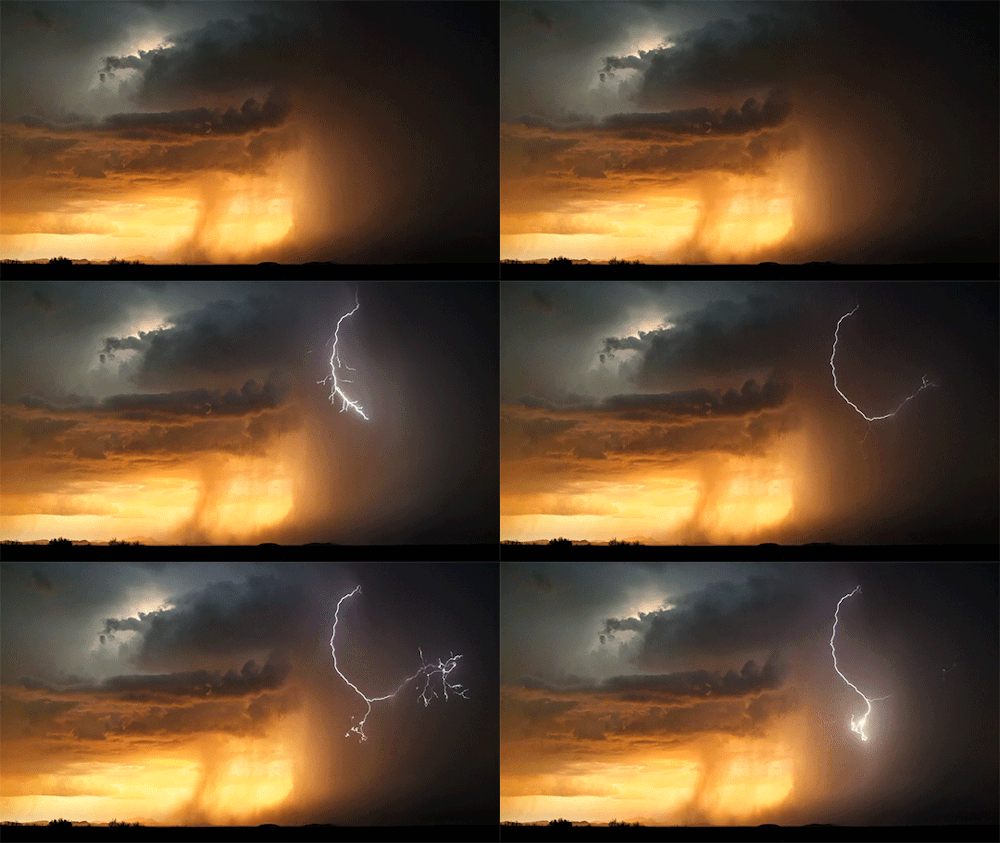
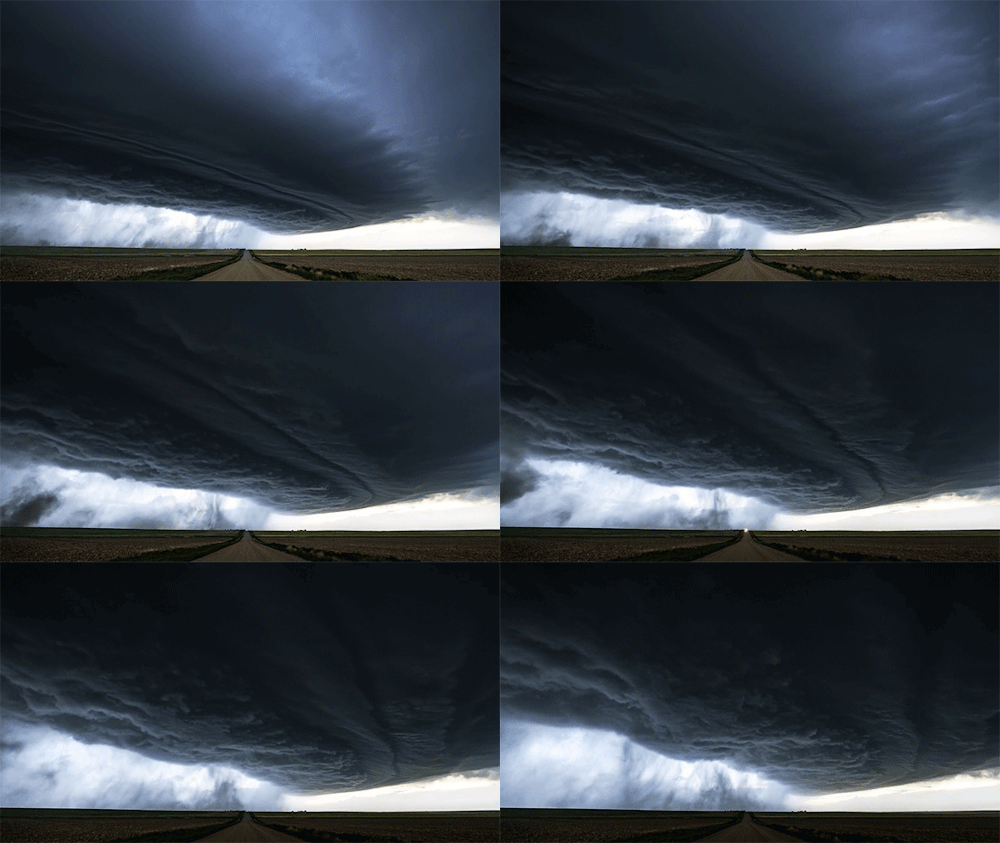
    Where cold and warm air meet, our atmosphere churns with energy. From the turbulence of supercell thunderclouds to the immense electrical discharge of lightning, there’s much that’s breathtaking about stormy skies. Photographer Dustin Farrell explores them, with a special emphasis on lightning, in his short film, “Transient 2″. 

    As seen in high-speed video, lightning strikes begin with tree-like leaders that split and spread, searching out the path of least resistance. Once that line from cloud to ground is discovered, electrons flow along a plasma channel that arcs from sky to earth. The estimated temperatures in the core of this plasma reach 50,000 Kelvin, far hotter than the Sun’s surface. It’s this heating that generates the blue-white glow of a lightning bolt. The heating also expands the air nearby explosively, producing the shock wave we hear as a crash of thunder. (Images and video credit: D. Farrell et al.; via Colossal)

  • Escaping the Limits of Viscosity

    Escaping the Limits of Viscosity

    For large creatures, it’s not hard to feel the evidence of someone else swimming nearby. But to tiny swimmers water is incredibly viscous and hard to move. These creatures have to swim very differently than their larger cousins, and evidence of their motion dies out quickly. But at least one microorganism,  Spirostomum ambiguum, has discovered a method for overcoming the limits of size and viscosity.

    The single-celled swimmer, when threatened, contracts its body in milliseconds, generating accelerations greater than those seen by fighter pilots. That acceleration is strong enough that it generates a burst of turbulence powerful enough to overcome the natural damping of its viscous surroundings. Within their colonies, S. ambiguum seem to use contraction to send out hydrodynamic signals to neighbors, who pass on the call to arms. To see the colonies in action, check out this previous article. (Image and research credit: A. Mathijssen et al.; via Physics Today; submitted by Kam-Yung Soh)
  • Inside the Canopy

    Inside the Canopy

    If you’ve ever gone into the woods on a windy day, you know that conditions there are drastically different than in the open. To blowing wind, trees of different sizes act like enormous roughness that disturbs the flow. Inside the canopy, flows can become incredibly complicated and many of the common techniques used by researchers no longer hold. 

    You can get a sense for this complexity with the second image above, which visualizes data from a wind tunnel experiment. The gray blocks represent roughness elements – the trees of this wind-tunnel-scale forest – and the large, blue arrow shows the direction of the flow. The thin colored lines show the paths taken by particles in the flow. The lines’ colors indicate what height the trajectory began at. 

    Notice how the blue and purple lines are relatively straight and oriented in the direction of the flow. This indicates that the flow here is relatively steady and uncomplicated. At the lower heights, though, especially in the green and yellow regions, the pathlines are far more twisted and complex. The flow here is turbulent, and the particles’ trajectories don’t necessarily correlate at all to the winds higher up. (Image credit: T. Japyassu and R. Shnapp et al.; research credit: R. Shnapp et al.; submitted  by Ron S.)

  • Reader Question: Waves Breaking

    Reader Question: Waves Breaking

    As a follow-up to the recent waves post, reader robotslenderman asks:

    What does it look like when the wave breaks? And why do waves sometimes push us back? Why are we able to ride them?

    I wasn’t able to find an equivalent breaking wave version of that dyed wave – side note: readers with flumes, please feel free to make one and share it! – but here’s an undyed breaking wave for our reference.

    Waves break, or get that white, frothy look, when they reach shallower water. In the previous post, the waves we saw were effectively deep-water waves, so they didn’t change in height as they rolled across the tank. Here there’s an incline to simulate a beach, which causes the water to slow down and steepen. That forms the characteristic curl of a plunging breaker, seen here.

    At the beach, a wave runs out of water to pass through and all the energy that wave was carrying has to go somewhere. Some is lost as heat, some turns into the sound of that classic crashing wave, and a lot of it gets dissipated as turbulence that pushes us, sand, shells, and anything else its way.

    As for why we can ride waves, there’s some special physics at play when it comes to surfing. To catch a wave, a surfer has to paddle hard to get up to the wave’s speed just as it reaches them. Too slow and the wave will just pass them by, leaving them bobbing more or less in place. (Image credit: T. Shand, source)

  • Order in Chaos

    Order in Chaos

    Although turbulent flow is chaotic, it’s not completely disordered. In fact, order can emerge from turbulence, though exactly how this happens has been a long-enduring mystery. Take the animations above. They show the flow that develops between two plates moving in opposite direction that are separated by a small gap. (The formal name for this is planar Couette flow.) The visualization is taken in a plane at a fixed height between the plates.

    Initially (top), the flow shows narrow bands of turbulence, shown in green, separated by calmer, laminar zones in black. As time passes, these areas of laminar and turbulent flow self-organize, eventually forming diagonal stripes that are much longer than the gap between plates (bottom), the natural length-scale we would expect to see in the flow. Researchers have wondered for years why these distinctive stripes form. What sets their spacing, and why are they along diagonals?

    To answer those questions, researchers explored the full Navier-Stokes equations, searching for equilibrium solutions that resemble the striped patterns seen in experiments and simulation. And for the first time, they’ve found a mathematical solution that matches. What the work shows is that the pattern emerges naturally from the equations; in fact, given the characteristics of the solution, the researchers found that many disturbances should lead to this result, which explains why the pattern appears so frequently. (Image and research credit: F. Reetz et al., source; via phys.org; submitted by Kam-Yung Soh)