Search results for: “turbulence”

  • Eye of the Stellar Storm

    Eye of the Stellar Storm

    AG Carinae is a bright, unstable luminous blue variable star. This rare type of star lives fast and dies young (by stellar standards) over only a few million years. During that time, it will occasionally blow off its outer layers in a violent eruption as a result of the ongoing tug of war between its radiation pressure and gravity. That’s the source for the nebula we see surrounding the star in this image. The red areas of the image are a mixture of hydrogen and nitrogen gas; the blue clumps are cooler pockets of dust shaped by the hotter, faster-moving stellar wind. Zoom in on the image and you can see amazing structural detail in the nebula, evidence of turbulence on a scale of light-years. (Image credit: NASA/ESA/STScI; via Gizmodo)

  • Seeing Through

    Seeing Through

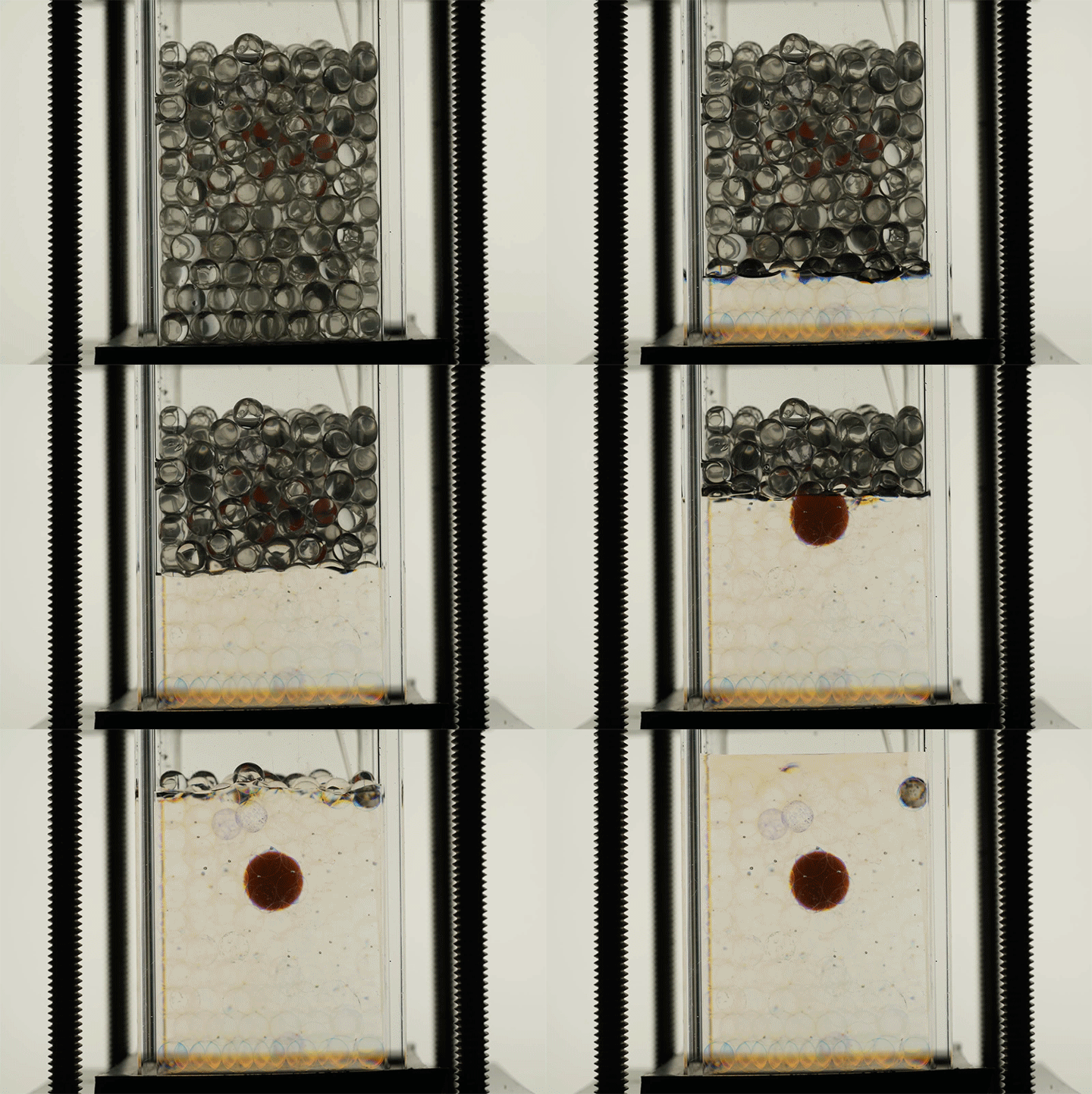
    Often researchers are interested in flows around and between objects, but seeing those flows is a challenge in a crowded field of view. One useful trick for this problem is matching the refractive index of your objects and the fluid they’re immersed in. Here we see the glass beads in a container seemingly disappear when a mixture of water and ammonium thiocyanate is poured in. Now the researchers can use many different visual diagnostic techniques to observe the interior flow! (Image credit: Datta Lab, Princeton University, source)

  • Featured Video Play Icon

    “Chocolate Lullaby”

    In this music video for the song “Chocolate Lullaby,” the Macro Room team feature all kinds of fluid dynamical phenomena. It begins with pouring viscous fluids, which, like honey or cake batter, fold and stack before they spread. From there things get significantly less viscous and more turbulent. There’s some neat coalescence, billowing streams colliding, and some gorgeous turbulence. Enjoy! (Image and video credit: Macro Room)

  • Chaos in the Lagoon Nebula

    Chaos in the Lagoon Nebula

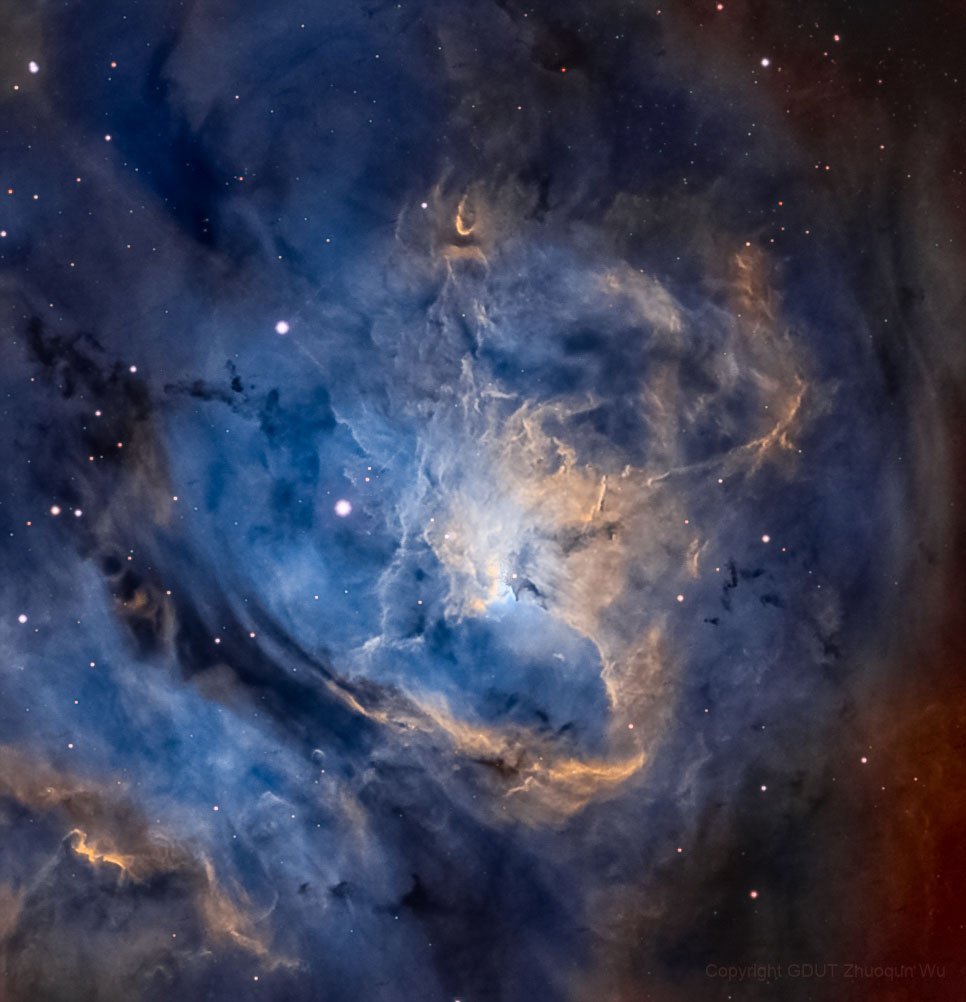
    Even on the scale of light-years, fluid dynamics plays a role in our universe. This photograph shows the Lagoon Nebula, where stars, gas, and dust are battling for supremacy. Jets from young stars push the dust left from supernova remnants into a chaotic patterns, and the high-energy particles streaming from the youthful stars illuminate interstellar gases, creating the nebula’s distinctive glow. This section of the nebula is about 50 light-years across, so every picture we capture is only the tiniest snapshot of the true scale of its turbulence. (Image credit: Z. Wu; via APOD)

  • Updating Undergraduate Heat Transfer

    Updating Undergraduate Heat Transfer

    For many engineering students, their first exposure to fluid dynamics comes in a heat transfer class. The typical focus in these classes is not on the underlying physics but on learning to use empirical formulas and correlations that are used in engineering heat exchangers, computer fans, and other applications.

    As part of this, students are presented with an extremely simplified view of classical flows like flow over a flat wall, known as a flat-plate boundary layer. Students are told that there are two main features of this and other flows: a laminar region where flow is smooth and orderly, and a turbulent region where flow is chaotic and better at mixing. The transition between these two, according to the undergraduate picture, takes place at a particular point that can be calculated as part of the correlation.

    The problem with this picture is that it grossly oversimplifies the actual physics, and for students who may not take dedicated, graduate-level fluid dynamics courses, leaves future engineers with a false understanding that may impact their designs. The truth of transition is far more complicated and nuanced. Transition from laminar to turbulent flow rarely takes place at a single, predictable point; instead it takes place over an extended region and where it begins depends on factors like geometry, vibration, and the level of turbulence already present in the flow.

    In an effort to bring undergraduate heat transfer correlations more in line with actual physics — as well as with real, experimental data — a new study revamps the mathematical models. Personally, I applaud any effort to add some nuance to the introduction of this important topic. (Image and research credit: J. Lienhard; via phys.org)

  • Featured Video Play Icon

    The Birth of a Liquor

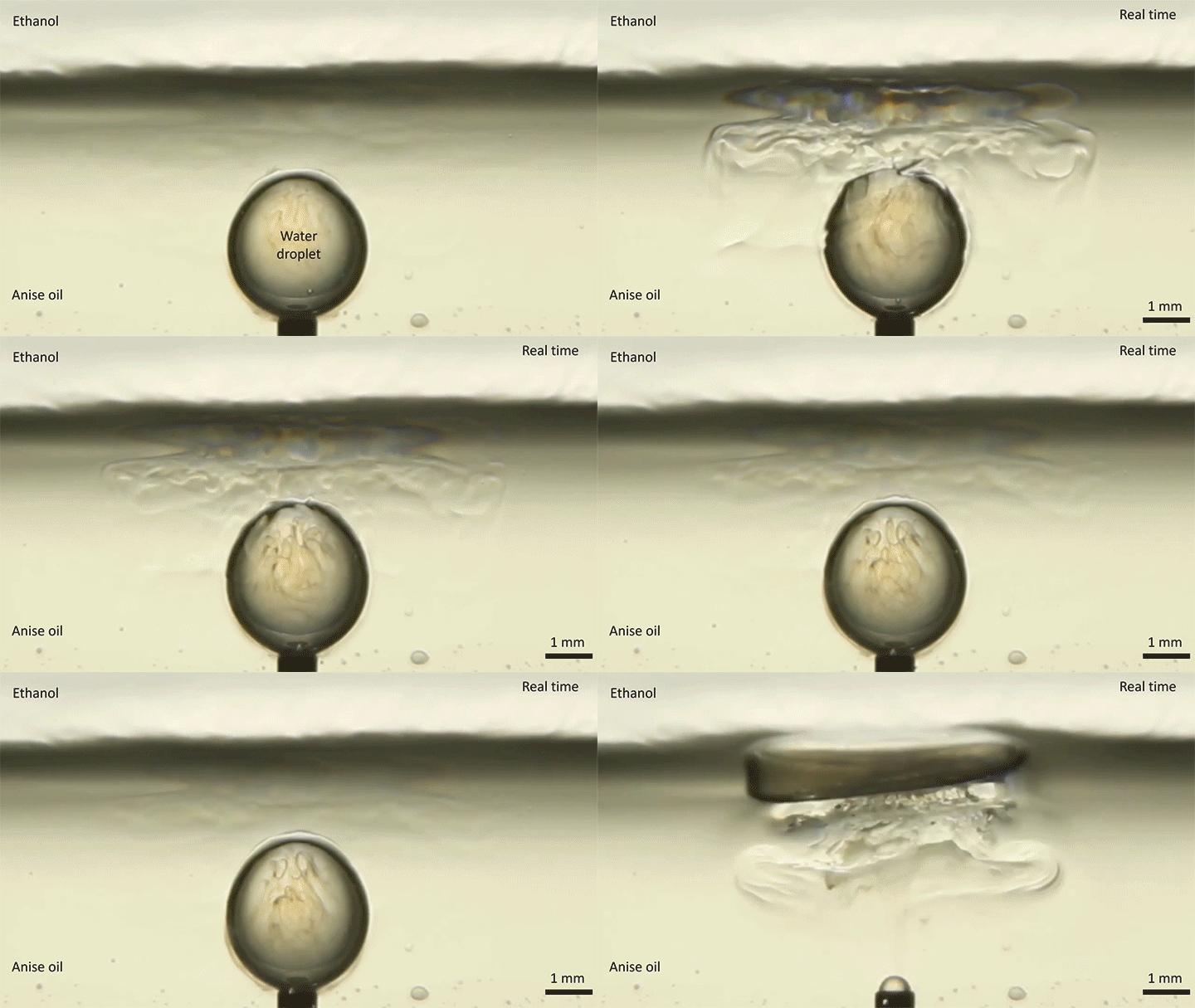
    A water droplet immersed in a mixture of anise oil and ethanol displays some pretty complicated dynamics. Its behavior is driven, in part, by the variable miscibility of the three liquids. Water and ethanol are fully miscible, anise oil and ethanol are only partially miscible, and anise oil and water are completely immiscible. These varying levels of miscibility set up a lot of variations in surface tension along and around the droplet, which drives its stretching and eventual jump.

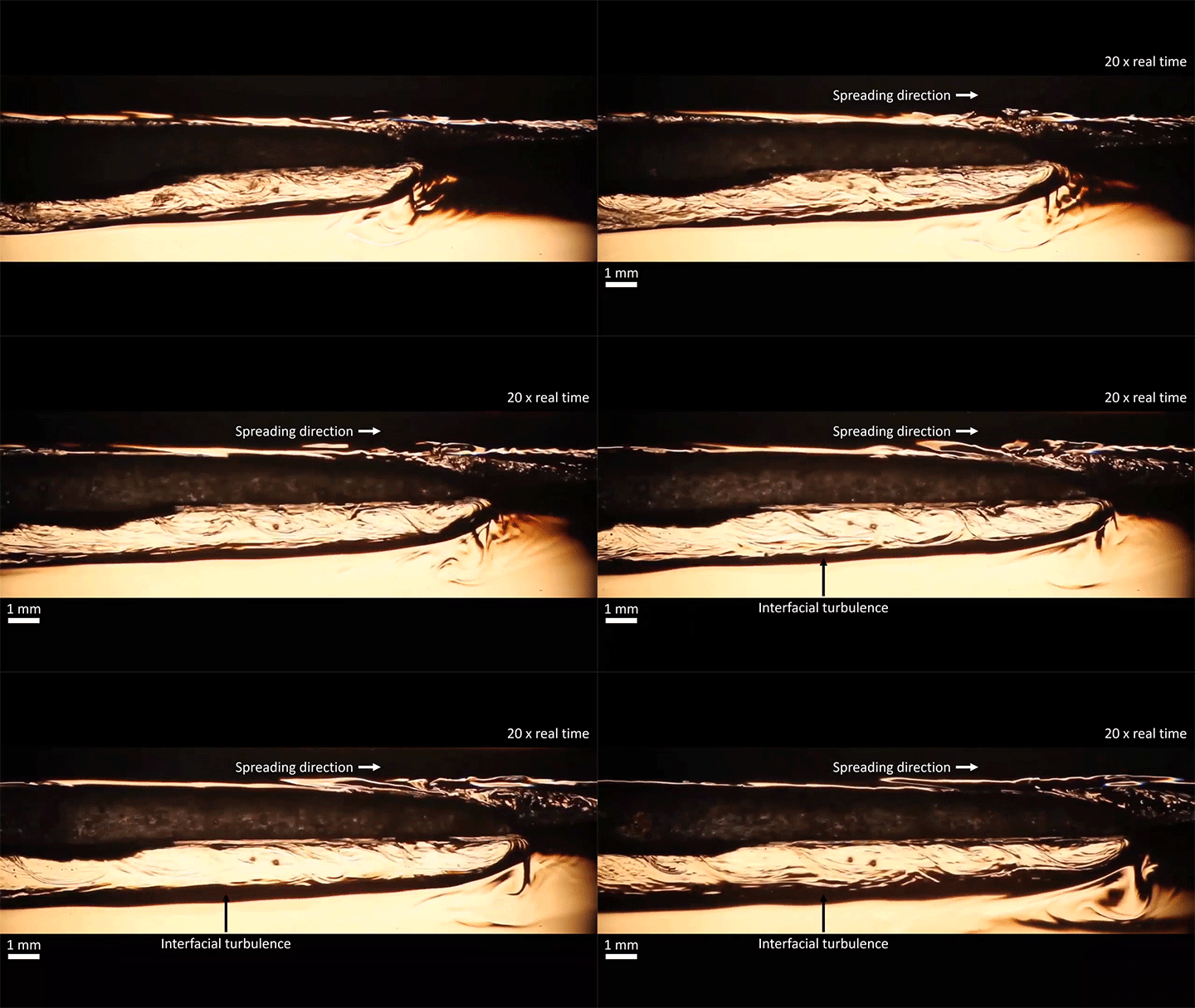
    Once detached, the droplet takes on a flattened, lens-like shape that continues to spread. That spreading is driven by the mixing of ethanol and water, which generates heat and, thus, convection around the drop. This not only spreads the droplet, it causes turbulent behavior along the drop’s interface. (Image and video credit: S. Yamanidouzisorkhabi et al.)

  • Dunes Avoid Collisions

    Dunes Avoid Collisions

    The speed at which a dune migrates depends on its size; smaller dunes move faster than larger ones. That speed differential implies that small dunes should frequently collide into and merge with larger dunes, eventually forming one giant dune rather than a field of smaller separate ones. But that’s not what we observe in nature.

    To figure out why dunes aren’t colliding that often, researchers built a dune field of their own in the form of a rotating water tank. Inside the tank, their two artificial dunes can chase one another indefinitely while the researchers observe their interactions. What they found is that the dunes “communicate” with one another through the flow.

    As flow moves over the upstream dune, it generates turbulence in its wake, which the downstream dune then encounters. All that extra turbulence affects how sediment is picked up and transported for the downstream dune, ultimately changing its migration speed. For two dunes of initially equal size and close spacing, these interactions push the downstream dune further away until the separation between the dunes is large enough that they both migrate at the same speed. Even between dunes of unequal sizes, the researchers found that these repulsive interactions force the dunes away from collision and into migration at the same speed. (Image credit: dune field – G. Montani, others – K. Bacik et al.; research credit: K. Bacik et al.; via Cosmos; submitted by Kam-Yung Soh)

  • Featured Video Play Icon

    Colorful Dissipation

    Colorful eddies swirl in this short video from photographer Karl Gaff. Formed near the boundary at the bottom of the frame, these eddies act to dissipate some of the energy in the flow. Structures like these are key in turbulent flows, where energy must pass from large eddies to smaller and smaller ones until they reach a size where viscosity can extinguish them. (Video, image, and submission credit: K. Gaff)

    P.S. – Today’s post is FYFD’s 2,500th! Crazy, right? That means we have a pretty enormous archive. Want to explore? Click here for a random post.

  • Featured Video Play Icon

    Using Flow Separation to Fly

    Fixed-wing flight typically favors the efficiency of long skinny wings, which is why so many aircraft have them. But for smaller flyers, like micro air vehicles (MAVs), short and stubby wings are necessary to stand up the disruption of sudden wind gusts. But a new MAV design eschews that conventional wisdom in favor of a biological tactic: intentionally disrupting the flow.

    Usually designers aim to have a smooth, rounded leading edge to wings in order to guide air around the airfoil. But here researchers instead chose a sharp, thick leading edge that immediately disrupts the flow, causing a turbulent separation region over the front section of the wing. A rounded flap added over the trailing edge of the wing guides flow back into contact, giving the wing its lift generation.

    Odd as that design choice seems at first blush, it actually makes the aircraft extremely resilient, especially to the turbulence that so often thwarts small flyers. When your flow is already disrupted, a little extra turbulence doesn’t make a difference.

    The thicker wing also allows them to use a longer wingspan — thereby gaining that skinny wing efficiency — and move most of the components that would normally be in a fuselage into the wings themselves. By essentially turning most of the MAV into a wing, the designers avoid the loss of lift associated with the fuselage section of the wings.

    Diagram of new micro air vehicle wing design, showing the full device as well as a cross-section with flow separation and reattachment.

    (Image, video, and research credit: M. Di Luca et al.; via IEEE Spectrum; submitted by Kam-Yung Soh)

  • River Avon

    River Avon

    One of the challenges in fluid dynamics is considering the instantaneous versus the average. Many flows — especially turbulent ones — are different at every point in space and in time. That’s a lot of data to collect and to wrap one’s head around. So often researchers will average turbulent measurements over a period of time and break that information down into two variables: an average velocity and a fluctuating one.

    What does that have to do with this image? Well, by capturing the River Avon’s flow near Pulteney Bridge as a long exposure, photographer Peter Leadbetter gives us a look at the river’s “averaged” flow. The long exposure smooths out some of the intermittent features visible in a faster picture, and instead draws our attention to the overall path of the flow and regions that may behave differently, like those near the wall in the foreground. The averaging researchers do is much the same. It will erase or obscure some features while making the large-scale patterns more obvious. (Image credit: P. Leadbetter; submitted by Ioanna S.)