Every four years, Adidas creates a newly designed ball for the World Cup. This year’s version is the Telstar 18, which features six glued panels (no stitching!) with a slightly raised texture. That subtle roughness is an important feature for the ball’s aerodynamics. It helps ensure that flow around the ball will become turbulent at relatively low speeds. Some previous designs, notably the 2010 Jabulani, were so smooth that flow near the ball would not become turbulent until much higher speeds. In fact, one side of the ball might have laminar flow while the other was turbulent, causing the ball to wobble and misbehave. To learn more about World Cup aerodynamics and the importance of a little surface roughness to the ball’s behavior, check out the Physics Girl video below. (Image credit: Adidas; via APS News; video credit: Physics Girl)
Search results for: “turbulence”

360 Fireball
Flames are inherently fascinating to watch. Most of the ones we see regularly, like candle flames and campfires, tend to flicker unsteadily due to their turbulence. But larger fires have a spell-binding nature all their own, one that’s highlighted in slow motion. Here the Slow Mo Guys take flame-gazing to a new level by circling a fireball with a high-speed camera. In the resulting footage, you can admire the incredible expansion of the flame front, and the beautiful, detailed turbulence that creates all the myriad tiny eddies you see in the slow motion. It’s well worth watching more than once! (Video and image credit: The Slow Mo Guys)


The Coexistence of Order and Chaos
One of the great challenges in fluid dynamics is understanding how order gives way to chaos. Initially smooth and laminar flows often become disordered and turbulent. This video explores that transition in a new way using sound. Here’s what’s going on.

The first segment of the video shows a flat surface covered in small particles that can be moved by the flow. Initially, that flow is moving in right to left, then it reverses directions. The main flow continues switching back and forth in direction. This reversal tends to provoke unstable behaviors, like the Tollmien-Schlichting waves called out at 0:53. Typically, these perturbations in the flow start out extremely small and are difficult or even impossible to see by eye. So researchers take photos of the particles you see here and analyze them digitally. In particular, they are looking for subtle patterns in the flow, like a tendency for particles to clump together with a consistent spacing, or wavelength, between them. Normally, researchers would study these patterns using graphs known as spectra, but that’s where this video does something different.
Instead of representing these subtle patterns graphically, the researchers transformed those spectra into sound. They mapped the visual data to four octaves of C-major, which means that you can now hear the turbulence. When the audio track shifts from a pure note to an unsteady warble, you’re hearing the subtle disturbances in the flow, even when they’re too small for your eye to pick out.

The last part of the video takes this technique and applies it to another flow. We again see a flat plate, but now it has a roughness element, like a tiny hockey puck, stuck to it. As the flow starts, we see and hear vortices form behind the roughness. Then a horseshoe-shaped vortex forms upstream of it. Aside from the area right around the roughness, this flow is still laminar. But then turbulence spreads from upstream, its fingers stretching left until it envelops the roughness element and its wake, making the music waver. (Video and image credit: P. Branson et al.)

“Breathe”
In black and white, the towering power of a thunderstorm looks almost apocalyptic. Photographer Mike Olbinski’s latest storm timelapse, “Breathe,” features roiling turbulence, distant downpours, and eerie mammatus clouds. Supercell thunderstorms churn and rotate over empty horizons. Billowing cumulus clouds condense from bright skies. Flashes of lightning reveal the outlines of massive thunderheads. It’s a beautiful glimpse of atmospheric fluid dynamics in action, with every texture magnified and enhanced by the stark black and white palette. (Video and image credit: M. Olbinski; via Gizmodo)

Withstanding Windstorms
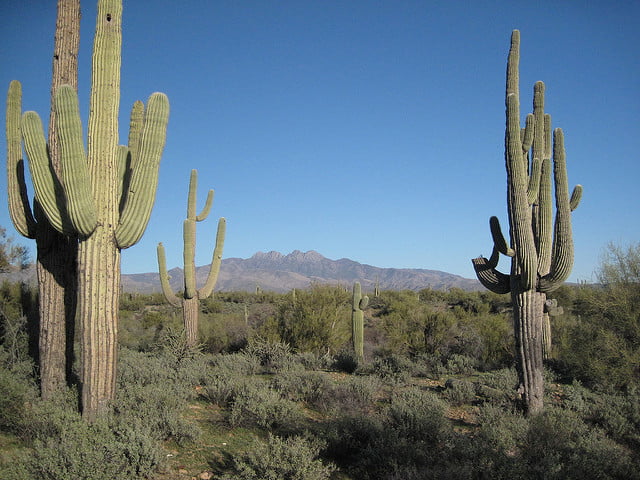
Saguaro cacti can grow 15 meters tall, and despite their shallow root systems can withstand storm winds up to 38 meters per second without being blown over. Grooves in the cacti’s surface may contribute to its resilience, by adding structural support and/or through reducing aerodynamic loads. The latter theory mirrors the concept of dimples on a golf ball; namely, grooves create turbulence in the flow near the cactus, which allows air flow to track further around the cactus before separating. The result is less drag for a given wind speed than a smooth cactus would experience.
Indeed, recent experiments on a grooved cylinder with a pneumatically-controlled shape showed exactly that; the morphable cylinder’s drag was consistently significantly lower than fixed samples. Cacti do change their shapes somewhat as their water content changes, but they don’t have the ability for up-to-the-minute alterations. Nevertheless, their adaptations can inspire engineered creations that morph to reduce wind impact. (Image credit: A. Levine; research credit: M. Guttag and P. Reis)

Seeing the Wake
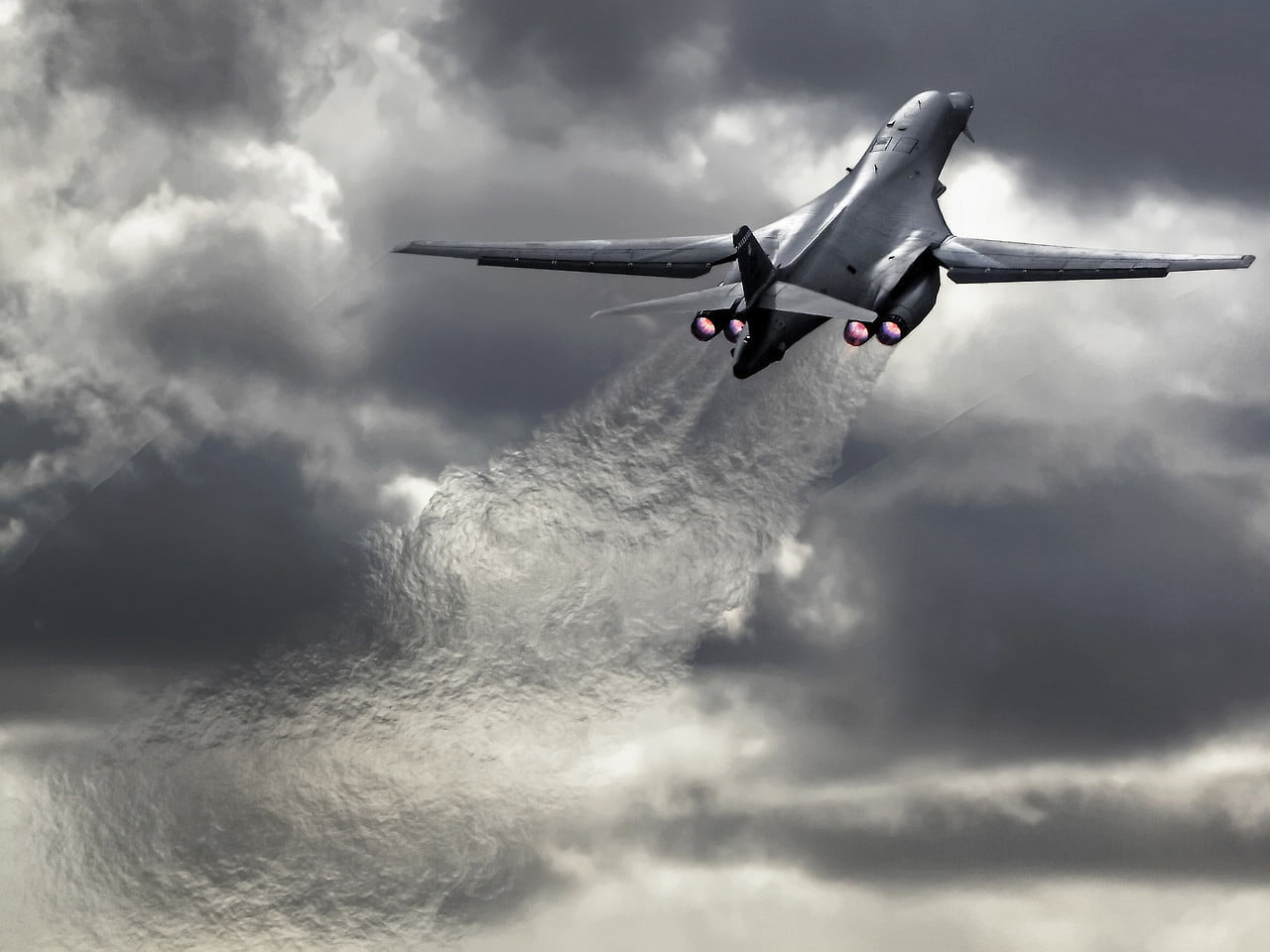
Hot exhaust gases churn in the wake of this climbing B-1B Lancer. The high temperature of the exhaust changes the density and, thus, the refractive index of the gases relative to the atmosphere. Light traveling through the exhaust gets distorted, making the highly turbulent flow visible to the human eye. Note how the four individual engine exhaust plumes quickly combine into one indistinguishable wake. This is typical for turbulence; it’s hard to track where any given fluctuations originally came from. The airplane’s wingtip vortices are just visible as well, if you look closely. (Image credit: T. Rogoway; submitted by Mark S.)

Cloud Flows
When viewed at the right pace, clouds can flow. This timelapse of fog over Mt. Tamalpais State Park near San Francisco shows clouds moving over the hills there. Physically, this flow is an example of a familiar phenomenon known as a hydraulic jump. It happens when a fast-moving flow moves into a region of slower flow. The kinetic energy of the incoming flow gets transferred into potential energy, causing the flow to suddenly rise in height. It can also trigger turbulence, as seen on the right side of the animation. Watch carefully along a river, and you’ll see the same thing happening. Or, if your kitchen sink has a flat bottom, you can create a circular hydraulic jump just by turning on the faucet. You’ll get a region of fast flow right where the water impacts the basin, and a little ways out, you’ll see a circular jump where the water is suddenly taller and slower. That’s a hydraulic jump, too! (Image credit: Nicholas Steinberg Photography, source; submitted by Madi R.)

Turbulent Volcanic Plumes
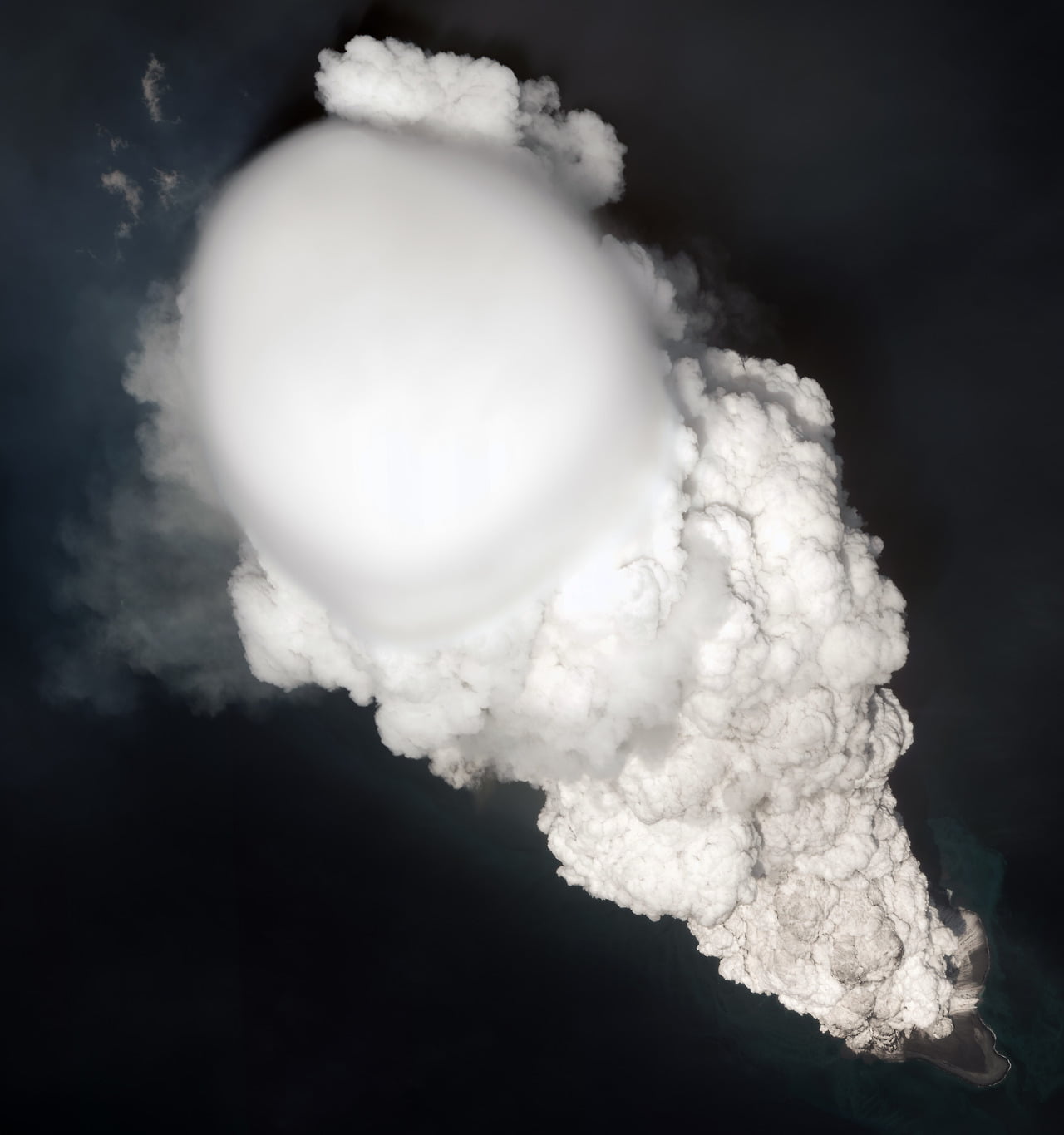
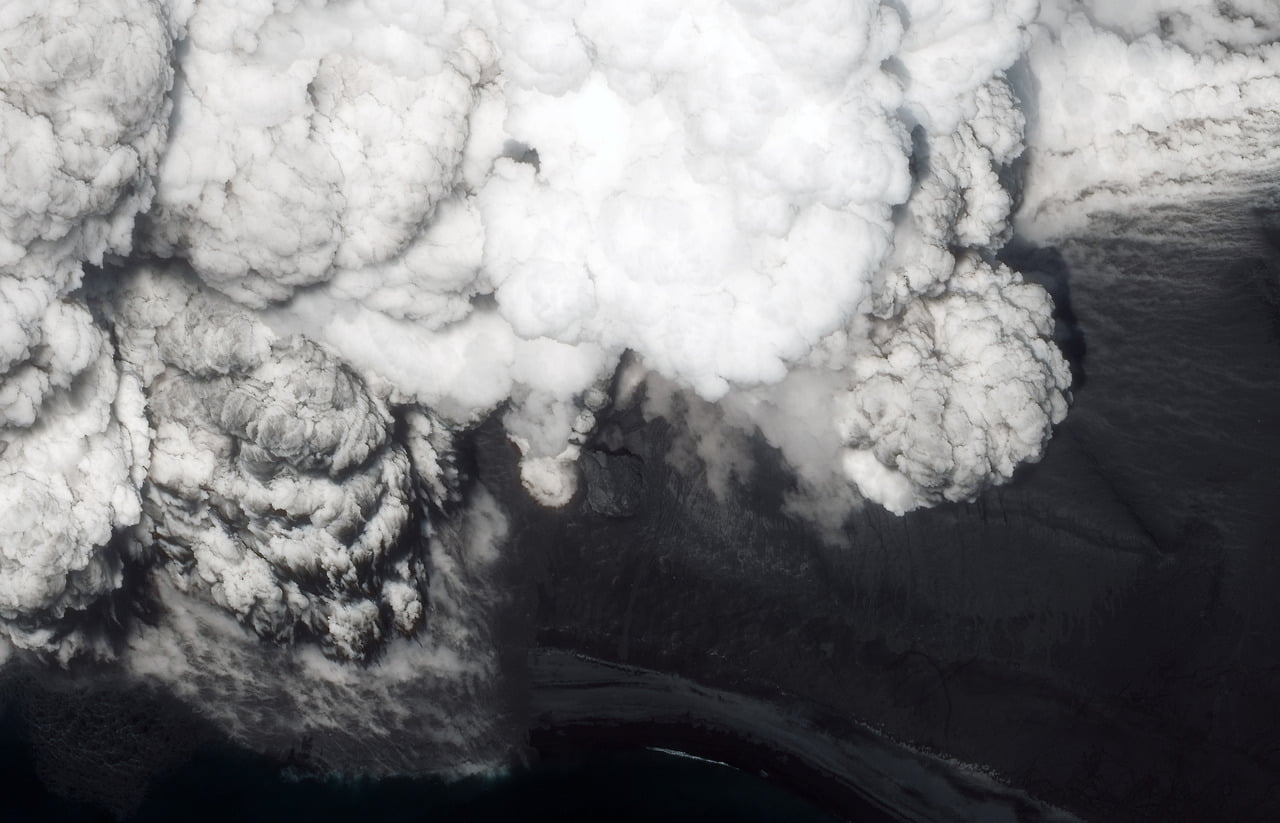
Volcanic eruptions produce some of the largest flows on Earth. These towering ash clouds were imaged from orbit in May 2017 as an eruption began on Alaska’s Bogoslof Island. The clouds are a beautiful example of a turbulent flow. Turbulence is characterized by its many length scales. Some features in the plume are tens or hundreds of meters across, yet there are also coherent motions down at the centimeter or millimeter scale. In a turbulent flow, energy cascades from these very large scales down to the smallest ones, where viscosity is significant enough to dissipate it. This is part of the challenge of modeling turbulence; to fully describe it, you have to capture what happens at every scale. (Image credit: DigitalGlobe, via Apollo Mapping; submitted by Mark S.)

Bubbles Sliding
Two-phase flows involve more than one state of matter – in this case, both gas and liquid phases. Flows like this are common, especially in applications involving heat transfer. In some heat exchangers, bubbles will rise and then slide along an inclined surface, as shown above. The motion of these bubbles is a complicated interplay between the surface, the bubble, and the surrounding fluid. The bubble’s wake, visualized here using schlieren imaging, is unsteady and turbulent. Although the bubble oscillates in its path, the wake spreads even wider, and its turbulence stirs up the liquid nearby, increasing the heat transfer. (Image and research credit: R. O’Reilly Meehan et al., source)

Peering Between Particles
Turbulence is not the only way to mix fluids. Even a steady, laminar flow can be an effective mixer if geometry lends a hand. Above, two dyes, fluorescein (green) and rhodamine (red), are injected into a porous flow through packed spheres. The flow runs from bottom to top in both images. Seeing the flow in such a crowded geometry is challenging. Here researchers used spheres with an index of refraction that matches water – that helps them avoid refraction that would prevent them from looking through spheres to the flow on the other side. They also lit a narrow plane of the flow using a laser sheet to isolate it. Together, this allowed the researchers to track the mixing of the two initially separate streaks of dye as they randomly mix in the spaces between spheres. (Image and research credit: M. Kree and E. Villermaux)