Search results for: “transition”

  • Featured Video Play Icon

    Sublimation

    Sublimation is a transition directly from a solid phase to a gaseous one. Given typical Earth atmospheric conditions, one of the most commonly observed examples of sublimation is that of solid carbon dioxide, a.k.a. dry ice. Submerging dry ice in water both speeds up the sublimation–since water is a better conductor of heat than air–and creates ethereal fog that’s a combination of the expanding carbon dioxide and condensate from the water. This gorgeous video from Wryfield Lab lets you admire the process close-up. As the dry ice sublimates, watch for the ice crystals that grow on its surface. This is deposition–the opposite of sublimation–and comes from water vapor freezing onto the dry ice. (Video credit: Wryfield Lab; via Gizmodo)

    A warning for those who want to try this at home: only do this in well-ventilated spaces. The shift from solid to gas requires a huge increase in volume. Carbon dioxide is denser than air, so it does stay low to the ground, but you can still suffocate yourself (or children or pets) if you do this in an enclosed space.

  • HIFiRE

    HIFiRE

    Earlier this month, an international team launched a successful hypersonic flight test in Australia. The Hypersonic International Research Experimentation (HIFiRE) Flight 5b was launched atop a two-stage rocket and reached its maximum speed of Mach 7.5, well above Mach 5, which defines the start of the hypersonic regime. The purpose of this particular flight test was not to test new propulsion technologies – there was no scramjet engine on this flight. Instead, researchers wanted to study aerodynamics at high Mach number, specifically the behavior of the air very close to the vehicle, its boundary layer.

    The payload being tested was an elliptical cone mounted on the front of the vehicle and shown in images above. The shape of the payload is such that flow will curve around the cone rather than following straight lines. The image on the lower right contains black streamlines that show how air twists around the cone. This complex flowfield complicates the physics of the boundary layer near the cone’s surface and increases the likelihood that the boundary layer will transition from laminar flow to turbulent flow, thereby increasing heating on the payload. Ideally, the data from the test flight will let engineers test their ability to understand and predict this boundary layer transition in the future. For more on boundary layer transition and its effects at hypersonic speeds, check out my latest FYFD video. (Image credit: Australia Department of Defense, R. Kimmel et al., F. Li et al.; topic requested by Guido)

  • Featured Video Play Icon

    How Fluid Dynamics Saved the Space Shuttle

    New FYFD video! In which Dianna Cowern (Physics Girl) joins me to explore boundary layer transition and how a couple of small bits of roughness could be a huge problem for the Space Shuttle during re-entry. A lot of people have asked me what I did for my PhD research, and the truth is, I’ve never really discussed my own work here on FYFD. This video is probably the closest I’ve come. The story I tell about STS-114 is one that appears in the first chapter of my dissertation, and it did, in many respects, motivate my work exploring roughness effects on transition in Mach 6 boundary layers. I hope you enjoy my video, and don’t forget to check out Dianna’s video, too! (Video credit: N. Sharp/FYFD)

  • Pouring Molten Aluminum on Dry Ice

    Pouring Molten Aluminum on Dry Ice

    What happens when you pour molten aluminum on dry ice? As the Backyard Scientist shows, you get what looks like slippery, sliding, boiling metal. In fact, what you see may remind you of the Leidenfrost effect, where a liquid can slide around over an extremely hot surface on a thin film of its own vapor. Despite the opposite temperature extremes–this is a very cold surface rather than a very hot one–a very similar thing is happening here. The molten aluminum is so much hotter than the dry ice that it causes the dry ice to sublimate, releasing gaseous carbon dioxide that the aluminum slides around on. For the same reason, the aluminum appears to boil in the bottom animation. What we’re really seeing is carbon dioxide gas rising and escaping the aluminum so violently that it carries some of the metal with it. Be sure to check out the full video for more awesome physics!  (Image credit: The Backyard Scientist, source; via Gizmodo)

    Do you enjoy FYFD and want to help support it? Then please consider becoming a patron!

  • Sharkskin Instability

    Sharkskin Instability

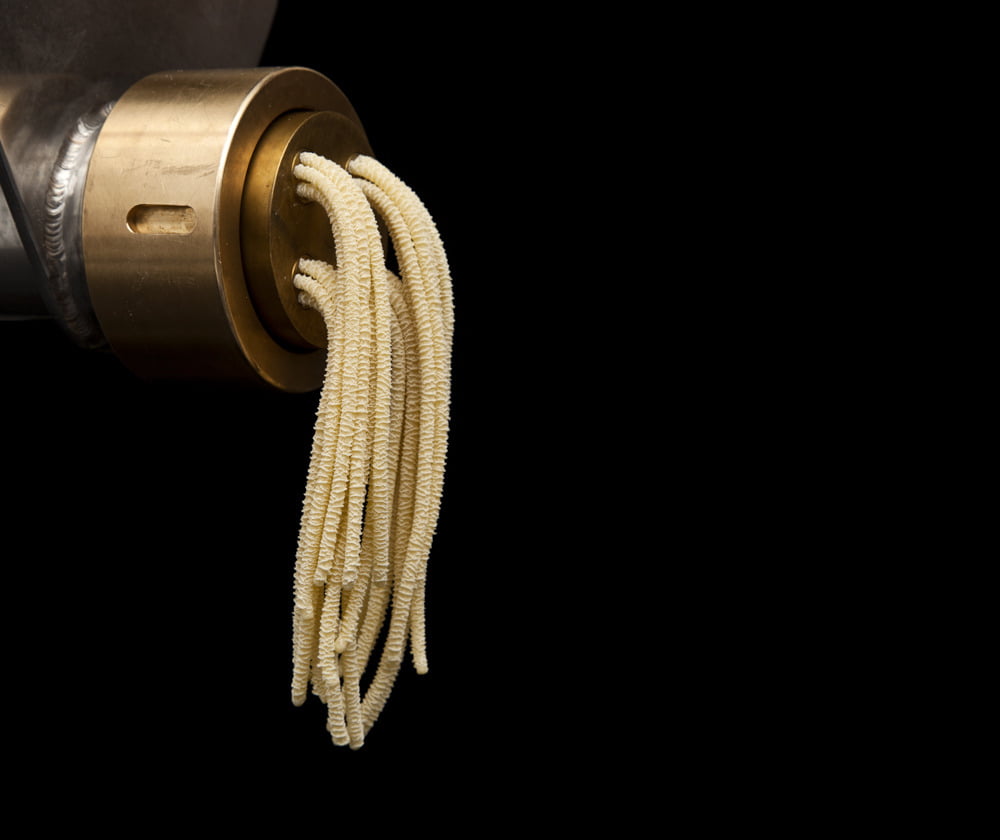
    Homemade spaghetti noodles exhibit a roughened surface that’s the result of viscoelastic behavior known as the sharkskin instability. It’s usually observed in the industrial extrusion of polymer plastics. In the case of spaghetti, the long, complex polymer molecules necessary for the instability come from the proteins in eggs. The characteristically rough surface of the extruded material is caused by the transition from flow through the die to air. Inside the die, friction from the walls exerts a strong shear force on the outer part of the fluid while the inner portion flows freely. When the material exits the die, the sudden lack of friction on the outer portion of the fluid causes it to accelerate to the same velocity as the middle of the flow. This acceleration stretches the polymers until they snap free of the die; after the strained polymers relax, the material keeps a rough, saw-tooth pattern. In industry, the sharkskin instability can be prevented by regulating temperature or flow speed. In the case of spaghetti, though, Modernist Cuisine suggests the roughness is desirable because it helps trap the pasta sauce. Bon appetit!  (Image credit: Modernist Cuisine)

  • Reader Question: Submarines

    Reader Question: Submarines

    Reader elimik asks:

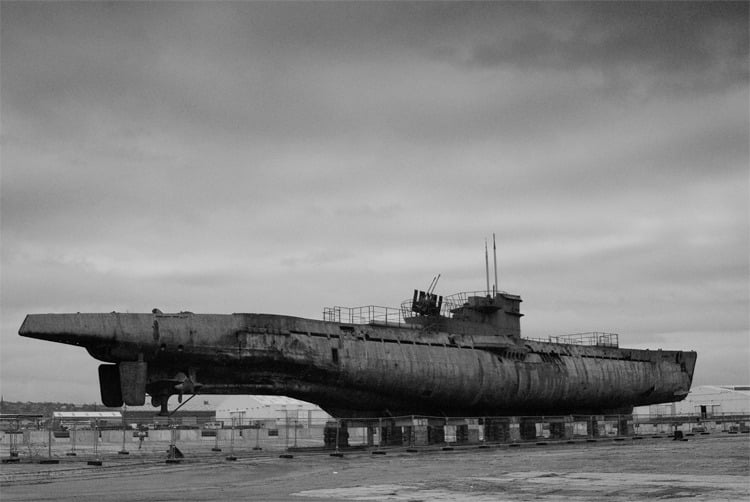
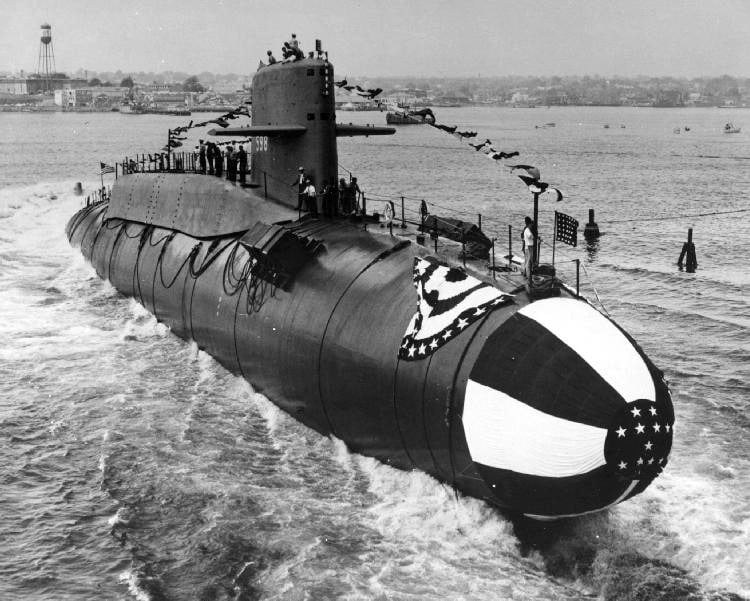
    Why do modern submarines have round bows instead of pointy ones, like the early WWII ones?

    Interestingly, there are more factors that affect this design choice than I originally thought! Perhaps the biggest factor, though, is propulsion. Although early submarines ran through several forms of propulsion from human power to steam, by World War II many subs were driven by diesel-power on the surface and relied on battery power when submerged. Power limitations meant that submarines of that era did most of their travel while at the surface, not underwater. As a result, the ships had better control and decreased drag with a pointed bow similar to that of a surface ship. It wasn’t until the advent of the nuclear-powered submarine that it became practical for submarines to spend most of their time submerged. Once fully-underwater travel was feasible (and, indeed, preferable), many subs transitioned to a blunter, rounded bow that’s more hydrodynamic underwater–and simultaneously more problematic control-wise when moving on the surface.

    Another factor separating WW-era submarines and modern subs is the depth to which they submerge. The deeper a submarine dives, the greater the pressure it must withstand. Rounded or cylindrical shapes make much better pressure vessels because they distribute pressure evenly around a surface. Historically, many subs have balanced control and hydrodynamics against pressure requirements by having two hulls, an outer one for cutting through surface waters and an inner cylindrical one that bears the brunt of the hydrostatic pressure. As we developed stronger materials, though, submarines have achieved greater depths. The German Type VII submarine, the most common U-boat of WWII, had a test depth of 230 m, whereas today’s Los-Angeles-class U.S. submarine can operate at 290 m. (Each 10 meters of depth adds about one atmosphere’s worth of pressure.) The combination of nuclear power for subsurface propulsion and stronger materials that allow deeper dives enables many modern submarines to have a single hull–the rounded hydrodynamic and pressure-resistant bow we commonly see.  (Image credits: U534 by P. Adams and USS George Washington by U.S. Navy)

  • Propagating Flames

    Propagating Flames

    Like many flows, flames can be unstable and undergo a transition from orderly laminar flow to chaotic turbulent flow. The timelapse image above shows the propagation of a flame front travelling downward. Each blue line represents the forwardmost position of the flame at a specific time. The flame is essentially two-dimensional, held between two glass plates separated by a 5-mm gap. The V-like points in the flame front are called cusps, and if you look closely, you can see cusps forming and even merging as the flame moves downward. Also notice how the flame front is more uniform near the top of the image, but, by the bottom, it has split into many more cusps. This is one of the indications that the flame is unstable. Check out the full poster-version of the image in the Gallery of Fluid Motion. (Photo credit: C. Almarcha et al., original poster)

  • “Smoke”

    “Smoke”

    Ethereal forms shift and swirl in photographer Thomas Herbich’s series “Smoke”. The cigarette smoke in the images is a buoyant plume. As it rises, the smoke is sheared and shaped by its passage through the ambient air. What begins as a laminar plume is quickly disturbed, rolling up into vortices shaped like the scroll on the end of a violin. The vortices are a precursor to the turbulence that follows, mixing the smoke and ambient air so effectively that the smoke diffuses into invisibility. To see the full series, see Herbich’s website.  (Image credits: T. Herbich; via Colossal; submitted by @jchawner@__pj, and Larry B)

    P.S. – FYFD now has a page listing all entries by topic, which should make it easier for everyone to find specific topics of interest. Check it out!

  • Does Liquid in a Vacuum Boil or Freeze?

    Does Liquid in a Vacuum Boil or Freeze?

    What happens to a liquid in a cold vacuum? Does it boil or freeze? These animations of liquid nitrogen (LN2) in a vacuum chamber demonstrate the answer: first one, then the other! The top image shows an overview of the process. At standard conditions, liquid nitrogen has a boiling point of 77 Kelvin, about 200 degrees C below room temperature; as a result, LN2 boils at room temperature. As pressure is lowered in the vacuum chamber, LN2’s boiling point also decreases. In response, the boiling becomes more vigorous, as seen in the second row of images. This increased boiling hastens the evaporation of the nitrogen, causing the temperature of the remaining LN2 to drop, the same way sweat evaporating cools our bodies. When the temperature drops low enough, the nitrogen freezes, as seen in the third row of images. This freezing happens so quickly that the nitrogen molecules do not form a crystalline lattice. Instead they are an amorphous solid, like glass. As the residual heat of the metal surface warms the solid nitrogen, the molecules realign into a crystalline lattice, causing the snow-like flakes and transition seen in the last image. Water can also form an amorphous ice if frozen quickly enough. In fact, scientists suspect this to be the most common form of water ice in the interstellar medium. (GIF credit: scientificvisuals; original source: Chef Steps, video; h/t to freshphotons)

  • Brazuca

    Brazuca

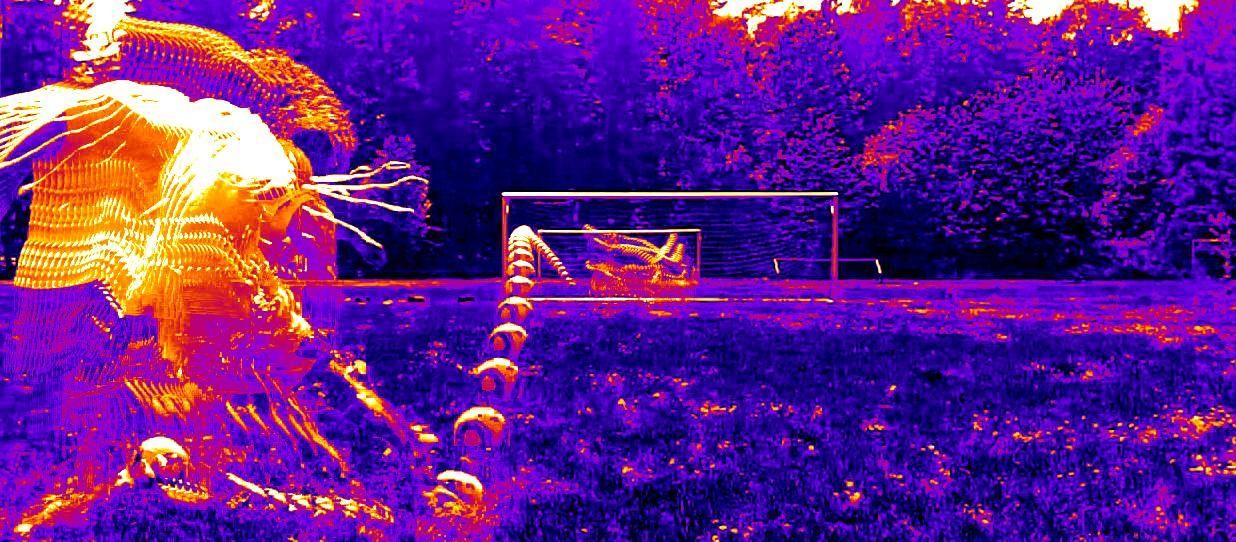
    Since 2006, Adidas has unveiled a new football design for each FIFA World Cup. This year’s ball, the Brazuca, is the first 6-panel ball and features glued panels instead of stitched ones. It also has a grippy surface covered in tiny nubs. Wind tunnel tests indicate the Brazuca experiences less drag than other recent low-panel-number footballs as well as less drag than a conventional 32-panel ball. Its stability and trajectory in flight are also more similar to a conventional ball than other recent World Cup balls, particularly the infamous Jabulani of the 2010 World Cup. The Brazuca’s similar flight performance relative to a conventional ball is likely due to its rough surface. Like the many stitched seams of a conventional football, the nubs on the Brazuca help trip flow around the ball to turbulence, much like dimples on a golf ball. Because the roughness is uniformly distributed, this transition is likely to happen simultaneously on all sides of the ball. Contrast this with a smooth, 8-panel football like the Jabulani; with fewer seams to trip flow on the ball, transition is uneven, causing a pressure imbalance across the ball that makes it change its trajectory. For more, be sure to check out the Brazuca articles at National Geographic and Popular Mechanics, as well as the original research article. (Photo credit: D. Karmann; research credit: S. Hong and T. Asai)