“What happens when two scientists, a composer, a cellist, and a planetarium animator make art?” The answer is “Dendritic,” a musical composition built directly on the tree-like branching patterns found when a less viscous fluid is injected into a more viscous one sandwiched between two plates.
Normally this viscous fingering instability results in dense, branching fingers, but when there’s directional dependence in the fluid, the pattern transitions instead to one that’s dendritic. In this case, that directionality comes from liquid crystals, whose are rod-like shape makes it easier for liquid to flow in the direction aligned with the rods.
For more on the science, math, and music behind the piece, check out this description from the scientists and composer. (Video, image, and submission credit: I. Bischofberger et al.)
Laminar flow is easy to love, but turbulence is a far richer phenomenon. That’s the premise behind Veritasium’s new video (and, yes, I agree with him). In the video Derek provides a nice introduction to turbulence, including a checklist of qualities a turbulent flow must have.
Personally, I don’t classify flows as simply being either laminar or turbulent; I view those two states as ends of a spectrum, which means there are many flows that fall somewhere in-between. (For more on what happens between laminar and turbulent, check out my video on transition.)
As neat and eye-catching as laminar flow can be, turbulence is critical to life as we know it. It’s a necessary ingredient in cloud and raindrop formation. It drives the mixing of blood in our hearts. It keeps the leaves on trees from overheating. Without it, your coffee would be cold long before your cream mixes in. Turbulence is even critical to star formation; without turbulence, our entire solar system might have lacked the matter and time necessary to form! (Video and image credit: Veritasium)
For many engineering students, their first exposure to fluid dynamics comes in a heat transfer class. The typical focus in these classes is not on the underlying physics but on learning to use empirical formulas and correlations that are used in engineering heat exchangers, computer fans, and other applications.
As part of this, students are presented with an extremely simplified view of classical flows like flow over a flat wall, known as a flat-plate boundary layer. Students are told that there are two main features of this and other flows: a laminar region where flow is smooth and orderly, and a turbulent region where flow is chaotic and better at mixing. The transition between these two, according to the undergraduate picture, takes place at a particular point that can be calculated as part of the correlation.
The problem with this picture is that it grossly oversimplifies the actual physics, and for students who may not take dedicated, graduate-level fluid dynamics courses, leaves future engineers with a false understanding that may impact their designs. The truth of transition is far more complicated and nuanced. Transition from laminar to turbulent flow rarely takes place at a single, predictable point; instead it takes place over an extended region and where it begins depends on factors like geometry, vibration, and the level of turbulence already present in the flow.
In an effort to bring undergraduate heat transfer correlations more in line with actual physics — as well as with real, experimental data — a new study revamps the mathematical models. Personally, I applaud any effort to add some nuance to the introduction of this important topic. (Image and research credit: J. Lienhard; via phys.org)
Chances are that you’ve seen plenty of hydraulic jumps in your life, whether they were in your kitchen sink, the whitewater of a river, or at the bottom of a spillway. Practical Engineering has a great primer on this oddity of open channel flow.
When water (or other liquids) flow with a surface open to the air – think like a river rather than a pipe – the flow has three important regimes: subcritical, critical, and supercritical. Which state the flow is in depends on the speed of the flow compared to the speed of a wave traveling in that flow. If the waves are faster than the flow, we call it subcritical. If the flow is faster than the waves, it’s called supercritical. (This is equivalent to subsonic or supersonic flow, where the regime depends on the flow speed compared to the speed of sound.)
Flows can transition naturally from one state to another, and where they transition from fast, supercritical flow to slower, subcritical flow, we find hydraulic jumps – places where the kinetic energy of the supercritical flow gets changed into turbulence and potential energy through a change in height. Check out the video above to learn how civil engineers use hydraulic jumps to control water and erosion. (Video and image credit: Practical Engineering)
If you take a glass of water and tap on the side of it, you’ll generate waves on the water’s surface. The form of the waves depends on surface tension and gravity, and viscosity governs how quickly the waves fade away. In a recent experiment, researchers performed an equivalent tap for a container of ultra-cold atoms, and the results they found were odd indeed.
The researchers used lithium-6 atoms chilled so close to absolute zero that they could form a superfluid. The “glass” they were contained in consisted of intersecting laser beams, and the “tap” came from toggling the intensity of one of the lasers. This created rippling waves through the atoms that the group could observe.
Measuring at various temperatures, the group found that the waves in the atoms always decayed the way one expects for a classical fluid like water. Even when the atoms transitioned into a superfluid, the wave decay did not change. Since superfluids are considered to have zero viscosity, you’d expect their waves to decay more slowly, but it turns out, that’s not the case! (Image credit: F. Mittermeier; research credit: M. Zwierlein et al., see also; via Physics; submitted by Kam-Yung Soh)
Ultrasonic vibrations can boil nanoscale liquid layers, according to a new simulation-based study. Above you see a layer of water initially about 2 nm thick. When the surface it’s on vibrates at frequencies in the 100 GHz range – about a billion times faster than a hummingbird flaps – it superheats the thin layer of water. In this case, the film undergoes nucleate boiling, forming the same kinds of bubbles you see when boiling a pot of water. When the water layer gets too thin to support nucleate boiling, it stops boiling but evaporation continues. The transition occurs when van der Waals forces become significant. The technique only works with ultrathin layers of a liquid, but the authors envision broad application possibilities in industry as well as in micro- and nano-scale fluid systems. (Image and research credit, and submission: R. Pillai et al.)
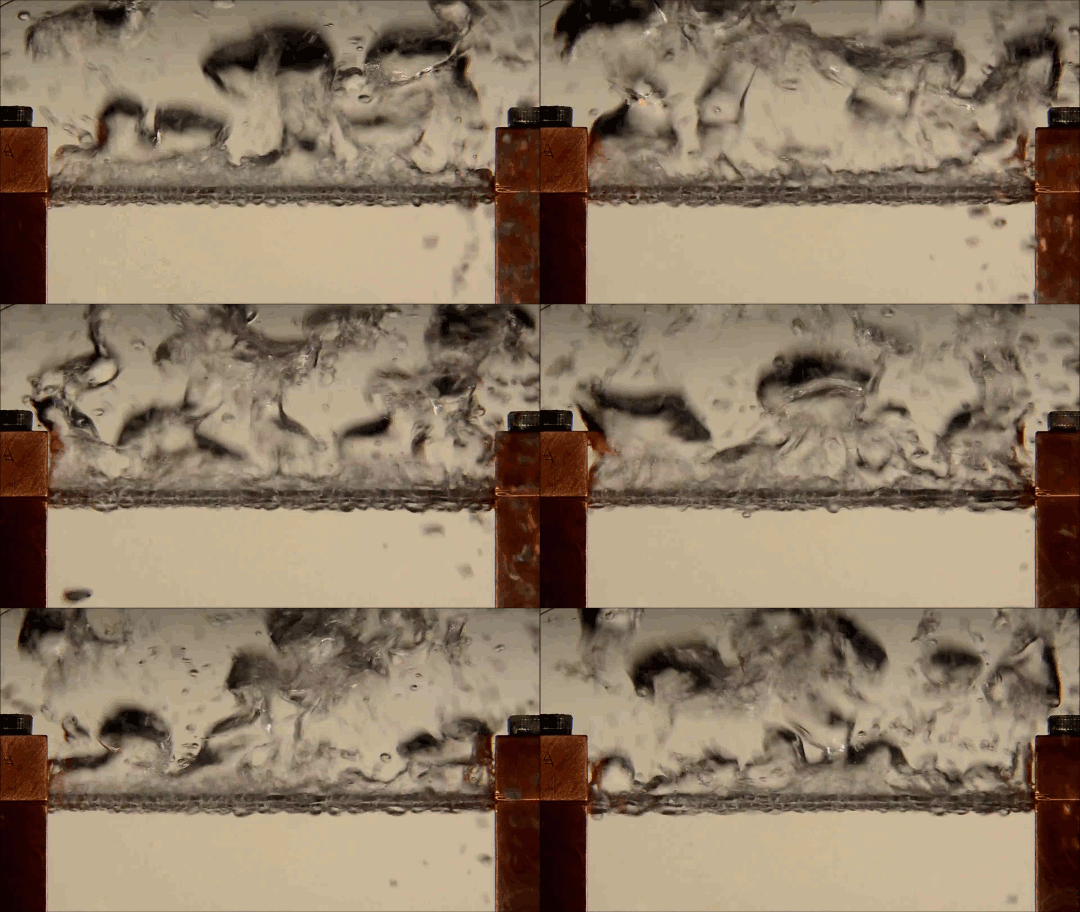
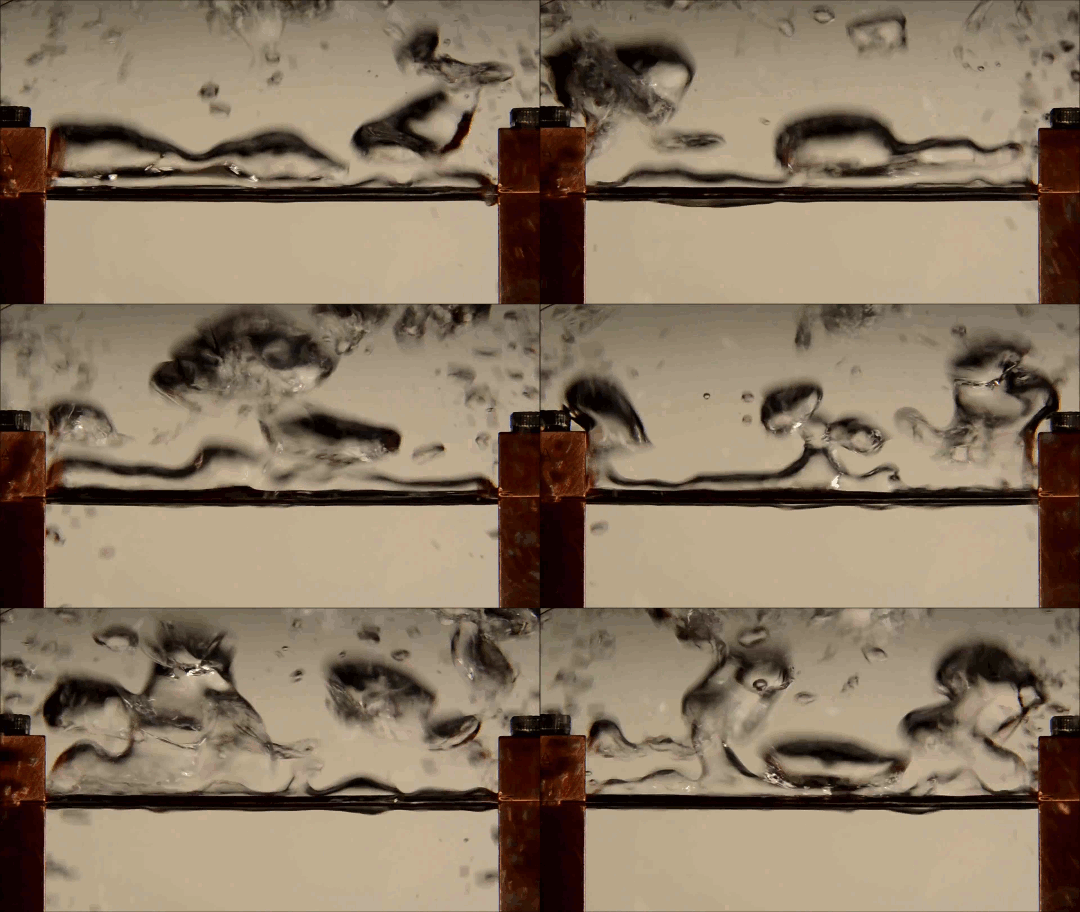
When you put a pot of water on to boil, you probably don’t give much thought to the process. In our daily lives, we pretty much only see one kind of boiling: the sort where lots of small bubbles form on a hot surface and then rise. That’s nucleate boiling (top image), and it’s typical when you have a surface close to the boiling point of a liquid.
But when you continue raising the temperature of the surface, you get a transition to a different boiling regime (middle image). In this final regime (bottom image), a film of vapor envelopes the heated surface; hence its name: film boiling. Because vapor is less efficient for heat transfer than a liquid, a surface undergoing film boiling can become much, much hotter because it cannot transfer its heat away efficiently. In this experiment, the tube starts at 375K during nucleate boiling and rises to a temperature nearly three times higher during film boiling. (Image credit: TSL, source)
Thomas Blanchard is back with another beautiful music video. This one features ink cascading over various shapes underwater. Lots of tiny mushroom-shaped Rayleigh-Taylor instabilities here caused by the ink’s greater density compared to the surrounding water. There are also some lovely examples of transitional flow, especially around the spheres. Initially, flow over the spheres looks completely smooth and laminar. But, on the latter half of the sphere, where the flow is under increasing pressure, you see disturbances growing until little fingers of ink break away entirely. Be sure to watch the whole video; you don’t want to miss this! (Video and image credit: T. Blanchard)
One of the great challenges in fluid dynamics is understanding how order gives way to chaos. Initially smooth and laminar flows often become disordered and turbulent. This video explores that transition in a new way using sound. Here’s what’s going on.
The first segment of the video shows a flat surface covered in small particles that can be moved by the flow. Initially, that flow is moving in right to left, then it reverses directions. The main flow continues switching back and forth in direction. This reversal tends to provoke unstable behaviors, like the Tollmien-Schlichting waves called out at 0:53. Typically, these perturbations in the flow start out extremely small and are difficult or even impossible to see by eye. So researchers take photos of the particles you see here and analyze them digitally. In particular, they are looking for subtle patterns in the flow, like a tendency for particles to clump together with a consistent spacing, or wavelength, between them. Normally, researchers would study these patterns using graphs known as spectra, but that’s where this video does something different.
Instead of representing these subtle patterns graphically, the researchers transformed those spectra into sound. They mapped the visual data to four octaves of C-major, which means that you can now hear the turbulence. When the audio track shifts from a pure note to an unsteady warble, you’re hearing the subtle disturbances in the flow, even when they’re too small for your eye to pick out.
The last part of the video takes this technique and applies it to another flow. We again see a flat plate, but now it has a roughness element, like a tiny hockey puck, stuck to it. As the flow starts, we see and hear vortices form behind the roughness. Then a horseshoe-shaped vortex forms upstream of it. Aside from the area right around the roughness, this flow is still laminar. But then turbulence spreads from upstream, its fingers stretching left until it envelops the roughness element and its wake, making the music waver. (Video and image credit: P. Branson et al.)
Kilauea continues to erupt without signs of abating. Aerial video, like this footage from Mick Kalber, shows the scope of the flow. Lava spurts like a hellish fountain from various fissures, then forms a gravity current that slowly flows downhill toward the ocean. Some of the angles give you an excellent view of the texture atop the flowing lava; it looks relatively rope-like now before solidification, indicating pahoehoe flow. Whether the flow will transition to the rougher appearance of a’a lava remains to be seen; as the lava cools and crystallizes, it may develop a yield strength. That would make it similar to fluids like your toothpaste, which only flow once a critical force is applied. Stay safe, Hawaiians! (Image and video credit: M. Kalber; via Colossal)