Search results for: “transition”

  • PyeongChang 2018: Ice-Making

    PyeongChang 2018: Ice-Making

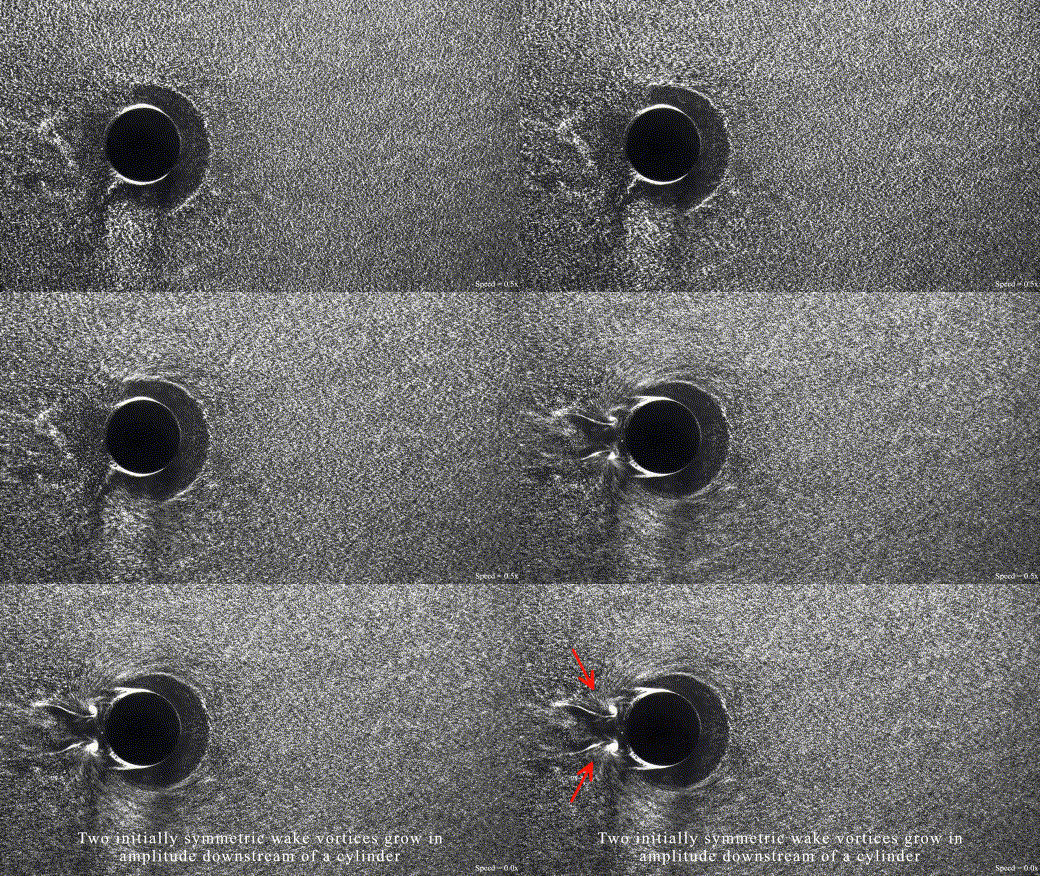
    When it comes to winter sports, not all ice is created equal. Every discipline has its own standards for the ideal temperature and density of ice, which makes venue construction and maintenance a special challenge. Figure skating, for example, requires softer ice to cushion athletes’ landings, whereas short-track speed skating values dense, smooth ice for racing. The Gangneung Ice Arena hosts both and can transition between them in under 3 hours. Gangneung Oval hosts long-track speed skating and makes its ice layer by layer, spraying hot, purified water onto the rink. This builds up a particularly dense and therefore smooth ice. 

    The toughest sport in terms of ice conditions is curling, which requires a finely pebbled ice surface for the stones to slide on. Forming those tiny crystals on the ice sheet can only be done at precise temperature and humidity conditions. This is a particular challenge for Gangneung Curling Center due to its coastal location. To keep the temperature and humidity under control at full crowd capacity, officials even went so far as to replace all the lighting at the facility with LEDs! (Image credit: Pyeongchang 2018, 1, 2, 3)

  • Pilot-Wave Hydrodynamics: Walking Drops

    Pilot-Wave Hydrodynamics: Walking Drops

    This post is a collaborative series with FYP on pilot-wave hydrodynamics. Previous entries: 1) Introduction; 2) Chladni patterns; 3) Faraday instability

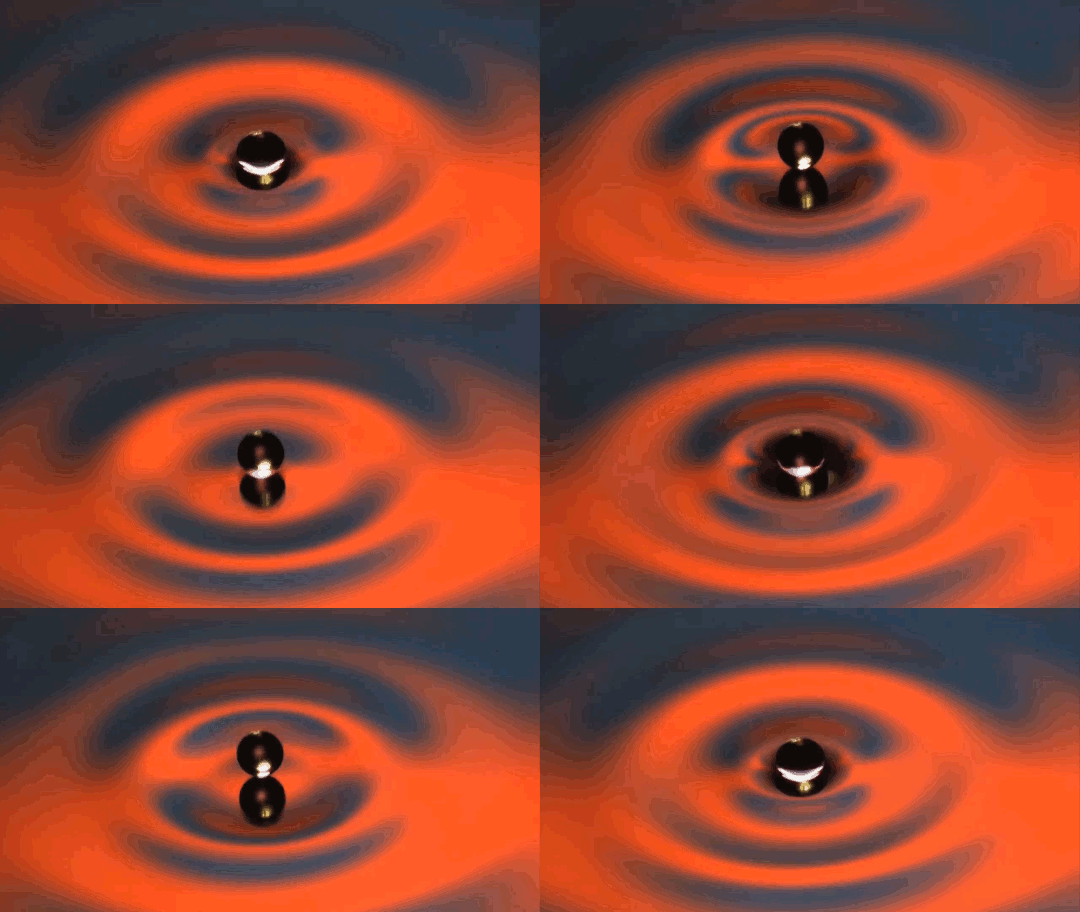
    If you place a small droplet atop a vibrating pool, it will happily bounce like a kid on a trampoline. On the surface, this seems quite counterintuitive: why doesn’t the droplet coalesce with the pool? The answer: there’s a thin layer of air trapped between the droplet and the pool. If that air were squeezed out, the droplet would coalesce. But it takes a finite amount of time to drain that air layer away, even with the weight of the droplet bearing down on it. Before that drainage can happen, the vibration of the pool sends the droplet aloft again, refreshing the air layer beneath it. The droplet falls, gets caught on its air cushion, and then sent bouncing again before the air can squeeze out. If nothing disturbs the droplet, it can bounce almost indefinitely.

    image

    Droplets don’t always bounce in place, though. When forced with the right frequency and acceleration, a bouncing droplet can transition to walking. In this state, the droplet falls and strikes the pool such that it interacts with the ripple from its previous bounce. That sends the droplet aloft again but with a horizontal velocity component in addition to its vertical one. In this state, the droplet can wander about its container in a way that depends on its history or “memory” in the form of waves from its previous bounces. And this is where things start to get a bit weird – as in quantum weirdness – because now our walker consists of both a particle (droplet) and wave (ripples). The similarities between quantum behaviors and the walking droplets, the collective behavior of which is commonly referred to as “pilot-wave hydrodynamics,” are rather remarkable. In the next couple posts, we’ll take a look at some important quantum mechanical experiments and their hydrodynamic counterparts.

    (Image credit: D. Harris et al., source)

  • Breaking Up Turbulence

    Breaking Up Turbulence

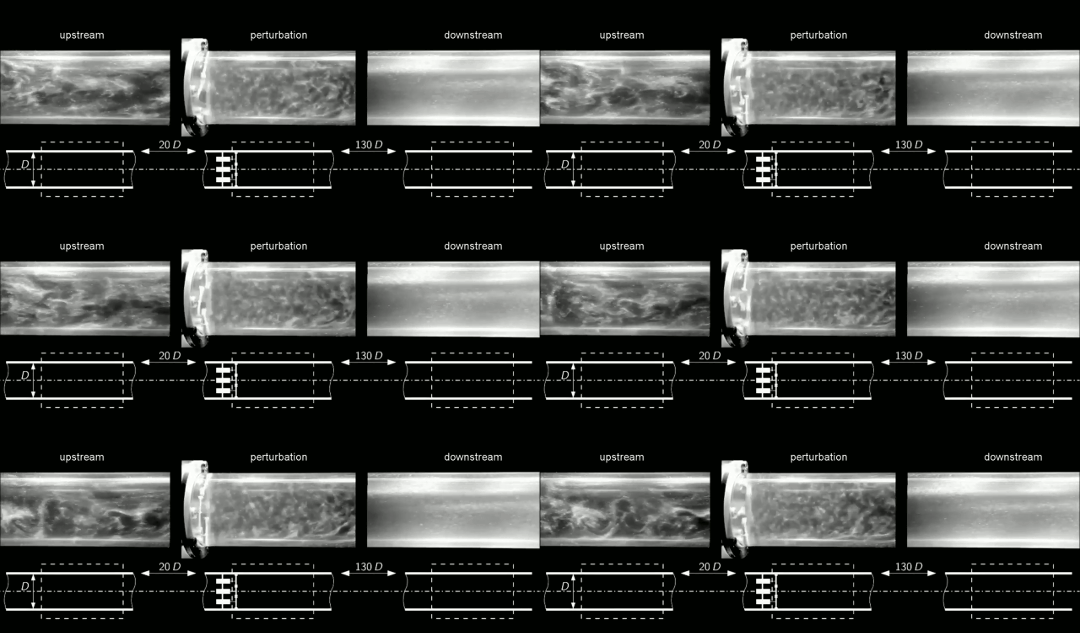
    Under most circumstances, we think about flows changing from ordered and laminar to random and turbulent. But it’s actually possible for disordered flows to become laminar again. This is what we see happening in the clip above. Upstream, the flow in this pipe is turbulent (left). Then four rotors are used to perturb the flow (center). This disrupts the turbulence and causes the flow to become laminar again downstream (right). To understand how this works, we have to talk about one of the fundamental concepts in turbulence: the energy cascade.

    Turbulent flows are known for their large range of length scales. Think about a volcanic plume, for example. Some of the turbulent motions in the plume may be a hundred meters across, but there are a continuous range of smaller scales as well, all the way down to a centimeter or less in size. In a turbulent flow, energy starts at the largest scales and flows further and further down until it reaches scales small enough that viscosity can extinguish them.

    That should offer a hint as to what’s happening here. The rotors are perturbing the flow, yes, but they’re also breaking the larger turbulent scales down into smaller ones. The smaller the largest lengthscales of the flow are, the more quickly their energy will decay to the smallest lengthscales where viscosity can damp them out. This is what we see here. Once the turbulent energy is concentrated at the smallest scales, viscosity damps them out and the flow returns to laminar. Check out the full video below for a cool sequence where the camera moves alongside the pipe so you can watch the turbulence fading as it moves downstream. (Image and video credit: J. Kühnen et al.)

    ETA: As it turns out, there’s more going on here than I’d originally thought. Simulations show that breaking up length scales is not the primary cause of relaminarization in this case. Instead, the rotors are modifying the velocity profile across the pipe in such a way that it tends to cause the turbulence to die out. The full paper is now out in Nature Physics and on arXiv.

  • Galapagos Week: Lava Flows

    Galapagos Week: Lava Flows

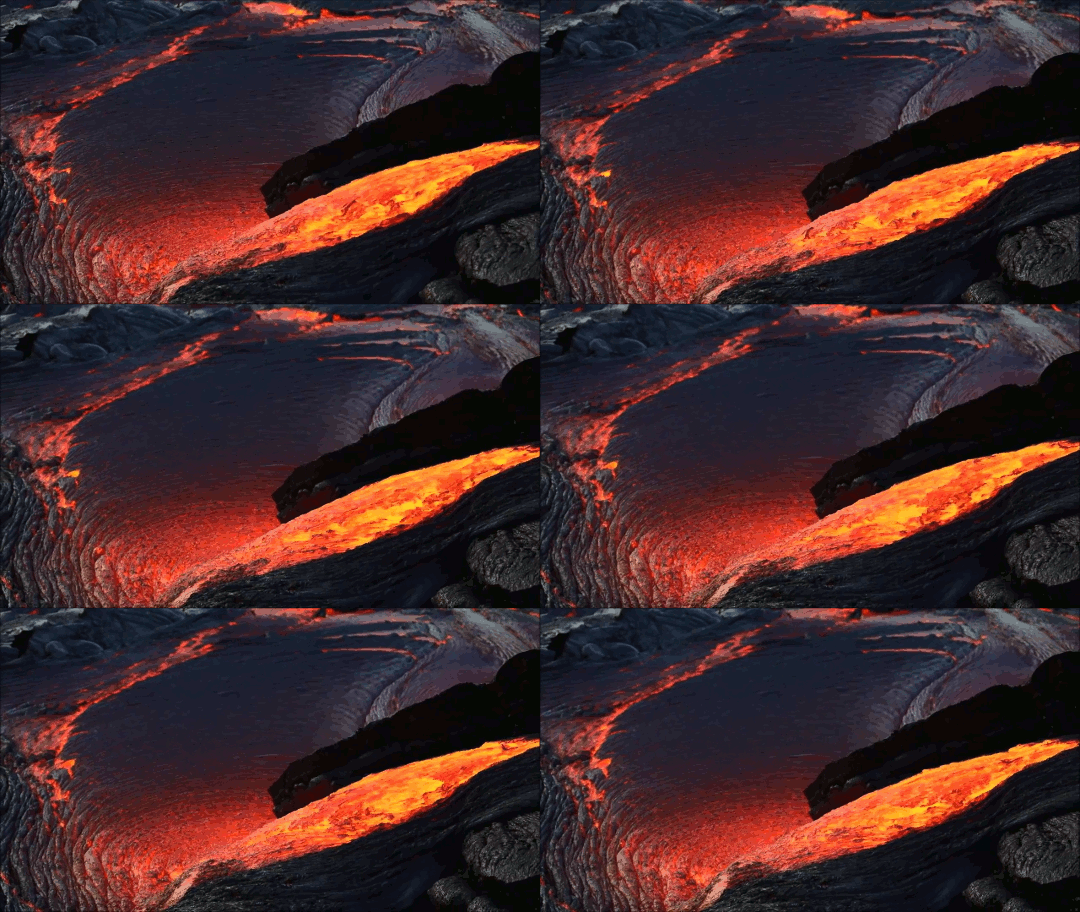
    The Galapagos islands are geologically similar to the Hawaiian islands; both are archipelagos that were born and continue to be formed by lava flows originating from a volcanic hot spot. Lava from this type of volcano is high in basalt content, which affects both its flow properties and the formations it creates. Geologists have actually borrowed words from the Hawaiian language to describe the two main kinds of lava formations seen in basaltic flows: pahoehoe and a’a.

    Pahoehoe formations tend to be relatively smooth and often leave behind a pattern of rope-like coils (below). In contrast, a’a lava features are sharp, rough, and challenging to traverse. Both flows are gravity-driven, and which features a given eruption forms depends on many factors. Many flows will even begin with a pahoehoe section that stretches for several kilometers before transitioning to an a’a structure. Researchers believe the transition occurs when the lava crystallizes enough to develop a yield-strength, meaning that it will behave like a solid until enough force is applied to make it flow again. Toothpaste, ointment, and mud are similar so-called yield stress fluids which will only flow after a critical force is applied.  (Image credits: lava flow – Epic Lava Tours, source; pahoehoe lava – J. Shoer)

    Galapagos Week continues tomorrow here on FYFD. Check out previous posts.

  • Featured Video Play Icon

    When Fire Ants are a Fluid

    Substances don’t have to be a liquid or a gas to behave like a fluid. Swarms of fire ants display viscoelastic properties, meaning they can act like both a liquid and a solid. Like a spring, a ball of fire ants is elastic, bouncing back after being squished (top image). But the group can also act like a viscous liquid. A ball of ants can flow and diffuse outward (middle image). The ants are excellent at linking with one another, which allows them to survive floods by forming rafts and to escape containers by building towers. 

    Researchers found the key characteristic is that ants will only maintain links with nearby ants as long as they themselves experience no more than 3 times their own weight in load. In practice, the ants can easily withstand 100 times that load without injury, but that lower threshold describes the transition point between ants as a solid and ants as a fluid. If an ant in a structure is loaded with more force, she’ll let go of her neighbors and start moving around.

    When they’re linked, the fire ants are close enough together to be water-repellent. Even if an ant raft gets submerged (bottom image), the space between ants is small enough that water can’t get in and the air around them can’t get out. This coats the submerged ants in their own little bubble, which the ants use to breathe while they float out a flood. For more, check out the video below and the full (fun and readable!) research paper linked in the credits. (Video and image credits: Vox/Georgia Tech; research credit: S. Phonekeo et al., pdf; submitted by Joyce S., Rebecca S., and possibly others)

    ETA: Updated after senoritafish rightfully pointed out that worker ants are females, not males. 

  • Spots of Turbulence

    Spots of Turbulence

    One of the enduring mysteries of fluid dynamics lies in the transition between smooth laminar flow and chaotic turbulent flow in the area near a wall. That region, known as the boundary layer, has a major impact on drag and other effects. The process begins with disturbances that are too tiny to see or measure, but eventually, those disturbances can grow large enough to generated an isolated turbulent spot, like the one imaged above. Flow in the photograph is from left to right. Turbulent spots have a distinctive wedge-like shape that expands as the spot grows and widens. These turbulent spots can merge together to create still larger spots, and when a surface eventually becomes completely covered in them, we call it fully-developed turbulent flow. (Image credit: M. Gad-El-Hak et al.)

  • Wrinkling Winds

    Wrinkling Winds

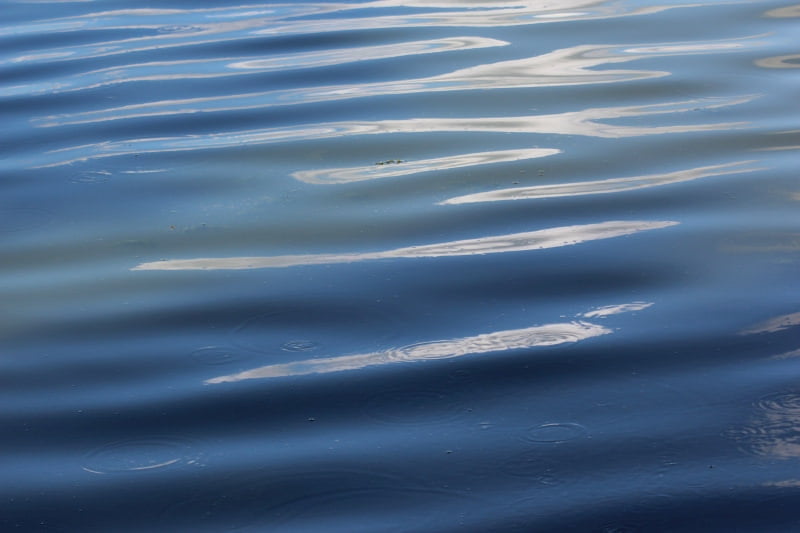
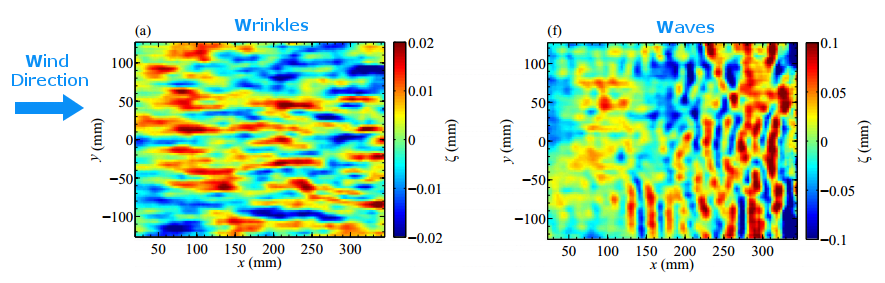
    If you’ve ever sat out on a lake and just watched the water’s surface, you’ve probably noticed how complex and variable it looks. There may be waves that rock your kayak but there are smaller variations, too, like little ripples or even tiny wrinkles that appear on the surface. Much of this activity comes from wind blowing across the water. When the wind exceeds a critical speed, waves form. They generally travel in lines that are aligned perpendicular to the wind (lower right). But what happens when the wind is below the critical speed?

    A recent study looked at just this question. By blowing air across the surface of different liquids and observing variations in the surface height as small as 2 micrometers, the researchers were able to measure tiny wrinkles on the water’s surface (lower left) when the wind speed was small. The size and shape of the wrinkles actually corresponds to structures in the turbulent air flow over the water! For fluids like water, there’s a smooth transition from wrinkles to waves as the wind speed increases, so both may be visible at the same time. For higher viscosity fluids, the switch from one to the other is more abrupt. (Image credits: water – M. Soveran; figure – A. Paquier et al. w/ annotations added in blue; research credit: A. Paquier et al.)

  • Featured Video Play Icon

    Supercritical

    Supercritical fluids are neither a gas nor a liquid. The video above shows a tube of pressurized xenon, initially below its boiling point of approximately ~16 deg C. As the temperature is raised, you see the meniscus that marks the liquid xenon disappear. At this point, the xenon has transitioned into the supercritical state. It takes up the entire tube – like a gas – but it is still capable of dissolving materials – like a liquid. At the same time, though, the xenon has no surface tension because there’s no liquid/vapor interface. Toward the end of the video, the temperature gets reduced and the xenon condenses back into a liquid state. Supercritical fluids can be used in a wide variety of industrial applications, including in decaffeination, dry cleaning, and refrigeration. (Video credit: wwwperiodictableru)

  • Featured Video Play Icon

    Where Does the Sun End?

    How do you define the edge of our sun? There’s a distinct surface to it, but our star is also surrounded by the corona, an even hotter region of plasma twisted by magnetic fields. The corona is sort of like the sun’s atmosphere. Farther out in the solar system, we receive a constant barrage of charged particles, known as the solar wind, that streams out from the sun. So where does the corona end and the solar wind begin?

    Scientists have been studying the flow structure of the solar wind in search of an answer to this question, and they’ve found that there’s a clear transition point about 32 million kilometers from the sun. At this distance, the sun’s magnetic field weakens to the point where it no longer exerts the same hold on the solar particles and they begin to move turbulently, behaving more like a gas than a plasma. With special measurements and image processing, scientists were able to actually see this flow change in the solar wind! (Video/image credit: NASA; research credit: C. DeForest et al.; via FlowViz)

  • The Knuckleball

    The Knuckleball

    For more than a century, athletes have used the zigzagging path of a knuckleball to confound their opponents. Knuckleballing is best known in baseball but appears also in volleyball, soccer, and cricket. It occurs when the ball has little to no spin. The source of the knuckleball’s confusing trajectory, according to a new study, is the unsteadiness of the lift forces around the ball. As the ball flies, tiny variations occur in the flow on either side, causing small variations to the lift as well. Using experiments and numerical models, the researchers established that this white noise in the lift forces is sufficient to cause knuckleball-like path changes.

    They were also able to explain why some sports see the knuckleball effect and others don’t. The wavelength of the deviations – the distance between a zig and a zag – is relatively long, so knuckleballing can only be noticed if the distance the ball flies is long enough for the deviation to be apparent. Additionally, the side-to-side motion is largest when flow on the ball is transitioning from laminar to turbulent flow, so knuckleballing also requires a very particular (and usually low) initial speed. (Image credit: L. Kang; research credit: B. Texier et al.; submitted by @1307phaezr)