Search results for: “transition”

  • Quantum Instability

    Quantum Instability

    In our everyday lives, two fluids moving past one another often form a wave-like pattern thanks to the Kelvin-Helmholtz instability. We see it in the curl of waves on the ocean, in clouds in the sky, and even in spirals of lava on Mars. Here researchers explore an analogous instability in the quantum world.

    By spinning a gas of ultracold atoms, the team observed a spontaneous transition from a needle-like configuration to a crystal made up of spirals. It’s a quantum Kelvin-Helmholtz instability! The authors found that wave’s phase is random; it arises purely from quantum interactions between the atoms. (Image, research, and submission credit: B. Mukherjee et al.; see also MIT News)

    The spinning cloud of ultracold atoms breaks up into a series of spirals.
  • Laser-Induced Jet Break-Up

    Laser-Induced Jet Break-Up

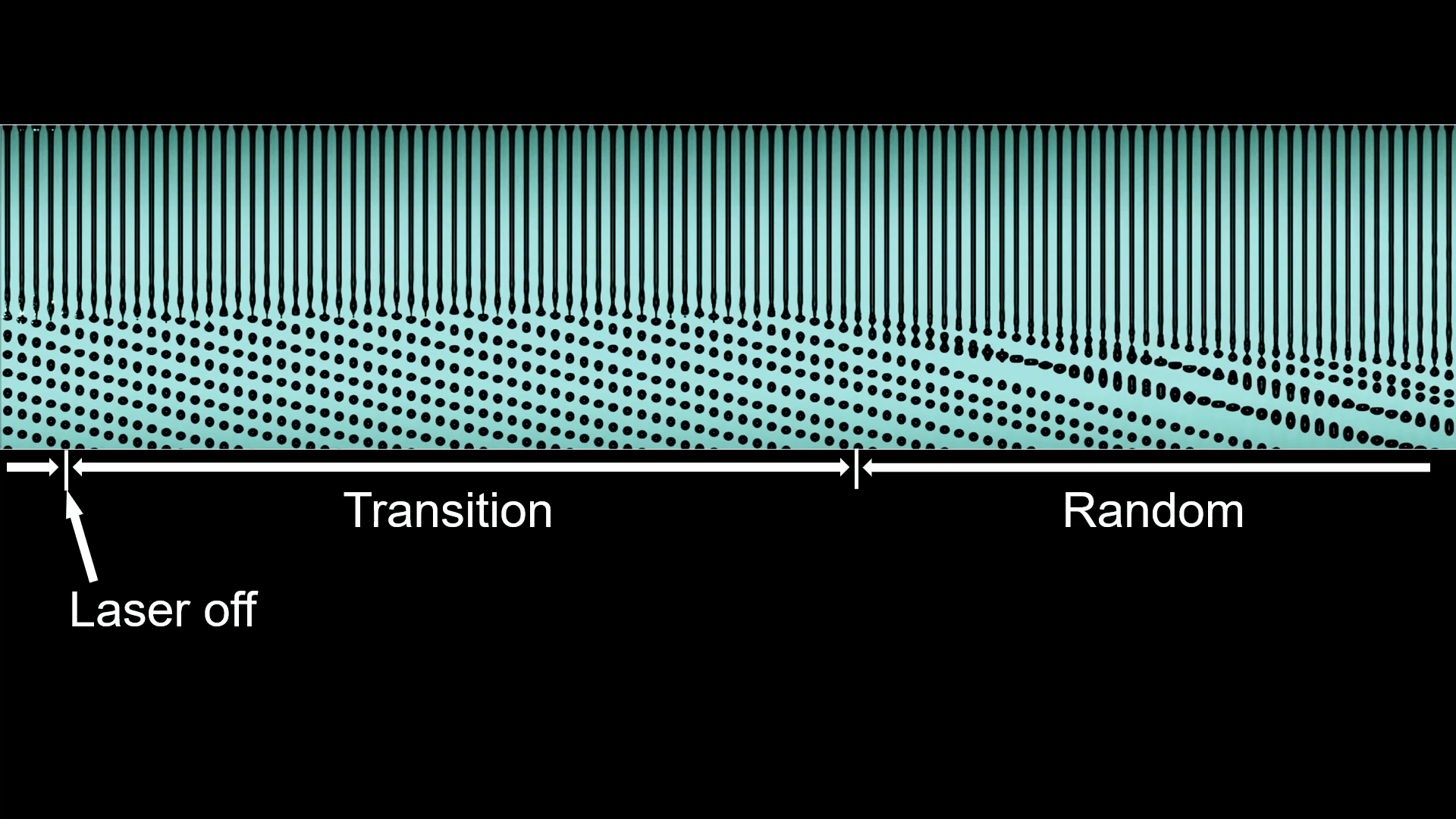
    A falling stream of water will naturally break up into droplets via the Plateau-Rayleigh instability. Those droplets are random, unless something like vibration of the nozzle sets their size. In this study, though, researchers found that shining a laser beam on the stream can trigger an orderly break-up with droplets that are consistent in size and spacing.

    The optofluidic phenomenon depends on a few different effects. The changing curvature of the liquid stream reflects the laser light, some of which undergoes total internal reflection and travels up the jet as if it were a fiber optic cable. Look closely in the right side of the second image, and you’ll see a periodic flicker of green light at the mouth of the nozzle. Those flashes of green reveal that the liquid jet is guiding the light upstream in bursts, each of which exerts an optical pressure that triggers the Plateau-Rayleigh instability.

    When the laser first turns on, there’s a transition period before the orderly break-up begins, and, likewise, turning the laser off triggers a transition from orderly to random (top image). (Image and research credit: H. Liu et al.; via APS Physics; submitted by Kam-Yung Soh)

  • Featured Video Play Icon

    A Colorful Fire Tornado

    This one definitely belongs in the do-not-try-this-yourself category, but this Slow Mo Guys video of a colorful fire tornado is pretty spectacular. Using an array of different fuels and a ring of box fans, Gav sets up a vortex of flame that transitions smoothly from red all the way to blue. As he points out in the video, the translucency of the vortex is so good that you can see how the two sides of the vortex rotate! (Video credit: The Slow Mo Guys)

  • Flying Out of the Water

    Flying Out of the Water

    Flying fish and diving birds often navigate the interface between water and air in their flight, but few studies have actually looked at the effects of this transition on lift. In this work, researchers measured forces on a small, fixed wing as it egresses from water into air at a constant velocity.

    The tests showed that exit velocity had a large effect on lift generation. At low speeds, an exiting wing experienced a strong, positive lift spike as soon as the leading edge broke the surface. But that lift changed to strongly negative as the wing continued out of the water. At higher speeds, the wings had no lift reversal but also reached lower peak lift coefficients. The team studied the effects of angle of attack and starting depth as well, concluding that any vehicles intended to navigate the water-air transition will need robust control systems prepared to deal with fast-changing forces. (Image credit: fish – J. Cobb, wing – W. Weisler et al.; research credit: W. Weisler et al.)

  • Tokyo 2020: Volleyball Aerodynamics

    Tokyo 2020: Volleyball Aerodynamics

    Like footballs and baseballs, the trajectory of a volleyball is strongly influenced by aerodynamics. When spinning, the ball experiences a difference in pressure on either side, which causes it to swerve, per the Magnus effect. But volleyball also has the float serve, which like the knuckleball in baseball, uses no spin. 

    In this case, how the ball behaves depends strongly on the way the ball is made. Some volleyballs use smooth panels, while others have surfaces modified with dimples or honeycomb patterns, and researchers found that these subtle changes make a big difference in aerodynamics. A float serve’s trajectory is unpredictable because the ball will swerve whenever air near the surface of the ball on one side goes turbulent or separates. And without spin to influence that transition, everything comes down to the ball’s speed and its surface.

    Researchers found that volleyballs with patterned surfaces transition to turbulence at lower speeds, which makes their behavior more predictable overall. But players who want to maximize the unpredictability of their float serve might prefer smooth-paneled balls, which don’t make the transition until higher speeds. (Image credit: game – Pixabay, volleyballs – U. Tsukuba; research credit: S. Hong et al.T. Asai et al.; via Ars Technica)

    Stick around all this week and next for more Olympic-themed fluid physics!

  • Featured Video Play Icon

    Collective Motion in Grains

    Flocks of birds and schools of fish swarm in complicated collective motions, but groups of non-living components can move collectively, too. In this Lutetium Project video, we learn about grains that, when vibrated, self-propel and form complex collective motions similar to those seen in groups of living organisms.

    A key feature of the grains is their lack of symmetry. To be self-propelling, they must have a well-defined orientation, defined by a different front and back. The grains also have the freedom to move in a direction that is not the same as the direction they’re oriented in. This allows the grains to rotate, which enables them to perform the large-scale motions seen in the experiments. (Video and image credit: The Lutetium Project; research credit: G. Briand et al.)

  • Snail Locomotion

    Snail Locomotion

    Snails and other gastropods move using their single muscular foot and a viscoelastic fluid they secrete. Muscular waves in the foot run from tail to head and are transmitted to the ground through the thin, sticky mucus layer without the snail ever fully detaching from the surface. The characteristics of this mucus layer are critical to the snail’s locomotion. As a movement cycle begins, the mucus behaves like an elastic solid. As the muscular wave approaches, it shears the fluid, increasing its stress and ultimately reaching the yield point, where the gel begins to flow. Once the wave passes, the mucus quickly transitions back to its elastic solid behavior. The net result of each cycle is an asymmetric force that propels the snail forward while keeping it adhered to whatever surface it’s crawling on.

    Many animals rely on similarly complex fluids to move, attack prey, defend against predators, or enable their reproduction. Check out this review article for more examples. (Image credit: A. Perry; see also P. Rühs et al.; submitted by Pascal B.)

  • Featured Video Play Icon

    An Intro to Liquid Crystals

    There’s a good chance that the screen you’re using to read this uses liquid crystals, but how much do you know about this ubiquitous technology? Liquid crystals are fluids made up of molecules that orient into crystalline structures. Their usefulness for displays comes from the way they interact with light, changing the polarization of light based on their orientation. This Lutetium Project video is a great introduction to liquid crystals and some of their important properties, and, as always with LP videos, the journey is a beautiful one. (Image and video credit: The Lutetium Project)

    Want to learn how to promote your research in traditional media and online? This Friday Tom Crawford and I are presenting a free webinar on the topic as part of the Fluid Mechanics Webinar Series. Be sure to register ahead of time for the link and tune in at 4pm GMT (11am EST) on Friday. See you there!

  • Synchronizing Microfluidic Drops

    Synchronizing Microfluidic Drops

    In nature, synchronization occurs when oscillators interact. A group of metronomes shifting to tick in unison is a classic example. Here, the system is a microfluidic T-junction and the oscillators are the liquid interfaces along the narrower inlet channels. Systems like this one have long been used to create alternating droplets (Image 1), corresponding to out-of-phase synchronization. But a new paper shows that the same system can perform in-phase synchronization (Image 2), too, generating droplets at the same time.

    For any synchronization to occur, the main channel must be narrow enough for the two side channels to influence one another. Once that’s the case, the out-of-phase synchronization happens at a relatively high flow rate, and lowering the flow rate causes the system to transition to in-phase synchronization. (Image and research credit: E. Um et al.; submitted by Joonwoo J.)

  • Recreating Infinity

    Recreating Infinity

    In the ocean, tiny organisms can migrate hundreds of meters through the water column. Recreating and tracking those journeys in a lab is quite a challenge, but it’s one the researchers behind the Gravity Machine have conquered. This apparatus uses a wheel to essentially give micro-organisms an infinite water column to traverse while keeping them fixed in the lab microscope’s field of view.

    With the device, researchers can watch organisms switch naturally between rising, sinking, and feeding behaviors as they would in the wild. The group is working to make it so that anyone with a microscope can recreate their set-up for observations. (Image, video, and research credit: D. Krishnamurthy et al.; see also Gravity Machine; submitted by Kam-Yung Soh)