Search results for: “transition”

  • Staying Cool in the Sun

    Staying Cool in the Sun

    For humans, staying cool in the summer heat often means expending energy on air conditioners, fans, and other cooling devices. But scientists are exploring other, less energy-intense options for beating the heat. At a conference, researchers recently unveiled a plant-based bi-layer film that’s able to stay about 7 degrees Fahrenheit cooler than its surroundings while illuminated by the sun.

    The film uses passive daytime radiative cooling, which means that it emits its heat into space (without getting absorbed by the air nearby) without any external power source. A square meter of the film generates over 120 watts of cooling power, comparable to many residential air conditioners. Even better, the films are built from layered cellulose, a sustainable and renewable resource, and can be made in a variety of colors.

    The team hopes to transition their films to commercial manufacturing, where they can be incorporated into buildings and automobiles to provide some passive cooling, thereby limiting reliance on air conditioners. (Image and research credit: Q. Shen et al.; via Ars Technica)

  • How a Leak Can Stop Itself

    How a Leak Can Stop Itself

    Some leaks can actually stop themselves, and a new analysis shows how. When a vertical pipe has a small hole, water initially spouts out of it, then dribbles, and, finally, drips as the water level in the pipe falls, decreasing the driving pressure of the flow. But the pipe doesn’t have to empty to a level below the hole for the leak to stop. Instead, a final droplet can form a cap over the hole, with its shape providing enough pressure to balance the remaining pressure from fluid in the pipe.

    Water leaking from a vertical pipe transitions from continuous flow to discrete drops (left). Dripping continues until the final droplet forms at t = 0 seconds.
    Water leaking from a vertical pipe transitions from continuous flow to discrete drops (left). Dripping continues until the final droplet forms at t = 0 seconds.

    The researchers found that the final drop’s kinetic energy (as well as its potential energy) was critical to determining which drop would stop the flow. The last drop behaves like a lightly-damped harmonic oscillator; it needs enough potential energy to counter the flow and a small enough inertia that it doesn’t slip away down the pipe. (Image credit: top – G. Crofte, experiment – C. Tally et al.; research credit: C. Tally et al.; via APS Physics)

  • Featured Video Play Icon

    Twisted Fibers

    A drop sliding down a fiber can do so asymmetrically or symmetrically. The asymmetric configuration is unstable and will spontaneously shift to a symmetric one. Adding a second, parallel fiber stabilizes an asymmetric drop, letting it slide without shifting. And twisting the two fibers together gives even more control, allowing researchers to tweak drop shape, speed, and orientation independent of properties like the drop’s volume or viscosity. (Image and video credit: V. Kern and A. Carlson)

  • Where Fresh and Salty Meet

    Where Fresh and Salty Meet

    Waterways twist through the wetlands of Adair Bay in this astronaut-captured image of northwestern Mexico. The estuary marks the transition between the Great Altar Desert and the Gulf of California. Fresh and salt water mix in the sediment-rich waterways. Mangroves and other salt-tolerant vegetation flourish in the coastal marsh. During low tides, evaporating water leaves behind salt flats, seen here in gray and white. High tides flood the area with nutrients that support both the vegetation and abundant aquatic life. (Image credit: NASA; via NASA Earth Observatory)

  • Featured Video Play Icon

    Little Surfer

    Here’s another look at SurferBot, a low-cost, vibration-based robot capable of traversing both water and land. SurferBot’s vibration creates asymmetric ripples on the water surface. Because the waves are bigger at the rear of the robot, it gets propelled forward. But there doesn’t have to be water for SurferBot to get around! It’s actually amphibious, moving on both land and water. It can even transition from land to water on its own. (Image and video credit: E. Rhee et al.; research credit: E. Rhee et al.)

  • Why Moths Are Slow Fliers

    Why Moths Are Slow Fliers

    Hawkmoths and other insects are slow fliers compared to birds, even ones that can hover. To understand why these insects top out at 5 m/s, researchers simulated their flight from hovering to forward flight at 4 m/s. They analyzed real hawkmoths flying in wind tunnels to build their simulated insects, then studied their digital moths with computational fluid dynamics.

    During hovering flight, they found that hawkmoths generate equal amounts of lift with their upstroke and downstroke. As the moth transitions into forward flight, though, its wing orientation shifts to reduce drag, and the upstroke stops being so helpful. Instead, the upstroke generates a downward lift that the downstroke has to counter in addition to the insect’s weight. At higher forward speeds, this trend gets even worse.

    The final verdict? Hawkmoths don’t have the flexibility to twist their wings on the upstroke the way birds do to avoid that large downward lift. Since they can’t mitigate that negative lift, the insects have a slower top speed overall. (Image and research credit: S. Lionetti et al.; via APS Physics; submitted by Kam-Yung Soh)

  • Mixing the Perfect Batter

    Mixing the Perfect Batter

    In baking, there’s a point when wet and dry ingredients get combined to form the batter (or dough) that eventually becomes a tasty treat. Experienced bakers know that the ratio of wet-to-dry must be just right for the final product. Too dry and the mixture won’t come together; too wet and the final product is a soggy mess.

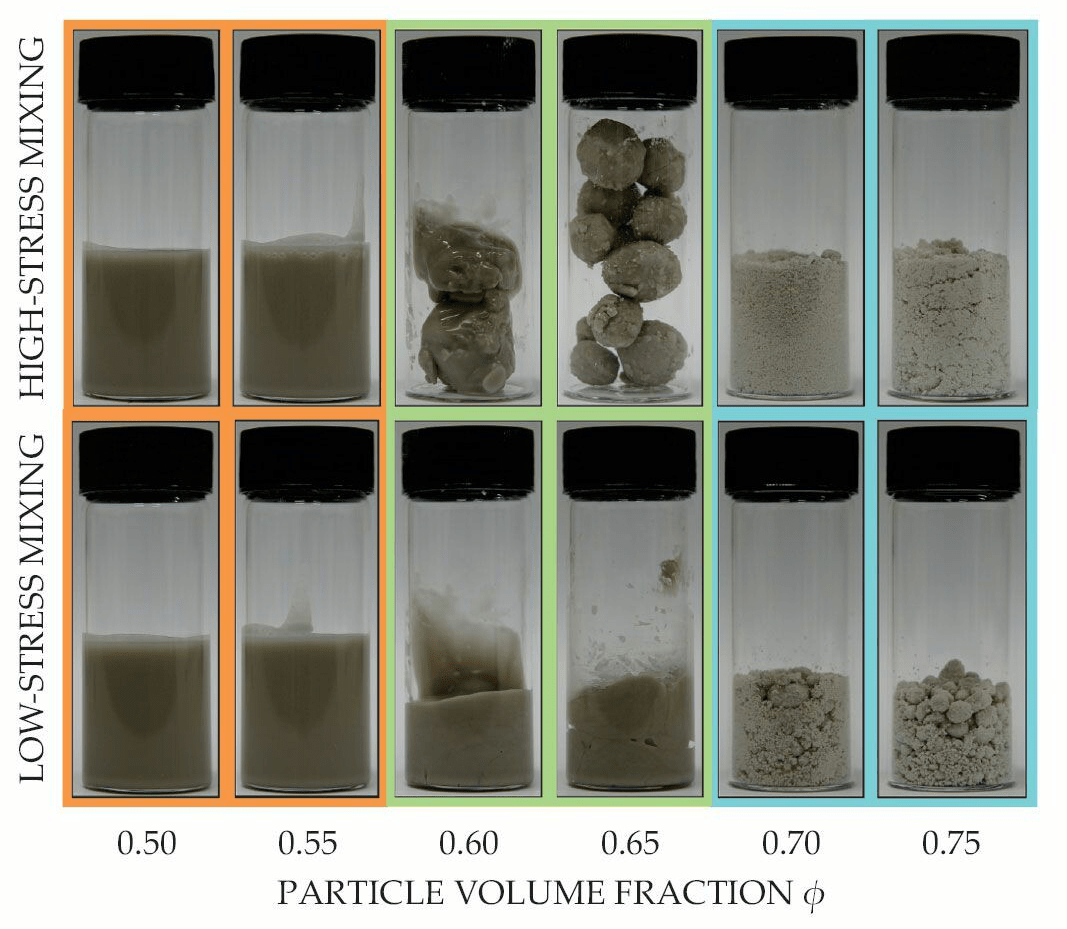
    Mixing liquids and powders is ubiquitous outside the kitchen, too. Ceramics, concrete, laundry detergent, chocolate — all involve this critical step. To understand how these mixtures transition from fluid to clustered granules to granulations (think wet sand), researchers carefully studied a mixture of glass spheres and glycerol. When there were relatively few particles in the mixture (in technical terms, a smaller “particle volume fraction”), the mixture was fully fluid (top image, orange background). When the ratio of particles-to-liquid was high, the mixture was granular (blue background). And in-between these ratios, whether the mixture formed clumps, or granules, depended on how it was mixed (green background). Vigorous mixing (top row) formed large granules, which consisted of a wet, jammed interior and an outer layer of dry particles (lower image).

    Their observations allowed the researchers to predict what ratio of liquid and powder is needed, and how much mixing is necessary, to create a desired outcome. (Image and research credit: D. Hodgson et al.; via Physics Today)

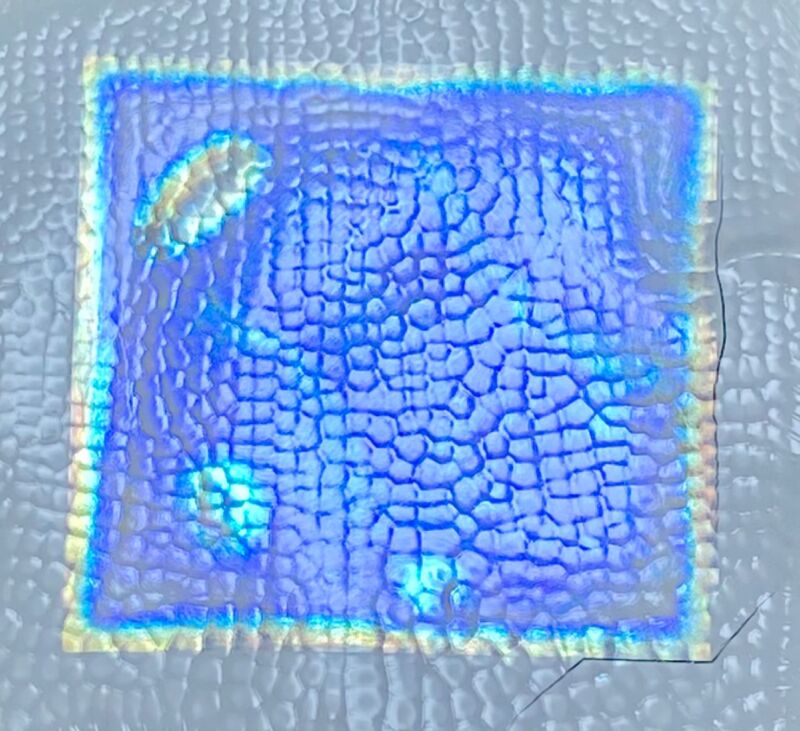
    A cross-section of a granule, showing the wet, jammed interior (left) surrounded by a region of dry particles (center, enclosed between red dashes).
    A cross-section of a granule, showing the wet, jammed interior (left) surrounded by a region of dry particles (center, enclosed between red dashes).
  • Zen Stones

    Zen Stones

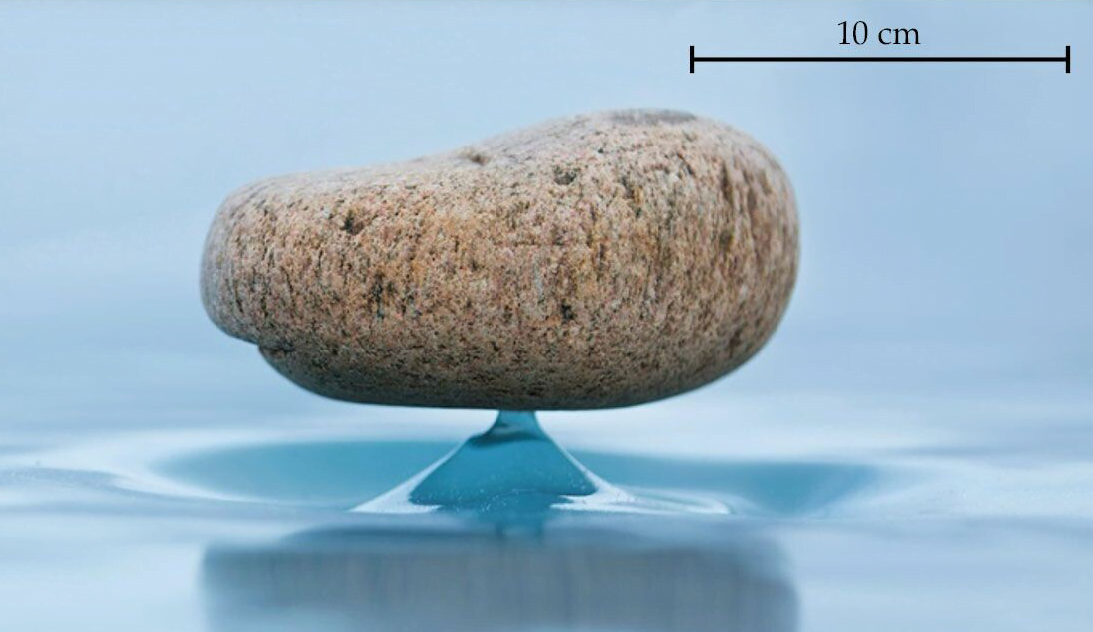
    On Lake Baikal, where Siberian winters are long and cold but have little precipitation, you can find a strange phenomenon: stones that balance on a thin spire of ice. Known as Zen stones — thanks to their visual similarity to stacks of balanced stones in Japanese Zen gardens — these natural oddities rely on time and sublimation, a transition from ice to vapor without melting.

    The process is simple. Toss a stone on the ice and wait. As the sun shines, the ice will sublimate, transforming from ice directly to vapor at an estimated rate of ~2 mm per day, for Lake Baikal’s typical weather. But the stone’s presence acts like an umbrella, protecting some of the ice beneath it from the sunlight that is critical for sublimation. As a result of this umbrella effect, a thin column of ice remains beneath the stone.

    In the lab, researchers were able to recreate the process in less time by tweaking the temperature, humidity, and irradiance to enhance sublimation. Instead of stones, they used metal disks, but their Zen stones made their ice columns just the same. (Image and research credit: N. Taberlet and N. Plihon; via Physics Today)

    A lab Zen stone, formed from a disk of aluminum atop a column of ice.
    A lab Zen stone, formed from a disk of aluminum atop a column of ice.
  • Featured Video Play Icon

    Peering Into the Gap

    This video offers a glimpse into turbulence developing in a classic flow set-up, a Taylor-Couette cylinder. The apparatus consists of two upright, concentric cylinders; the outer cylinder is fixed, and the inner one rotates. This video shows the gap between the cylinders, and it’s rotated so that the inner cylinder is at the bottom of the frame. Gravity points from left to right in the video. The fluid in the 8-cm gap between the cylinders is water, seeded with rheoscopic particles to visualize the flow.

    The video begins as the inner cylinder has just begun to rotate, dragging nearby fluid with it. A thin, laminar boundary layer forms at the bottom of the frame, growing as time goes on. A few seconds in, the boundary layer transitions to turbulence; look closely and you’ll see hairpin-shaped vortices appear. Just after that, the boundary layer becomes entirely turbulent and continues to slowly move upward to take over the full gap. The video is available in a full 4K resolution if you really want to get lost in the flow. (Video credit: D. van Gils)

  • Featured Video Play Icon

    A Levitated Boil

    When acoustically levitated, objects tend to clump together and move like a single, large solid. But researchers found more fluid-like states for their levitated particles when the particles were smaller. At low acoustic power, the particles behave like a liquid and shift primarily within a plane. But as the acoustic power increases, the granular liquid begins to “boil” and transition into a gaseous state, with particles moving in all directions. It’s amazing how often these metaphors (e.g., treating a group of particles as a “liquid”) hold true when observing different physical systems! (Image and video credit: B. Wu et al.)