It is common in many industries to use oil as a defoamer to break up existing foams or prevent foams from forming. But with the right surfactants–additives that change the foam’s surface tension–it’s possible to make aqueous foams that are actually stabilized by the presence of oil. This video explores some of the ways that oil can interact with these kinds of foam, beginning with capillary action, which draws the oil up into the junctions between foam films. For more, see Piroird and Lorenceau. (Video credit and submission: K. Piroird)
Search results for: “surface tension”

Space Balls (of Water!)
The microgravity environment of space is an excellent place to investigate fluid properties. In particular, surface tension and capillary action appear more dramatic in space because gravitational effects are not around to overwhelm them. In this animation, astronaut Don Petit injects a jet of air into a large sphere of water. Some of the water’s reaction is similar to what occurs on Earth when a drop falls into a pool; the jet of air creates a cavity in the water, which quickly inverts into an outward-moving jet of water. In this case, the jet is energetic enough to eject a large droplet. Meanwhile, the momentum, or inertia, from the air jet and subsequent ejection causes a series of waves to jostle the water sphere back and forth. Surface tension is strong enough to keep the water sphere intact, and eventually surface tension and viscosity inside the sphere will damp out the oscillations. You can see the video in full here. (Image credit: Don Petit/Science off the Sphere)

Pointed Drops
When water droplets sit on a cold substrate, they freeze into a shape with a pointed tip. At first glance, this behavior seems very odd since surface tension usually acts to prevent such sharp protrusions. The shape is, however, a result of water’s expansion as it freezes. The droplet freezes from the substrate upward, with a concave shape to the solidification front. The angle of the point does not depend on the substrate temperature or the wetting angle between the water and surface. Instead, it turns out that this concave front shape and water’s expansion are the key factors that determine the pointed cusp’s angle, and that the final geometry of the cusp is essentially universal. (Video credit: M. Nauenberg; additional research credit: A. Marin et al.)
Vibrating on a Subwoofer
[original media no longer available]
Vibrating a liquid droplet produces some awesome behavior. The video above shows a water droplet vibrating on a subwoofer at real-time speeds. The behavior and shape of the droplet shifts with the frequency of vibration, which we hear as a change in pitch. To see more clearly the shapes a particular frequency induces, check out this high-speed video of vibrating water droplets. For a given driving frequency, the droplet’s shape, or mode, is distinct and consistent. For a droplet vibrating to a song, though, there is more than one frequency driving its motion. In this case, the droplet’s shape is a superposition of the individual modes, which is just a way of saying adding the shapes together. So frequency determines the droplet’s shape. The vibration amplitude, or audible volume, affects how energetic the drop’s motion is. And the fluid’s surface tension and viscosity act as dampers to the system, controlling how quickly the drop can change shape as well as how well it holds together. (Video credit: A. Read)
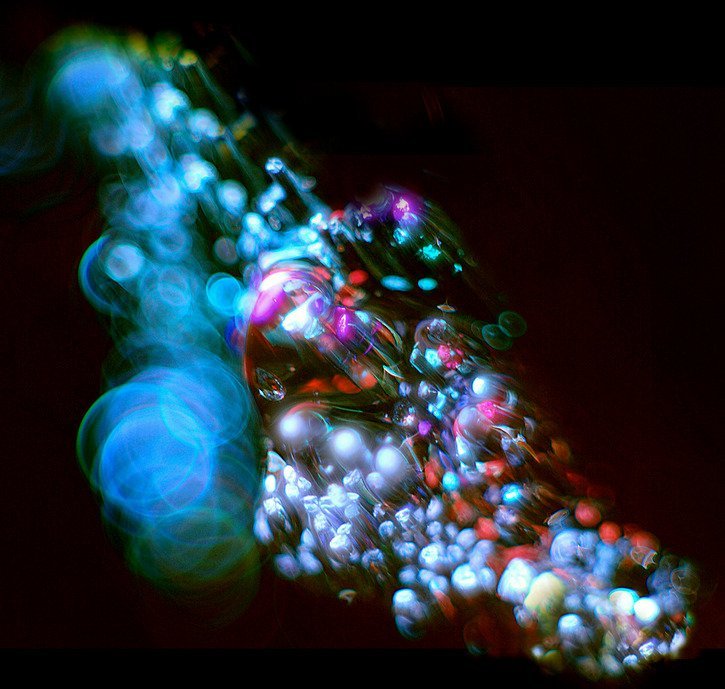
Abstract Fluids
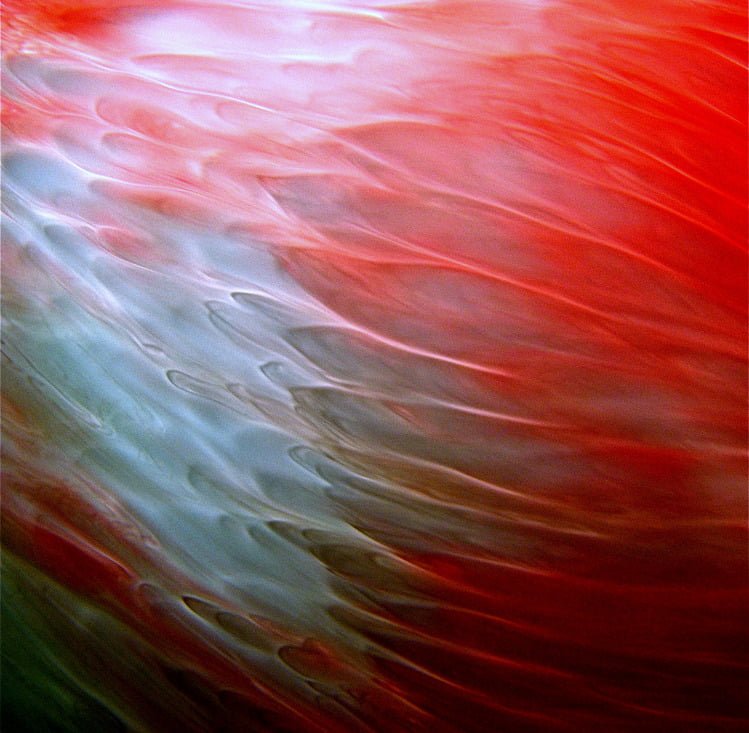
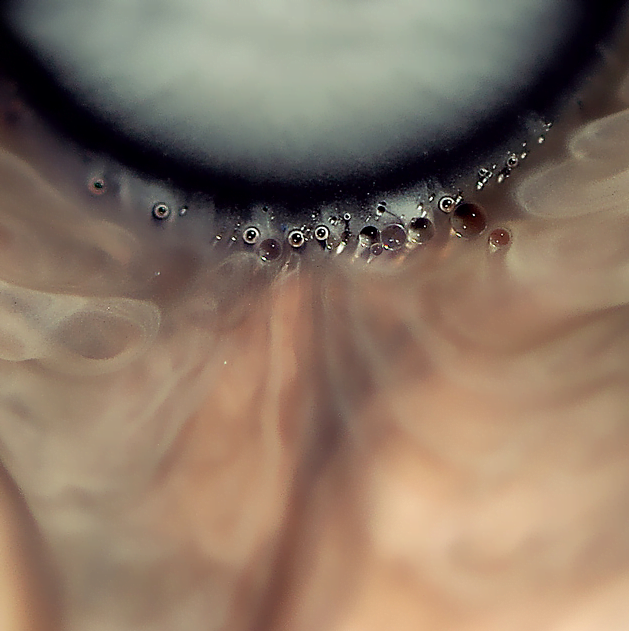
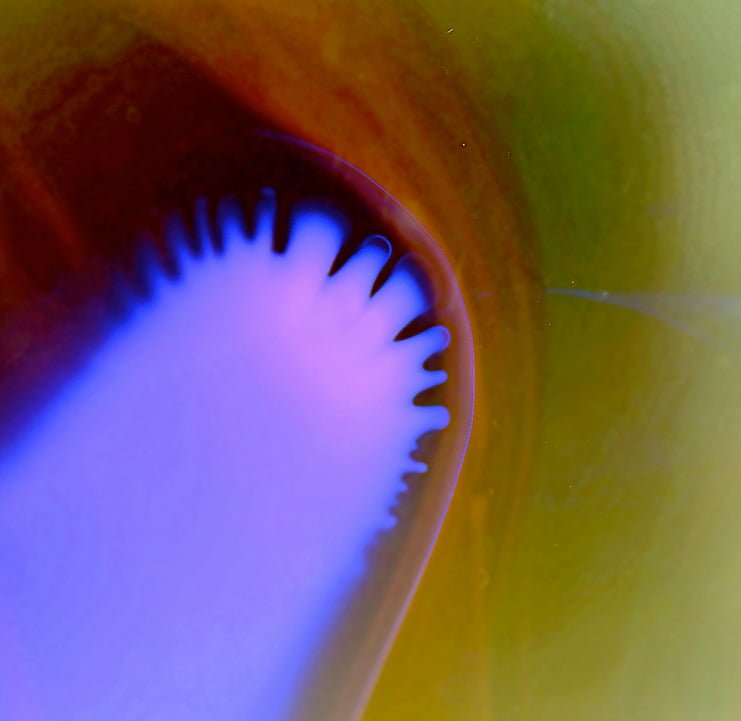
Janet Waters’ abstract photography is full of effects created with fluid dynamics. Diffusion merges different fluids, and gradients in surface tension drive interfacial flows. Changes in density and viscosity produce fingers and streaks and all manner of forms. Be sure to check out her photostream for many more examples of fluids as art. (Photo credits: J. Waters)
Granular Jet
Sometimes the similarity between fluid flow and granular flows is quite striking. This video shows a stream of sand falling down a tube and impacting a rod. (Note: the view is rotated 90 degrees counter-clockwise, so down points to the right.) As the sand strikes the rod, it’s deflected into a conical sheet, very much like a water bell. There are even ripple-like instabilities that form in the granular sheet, though they move differently than in a liquid due to the sand’s lack of surface tension. (Video credit: S. Nagel et al.)
Inside a Splash

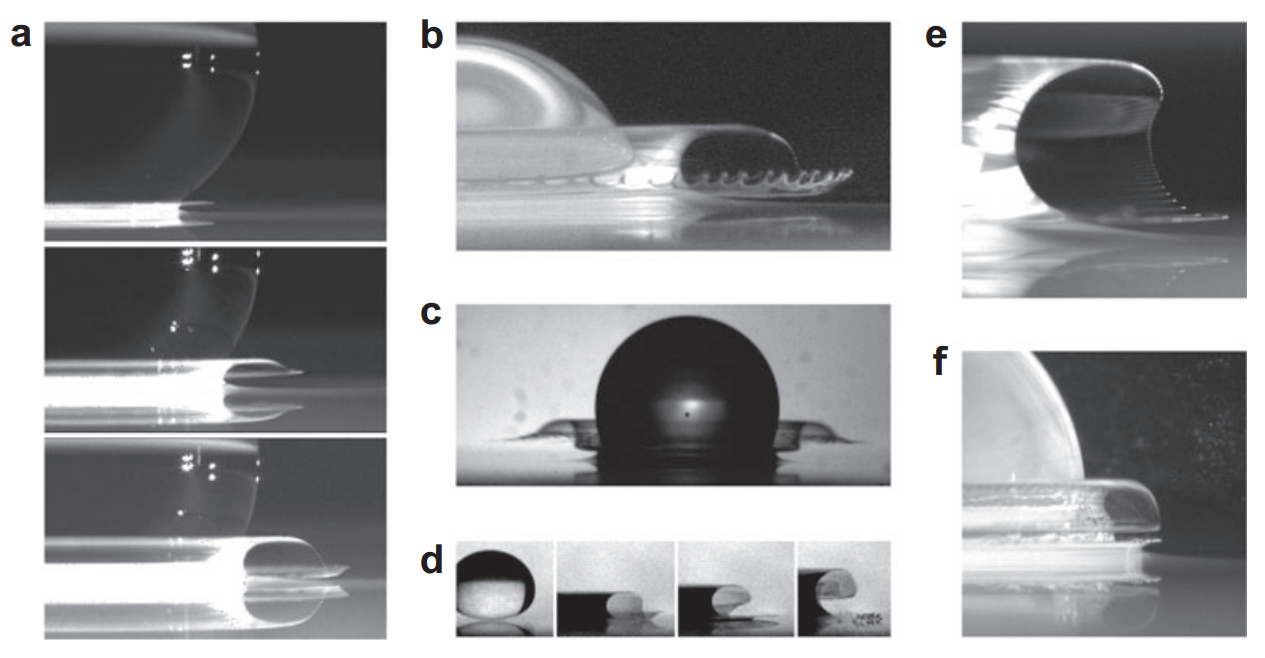
When a droplet strikes a pool, a thin, fast-moving sheet of liquid expands outward from the region of contact. These ejecta sheets come in many forms depending on surface tension, viscosity, air pressure, and droplet momentum. When the ejecta sheet curls downward to touch the pool, it can spray microdroplets outward or trap a layer of air underneath the droplet. For more, see this video by S. Nagel et al., and the papers Thoroddsen (2002) and Thoroddsen et al. (2008). (Photo credits: S. Thoroddsen et al.; GIF from this video by S. Thoroddsen et al.)
Bursting a Bubble
Though seemingly instantaneous to the naked eye, the bursting of a soap bubble is fascinating when slowed down. Here it is at about 2200 frames per second. Initially, the bubble is approximately spherical – its shape determined by a balance between surface tension, gravity, and pressure. The prick of a pinpoint disrupts the balance, and surface tension pulls the thin film away from the defect. The liquid sheet of the bubble retracts swiftly into a filament of fluid and a cloud of tiny droplets. (Video credit: soapbubble.dk)
Coalescence
The coalescence of two liquid droplets takes less than the blink of an eye, but it is the result of an intricate interplay between surface tension, viscosity, and inertia. The high-speed video above was filmed at 16000 frames per second, yet the initial coalescence of the silicone oil drops is still nearly instantaneous. At the very instant the drops meet, an infinitesimally small neck is formed between the droplets. Mathematically speaking, the pressure and curvature of the droplets diverge as a result of this tiny contact area. This is an example of a singularity. Surface tension rapidly expands the neck, sending capillary waves rippling along the drops as they become one. (Video credit: S. Nagel et al.; research credit: J. Paulsen)
Convection Cells
Human eyesight is not always the best for observing how nature behaves around us. Fortunately, we’ve developed cameras and sensors that allow us to effectively see in wavelengths beyond those of visible light. What’s shown here is a frying pan with a thin layer of cooking oil. To the human eye, this would be nothing special, but in the infrared, we can see Rayeigh-Benard convection cells as they form. This instability is a function of the temperature gradient across the oil layer, gravity, and surface tension. As the oil near the bottom of the pan heats up, its density decreases and buoyancy causes it to rise to the surface while cooler oil sinks to replace it. Here the center of the cells is the hot rising oil and the edges are the cooler sinking fluid. The convection cells are reasonably stable when the pan is moved, but, even if they are obscured, they will reform very quickly. (Video credit: C. Xie)