Search results for: “surface tension”

  • Reader Question: What is Viscosity?

    Reader Question: What is Viscosity?

    Reader thesnazz asks:

    Is there a difference between surface tension and viscosity, or are they two manifestations of the same process and/or principles? If you know a given fluid’s surface tension, can you predict its viscosity, and vice versa?

    This is a good question! To answer it, let’s think about where surface tension and viscosity come from. Like many concepts in fluid dynamics, these quantities describe for a whole fluid the properties that arise from interactions between molecules.

    To prevent this becoming overly long, I’m going to tackle this over a couple posts. Today, I’ll talk about viscosity.

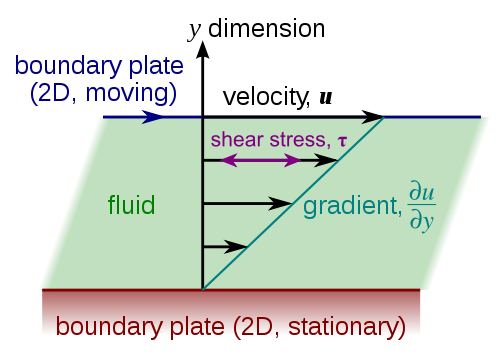
    One way to describe a fluid’s viscosity is as a measure of its resistance to deformation. Another way to think of it is how easily momentum is transmitted from one part of the fluid to another. The diagram above is the classic representation. A layer of fluid is sandwiched between two flat plates. If the top plate moves, friction requires that the fluid particles in contact with the plate get dragged along. This shears the fluid just below that and drags it along, but not quite as much. Those fluid particles do the same to their neighbors and so on down to the stationary second plate, where the fluid is at rest.

    Viscosity is the property that determines how much those neighboring fluid particles move; the more viscous the fluid, the more the neighboring bits of fluid resist getting pulled along. This is a property that’s inherent to a fluid. It comes from how the molecules of the fluid interact with one another, but there are no simple expressions to calculate the viscosity of a liquid or a gas from the individual interactions of its molecules. Instead we experimentally measure viscosity values and use empirical formulas to approximate how viscosity changes with temperature and other effects. (Image credit: Wikimedia)

  • Liquid Umbrella

    Liquid Umbrella

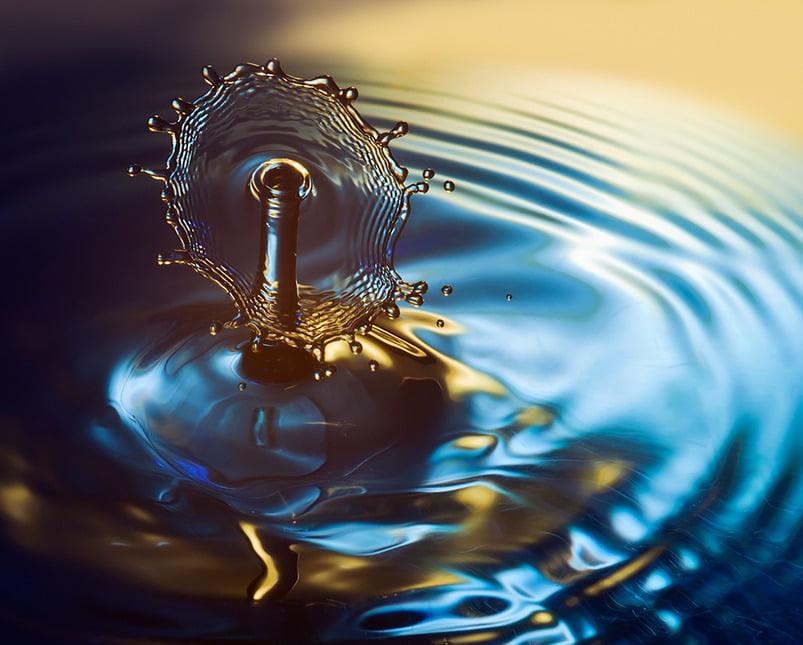
    When a water drop strikes a pool, it can form a cavity in the free surface that will rebound into a jet. If a well-timed second drop hits that jet at the height of its rebound, the impact creates an umbrella-like sheet like the one seen here. The thin liquid sheet expands outward from the point of impact, its rim thickening and ejecting tiny filaments and droplets as surface tension causes a Plateau-Rayleigh-type instability. Tiny capillary waves–ripples–gather near the rim, an echo of the impact between the jet and the second drop. All of this occurs in less than the blink of an eye, but with high-speed video and perfectly-timed photography, we can capture the beauty of these everyday phenomena. (Photo credit: H. Westum)

  • Featured Video Play Icon

    Put the Lid Down When You Flush

    Hospital-acquired infections are a serious health problem. One potential source of contamination is through the spread of pathogen-bearing droplets emanating from toilet flushes. The video above includes high-speed flow visualization of the large and small droplets that get atomized during the flush of a standard hospital toilet. Both are problematic for the spread of pathogens; the large droplets settle quickly and contaminate nearby surfaces, but the small droplets can remain suspended in the air for an hour or more. Even more distressing is the finding that conventional cleaning products lower surface tension within the toilet, aggravating the problem by allowing even more small droplets to escape. To learn more, see the Bourouiba research group’s website. (Video credit: Bourouiba research group)

  • Bubbles Through Constrictions

    Bubbles Through Constrictions

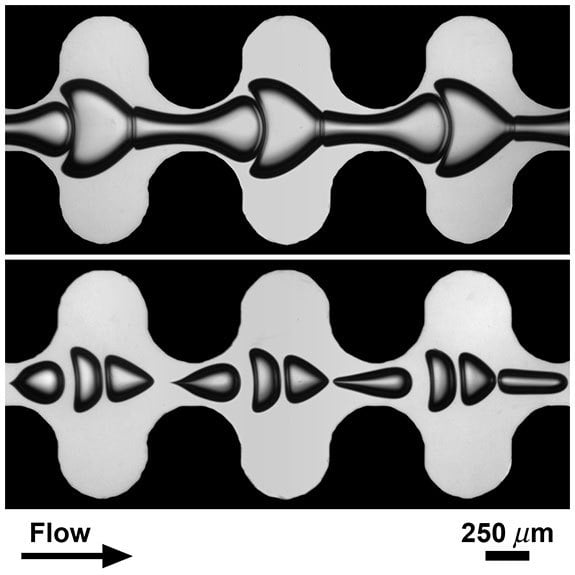
    Surface tension usually constrains bubbles to the smallest area for a given volume – a sphere – but sometimes other forces generate more complicated geometries. The images above show bubbles flowing through microfluidic channels filled with a highly viscous carrier fluid. The bubble size and packing affects the shapes they assume, but so does the geometry of the channel. The narrow constrictions accelerate the flow, elongating the bubbles, whereas the wider channel regions slow the carrier fluid and squish the bubbles together. (Image credit: M. Sauzade and T. Cubaud (Stony Brook University))

  • “Orchid”

    “Orchid”

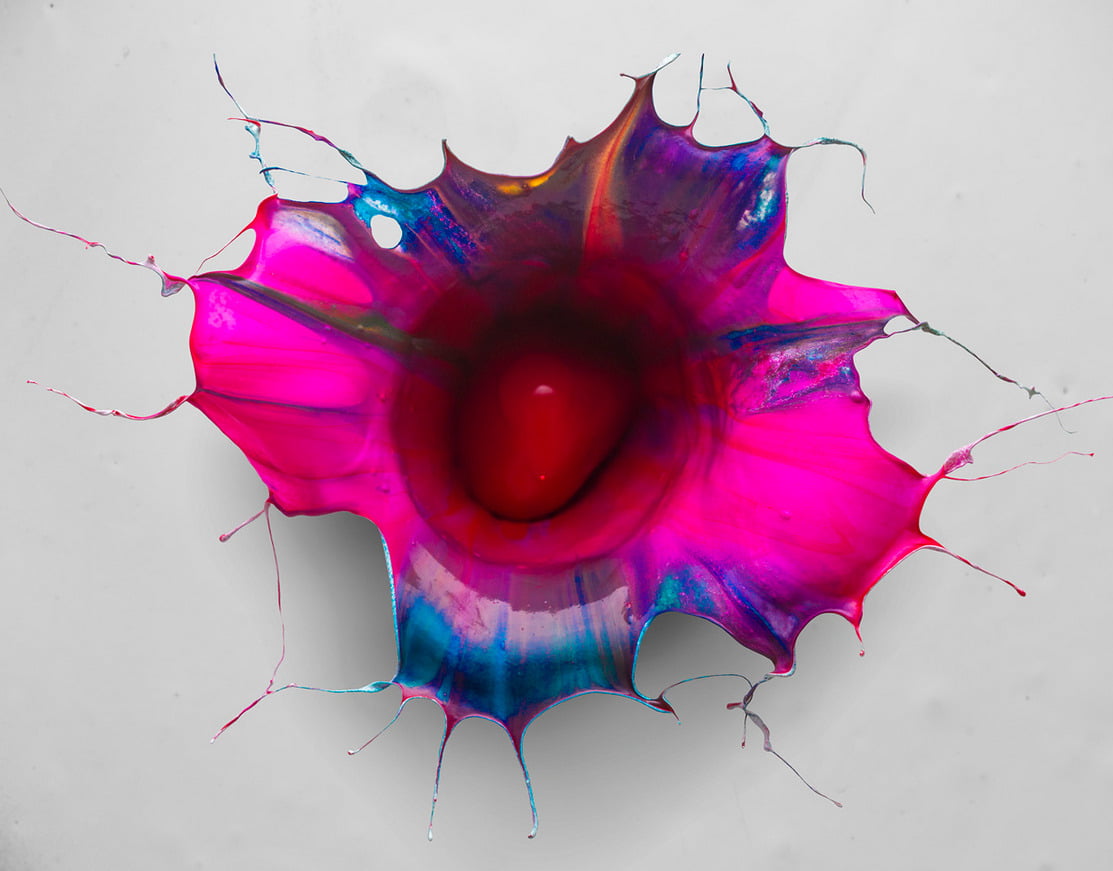
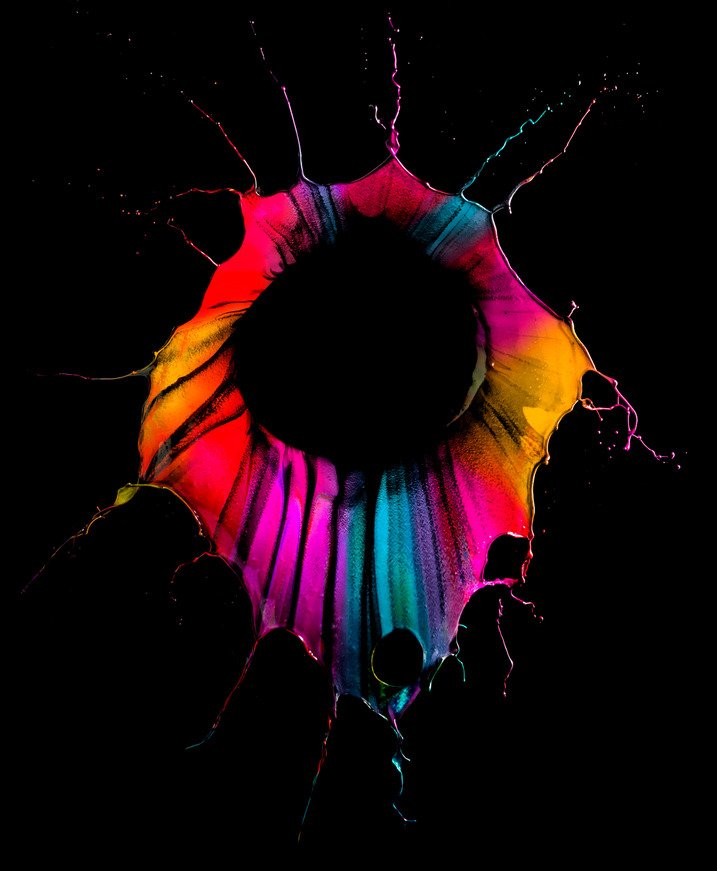
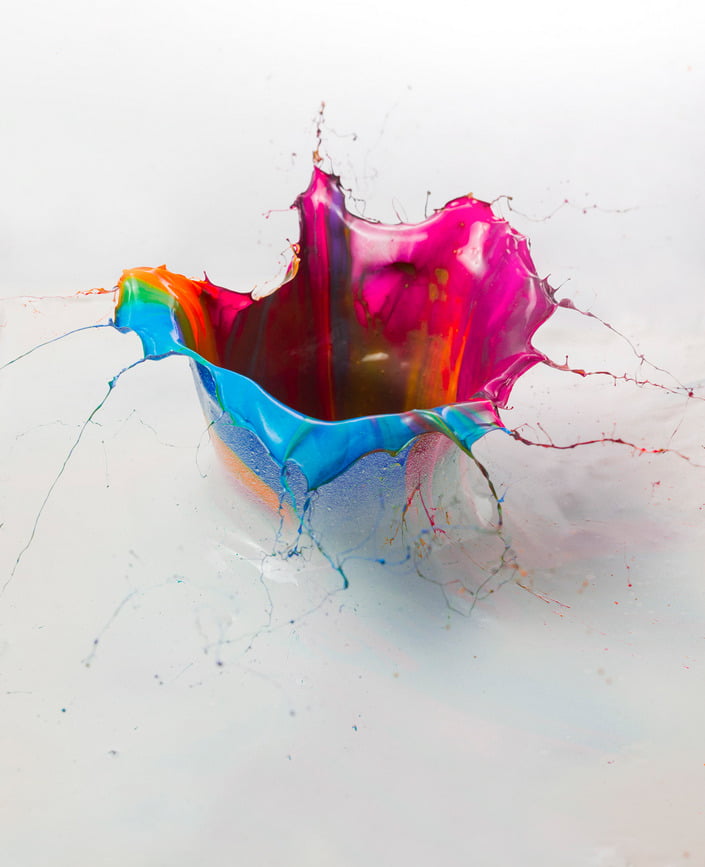
    Artist Fabian Oefner enjoys capturing both art and science in his work. In his latest series, “Orchid”, the blossom-like images are the result of splashes. He layered multiple colors of paint, ending with a top layer of black or white, then dropped a sphere into the paint. The images show how the colors mix and rebound, a delicate splash crown seen from above. The liquid sheet thickens at the rim and breaks up into ligaments from the instability of the crown’s edge. It makes for a remarkable demonstration of the effects of momentum and surface tension. Several of Oefner’s previous collections have appeared on FYFD (1, 2, 3). (Photo credit: F. Oefner)

  • Featured Video Play Icon

    Holey Splashes

    A liquid’s surface tension can have a big effect on its splashes. In this video, a 5-mm droplet hits a surface covered in a thin layer of a liquid with lower viscosity and surface tension. The result is a dramatic effect on the spreading splash. As the initial curtain grows and expands, the lower surface tension of the impacted fluid thins the splash curtain. Fluid flows away from these areas due to the Marangoni effect, causing holes to grow. The sheet breaks up into a network of liquid filaments and ejected droplets before gravity can even bring it all to rest. For more, see this previous post and review paper. (Video credit: S. Thoroddsen et al.)

  • Marangoni Flows

    Marangoni Flows

    Differences in surface tension cause fluid motion through the Marangoni effect. Because an area with higher surface tension pulls more strongly on nearby liquid than an area of low surface tension, fluid will flow toward areas of higher surface tension. Here surfactants, shown in white, are constantly injected onto a layer of water dyed blue. You can also see the flow in motion in this video. Outside of the central source flow, the pattern features lots of 2D mushroom-like shapes reminiscent of Rayleigh-Taylor instabilities. But these shapes are driven by variations in surface tension rather than unstable density variations. For more, check out the original paper or learn about other examples of Marangoni effect. (Photo credit: M. Roché et al.)

  • Featured Video Play Icon

    The Cheerios Effect and Tiny Swimmers

    Anyone who has eaten a bowl of Cheerios is familiar with the way solid objects floating on a liquid surface will congregate. This is a form of capillary force driven by the wetting of the particles, surface tension, and buoyancy. Using ferromagnetic particles and a vertical magnetic field, one can balance capillary action and lock the particles into a fixed configuration relative to one another. By adding a second, oscillating magnetic field, it’s possible to make the beads dance and swim together. Like all of this week’s videos, this video is an entry in the 2013 Gallery of Fluid Motion. (Video credit: M. Hubert et al.)

  • Featured Video Play Icon

    Shaping and Levitating Droplets

    Opposing ultrasonic speakers can be used to trap and levitate droplets against gravity using acoustic pressure. Changes to field strength can do things like bring separate objects together or flatten droplets. The squished shape of the droplet is the result of a balance between acoustic pressure trying to flatten the drop and surface tension, which tries to pull the drop into a sphere. If the acoustic field strength changes with a frequency that is a harmonic of the drop’s resonant frequency, the drop will oscillate in a star-like shape dependent on the harmonic. The video above demonstrates this for many harmonic frequencies. It also shows how alterations to the drop’s surface tension (by adding water at 2:19) can trigger the instability. Finally, if the field strength is increased even further, the drop’s behavior becomes chaotic as the acoustic pressure overwhelms surface tension’s ability to hold the drop together. Like all of this week’s videos, this video is a submission to the 2103 Gallery of Fluid Motion. (Video credit: W. Ran and S. Fredericks)

  • Featured Video Play Icon

    Droplet Collisions

    When droplets collide, there are three basic outcomes: they bounce off one another; they coalesce into one big drop; or they coalesce and then separate. Which outcome we observe depends on the relative importance of the droplets’ inertia compared to their surface tension. This is expressed through the dimensionless Weber number, made up of density, velocity, droplet diameter, and surface tension. For a low Weber number droplet, surface tension is still significant, so colliding droplets bounce off one another. At a moderate Weber number, the droplets coalesce. But when the fluid inertia is too high, as in the high Weber number example, the drops will coalesce but still have too much momentum and ultimately separate. (Video credit: G. Oldenziel)