The “Bubble Circus” is a delightful outreach device equipped for all manner of physics demos, as seen in the video above. Many of its exercises explore surface tension, a force observed at the interface of a fluid. Surface tension is what provides bubbles with their surface-minimizing spherical shape. That same property determines the minimal distance between the four vertices of a pyramid (0:54). Changing the surface tension causes fluid at the interface to move. At 1:16 adding a lower surface tension fluid makes the water and black pepper pull away; the same physics drives the boat away at 2:09. For more on the Bubble Circus, see here. (Video credit: A. Echasseriau et al.; via J. Ouellette)
Search results for: “surface tension”

Pearls of Mezcal
Mezcal is a traditional Mexican liquor distilled from agave. (The more commonly known tequila is actually a special type of mezcal.) As a part of the production process, distillers pour a stream of mezcal into a bowl, creating a flotilla of small bubbles called pearls. Strange as it sounds, these pearls let the distiller judge the alcohol content of the liquor! When the ratio of alcohol and water in the mixture is just right, the bubbles will have a longer lifetime before they coalesce. If there’s too little or too much alcohol, the bubbles won’t last as long. The effect depends on both the viscosity and the surface tension of the liquor, but it’s the odd way that viscosity changes in water/alcohol mixtures that creates this Goldilocks behavior. It’s a fascinating demonstration of how traditional techniques often have true scientific underpinnings. (Video credit: M. Wilhelmus et al.)

Pinning a Drop
The shape of a droplet sitting on a surface depends, in part, on its surface tension properties but also on the nanoscale roughness of the surface. Small variations in the height and shape of the surface will change the area a drop contacts as well as the contact angle the edge of the drop makes with the surface. If the contact line between the drop and surface stays the same as a droplet evaporates into the surrounding gas or dissolves into the surrounding liquid, then we say the drop is pinned. A pinned drop’s contact angle will decrease as the drop’s volume decreases. This strains the ability of the nanoscale roughness to keep the drop’s edge pinned. As individual points of contact fail, the drop’s edge may jump inward to a new contact point. This set of discrete jumps between pinned states is called a stick-jump or stick-slip mode. (Image credit: E. Dietrich et al., source; see also: E. Dietrich et al. 2015)
Coffee-Making in Space
In this video, Kjell Lindgren demonstrates his technique for making coffee aboard the Space Station. Astronauts usually drink coffee reconstituted from powder, or, on special occasions, enjoy a beverage from their special espresso machine. But Lindgren uses a pour-over method by attaching a pod of coffee grounds to the underside of a Capillary Beverage Experiment cup – a specially-designed 3D printed cup that uses capillary action and surface tension to guide fluids. Then, by forcing hot water from a syringe through the grounds and into the cup, he gets a result that’s not too different from the way many people enjoy their coffee here on Earth. I must say, though, that my favorite part of this video is how he just starts spinning to separate the air and water in the syringe! (Video credit: NASA; via IRPI LLC)

Rotating Jet
This photo, one of the winners of the Engineering and Physical Sciences Research Council’s (EPSRC) annual photography contest, shows a rotating viscoelastic jet. Rotating liquid jets are common to many manufacturing processes, and their sometimes-wild appearance comes from a balance of gravitational forces and centrifugal force against surface tension. But because this fluid contains a small amount of polymer additive, surface tension has the additional aid of some elasticity to help hold the jet together and keep the globules and ligaments you see from flying off. As centrifugal forces fling the fluid outward, it stretches the polymer chains within the fluid, and they pull back against that tension like a stretched rubber band. To see some of the other contest winners–including other fluids entries!–check out the Guardian’s run-down. (Image credit and submission: O. Matar et al., ICL press release)
Dancing Droplets
The seemingly-alive dancing droplets are back in a new video from Veritasium. These droplets of food coloring attract, merge, and chase one another due to evaporation and surface tension interactions between their two components: water and
propylene glycol. Because the droplets are constantly evaporating, they are surrounded by a cloud of vapor that helps determine a drop’s surface tension. These localized differences in surface tension are what causes the drops to attract. The chasing is also surface-tension-driven. Like any liquid, the drops will flow from areas of low surface tension to those of higher surface tension due to the Marangoni effect. Thus drops of different concentration appear to chase one another. This is a relatively simple experiment to try yourself at home, and Derek outlines what you need to know for it. (Video credit: Veritasium; research credit: N. Cira et al.; submitted by @g_durey)
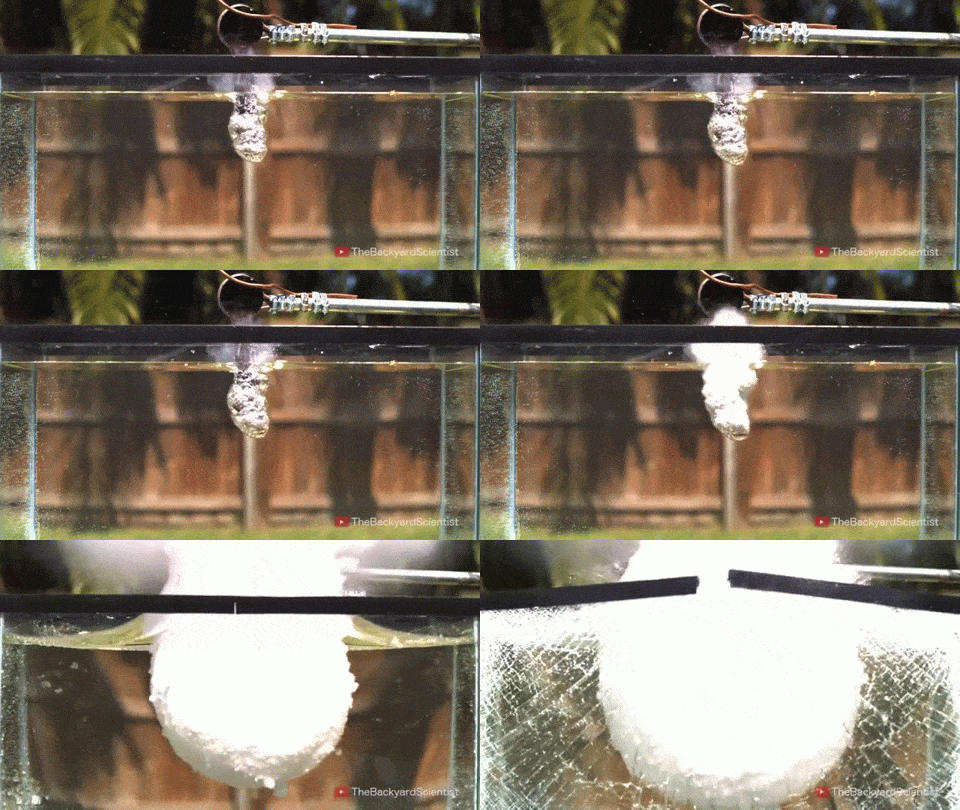
Molten Salt in Water
In his latest video, The Backyard Scientist explores what happens when molten salt (sodium chloride) gets poured into water. As you can see, the results are quite dramatic! He demonstrates pretty convincingly that the effect is physical – not chemical. The extreme difference in temperature between the liquid water (< 100 degrees Celsius) and the molten salt (> 800 degrees Celsius) causes the water to instantly vaporize due to the Leidenfrost effect. This vapor layer protects the liquid water from the molten salt – until it doesn’t. When some driving force causes a drop of water to touch the salt without that protective vapor layer, the extreme temperature difference superheats the water, causing it to expand violently, which drives more water into salt and feeds the explosion.
But why don’t the other molten salts he tests explode? Sodium carbonate, the third salt he tests, has a melting point of 851 degrees Celsius, 50 degrees hotter than sodium chloride. Yet for that test, the Leidenfrost effect prevents any contact between the two liquids. The key in this case, I hypothesize, is not simply the temperature difference between the water and salt, but the difference in fluid properties between sodium chloride and sodium carbonate. The breakdown of the vapor layer and subsequent contact between the water and the molten salt depends in part on instabilities in the fluids. A cavity where instabilities can grow more easily is one where the Leidenfrost effect is less likely to protect and separate the two fluids. And, in fact, it turns out that the surface tension of molten sodium chloride is significantly lower than that of molten sodium carbonate! A lower surface tension value means that the molten sodium chloride breaks into droplets more easily and its vapor cavity will respond more strongly to fluid instabilities, making it more likely to come in contact with liquid water and, thus, cause explosions. (Image/video credit: The Backyard Scientist; submitted by Simon H)

Jumping Off Water

Many insects and arachnids can walk on water by virtue of their hydrophobicity and small size. With their light weight and skinny legs, these invertebrates curve the air-water interface like a trampoline, with surface tension providing the elasticity that keeps them afloat. What’s truly incredible, though, is that many of these creatures, like water striders, can actually jump off the water surface.
The top animation shows high-speed video footage of a water strider leaping off the water. Notice how it distorts the air-water interface but doesn’t break the surface – it makes no splash.
The key is not to push too hard. If the insect exerts a force exceeding the limits of what surface tension can withstand, then its legs will break the water surface and it will lose energy to drag and viscous forces. The insect must generate its jumping force without exceeding a hard limit.
The water strider achieves this feat not by pushing downward but by rotating its middle and hind legs. Rotating its legs allows the insect to maintain contact with the water surface longer and continue deforming the interface as it jumps. This maximizes the momentum it transfers to the water, which, in turn, increases the insect’s take-off velocity. By studying and then emulating this mechanism, scientists were able to successfully create a tiny 68-mg water-jumping robot. (Image credits: J. Koh et al., sources, PDF)
This week FYFD is exploring the physics of walking on water, all leading up to a special webcast March 5th with guests from The Splash Lab.

The Basilisk Lizard
One of the most famous water-walking creatures is the common basilisk lizard. These South American reptiles are far too large to be kept aloft by surface tension and other interfacial effects. They generate the vertical force necessary to stay above water by slapping the water hard and fast. There are three phases to a basilisk’s water running gait: the slap, the stroke, and the retraction.
In the slap phase, the lizard slams its foot flat against the water surface at a peak velocity of about 3.75 m/s. The impact pushes water down and generates an upward force on the lizard that accounts for between 15-30% of the lizard’s body weight, depending on the size of the lizard. The rest of the upward force comes from the stroke phase, where the lizard pushes its foot downward in the water, causing an air cavity to form.
The air cavity is vital for the last phase of the lizard’s step. The basilisk must pull its foot out and prepare for the next slap, ideally doing so without generating too much drag. The lizard does this by pulling its foot through the air cavity before it seals. Doing so through air is much easier than through water.
Water-walking this way requires fast reflexes. Basilisks take up to 20 steps per second when running across water and reach speeds of about 1.6 m/s. Although both juvenile and adult basilisks can run on water, the smaller lizards do better because they can generate more than enough impulse to overcome their weight. (Image credit: T. Hsieh/Lauder Laboratory, source; video credit: BBC; research credits: J. Glasheen and T. McMahon, G. Clifton et al.)
This week FYFD is exploring the physics of walking on water, all leading up a special webcast March 5th with guests from The Splash Lab.

Drying Blood Can Reveal Anemia
Blood is a remarkably complicated fluid, thanks in part to its many constituents. What we see here is an animation of a drop of blood evaporating at several times normal speed. As water from the blood evaporates, it causes relative changes in surface tension. These surface tension gradients cause convection inside the drop and carry red blood cells toward the outer portion of the drop. As the blood evaporates further, it leaves behind different patterns that depend on which parts of the whole blood mixture were deposited in each region. Interestingly, the final desiccation patterns can indicate the healthiness of a patient. Below are images of dried blood patterns from (left) a healthy individual and (right) an anemic individual. (Image credits: D. Brutin et. al., source)

Special thanks to our Patreon patrons, who help keep FYFD bringing you daily doses of fluid dynamics.