The coalescence of two water droplets happens so quickly, it’s essentially impossible to see, even with high-speed cameras. For this reason, researchers have turned to simulating molecular dynamics – essentially building computer programs that model the actions of all the molecules contained in the water droplets. Viewed this way, the very first contact between drops comes from thermal fluctuations – the random jumping of molecules across the separating gap. Once the bridge starts to form, it continues to grow, driven by thermal forces and opposed by surface tension. Eventually, this thermal regime gives way to the more familiar hydrodynamic one, where the bridge is large enough for flow to drive its growth. (Image credits: experiment – S. Nagel et al.; simulation – S. Perumanath et al.; research credit: S. Perumanath et al.; submitted by Rohit P.)
Search results for: “surface tension”

Magma Mixing
Magmas typically consist of a mixture of molten liquid, bubbles, and solid crystals. As they mix, those crystals can sink from one viscous layer into another. To investigate this sort of process, researchers studied solid particles sinking across an interface between two viscous liquids. This is what we see above. One fluid is clear; the other is dyed red, and gravity points toward the left so the particles fall from right to left.
What happens when the particle reaches the interface between fluids depends on three main factors: the gravitational force acting on the particle, the surface tension at the interface, and the ratio of the viscosities of the two fluids. The researchers observed two main outcomes. In one (top), the particle slows at the interface and breaks through slowly, its surface wetted by the second fluid so that it drags little to none of the previous fluid with it. The researchers named this the film drainage mode. It tends to occur when the viscosity ratio between fluids is large.
The second method, shown in the bottom image, is the tailing mode. As the particle approaches, the interface deforms. A thick layer of the first fluid coats the particle even as it pass through, forming a tail that destabilizes behind the falling particle. This mode occurs when the viscosity ratio is small or the gravitational force is large compared to the surface tension. (Image and research credit: P. Jarvis et al.)

Keeping Bubbles Around
Bubbles don’t stick around in pure water. Surfactants are needed to stabilize the thin liquid film for longer than the blink of an eye. But that’s not necessarily the case for other liquids. As the video below shows, a bubble in isopropyl alcohol is quite stable. This is because of the alcohol’s volatility – its ability to evaporate easily.
As the alcohol in the bubble film evaporates, it cools the film, creating a difference in surface tension that pulls fresh alcohol up into the bubble film. It’s so efficient at pulling alcohol up that the alcohol can’t evaporate fast enough to use it all. Once the excess alcohol is heavy enough, it slides back down the side of the bubble. Overall, though, the process is enough to keep a bubble in pure isopropyl alcohol from rupturing for minutes to hours at a time. (Image and video credit: M. Menesses et al.)

Collective Motion: Nematodes
We often imagine that collective motion creates an advantage – that the schooling fish and flocks of birds gain something from this behavior – but that’s not always the case. Above, you see nematodes moving through a thin liquid layer. Random collisions occasionally bring the nematodes into contact, and once that happens, surface tension holds them together with a force that exceeds what their muscles can supply. Essentially, they move together for the same reason that Cheerios clump together in your cereal bowl. But despite being stuck alongside one another, there’s no change in how the nematode moves. It sees neither an advantage nor a disadvantage from being attached to its neighbor. (Image and research credit: S. Gart et al., source)
This post completes our series on collective motion. Check out the previous posts about honeybee waves, how crowds are like sand, the fluid properties of worms, and why a lack of randomness makes predicting group behaviors hard.

“The Empire of C”
Filmmaker Thomas Blanchard has once again released a beautiful, fluid-filled short to captivate us. Built from paint, oil, and liquid soap, “The Empire of C” feels like it gives viewers a birds-eye perspective over a fantastical land. I was particularly drawn to two fluid dynamical aspects of the film. The first were the dendritic sequences in the opening, which feel a bit like watching river deltas form in real time. Despite their resemblance to the Saffman-Taylor instability, I think these fingers are interfacially driven – meaning that they result from differences in surface tension between the different liquids Blanchard is using.
The second thing that caught my eye and made me rewind the video over and over were the glittery droplets. The glitter acts like tracer particles, allowing you to see the flow inside the droplets. Check out that counter-circulation compared to the paint flowing by outside! It’s a reminder that even inside a seemingly still droplet, there’s lots going on. (Video and image credit: T. Blanchard)

Dip Coating
Imagine dipping a rod into a liquid mixture filled with particles. When you pull the rod out, do particles stick to it? The answer depends on the relative importance of two sets of forces: the viscous drag as you lift the rod and adhesive power of surface tension. Scientists express this as a dimensionless ratio known as the capillary number.
When the capillary number is small, viscous drag dominates, and any particles that try to stick to the rod get pulled away (upper left). But as you increase the capillary number, surface tension helps particles clump together and stick to the rod (lower left and right). If the surface tension forces are strong enough – meaning that the capillary number is high – you can actually get multiple layers of particles adhering to the dipped surface. (Image and research credit: E. Dressaire et al.)

“Winter’s Magic”
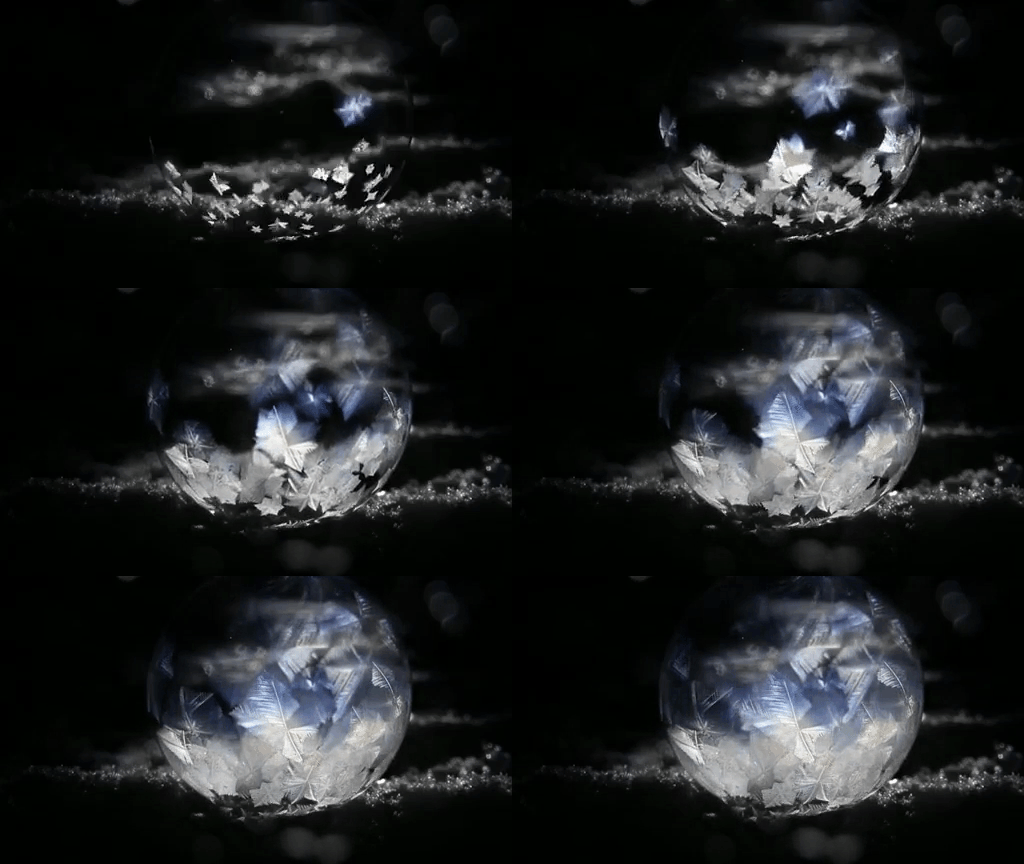
Don Komarechka’s beautiful short film, “Winter’s Magic,” captures the beauty of soap bubbles as they freeze. It’s a delicate process and one difficult to capture in video. The bubble freezes first at the bottom, where it touches the cold surface – in this case, snow. That freezing releases latent heat and creates a temperature gradient along the thin liquid film. With that temperature gradient comes a variation in surface tension, and it’s this that creates the flow that lifts the ice crystals from the surface and turns the bubble into a snow globe. Eventually, as the frozen crystals continue growing, flow in the bubble walls comes to halt as the film solidifies.
For more on the physics of freezing bubbles, check out this interview with the researchers, or, to learn more on how to film freezing bubbles, check out Komarechka’s description. (Video and image credit: D. Komarechka; via Laughing Squid; h/t to Jennifer O.)


Water-Walking Geckos
Many animals can run on water. The tiniest creatures, like water striders, use surface tension to keep themselves atop the water. Larger creatures like the basilisk lizard or the grebe slap the water’s surface to generate a vertical impulse that keeps them aloft. Geckos, it turns out, can run on water, too, but they’re too big to stay up with surface tension and too small to support their weight by slapping. So they’ve developed their own method.
As you see in the top image, geckos use the slapping method for part of their support. Their slaps generate a little less than half of the force needed to keep them out of the water.
Surface tension is an important component, too. Geckos are extremely water repellent, which helps boost the lift they get from surface tension. In the bottom image, you see a gecko attempting to run on soapy water, which has a lower surface tension. The gecko is mostly submerged and more swimming than running – a clear demonstration that surface tension is important to its water-walking.
Finally, the gecko undulates its body as it runs, much the way an alligator swims. The researchers suspect this helps the gecko generate forward thrust. Altogether, it creates a water-walking gait that, for now, is unique among observed mechanisms. (Image and research credit: J. Nirody et al.; via Ars Technica; submitted by Kam-Yung Soh)

What Drives Droplets
There’s been a lot of interest recently in what goes on inside droplets made up of more than one fluid as they evaporate. This can be entertaining with liquids like whiskey or ouzo, but it has practical applications in ink-jet printing and manufacturing as well. And a new experiment suggests that we’ve been fundamentally wrong about what drives the flow inside these drops.
As these drops evaporate, a donut-shaped recirculating vortex forms inside them, as seem in the cutaway views above. Conventional wisdom says that vortex is driven by surface tension. Evaporation of components like alcohol is more efficient at the edges of the drop, and as the alcohol evaporates, it creates a higher surface tension at the drop’s edge than at its peak. Marangoni forces then pull fluid down toward the edges, creating the vortex. That explanation is consistent with observations of a sessile drop sitting on top of a surface (left side of images).
But those observations are also consistent with another explanation: evaporating ethanol makes the local density higher, so alcohol-rich parts of the drop rise toward the peak while alcohol-poor regions sink. This difference in density would also create a flow pattern consistent with observations. So which is the real driver, surface tension or gravity?
To find out, researchers flipped the drop upside-down (right side of images). When hanging, the preferred flow direction due to surface tension doesn’t change; flow should still go from the deepest point on the drop toward the edge. But gravity is swapped; alcohol-rich areas should be found near the edge and attachment points of the drop because buoyancy drives them there. And that is exactly what’s observed. The flow direction inside the hanging droplet is consistent with the direction prescribed by buoyancy-driven flow, thereby upending conventional wisdom. It turns out that gravity, not surface tension, is the major driver of internal flow in these multi-component droplets! (Image and research credit: A. Edwards et al.; via APS Physics; submitted by Kam-Yung Soh)

“If I Say”
The new Mumford & Sons single “If I Say” features a fluid-dynamical music video. It’s full of dendritic fingers and flowing colors – likely from combinations of inks, paints, and other fluids. Although the fingers are reminiscent of the viscosity-dependent Saffman-Taylor instability, these appear to be driven by variations in surface tension between the different fluids. That’s a major feature throughout the video; although some of the flow is caused by the syringes depositing fluids, much of it seems to be a Marangoni effect, where flow moves away from areas of low surface tension to ones with higher surface tension. (Video credit: Mumford & Sons; filmed by P. Hofstede; via Katie M.)