Schlieren photography is a common method of visualizing shock waves in wind tunnel experiments, but it’s much harder to pull off for aircraft in the sky. This video from NASA shows off some stunning work out of NASA Dryden capturing schlieren video of shock waves from a F-15B aircraft at Mach 1.38. You’ll notice that shock waves extend off the nose, wings, tail, and other parts of the airplane and extend well beyond the camera’s field of view. It’s these shock waves hitting the ground level that causes distinctive sonic booms. These tests are part of NASA’s on-going research into minimizing the effects of sonic boom so that civilian supersonic flight over land is feasible in the future. When the U.S. government shutdown ends, you’ll be able to learn more about this work at NASA Dryden’s GASPS page. (Video credit: NASA Dryden)
Search results for: “supersonic”

Fluids Round-up – 5 October 2013
This is the last week that my IndieGoGo project is open for donations. All money above and beyond what is needed for the conference will go toward FYFD-produced videos. Also, donors can get some awesome FYFD stickers.
As a reminder, those looking for more fluids–in video, textbook, or other form–can always check out my resources page. And if you know about great links that aren’t on there, let me know so that I can add them. On to the round-up!
- Popular Science has look at what it was like to fly on the Concorde, the only supersonic commercial airliner ever flown.
- For the cyclists and CFD folks out there, Zipp has put out a new video discussing their Firecrest wheels’ aerodynamics.
- io9 explains how superhydrophobic surfaces impart a charge to water droplets and how this can be used to increase efficiency at power plants.
- BuzzFeed UK has 32 fun science GIFs, several of which are fluids-related, and several of which will look familiar to long-time readers. (via Flow Visualization on FB)
- Wired has an intriguing short on Acoustic Archives, a group that focuses on capturing the acoustic qualities of historic locations using custom-designed 3D microphones.
- Congratulations to Richard over at Flow Viz for hitting his 100th post! Here’s to many more.
- Finally, our lead image comes from Martin Klimas. Smithsonian’s blog has a feature on his work in which he transforms songs from artists like Pink Floyd, Daft Punk, and Bach into sonic sculptures using paint on speakers. (via Flow Visualization on FB)
I had a lot of fun earlier this week giving a talk for the Texas A&M Applied Mathematics Undergraduate Seminar series. I didn’t get a chance to record it, but the slides are up here if anyone is interested.(Photo credit: M. Klimas)
Shock Trains
In compressible flows, shock waves are singularities, a tiny distance across which the density, temperature, and pressure of a fluid change suddenly and discontinuously. In this video, there is a wedge at the top and bottom of the frame and a Pitot probe roughly in the center. Flow is left to right and is initially subsonic. Once Mach 6 flow is established in the wind tunnel, a series of shock waves and expansion fans appear as light and dark lines in this schlieren video. Oblique shocks extend from the sharp tip of each wedge and interfere to create a normal shock in front of the Pitot probe. The air that passes through the normal shock is subsonic to the right of the shock, whereas air that goes through the oblique shocks remains supersonic. The fainter lines further to the right are weaker shock waves and expansion fans that reflect off the walls and probe. They exist to continue turning the airflow around the probe and to equalize conditions between different regions. (Video credit: C. Mai et al.)

Shocking Instabilities
The Richtmyer-Meshkov (RM) instability occurs when the interface between two fluids of different density is impulsively accelerated – usually by the passage of a shock wave. The image above shows a thin layer of gaseous sulfur hexafluoride embedded in air. Each vertical line, from left to right, shows the distortion of the two fluids at subsequent time steps after a Mach 1.2 shock wave passes through the gases. The interface’s initial waviness grows into mushroom-like shapes that mix the two gases together, ultimately leading to turbulence. Scenarios involving the RM instability include supersonic combustion ramjet engines, supernovas, and inertial confinement fusion. The RM instability is closely related to Rayleigh-Taylor instability and shares a similar morphology. (Photo credit: D. Ranjan et al.)

Streamlines in Oil
Bernoulli’s principle describes the relationship between pressure and velocity in a fluid: in short, an increase in velocity is accompanied by a drop in pressure and vice versa. This photo shows the results left behind by oil-flow visualization after subsonic flow has passed over a cone (flowing right to left). The orange-pink stripes mark the streamlines of air passing around the Pitot tube sitting near the surface. The streamlines bend around the mouth of probe, leaving behind a clear region. This is a stagnation point of the flow, where the velocity goes to zero and the pressure reaches a maximum. Pitot tubes measure the stagnation pressure, and, when combined with the static pressure (which, counterintuitively, is the pressure measured in the moving fluid), can be used to calculate the velocity or, for supersonic flows, the Mach number of the local flow. (Photo credit: N. Sharp)

101 Signals
Welcome, Wired readers! I’m stunned, honored, and very grateful to see FYFD featured on this year’s 101 Signals science recommendations, especially given how much I admire many of the others on that list! The premise of FYFD is simple: every weekday I post a new photo or video and a brief explanation of the fluid dynamics and physics therein. Topics include everything from chip-sized microfluidics to astrophysics, from super-slow-moving flows to hypersonic planetary re-entry, from the aerodynamics of cycling to the bizarre behavior of cyrogenic superfluids. You can find a little bit of just about anything here. Jump into the visual archive and take a look around. I’m also always happy to answer reader questions on Tumblr or by email. Happy reading! – Nicole
Rocket Sonic Boom
Originally posted: 22 July 2010 This video of the NASA Solar Dynamics Observatory’s launch is such a favorite of mine that it was part of the original inspiration for FYFD and was the very first video I posted. Watch closely as the Atlas V rocket climbs. At 1:51 you’ll see a rainbow-like cloud in upper right corner of the screen. This effect is created by sunlight shining through ice crystals of the cloud. A couple seconds later you see pressure waves from the rocket propagate outward and destroy the rainbow effect by re-aligning the ice crystals. Just after that comes the announcement that the vehicle has gone supersonic. The atmospheric conditions of the launch happened to be just right to make those pressure waves coming off the rocket visible just before they coalesced into a leading shockwave. (Video credit: B. Tomlinson)
Reminder: If you haven’t already, please fill out our reader survey and help us improve FYFD!
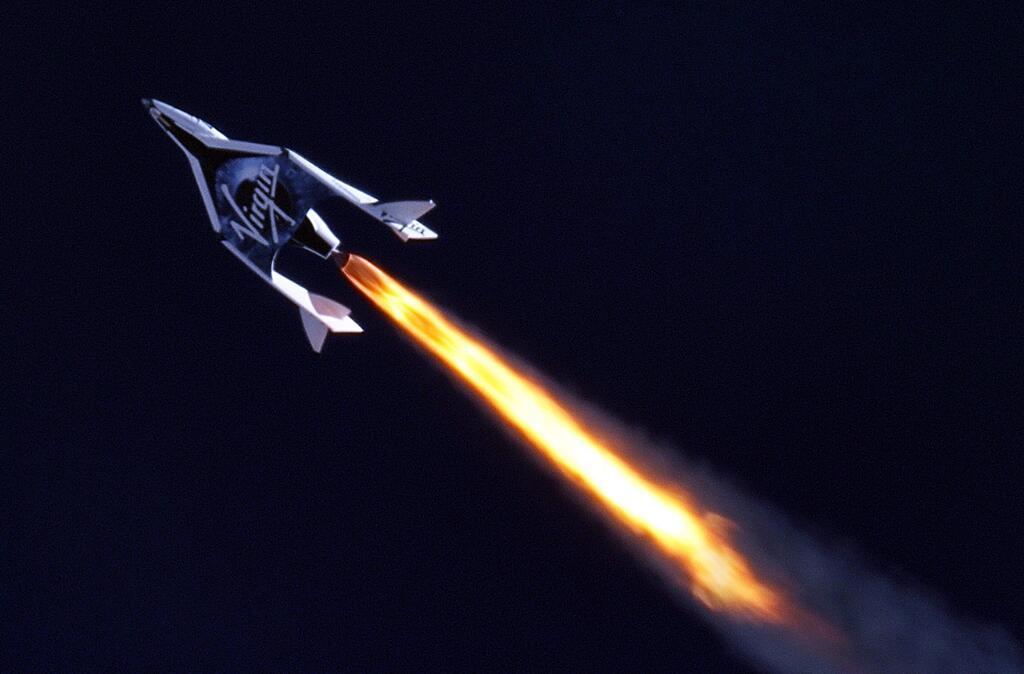
SpaceShipTwo Lights It Up
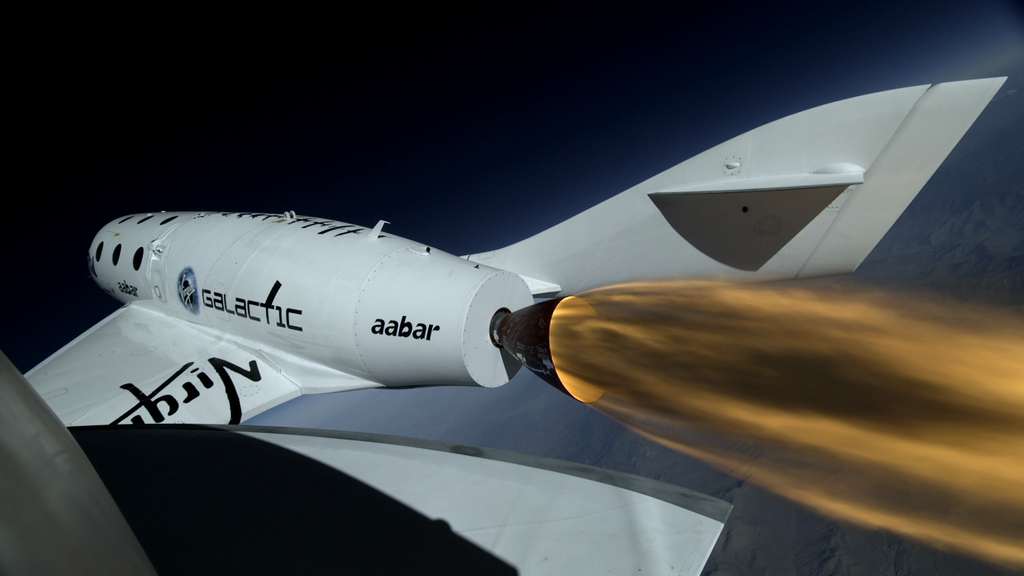
Monday morning Virgin Galactic and their partners at Scaled Composites reached a new milestone in their commercial sub-orbital spaceflight program, firing SpaceShipTwo’s main engine for the first time and accelerating to supersonic speeds. The upper image shows hints of Mach diamonds, formed by a series of shock waves and expansions, in its exhaust. This is very common for rockets since most have a fixed geometry, and, by extension, a fixed Mach number and exhaust pressure. (Photo credits: Virgin Galactic and Mars Scientific)
Bottle Rocket Shock Waves
This high speed video shows schlieren photography of a bottle rocket’s exhaust. The supersonic CO2 leaving the nozzle is underexpanded, meaning its pressure is still higher than the ambient atmosphere. As a result, a series of diamond-shaped shock waves and expansion fans appear in the exhaust jet. Each shock and expansion changes the pressure of the exhaust until it ultimately reaches the same pressure as the ambient air. This distinctive pattern, also known as Mach diamonds or shock diamonds, often occurs in wake of rockets. (Video credit: P. Peterson and P. Taylor)

Shock Waves in Flight
Schlieren photography allows visualization of density gradients, such as the sharp ones created by shock waves off this T-38 aircraft flying at Mach 1.1 around 13,000 ft. Although shock waves are relatively weak at this low supersonic Mach number, they persist, as seen in the image, at significant distances from the craft. The sonic boom associated with the passage of such a vehicle overhead is due to the pressure change across a shock wave. The higher the altitude of the supersonic craft, the less intense its shock wave, and thus sonic boom, will be by the time it reaches ground level. (Photo credit: NASA)