Search results for: “shear”

  • Breaking With a Wave

    Breaking With a Wave

    For rocket combustion and other applications, like watering your lawn with a hose, a stream of fluid may need to be broken up into droplets. While simply spraying a liquid jet will make it break up, waving that jet back and forth will break it up faster. A recent study simulated this problem numerically to determine the exact mechanisms driving that break-up. The researchers found two major culprits.

    The first is a Kelvin-Helmholtz, or shear-based, instability. When a jet leaves the nozzle, there’s friction between it and the comparatively still air surrounding it. This creates tiny ripples in the surface that eventually grow into the distortions we can see, and it’s found in all jets, regardless of their side-to-side motion.

    The second culprit, which is only found in the oscillating jet, is a Rayleigh-Taylor instability. By moving the jet side-to-side, you’re driving the dense liquid into less dense air, which creates a different set of disturbances that also help break up the jet. The final result: swinging the jet side-to-side breaks it into smaller droplets faster. (Image and research credit: S. Schmidt et al.)

  • Using Air to Break Up Jets

    Using Air to Break Up Jets

    One method of breaking a liquid into droplets, or atomizing it, uses a slow liquid jet surrounded by an annulus of fast-moving gas. The gas along the outside of the liquid shears it, creating waves that the wind blowing past can amplify. This draws the liquid into thin ligaments that then break into droplets. This is a popular technique in rocket engines, where cryogenic liquid fuels often need to be atomized for efficient combustion. When things aren’t working exactly right, however, the liquid jet may start flapping instead of breaking up. In this case, the jet will swing back and forth, but only part of it will atomize. For a rocket engine, this would mean slower and less efficient combustion – never desirable outcomes! (Image credit: A. Delon et al.)

  • Wild Extrusions

    Wild Extrusions

    In their continuing quest to squish all the things, the Hydraulic Press channel recently debuted a tool with a series of small holes they can extrude various substances through. The video features several great extrusions, including oobleck, temperature-sensitive putty, cheese, and crayons (above). Most of these substances are non-Newtonian fluids of some kind, and the extreme forces the hydraulic press causes makes for some wild effects.

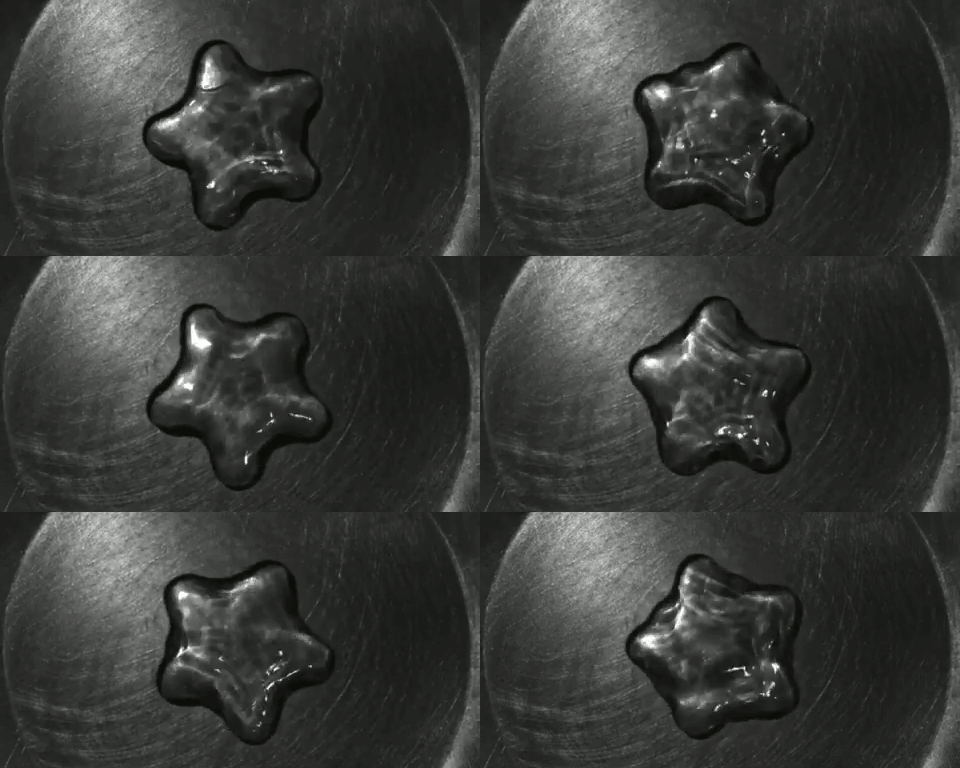
    Many of the substances, including the crayons above, display signs of the sharkskin instability in their rough edges. When non-Newtonian fluids (like the paraffin wax in crayons) get extruded quickly, the material at the edges experiences a lot of friction and shear when trying to flow along the wall of the hole. When the fluid finally breaks free, the region along the outside accelerates to match the speed of fluid at the center of the extrusion. Parts of the mixture may resist that acceleration, resulting in the uneven edges seen above. (Video credit: Hydraulic Press Channel; GIF via Colossal)

  • Plasma From a Jet of Water

    Plasma From a Jet of Water

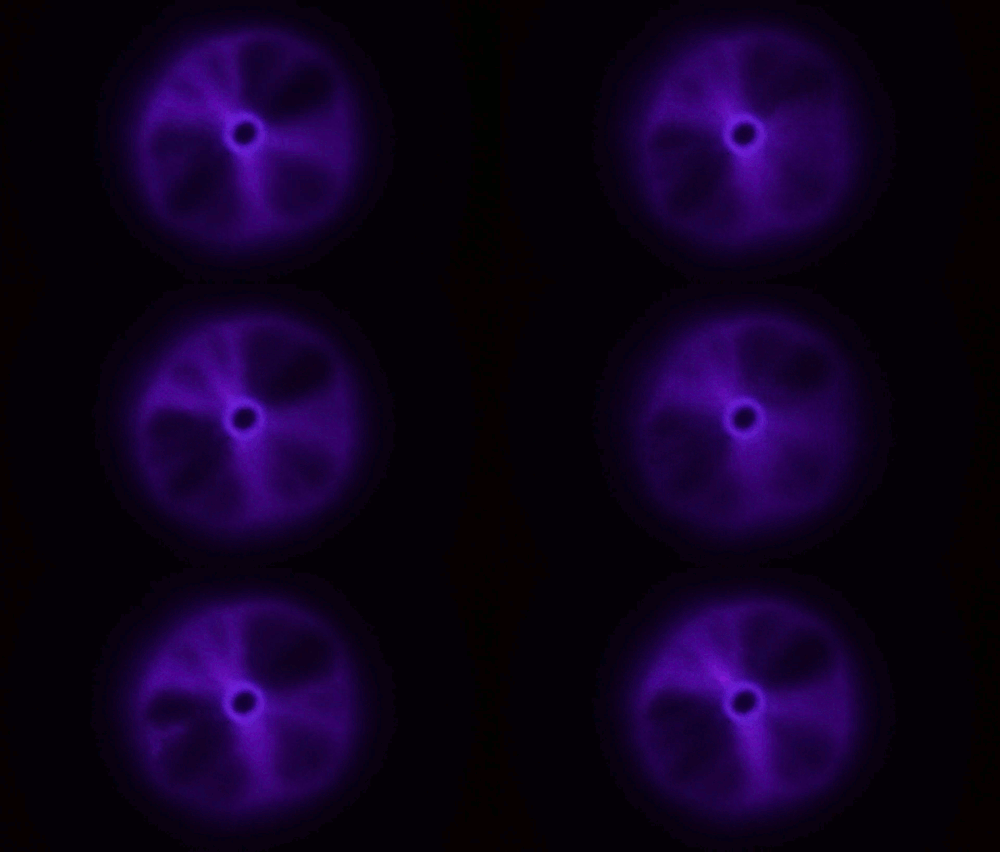
    There aren’t many naturally occurring plasmas in our daily lives; by far the most common one is lightning. So it’s something of a surprise that a stream of water hitting a material like glass is able to produce a toroid of plasma like the one above. The key here, though, is that the jet has to be fast – to the tune of 200 meters per second or faster. When a jet of deionized water strikes a surface at that speed, the water has to take a very sharp, 90-degree turn, and, thanks to the polar nature of water, this causes a (negative) charge to build up at that turn. It’s akin to rubbing a balloon to build up a static charge, and it’s known as a triboelectric effect. At rest (and without high shear rates), water and glass in contact tend to create in a positive charge in the water. The plasma is created when an arc forms through air between those two charged areas.

    Experiments in helium environments create a different color of plasma, confirming that the arc definitely travels through the gas. Similarly, if you use regular water instead of deionized water, the conductivity of the dissolved salts in the water is enough to prevent the necessary build up of charge. (Image and research credit: M. Gharib et al.; video credit: Applied Science; submitted by Kam-Yung Soh)

  • Twisting to Pack

    Twisting to Pack

    One conventional method for packing granular materials is to tap them repeatedly, but a new study suggests that twisting is a faster method. Researchers poured thousands of dice into a cylinder, then twisted the container back and forth. When the acceleration caused by the change in direction exceeded a threshold value, the dice worked their way into ordered layers of concentric rings over ~10,000 cycles. Reaching this maximum packing density through tapping requires a specially designed method where the tapping characteristics change over time. With twisting, shear forces transmitted from the walls of the container tend to align the flat surfaces of the dice, providing an efficient method of ordering if the acceleration is large enough. The researchers hope methods like this may be useful where tapping works poorly, such as in microgravity. (Image and research credit: K. Asencio et al.; via APS Physics; submitted by Kam-Yung Soh)

  • Bioluminescent Plankton

    Bioluminescent Plankton

    In nutrient-rich marine waters, dinoflagellates, a type of plankton, can flourish. At night, these tiny organisms are responsible for incredible blue light displays in the water. The dinoflagellates produce two chemicals – luciferase and luciferin – that, when combined, produce a distinctive blue glow. The plankton use this as a defense against predators, creating a flash of blue light when triggered by the shear stress of something swimming nearby. The dinoflagellates respond to any sudden application of shear stress this way, so they glow not only for predators, but for any disturbance – mobula rays (above), sea lions, boats, or even just a hand splashing in the water. In person, the experience feels downright magical. I had the opportunity to experience bioluminescence in the Galapagos last year. The light from the dinoflagellates is incredibly difficult to film because it can be so dim, but as the BBC demonstrates, it’s well worth the effort it takes to capture. (Image credit: BBC from Blue Planet II and Attenborough’s Life That Glows; video credit: BBC Earth)

  • Jupiter’s Atmosphere

    Jupiter’s Atmosphere

    Jupiter’s atmosphere is fascinatingly complex and stunningly beautiful. This close-up from the Juno spacecraft shows a region called STB Spectre, located in Jupiter’s South Temperate Belt. The bluish area to the right is a long-lived storm that’s bordering on very different atmospheric conditions to the left. Shear from these storms moving past one another creates many of the curling waves we see in the image. These are examples of the Kelvin-Helmholtz instability, which generates ocean waves here on Earth, creates spectacular clouds in our atmosphere, and is even responsible for waves in galaxy clusters. Check out some of the other amazing images Juno has sent back of our solar system’s largest planet. (Image credit: NASA/JPL-Caltech/SwRI/MSSS/R. Tkachenko; via Gizmodo)

  • Jupiter On Display

    Jupiter On Display

    The rich detail of Jupiter’s atmosphere is on full display in this enhanced-color image from the Juno spacecraft. (Full resolution version here – trust me, you want to click that link.) To the north, on the left side of the image, Jupiter’s Great Red Spot swirls. To the center and right, the cloud bands of Jupiter’s southern region are coming into view. The color enhancements really highlight eddies on the edge of these bands. These are examples of Kelvin-Helmholtz instabilities caused by shear between cloud bands moving at different speeds. Within the bands, smaller vortices spin. Some of these are anti-cyclones, high-pressure storm systems found all over the planet. Jupiter’s atmosphere still holds many mysteries for scientists, but I love how every gorgeous image Juno sends back shows fluid physics written larger than life across our solar system’s biggest planet. (Image credit: NASA/JPL-Caltech/SwRI/MSSS/G. Eichstädt /S. Doran; via Gizmodo)

  • Wrinkling Drops

    Wrinkling Drops

    When a viscous drop falls into a pool of a less viscous liquid, the drop can deform into some beautiful and complex shapes. Typically, shear forces between the drop and its surroundings cause a vortex ring to roll up and advect downward, thereby stretching the remainder of the drop into thin sheets that can buckle and wrinkle. Here the drop is about 150 times more viscous than the pool and impacts at 1.45 m/s, making a rather energetic entry. The vortex ring (not visible) has stretched the drop’s remains downward while a buoyant bubble caught by the impact pulls some of the drop back toward the surface. As a result, the thin sheets of the drop’s fluid are buckling and folding back on themselves like an elaborate and delicate glass sculpture. This entire paper is full of gorgeous images and videos. Be sure to check them out! (Image and research credit: E. Q. Li et al.; see supplemental info zip for videos)

  • Featured Video Play Icon

    Kelvin-Helmholtz Instability

    Sixty Symbols has a great new video explaining the laboratory set-up for demoing a Kelvin-Helmholtz instability. You can see a close-up from the demo above. Here the pink liquid is fresh water and the blue is slightly denser salt water. When the tank holding them is tipped, the lighter fresh water flows upward while the salt water flows down. This creates a big velocity gradient and lots of shear at the interface between them. The situation is unstable, meaning that any slight waviness that forms between the two layers will grow (exponentially, in this case). Note that for several long seconds, it seems like nothing is happening. That’s when any perturbations in the system are too small for us to see. But because the instability causes those perturbations to grow at an exponential rate, we see the interface go from a slight waviness to a complete mess in only a couple of seconds. The Kelvin-Helmholtz instability is incredibly common in nature, appearing in clouds, ocean waves, other planets’ atmospheres, and even in galaxy clusters! (Image and video credit: Sixty Symbols)