Even when the sky is mostly blue, there’s a lot going on at different altitudes. The winds do not move in a consistent direction or at the same speed, something which becomes apparent when watching clouds move relative to one another. When different layers of air move past one another, there is shear between them, not unlike the friction you feel when running your hand along a table. Under the right circumstances, this shear creates Kelvin-Helmholtz waves like the ones in this image over Helena Valley, Montana. Fast-moving winds (blowing right to left in the image) above a layer of clouds created these breaking wave-like curls. The same phenomenon creates many of the ocean’s waves from the shear caused by wind blowing across water. (Image credit: H. Martin, via EPOD)
Search results for: “shear”

Asymmetric Wakes
When a ship moves through water, it leaves a distinctive V-shaped wake behind it. In the nineteenth century, Lord Kelvin made some of the earliest theoretical studies of this phenomenon, calculating that the arms of the V should have an angle of about 39 degrees, known as the Kelvin angle. But that theoretical result doesn’t always hold in practice.
More recently, researchers calculated and experimentally verified an extension to Kelvin’s theory, one which accounts for what’s going on below the water. They found that any shear in the currents below the surface can strongly affect the shape of a boat’s wake, altering angles and creating asymmetry between the two sides. The results have practical consequences, too: they help predict the wave resistance ships will encounter when traversing areas with substantial subsurface shear, like near the mouths of river deltas. (Image credit: M. Adams; research credit: B. Smeltzer et al.; submitted by clogwog)

Storing Memory in Bubbles
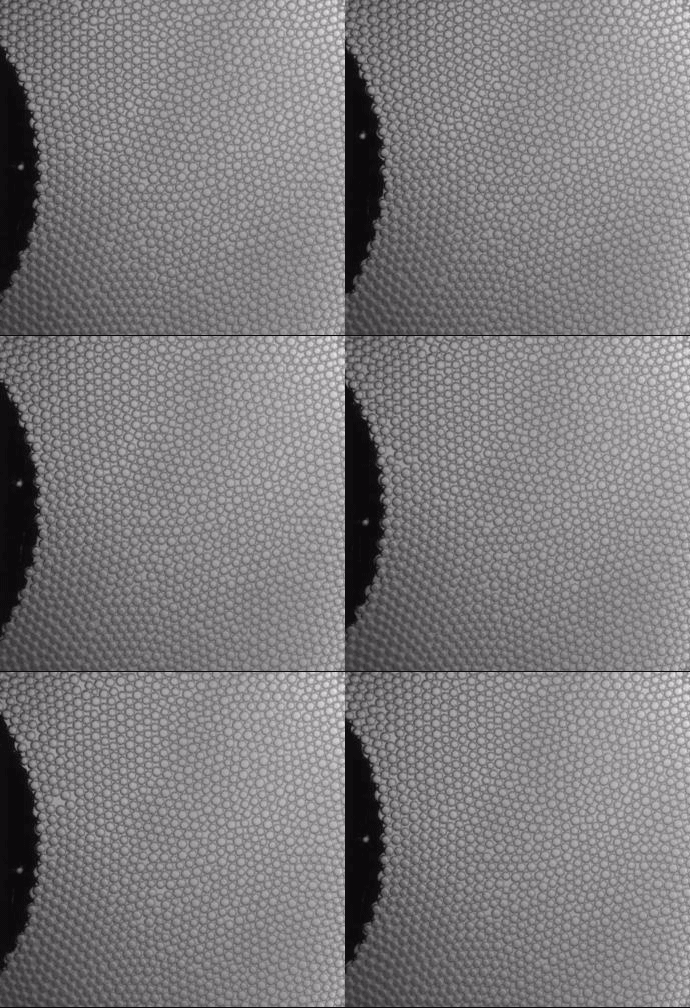
Soft systems like this bubble raft can retain memory of how they reached their current configuration. Because the bubbles are different sizes, they cannot pack into a crystalline structure, and because they’re too close together to move easily, they cannot reconfigure into their most efficient packing. This leaves the system out of equilibrium, which is key to its memory.
By shearing the bubbles between a spinning inner ring (left in image) and a stationary outer one (not shown) several times, researchers found they they could coax the bubbles into a configuration that was unresponsive to further shearing at that amplitude.
Once the bubbles were configured, the scientists could sweep through many shear amplitudes and look for the one with the smallest response. This was always the “remembered” shear amplitude. Effectively, the system can record and read out values similar to the way a computer bit does. Bubbles are no replacement for silicon, though. In this case, scientists are more interested in what memory in these systems can teach us about other, similar mechanical systems and how they respond to forces. (Image and research credit: S. Mukherji et al.; via Physics Today; submitted by Kam-Yung Soh)

Floccing Particles
Adding particles to a viscous fluid can create unexpected complications, thanks to the interplay of fluid and solid interactions. Here we see a dilute mixture of dark spherical particles suspended in a layer of fluid cushioned between the walls of an inner and outer cylinder. Initially, the particles are evenly distributed, but when the inner cylinder begins to rotate, it shears the fluid layer. Hydrodynamic forces assemble the particles together into loose conglomerates known as flocs. Once the particles form these log-like shapes, they remain stable thanks to the balance between viscous drag on particles and the attractive forces that pull particles toward one another. (Image and research credit: Z. Varga et al.; submitted by Thibaut D.)

Using Bubbles to Keep Clean
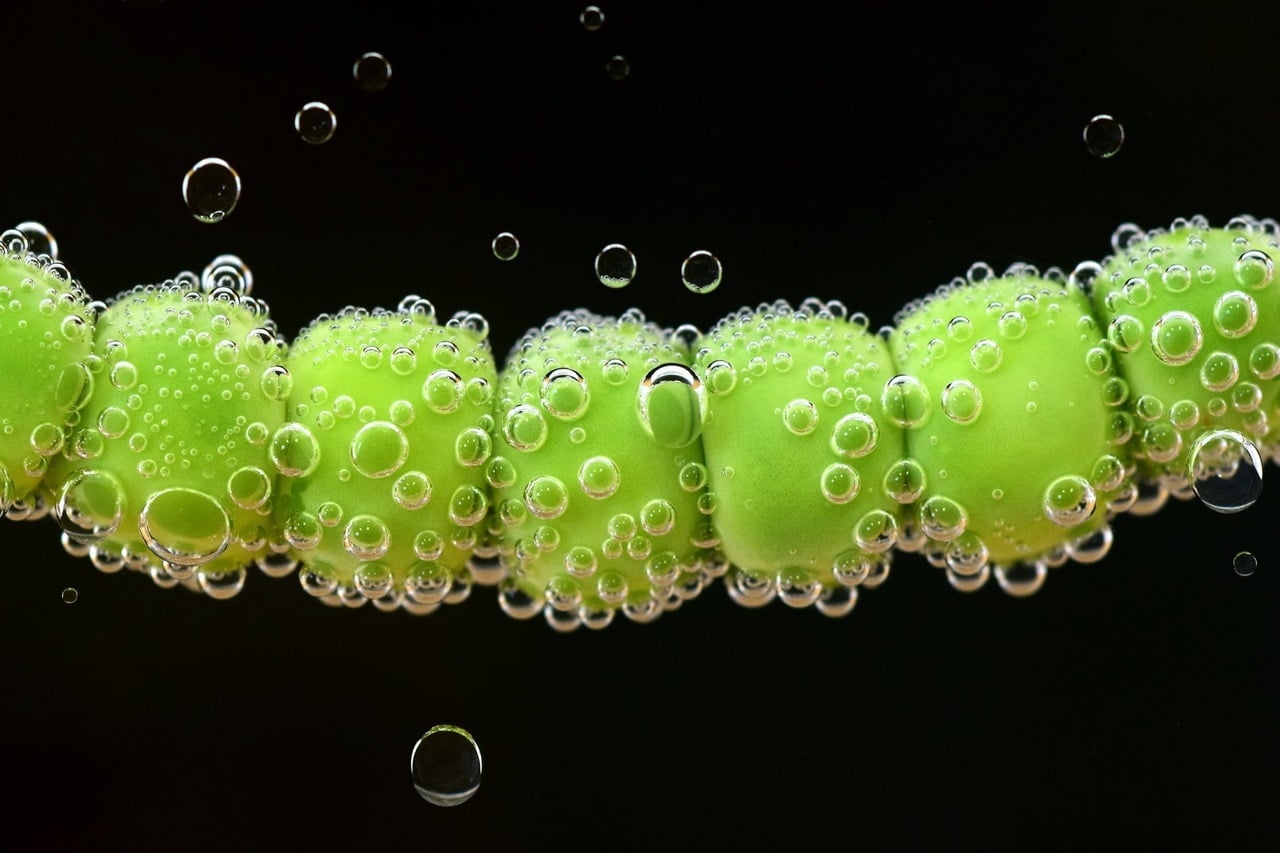
Keeping produce clean of foodborne pathogens is a serious issue, and delicate fruits and vegetables like tomatoes cannot withstand intense procedures like cavitation-based cleaning. But a new study suggests that simple air bubbles may have the power to keep our produce free of germs.
In particular, researchers studied air bubbles injected into water as they bounced and slid along an inclined solid surface. They found that as a bubble approaches a tilted surface, it squeezes a thin film of liquid between itself and the surface. That flow creates a shear stress that pushes contaminants like E. coli away from the point of impact. When the bubble bounces away, fluid gets sucked back into the void left behind, creating more shear stress. In their experiments and simulations, the team measured shear stresses greater than 300 Pa, more than double what’s needed to remove foodborne bacteria like Listeria. (Image credit: Pixabay; research credit: E. Esmaili et al.)

Viscoelasticity and Liquid Armor
One proposed method for improving bulletproof armor is adding a layer of non-Newtonian fluid that can help absorb and dissipate the kinetic energy of impact. Thus far researchers have focused on shear-thickening fluids – like cornstarch-based oobleck – filled with particles that jam together if anything tries to deform them quickly. But is it really the shear-thickening properties that matter for high-speed impacts?
To test this, researchers studied projectile impact on three fluids: water (left), a cornstarch mixture (not shown), and a shear-thinning polymer mixture (right). Water is Newtonian, and it slows down the projectile but doesn’t stop it. Both the shear-thickening cornstarch and the shear-thinning polymer mixture do stop the projectile. And by modeling the impacts, researchers concluded that the key to that energy dissipation isn’t their shear-related behaviors: it’s the fact that both fluids are viscoelastic.
That means that these fluids show both viscous (fluid-like) and elastic (solid-like) responses depending on the timescale of an impact. The high speed of the impact triggered a strong viscous response in both fluids, bringing the projectile to a halt. And if, as the researchers suggest, it’s a fluid’s viscoelasticity that matters most, that widens the field of candidates when it comes to developing a fluid-based armor. (Image and research credit: T. de Goede et al.)

Zones and Stars
Large-scale rotating flows, like planetary atmospheres, tend to organize themselves into zones. Within a zone, flow remains essentially in an east-west direction and serves as a barrier that keeps heat or other elements from mixing from one zone to another. This is, for example, how the tropical trade winds work here on Earth.
Stars, on the other hand, don’t show this kind of zonal behavior. The reason, it turns out, is their magnetic fields. When there’s no magnetic influence, even weak shear in a rotating flow is enough to start organizing turbulent fluctuations and grow a zonal flow. This tendency toward growth is known as the zonostrophic instability. But when you add a magnetic field, instead of organizing the hydrodynamic disturbances, that weak shear strengthens the magnetic ones, which in turn suppress the flow fluctuations. As a result, the hydrodynamic disturbances cannot grow and no zonal flow forms.
Researchers think this mechanism can explain both why stars have no zonal flows and just how deep zones can penetrate inside the atmospheres of gas giants like Jupiter and Saturn before their planet’s magnetic field suppresses them. (Image credit: NASA; research credit: N. Constantinou and J. Parker, arXiv; via LLNL News; submitted by Stephanie N.)

Reducing Viscosity With Bacteria
Conventional wisdom – and the Second Law of Thermodynamics – require all fluids to have viscosity, with the noted and bizarre exception of superfluids, which can flow with zero viscosity. In essence, you cannot have work (i.e. flow) for free. Some effort has to be lost to resistance.
But scientists have discovered, bizarrely, that adding bacteria to water can result in zero or even negative viscosities – meaning that effort is required to keep the flow from accelerating. Before you ask, no, this is not a recipe for a perpetual motion machine. What happens when the bacteria-filled fluid is sheared is that the bacteria align and start collectively swimming. The local effects of each bacteria combine en masse to create a fluid that seemingly flows on its own. In the end, though, it’s the bacteria that are supplying that work. It certainly raises interesting prospects, though, for harnessing the power of bacterial superfluids. See the links below for more. (Image credit: M. Copeland, source; research credit: S. Guo et al., A. Loisy et al.; via Quanta; submitted by Kam-Yung Soh)

A Star Drop
There are many ways to make a droplet oscillate in a star-shape – like vibrating its surface or using acoustic waves to excite it – but these methods involve externally forcing the droplet’s oscillation. Leidenfrost drops – liquids levitating on a film of their own vapor caused by the extremely hot surface below – turn themselves into stars. It all starts with the constant evaporation driven by the heat below. This creates a thin, fast-moving layer of vapor flowing beneath the drop. That vapor shears the drop, causing capillary waves – essentially ripples – that travel through the drop in a characteristic way. Those ripples in turn cause pressure oscillations in the vapor layer, alternately squeezing and releasing it. Feedback from the vapor layer then drives the droplet into star-shaped oscillations. Under the right conditions, water drops can form stars with as many as 13 points! (Image and research credit: X. Ma and J. Burton, source)

The Kaye Effect
Allow a stream of shampoo to fall into a pile and you’ll catch a glimpse of the bizarre Kaye effect. A jet of shampoo will briefly rise up before becoming chaotic and falling. The key to this behavior is the shear-thinning of the shampoo. When the shampoo is just sitting on a surface, it’s quite viscous, but slide your hand across it, and the shampoo will become much less resistant to flowing.
When the jet of falling shampoo hits the pile, it creates a little dimple. Sometimes the incoming jet hits that dimple and slips along it, thanks to a sudden decrease in viscosity. That can send an outgoing jet of shampoo riding off the dimple like a ramp. As the dimple deepens, the outgoing streamer rises up until it hits the incoming jet and becomes unstable. The shampoo streamer collapses, only to be restarted when a new dimple forms. (Image and video credit: S. Mould; h/t to Guillaume D.)