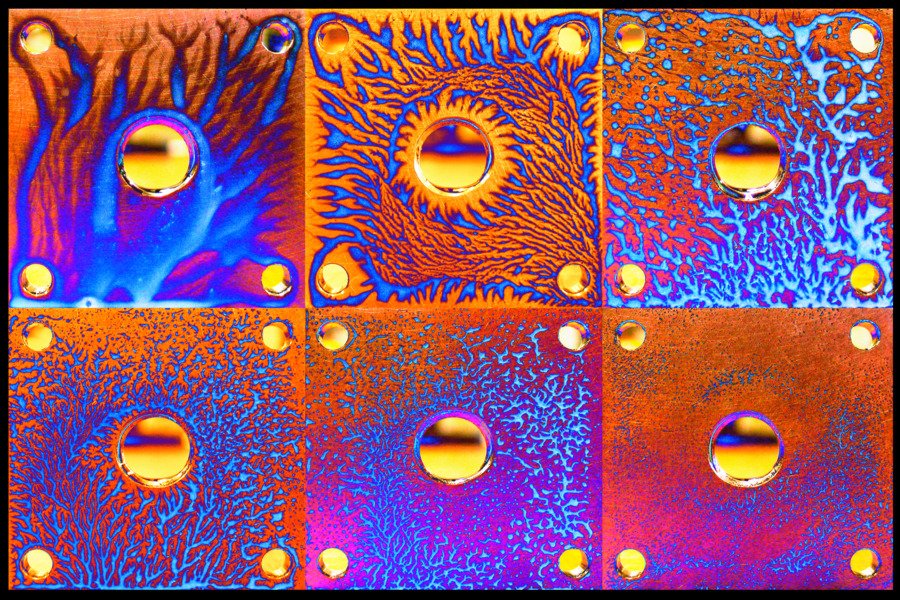
Fluid phenomena can show up in unexpected places. The collage above shows patterns formed when an aluminum block is lifted during wet sanding, a polishing technique. The dendritic fingers are formed from oil and the slurry of sanded particles being polished away. They are an example of the Saffman-Taylor instability, which forms when less viscous fluids (oil) protrude into a more viscous one (the slurry). Each image contains a different concentration of oil, resulting in very different fingering patterns. (Image credit: D. Lopez)
Search results for: “lift”

Reader Question: Rudders

Reader le-mec writes:
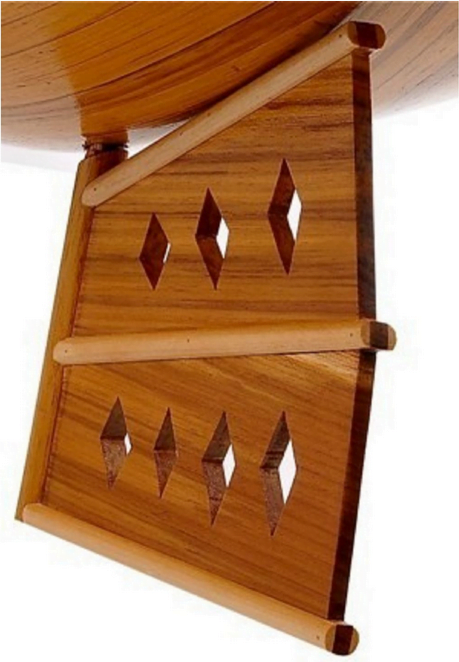
My question involves “fenestrated rudders”, a Chinese invention that
involved cutting diamond-shaped holes in the rudders of ancient Chinese
sailing ships (known as Junks). According to several articles (on the
internet, ha ha), it reduces the amount of effort required to steer the
ship at higher speeds with “no loss of function”. All I can find is
anecdotal evidence and I’d like to know if these claims hold water or if
they’re just steering us in the wrong direction.First off:

Now, I’m no expert on ships or sailing, but let’s talk rudders. Ships use rudders for steering. The rudder is completely submerged and turning it deflects water and creates a side force that helps steer a boat. In essence, it’s an underwater wing that generates lift in the side-to-side direction. Modern rudders even have the same shape as airfoils. That’s clearly not the case with the rudders of Chinese junks, but flat plates are a lot easier to make.
There’s another key feature of the junk’s rudder, and that’s the way it’s mounted. The junk’s rudder attaches to the ship such that it rotates about its leading edge. This makes it an unbalanced rudder. More modern rudders are typically mounted so that they rotate around an axis that’s partway back on the rudder. This is called a balanced rudder; I’ve illustrated both below.

The advantage of the balanced rudder is that it’s easier to turn. You can see this for yourself without adding water into the equation. Imagine holding a big rectangular sheet. If you hold it by one edge and try to rotate it, you can do it, but it’s kind of difficult. If you instead hold it about a third of the way across, you’ll find rotating it easier. Once you have a fluid moving past, it will only magnify how hard it is to turn the rudder.
So the Chinese junks had rudders that were harder to handle (by later ship-building standards) to begin with. By putting holes in the rudder, they equalized the pressure on either face of the rudder. That does make it easier to steer, since the helmsman is no longer fighting pressure differences across the rudder, but it would also reduce steering efficiency. It’s likely, however, given the slow speed of the junks, large rudder area, and their low hydrodynamic efficiency to begin with, that any drop in efficiency was negligible compared to the reduction in force necessary to steer.
Since modern designs rely on foil shapes to generate pressure differences (and therefore side force) across the rudder, adding holes to them would be a bad idea. But back in the Song dynasty, the fenestrated rudder was major advance in nautical engineering!
(Image credits: Chinese junk ship model – Premier Ship Models; Joffrey applauding – HBO; Rudder diagram – N. Sharp)

Rio 2016: Synchro Swimming and Water Polo
Both synchronized swimming and water polo require competitors to hold themselves stable above the water’s surface without touching the pool’s bottom. One of the basic techniques for doing so in both sports is known as the eggbeater kick, shown above. The eggbeater kick is very similar to the motion for the breaststroke’s kick, but it’s performed upright and with alternating leg motions, sweeping a clockwise circle with the left leg and a counterclockwise one with the right.
A swimmer typically stays afloat due to a buoyant force equal to the weight of the volume of water the swimmer displaces. Rising further out the water means reducing the buoyant force, so the swimmer must generate other forces to counter their weight. The eggbeater kick does this two ways. First, as the swimmer sweeps their foot around, it acts like a hydrofoil, generating lift that holds the swimmer up. Second, other parts of the kick cycle force water downward, which, by Newton’s third law, pushes the swimmer up.
Keeping a wide stance and sweeping the legs alternately allows the athlete to balance the horizontal forces their motions create while keeping the upward forces generated relatively constant. This gives them a stable, arms-free platform that’s a foundation for everything else their sport requires. (Image credits: GettyImages; The Studio WLV, source)
Previously: How buoyancy helps swimmers
Join us throughout the Rio Olympics for more fluid dynamics in sports. If you love FYFD, please help support the site!

Rio 2016: Rugby

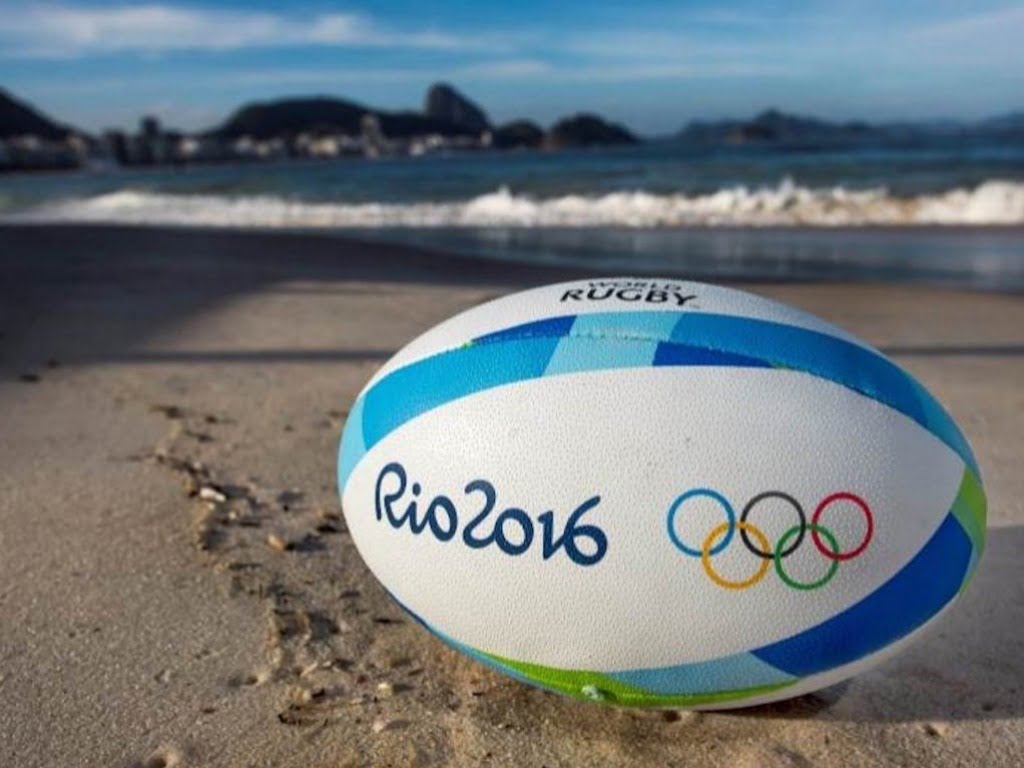
The sport of rugby returns to the Olympics in Rio this year. Rugby’s ball is somewhat similar in size and shape to an American football, but it is a little wider and more rounded. Aerodynamically, this means that the rugby ball has more drag, but it is also more stable in flight, allowing players to pass and kick accurately, with or without a spiral.
As seen in the flow visualizations above, air travels up and around the ball before separating on the far side. The more the ball is tilted, the larger this separated region is and the greater the drag. At the same time, though, that tilt provides lift on the ball. The ideal orientation is the one with the largest ratio of lift force and drag force. For a rugby ball, this occurs at about 40 degrees.(Image credits: Planet Rugby; A. Vance et al.)
Previously: The aerodynamics of the American football
Join us throughout the Rio Olympics for more fluid dynamics in sports. If you love FYFD, please help support the site!

Sharks Swimming Sideways
Like many sharks, the great hammerhead shark is negatively buoyant, meaning that, absent other forces, it would sink in water. To compensate, sharks generate lift with their pectoral (side) fins to offset their weight. Their dorsal (top) fin is used to generate the horizontal forces needed for control and turning. However, both captive and wild great hammerhead sharks tend to swim rolled partway onto their sides. The reason for this unusual behavior is hydrodynamic – it is more efficient for the shark. Unlike other species, the great hammerhead has a dorsal fin that is longer than its pectoral fins. By tipping sideways, the shark effectively creates a larger lifting span and is able to induce less drag than when it swims upright. Models show that swimming on their sides requires ~8% less energy than swimming upright! (Image credit: N. Payne et al., source)

The Knuckleball
For more than a century, athletes have used the zigzagging path of a knuckleball to confound their opponents. Knuckleballing is best known in baseball but appears also in volleyball, soccer, and cricket. It occurs when the ball has little to no spin. The source of the knuckleball’s confusing trajectory, according to a new study, is the unsteadiness of the lift forces around the ball. As the ball flies, tiny variations occur in the flow on either side, causing small variations to the lift as well. Using experiments and numerical models, the researchers established that this white noise in the lift forces is sufficient to cause knuckleball-like path changes.
They were also able to explain why some sports see the knuckleball effect and others don’t. The wavelength of the deviations – the distance between a zig and a zag – is relatively long, so knuckleballing can only be noticed if the distance the ball flies is long enough for the deviation to be apparent. Additionally, the side-to-side motion is largest when flow on the ball is transitioning from laminar to turbulent flow, so knuckleballing also requires a very particular (and usually low) initial speed. (Image credit: L. Kang; research credit: B. Texier et al.; submitted by @1307phaezr)

Daily Fluids, Part 2
We play with fluid dynamics all the time, though we don’t always think of it as such. Here are a few ways it shows up in the ways we play:

Aerodynamics
This is the study of air moving past an object. Whether you’re throwing a paper plane, flying a kite, or riding a bike, aerodynamics has an impact on what you’re doing.
Lift
Skipping a rock won’t work unless its impact generates some lift, but we see lift in lots of other places, too, from birds and planes to racecars and sailboats.
Magnus Effect
The Magnus effect relates to lift forces on a spinning object. It can affect the way a frisbee flies, but we see it a lot in ball-related sports, too. The flight of golf balls, volleyballs, baseballs, and soccer balls can all be significantly impacted by the Magnus effect. Check out these videos for a primer on the Magnus effect and the reverse Magnus effect.
Bubbles
Everybody loves playing with bubbles. But they may have more of a impact than you realize, whether it’s in making the foam on your latte, enhancing the aroma of your champagne, or making your joints pop.Tune in all week for more examples of fluid dynamics in daily life. (Image credit: S. Reckinger et al., source)

Reader Question: Shower Curtains
Reader thansy asks:
Why do the bottoms of shower curtains drift in toward the water coming from the shower head?
We all know that moment. You’re minding your own business, scrubbing away, and all of a sudden, the shower curtain billows up and grabs you. Scientists have debated the cause of this behavior for years. Some argued that the curtain billowed due to hot air rising from the shower. Others claimed the fast-moving spray caused lift that pulled the curtain up. But fifteen years ago, one scientist tackled the problem computationally. He performed a numerical simulation of a shower head spraying into a bath and found that this spray of droplets creates a weak horizontal vortex in the shower.

This shower vortex has a low-pressure core at the middle, which is thought to provide the suction that causes the shower curtain to billow. The scientist, David Schmidt, was awarded the 2001 Ig Nobel Prize for his work. (Image credits: N. Paix, D. Schmidt; research credit: D. Schmidt)

Wingtip Vortices Visualized

In flight, airplane wings produce dramatic wingtip vortices. These vortices reduce the amount of lift a 3D wing produces relative to a 2D one. How much they influence the lift depends on both the strength and proximity of the vortex. The stronger and closer it is, the more detrimental its effect. One way airplane designers reduce the effects of wingtip vortices is by adding an extra section, called a winglet, to the end of the wing. Among other effects, the winglet moves the wingtip vortex further away from the main wing, which reduces its influence and allows the airplane to regain some of the lift that would otherwise be lost. (Image credits: A. Wielandt et al., source)

Flying with Large Ears

Evolution often requires compromise between competing effects. Large-eared bats, for example, rely on the size of their ears to aid their echolocation, but such large ears can hurt them aerodynamically, thus limiting their flight. Results from a recent experiment, however, suggest that large ears are not a total loss aerodynamically speaking. Researchers used particle image velocimetry to study the wakes behind free-flying, large-eared bats and found significant downward flow behind the bats’ bodies. This indicates that the bats generate some lift with their ears, body, and/or tail. The position and tilt of the ears in flight is similar to forward swept wings, which the authors suggest could help contract the wake behind the ears and reduce its negative influence on flow over the wings. Although the evidence is not yet conclusive, the study does suggest that large ears may be more aerodynamically beneficial than they appear. (Image credit: L. Johansson et al./Lund University, source; via Jalopnik)

The next FYFD webcast will be this Saturday, May 21st at 1pm EDT. My guests will be Professor Jean Hertzberg of the University of Colorado at Boulder and Professor Kate Goodman of the University of Colorado at Denver. Dr. Hertzberg is the creator of the course Flow Visualization, an interdisciplinary course combining engineering, art, and fluid dynamics. It’s a class (and website) that’s been an inspiration for me and FYFD since the early days! Dr. Goodman, an expert in engineering education, earned her PhD studying the Flow Viz course and its impact. This will be wide-ranging discussion – with everything from experimental fluid dynamics and engineering education to art, photography, and hopefully even cardiac fluid dynamics!
(Original images: P. Davis et al.; B. Moore; L. Swift et al.)