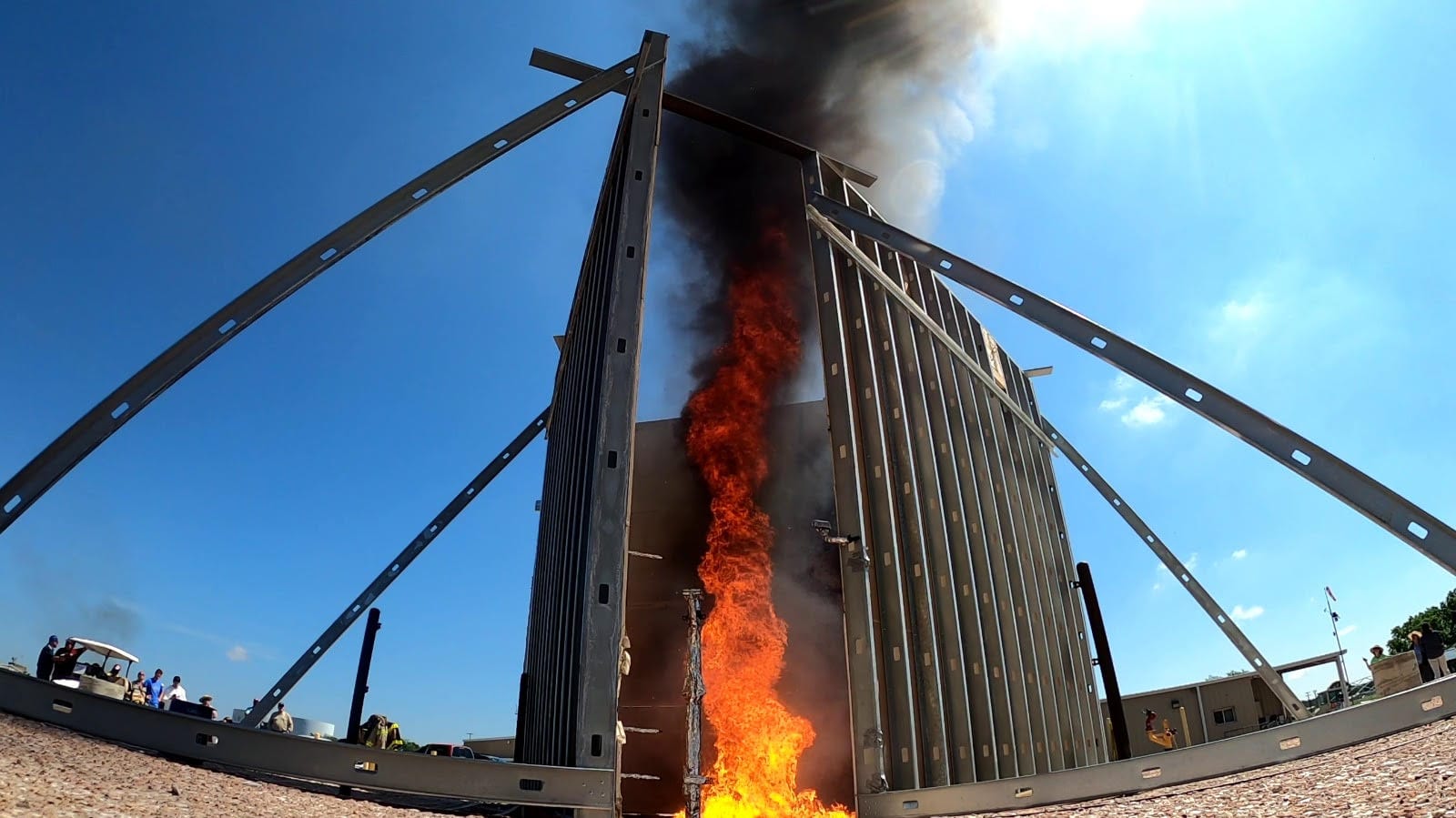
Though they are relatively infrequent, large marine oil spills, like 2010’s Deepwater Horizon, are devastating and incredibly difficult to clean up. In many locations, the “best” option for responding to such disasters is burning off the oil before it can absorb enough water to sink. But these floating fires leave behind unburned oil and produce soot. To enhance the burn, researchers are looking at the possibility of triggering large-scale fire whirls.
Often seen in wildfires, these fire vortices are intense and localized. Researchers made a more than 5-meter tall version in these experiments by arranging three walls that spun up the in-flowing air. The fire whirl sat above a pool of water topped in a layer of oil that served as the whirl’s fuel.
Within the whirl, the fire’s burn rate was 40% higher than a typical pool fire, and soot production was 40% lower–showing that fire whirls can burn cleaner. But the whirls are more finicky to start and maintain. It’s not yet clear whether such intense whirls are possible in the chaotic conditions on the ocean. (Research and image credit: W. Cui et al.; via Eos)




Leave a Reply