Search results for: “jet”

  • Inside an Evaporating Drop

    Inside an Evaporating Drop

    The evaporation of a simple droplet holds far more complexity than one would expect. If you look closely at the edge of the drop, there’s a tiny, beautiful display at work. It begins with small variations in surface tension at the contact line where solid, liquid, and gas meet. These could be caused by local temperature or concentration differences; either way, the gradient in surface tension creates a flow. It starts out as a series of microjets spaced evenly around the contact line (left). 

    As the microjets strengthen, they merge into larger and larger vortical structures (right). This kind of feature – large structures emerging from smaller ones – is known as an inverse cascade. Fluid dynamicists have traditionally studied the classic (turbulent) energy cascade, where kinetic energy moves from large scales into smaller ones, but researchers are beginning to recognize more situations where the inverse cascade occurs, such as in the storms of Jupiter. (Image and research credit: A. Ghasemi et al., source)

  • The Bouncing Drop

    The Bouncing Drop

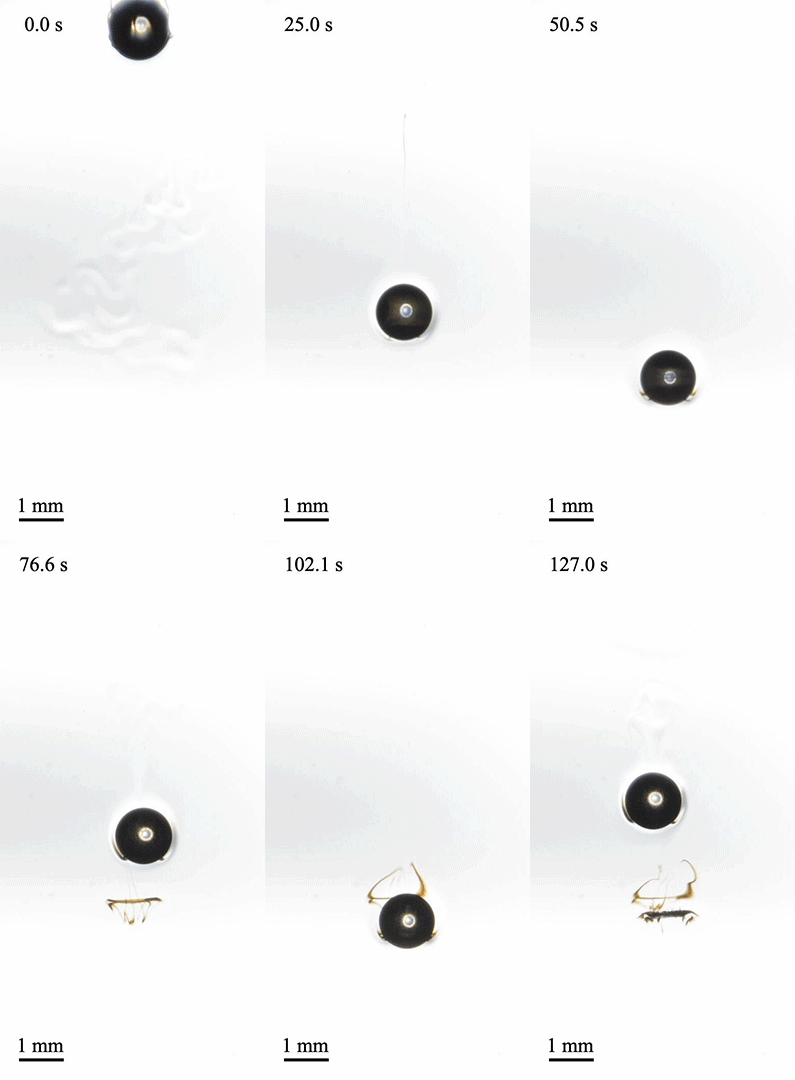
    For a droplet to bounce, we expect it to hit a wall or a sharp interface of some kind. But in a new study, researchers demonstrate a droplet that bounces with neither. Shown above is an oil droplet sinking through a stratified mixture of ethanol (toward the top) and water (toward the bottom). Because the oil is heavier than ethanol, it initially sinks, dragging some of the ethanol with it as it falls. Over time, some of that ethanol rises again, forming what’s known as a buoyant jet.

    Simultaneously, the gradient of ethanol to water between the top and bottom of the drop creates an imbalance in surface tension. The ethanol near the top of the drop has a lower surface tension than the water at the bottom. This creates a downward Marangoni flow along the drop interface.

    The bounce itself happens quickly after a long, slow sinking period. As the drop’s sinking slows, the buoyant jet weakens until it disappears completely. At the same time, the downward Marangoni flow pulls fresh ethanol-rich fluid toward the top of the drop. That increases the surface tension difference and strengthens the Marangoni flow, creating a positive feedback loop. In less than a second, the Marangoni flow increases by two orders of magnitude, pulling so hard that the drop shoots upward.

    That resets the cycle by weakening the Marangoni flow and strengthening the buoyant jet. The droplet can continue bouncing for about 30 minutes until the concentration gradient is so well-mixed that the cycle can’t continue. (Image and research credit: Y. Li et al.; via APS Physics; submitted by Kam-Yung Soh)

  • Astrophysical Turbulence

    Astrophysical Turbulence

    Subsonic turbulence – like the random and chaotic motions of air and water in our everyday lives – is something we have only a limited understanding of. Our knowledge of supersonic turbulence, where shock waves and compressibility rule, is even more tenuous. In part this is because, although we can observe snapshots of supersonic turbulence in astronomical settings like the Orion Nebula shown above, we cannot watch it evolve. On these scales, features simply don’t change appreciably on human timescales.

    This has limited scientists to mostly numerical and theoretical studies of supersonic turbulence, but that is starting to change. Researchers are now building experimental set-ups that collide laser-driven plasma jets to generate boundary-free turbulence at Mach 6. Thus far, the observations are consistent with what’s been seen in nature: at low speeds, the turbulence is consistent with Kolmogorov’s theories, with energy cascading from large scales to smaller ones predictably. But as the Mach number increases, the nature of the turbulence shifts, moving toward the large density fluctuations seen in nebulae and other astrophysical realms. (Image credit: F. Battistella; research credit: T. White et al.; see also Nature Astronomy; submitted by Kam-Yung Soh)

  • Featured Video Play Icon

    The Beauty of Flames

    The flickering yellow and orange flames most of us are used to thinking of are rather different from the flames researchers study. In this video, the Beauty of Science team offers a short primer on different flame shapes studied in combustion, including laminar, swirling, and jet flames. Each has its own distinctive character and may be advantageous or not, depending on the application for the flame. A laminar flame, for example, is steady, which might make it a good choice for something like a Bunsen burner, where consistency is needed. Whereas a turbulent flame is better capable of mixing fuel and oxidizer, which is key in applications like rocket engines, where that mixing can be a limiting factor in the engine’s efficiency. (Image and video credit: Beauty of Science)

  • Understanding Jupiter

    Understanding Jupiter

    The swirling clouds of Jupiter hide a complicated and mysterious interior. For decades, scientists have worked to puzzle out the inner dynamics of Jupiter’s atmosphere and what could be going on inside it to generate the flows we see visibly. Near Jupiter’s equator, we see strong jets that flow either east or west, depending on their latitude; this creates the stunning cloud bands we’re used to seeing on the planet. Toward the poles, though, things look more like what we see above – swirling but unbanded.

    Through theory, experiments, and simulations, scientists have tried to work out exactly what ingredients are necessary to make Jupiter look this way, but it’s pretty tough to recreate the conditions simply because Jupiter is so extreme. You need a lot of rotation, a lot of turbulence, and a way to stretch that turbulence if you want to imitate Jupiter. There’s been progress recently, though, and it suggests that the jets we see on Jupiter are far more than skin-deep. Instead, they likely stretch deep into the Jovian atmosphere at the equator and ride somewhat shallower toward the poles. (Image credit: NASA JPL; research credit: S. Cabanes et al.)

  • Inside a Heart

    Inside a Heart

    You may not give it much thought, but there is important fluid dynamics happening inside you every moment of every day, especially inside your heart. Of the four chambers of the heart, the left ventricle has the thickest walls, reflecting its important task: pumping oxygenated blood throughout the body. In a healthy heart (top of poster; click here for the full-size version), a vortex ring and trailing jet fill the ventricle when the mitral valve opens. Then the ventricle contracts and pumps blood out the aortic valve and into the rest of the body.

    But for individuals with a leaking aortic valve (bottom of poster), things look different. Blood leaks back through the aortic valve at the same time that the mitral valve opens to allow freshly oxygenated blood back in. The two inflows disrupt mixing in the chamber, and, instead of pumping fully-oxygenated blood into the body, the left ventricle has to struggle to pump a less-oxygenated mixture into the body. (Image credit: G. Di Labbio et al.)

    ETA: (Research paper: G. Di Labbio et al., arXiv)

  • What Drives Droplets

    What Drives Droplets

    There’s been a lot of interest recently in what goes on inside droplets made up of more than one fluid as they evaporate. This can be entertaining with liquids like whiskey or ouzo, but it has practical applications in ink-jet printing and manufacturing as well. And a new experiment suggests that we’ve been fundamentally wrong about what drives the flow inside these drops.

    As these drops evaporate, a donut-shaped recirculating vortex forms inside them, as seem in the cutaway views above. Conventional wisdom says that vortex is driven by surface tension. Evaporation of components like alcohol is more efficient at the edges of the drop, and as the alcohol evaporates, it creates a higher surface tension at the drop’s edge than at its peak. Marangoni forces then pull fluid down toward the edges, creating the vortex. That explanation is  consistent with observations of a sessile drop sitting on top of a surface (left side of images).

    But those observations are also consistent with another explanation: evaporating ethanol makes the local density higher, so alcohol-rich parts of the drop rise toward the peak while alcohol-poor regions sink. This difference in density would also create a flow pattern consistent with observations. So which is the real driver, surface tension or gravity?

    To find out, researchers flipped the drop upside-down (right side of images). When hanging, the preferred flow direction due to surface tension doesn’t change; flow should still go from the deepest point on the drop toward the edge. But gravity is swapped; alcohol-rich areas should be found near the edge and attachment points of the drop because buoyancy drives them there. And that is exactly what’s observed. The flow direction inside the hanging droplet is consistent with the direction prescribed by buoyancy-driven flow, thereby upending conventional wisdom. It turns out that gravity, not surface tension, is the major driver of internal flow in these multi-component droplets! (Image and research credit: A. Edwards et al.; via APS Physics; submitted by Kam-Yung Soh)

  • Settling in Straws

    Settling in Straws

    At some point in your life, you’ve probably stuck your finger over the end of a straw and used it to pick up the liquid you’re drinking. If you lift the straw so that the end is still in your drink and remove your finger from the top, the liquid level in the straw will drop, then bounce up and down a couple times before it settles. This is what we see happen in the series of snapshots in the top image. Eventually, the liquid level settles at its equilibrium position, marked by the red arrow at the far right.

    The liquid has to bounce before settling because capillary forces and the liquid’s inertia are battling it out moment by moment. Just how long the rebound takes depends on the initial height of the fluid and the depth the straw is immersed at, but it doesn’t depend on the fluid’s viscosity. Lower viscosity fluids do sometimes have a neat jet (bottom image) that forms at the immersed end of the straw, though. (Image and research credit: J. Marston et al.)

  • How Mantas Filter But Never Clog

    How Mantas Filter But Never Clog

    Manta rays spend much of their time leisurely cruising through the water with their meter-wide mouths open. As they swim, they filter plankton, which makes up most of their diet, from the water. And they do so without ever clogging. 

    The inside of the manta’s mouth is lined with gill rakers (upper right), a series of comb-like teeth. When flow hits the leading edge of these (bottom), it creates a vortex that accelerates any particles caught in the flow. They essentially ricochet along the top of the gill rakers, getting led straight into the manta’s digestive system – while excess water gets deflected between the gill rakers and back out the manta’s gills. To drive this, all the manta has to do is swim; with the right flow speed, the shape of the gill rakers handles all the filtration with no additional effort. (Image credit: manta ray – G. Flood; gill rakers – M. Paig-Tran; flow vis – R. Divi et al., source; research credit: M. Paig-Tran et al.; via The Atlantic; submitted by Kam-Yung Soh)

  • Using Sound to Print

    Using Sound to Print

    Inkjet printing and other methods for directing and depositing tiny droplets rely on the force of gravity to overcome the internal forces that hold a liquid together. But that requires using a liquid with finely tuned surface tension and viscosity properties. If your fluid is too viscous, gravity simply cannot provide consistent, small droplets. So researchers are turning instead to sound waves

    Using an acoustic resonator, scientists are able to generate forces up to 100 times stronger than gravity, allowing them to precisely and repeatably form and deposit micro- and nano-sized droplets of a variety of liquids. In the images above, they’re printing tiny drops of honey, some of which they’ve placed on an Oreo cookie for scale. The researchers hope the technique will be especially useful in pharmaceutical manufacturing, where it could precisely dispense even highly viscous and non-Newtonian fluids. (Image and research credit: D. Foresti et al.; via Smithsonian Mag; submitted by Kam-Yung Soh)