
Antibubbles are peculiar and ephemeral creations. A bubble typically encloses a gas within a thin layer of fluid. As the name suggests, an antibubble does the opposite: it’s a thin film of gas enclosing a liquid droplet within a larger background liquid. That thin gas film makes antibubbles extremely delicate. Disturb it at all – as the thinning jet at the top of the animation above does – and that film will break apart, much like a soap bubble. To see more antibubble action, check out some of our previous entries, including antibubbles in a vortex and a simple way to create antibubbles. (Image credit: C. Kalelkar and S. Phansalkar, source)
Search results for: “jet”
The Driver of Hydraulic Jumps
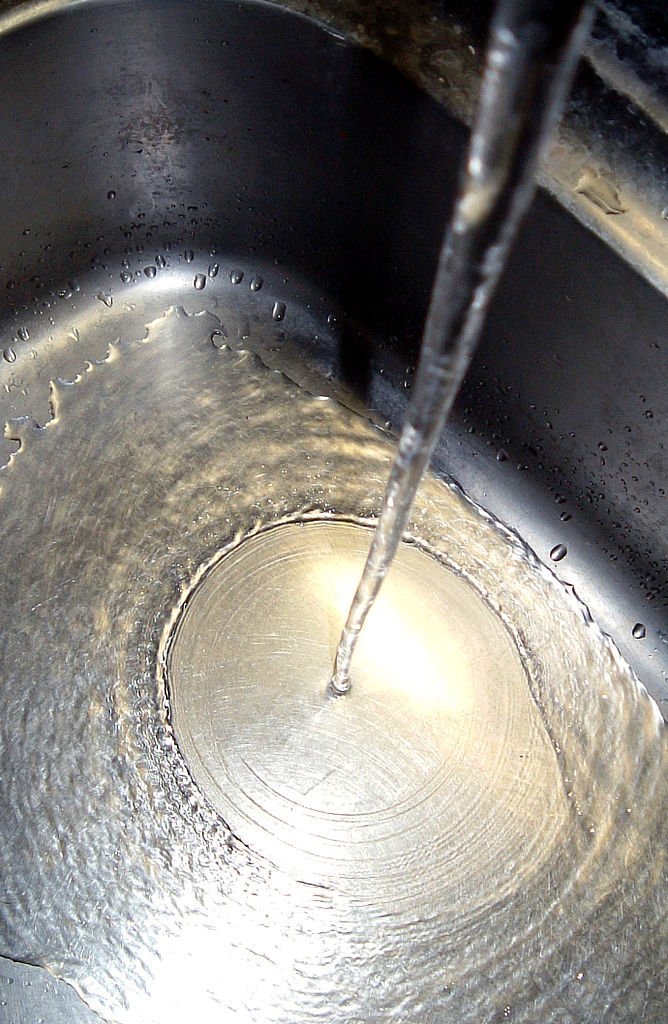
You’ve seen it a million times. When you turn on your kitchen faucet, the falling water forms a distinctive ring – known as a hydraulic jump – in the bottom of your sink. First described by Leonardo da Vinci, this phenomenon has been studied for centuries, and, for nearly all of that time, scientists assumed that gravity played a major role, even in kitchen-sink-sized hydraulic jumps. But that’s not the case.
A newly published study shows that gravity can’t be a major player in setting the radius of these small-scale hydraulic jumps because they form the same whether the jet impinges from above, below, or sideways. Instead, the researchers found that surface tension and viscosity are the parameters that determine the jump’s formation. It’s not every day that you get to overturn a centuries-old theory in physics! (Image credit: J. Kilfiger; research credit: R. Bhagat et al.; via Silicon Republic; submitted by Patrick D.)

Using Paper to Avoid Splashback


Daily life and countless pool parties have taught us all that objects falling into water create a splash. Sometimes that splash is undesirable, and while there are many ways to tune a splash – by adding surfactants or changing the fluid’s viscosity – there’s a relatively common one that’s escaped scientific study until now. Researchers looked at how splashes change when you add a thin, penetrable fabric – commonly known as toilet paper – to the water surface.
Now, the common assumption is that adding a sheet of toilet paper can prevent splashback, but the story is not quite that simple. On the left, you see a splash generated without toilet paper. Because the ball is hydrophilic (water-loving), it does not pull any air into a cavity as it passes. There’s a nice axisymmetric Worthington jet formed, and it doesn’t splash very high, although some of the satellite droplets go quite a bit higher.
On the right, we see a splash with a single sheet of toilet paper. In this case, the impact of the sphere penetrates the paper, and the way the paper deforms causes air to get sucked down into a cavity behind the ball. That creates a wider, amorphous jet that rebounds higher than the jet in clean water, though it does not shed satellite drops.
The researchers found that single and even double sheets of toilet paper can actually increase the height of the splash jet if the object penetrates them. The hole the object makes actually helps focus the jet. Adding a couple more layers, though, can eliminate splashing completely. (Image and research credit: D. Watson et al.)
A Burst of Microdroplets
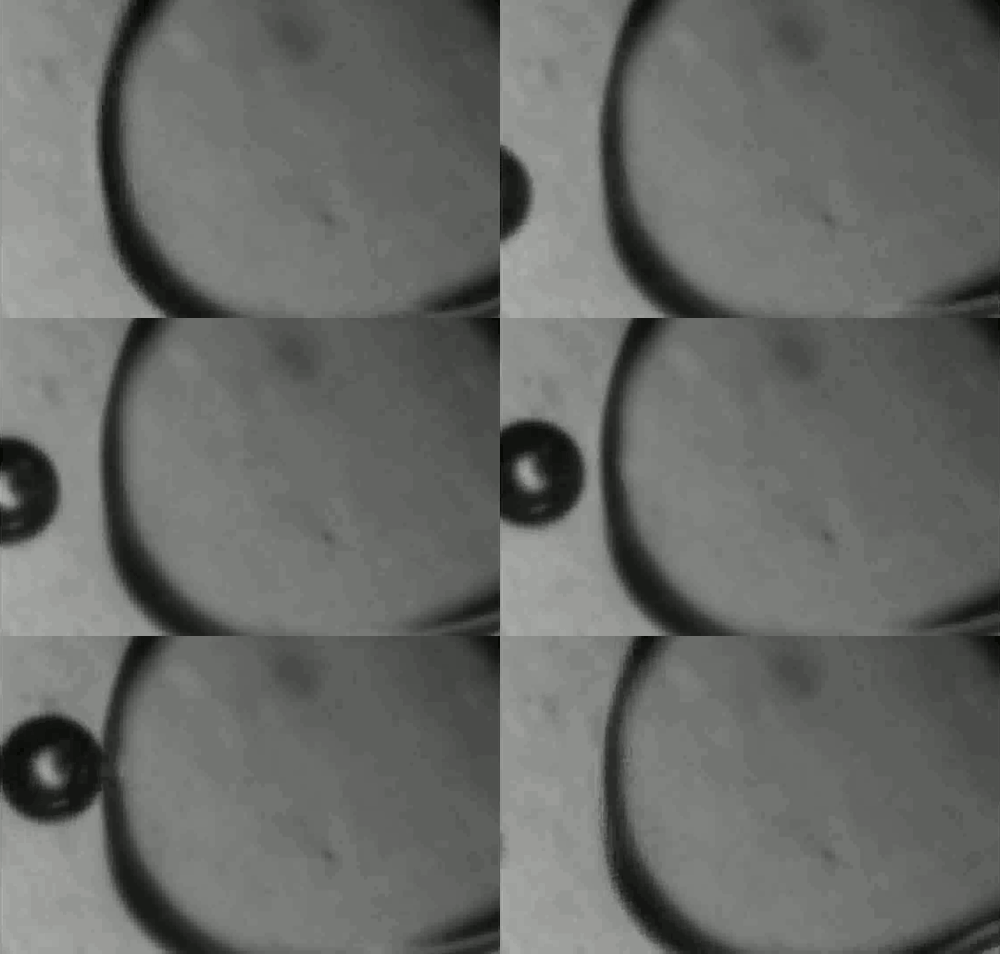
If you hold a bubbly beverage like champagne or soda near your face, you’ll feel a light mist of tiny, nearly invisible droplets.These droplets form when bubbles reach the surface and pop, generating a tiny jet that ejects an even tinier droplet, as shown in the animation above. This process is remarkably common; its occurrence in the ocean results in billions of tons of sea salt entering our atmosphere each year. Since these tiny microdroplets stay aloft for far longer than their larger brethren, understanding how they form and just how small they can be is vital for understanding their impact on climate, pathogen spreading, and other topics. A new study suggests that the minimum size for an ejected droplet is just 1% of the size of the bubble that births it. (Image and research credit: C. F. Brasz et al., source)

The Kaye Effect
Allow a stream of shampoo to fall into a pile and you’ll catch a glimpse of the bizarre Kaye effect. A jet of shampoo will briefly rise up before becoming chaotic and falling. The key to this behavior is the shear-thinning of the shampoo. When the shampoo is just sitting on a surface, it’s quite viscous, but slide your hand across it, and the shampoo will become much less resistant to flowing.
When the jet of falling shampoo hits the pile, it creates a little dimple. Sometimes the incoming jet hits that dimple and slips along it, thanks to a sudden decrease in viscosity. That can send an outgoing jet of shampoo riding off the dimple like a ramp. As the dimple deepens, the outgoing streamer rises up until it hits the incoming jet and becomes unstable. The shampoo streamer collapses, only to be restarted when a new dimple forms. (Image and video credit: S. Mould; h/t to Guillaume D.)

Breaking With a Wave
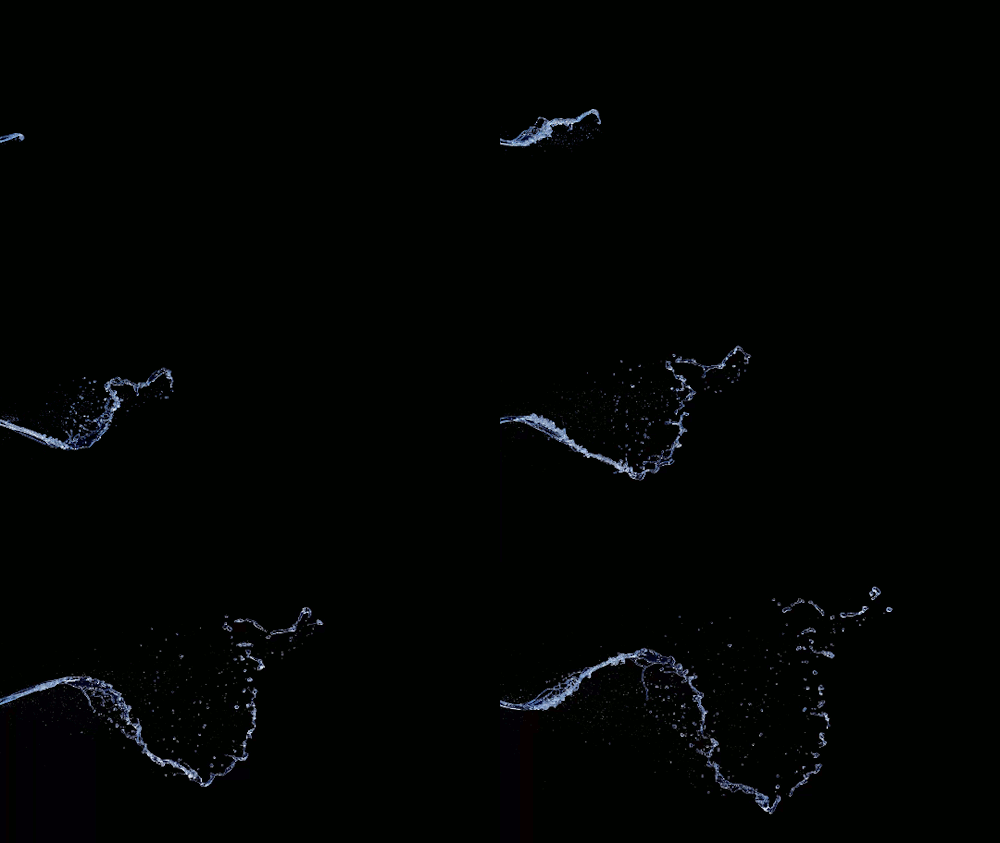
For rocket combustion and other applications, like watering your lawn with a hose, a stream of fluid may need to be broken up into droplets. While simply spraying a liquid jet will make it break up, waving that jet back and forth will break it up faster. A recent study simulated this problem numerically to determine the exact mechanisms driving that break-up. The researchers found two major culprits.
The first is a Kelvin-Helmholtz, or shear-based, instability. When a jet leaves the nozzle, there’s friction between it and the comparatively still air surrounding it. This creates tiny ripples in the surface that eventually grow into the distortions we can see, and it’s found in all jets, regardless of their side-to-side motion.
The second culprit, which is only found in the oscillating jet, is a Rayleigh-Taylor instability. By moving the jet side-to-side, you’re driving the dense liquid into less dense air, which creates a different set of disturbances that also help break up the jet. The final result: swinging the jet side-to-side breaks it into smaller droplets faster. (Image and research credit: S. Schmidt et al.)

Flying Backwards


Spend a summer afternoon floating in a kayak and chances are you’ll see some impressive aerial acrobatics from dragonflies. One of the dragonfly’s superpowers is its ability to fly backwards, which helps it evade predators and take-off from almost any orientation. To do this, the dragonfly rotates its body so that it is nearly vertical, thereby changing the direction it generates lift. In engineering terms, this is “force-vectoring,” similar to the techniques used by helicopters and vertical-take-off jets.
Scientists found that backwards-flying dragonflies could generate forces two to three times their body weight, in part due to the strong leading-edge vortices (bottom image) formed on the forewings. They also found that the hind wings are timed so that their lift is enhanced by catching the trailing vortex of the first pair of wings. Engineers hope to use what they’re learning from insect flight to build more capable flying robots. (Image and research credit: A. Bode-Oke et al., source; via Science)

Sandy Splashes
Sand and other granular materials can be strikingly fluid-like. Here the impact of a solid sphere on sand generates a splash remarkably similar to what’s seen with water. When the ball hits, it creates a crater in the surface and sends up a bowl-like spray of sand. As the ball continues falling through the sand, the grains try to fill the empty space left behind. The walls of sand collapsing around the void meet somewhere between the surface and the depth of the ball. This generates the tall jet we observe, as well as a second one under the surface that we can’t see. We know that collapse traps an air bubble under the surface because of the eruption that occurs as the jet falls. That’s the air bubble reaching the surface. (Image credit: T. Nguyen et al., source; see also R. Mikkelsen et al.)
Rim Break-Up


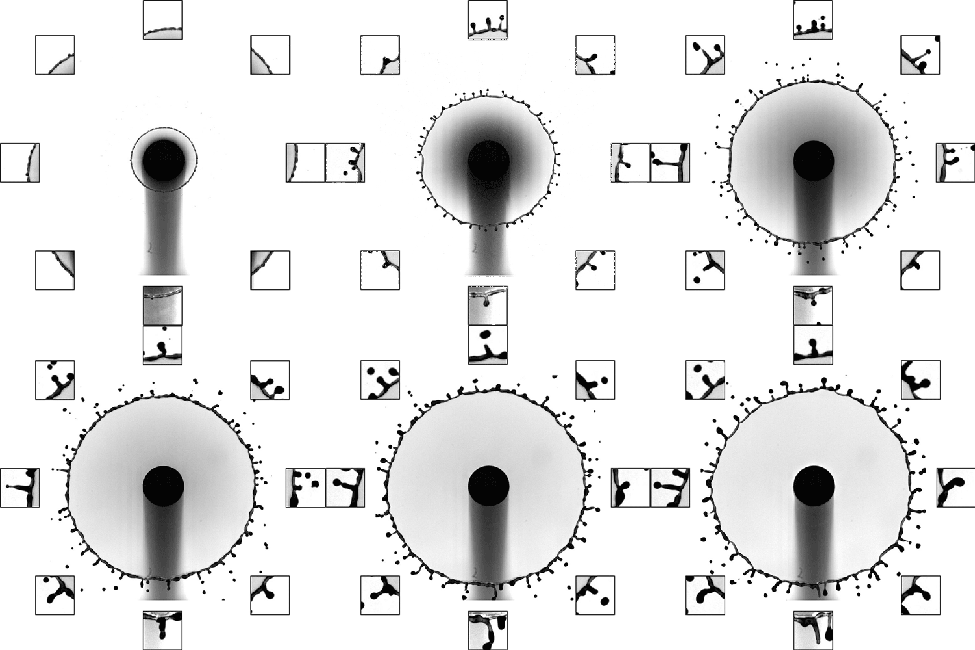
Splashing drops often expand into a liquid sheet and spray droplets from an unstable rim. Although this behavior is key to many natural and industrial processes, including disease transmission and printing, the physics of the rim formation and breakup has been difficult to unravel. But a new paper offers some exciting insight into this unsteady process.
The researchers found that if they carefully tracked the instantaneous, local acceleration and thickness of the rim, it always maintained a perfect balance between acceleration-induced forces and surface tension. That means that even though different points on the rim appear very different, there’s a universality to how they behave. They found that this rule held over a remarkably large range of situations, including across fluids of different viscosities and splashes on various surfaces. (Image and research credit: Y. Wang et al.; via MIT News; submitted by Kam-Yung Soh)

Turbulence and Star Formation
Space, as I’ve discussed previously, is surprisingly full of matter, especially clouds of dust. And yet the rate of star formation we observe is bizarrely low; the Milky Way, for example, produces only about one solar mass worth of new stars every year. If gravity were the sole force driving star formation, we’d see far more stars forming. Recent research suggests that turbulence plays a major role in regulating the star formation process, both by countering gravity’s attempts to collapse gases into a proto-star and by creating supersonic shocks that drive material together to jump-start star formation. There seem to be other important ingredients as well: young stars tend to form jets that blow material back into the interstellar clouds they’re forming in, feeding the turbulent background. For more, check out Physics Today. (Image credit: ESA/NASA/Hubble/ESO, via APOD; research credit: C. Federrath)
