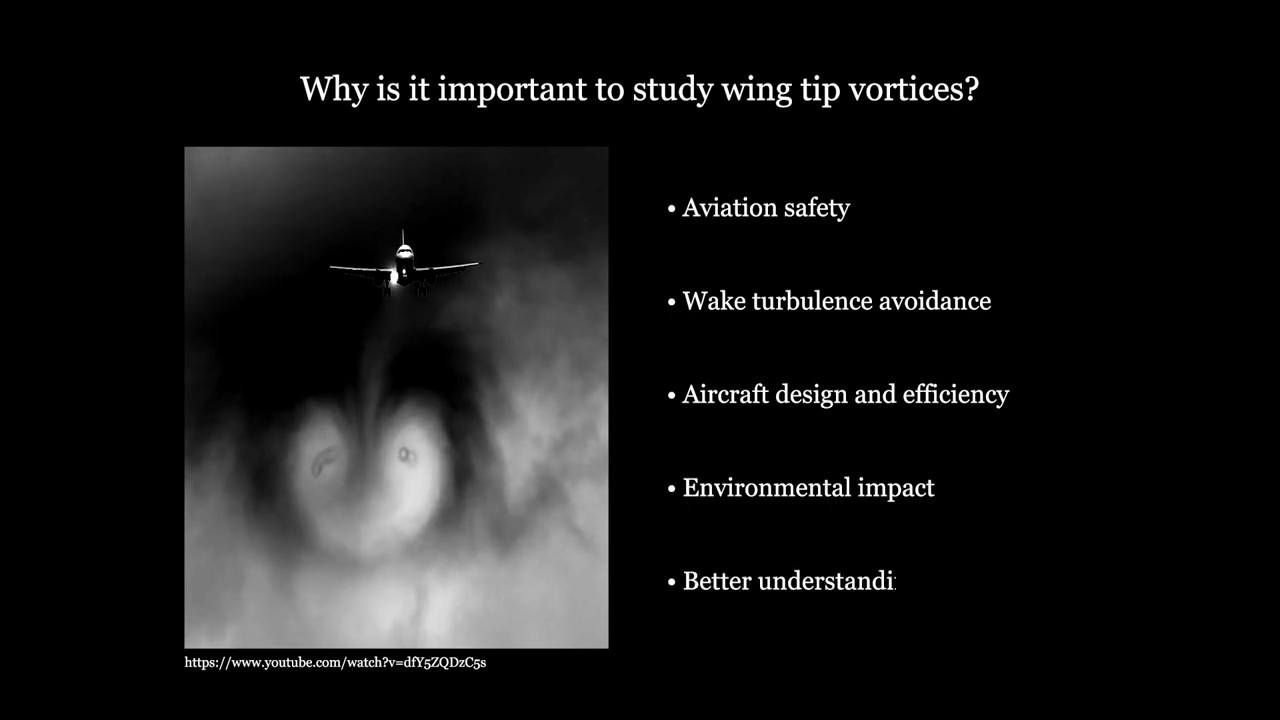
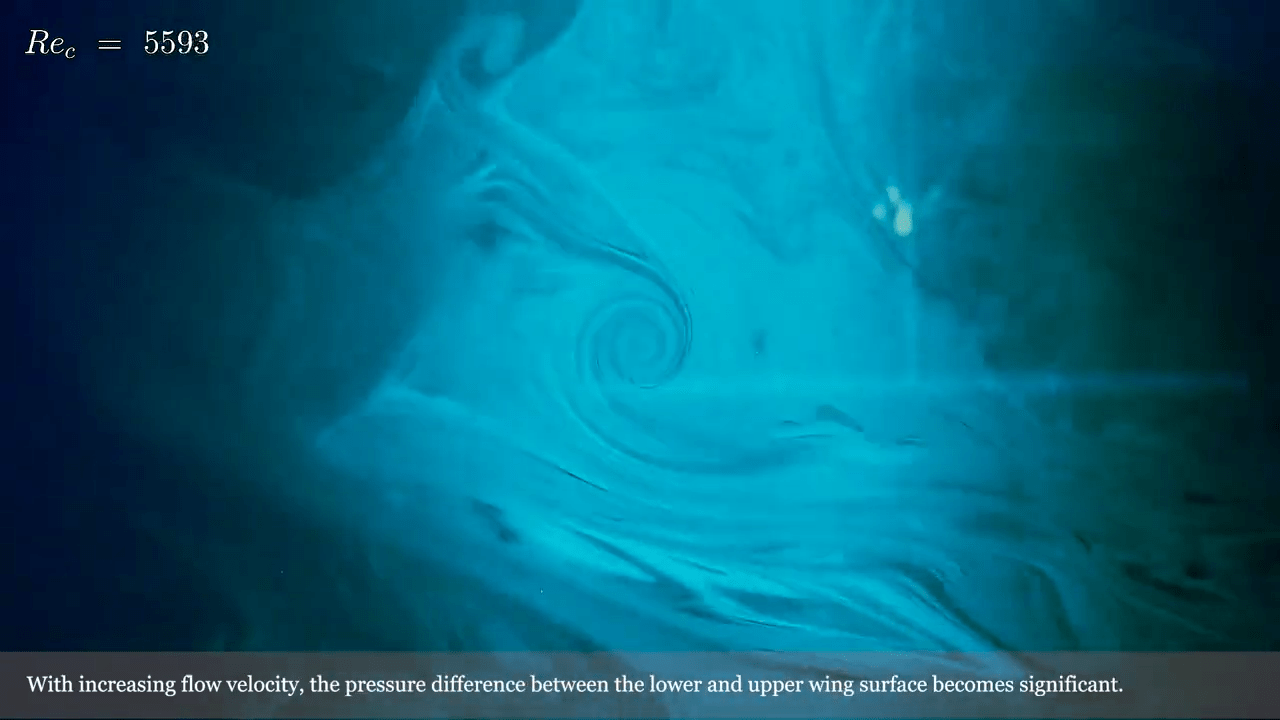
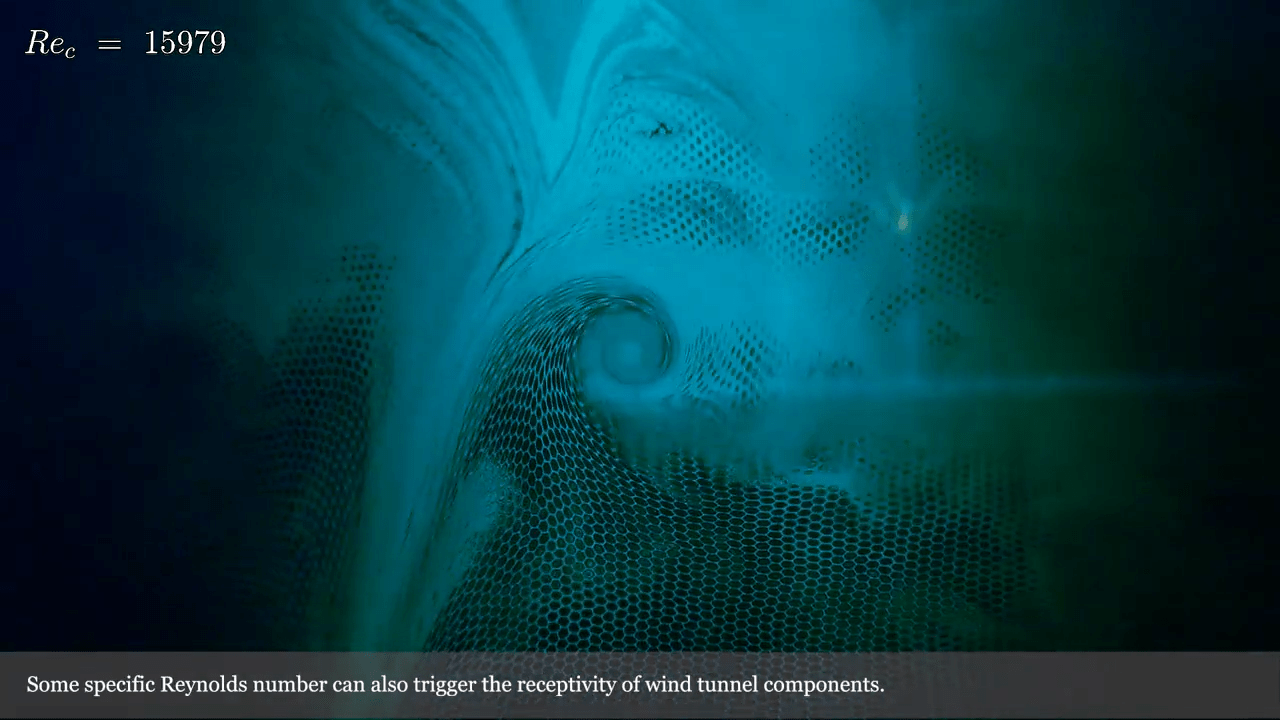
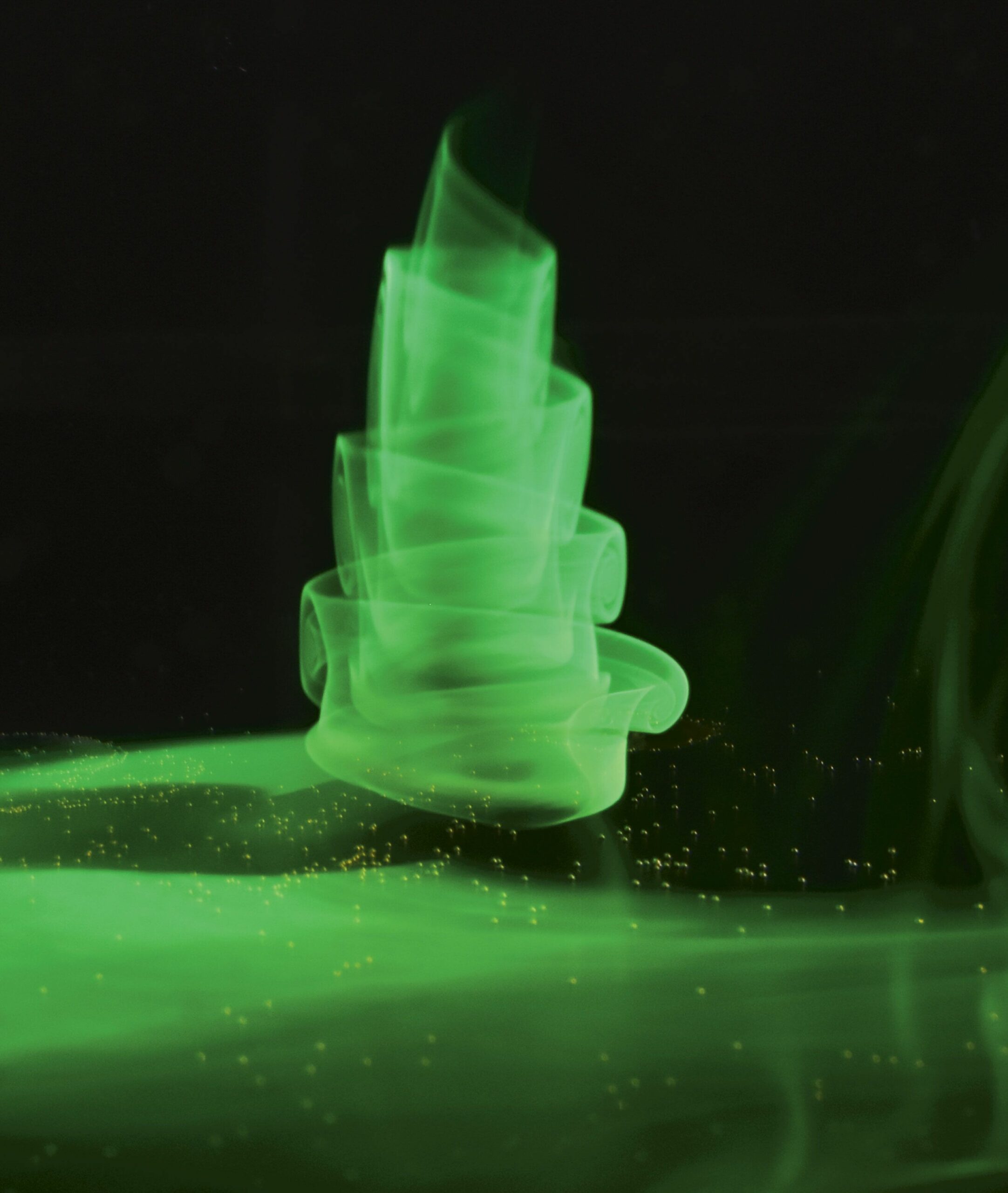
At the ends of an airplane‘s wings, the pressure difference between air on top of the wing and air below it creates a swirling vortex that extends behind the aircraft. In this video, researchers recreate this wingtip vortex in a wind tunnel, visualized with laser-illuminated smoke. The team shows the progression from no vortex to a strong, coherent vortex as the flow in the tunnel speeds up. Along the way, there are interesting asides, like the speed where the honeycomb used to smooth the upstream flow is suddenly visibly imprinted on the smoke! (Video and image credit: M. Couliou et al.)
Every child learns to blow soap bubbles, but it’s rare that we have a chance to look inside them and see the flow there. In this poster, researchers seed a growing bubble with olive oil droplets, then illuminate them with a laser. This provides a glimpse inside the bubble. In the center, we see the incoming jet dividing the bubble in two and forming two large, counter-rotating vortices. Along the left side, snapshots show the bubble’s interior as it grows and, eventually, pops. (Image credit: S. Rau et al.)
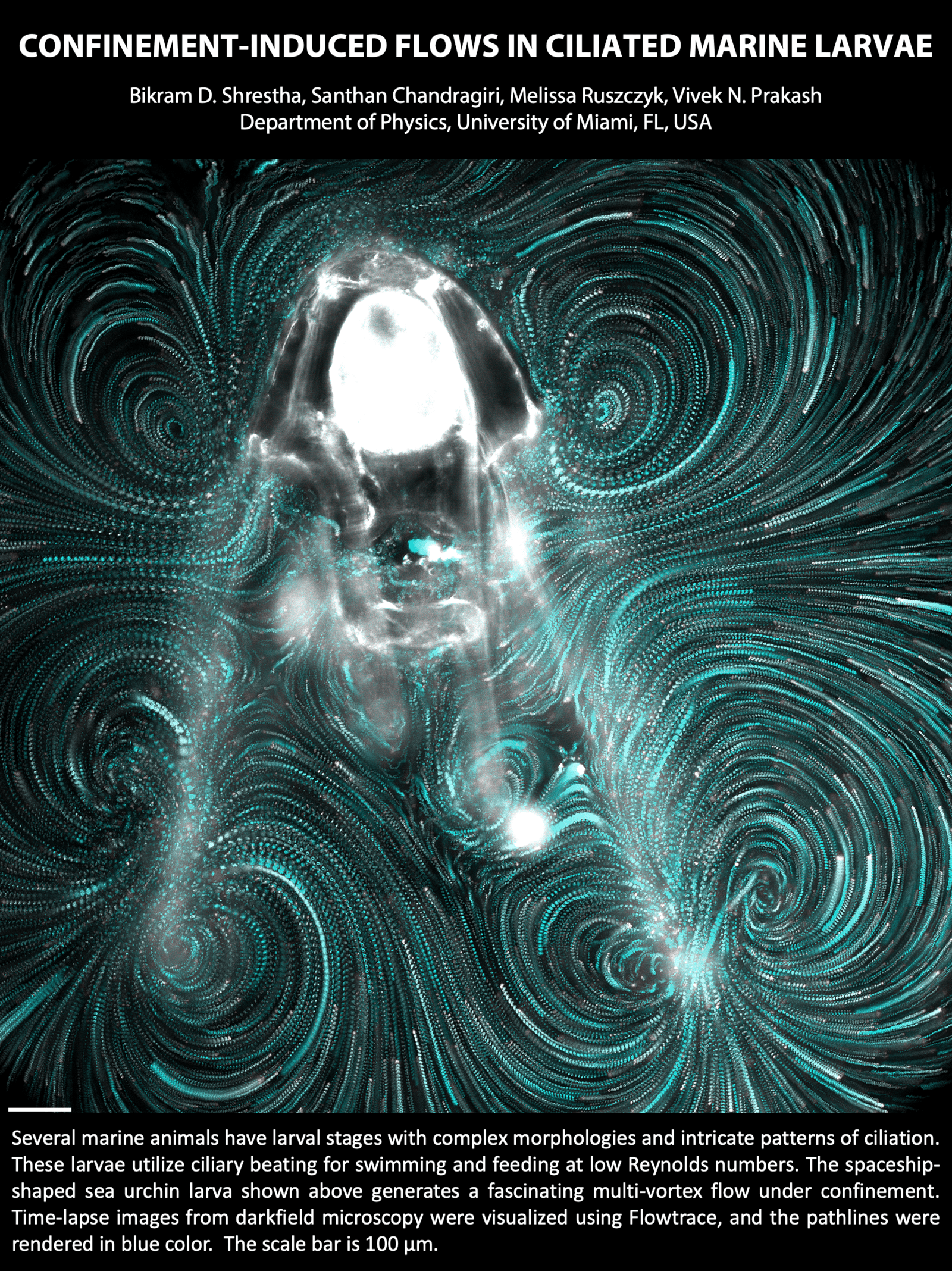
For tiny creatures, swimming through water requires techniques very different than ours. Many, like this sea urchin larva, use hair-like cilia that they beat to push fluid near their bodies. The flows generated this way are beautiful and complex, as shown above. Importantly for the larva, the flows are asymmetric; that’s critical at these scales since any symmetric back-and-forth motion will keep the larva stuck in place. (Image credit: B. Shrestha et al.)
Droplets of paint whirl to Chopin’s “Nocturne Op. 9 No. 2” in this short film from artist Thomas Blanchard. The glitter particles in the paints act as seed particles that highlight the flow within and around each drop. It’s a beautiful dance of surface tension, advection, and buoyancy. (Image and video credits: T. Blanchard; via Colossal)
James Bond notoriously orders his martinis “shaken, not stirred,” a request bartenders fulfill by shaking the cocktail over ice in a separate shaker. But what if you shake the martini glass itself? That’s the question that inspired this lovely mixology.
By shaking the martini glass gently back and forth (along the directions shown by the arrows in each image), the team created different mixing patterns within the glass. With a little food dye and pearl dust, they visualized the flows they found. By changing the viscosity of the cocktail and the speed of the swish, they made everything from a four-leaf clover to a cadre of ghosts. It seems that martini glasses hold a flow for every occasion! (Image and research credit: X. Song et al.; submitted by Zhao P.)
GFM poster, describing the experiments used to create these picturesque martinis.
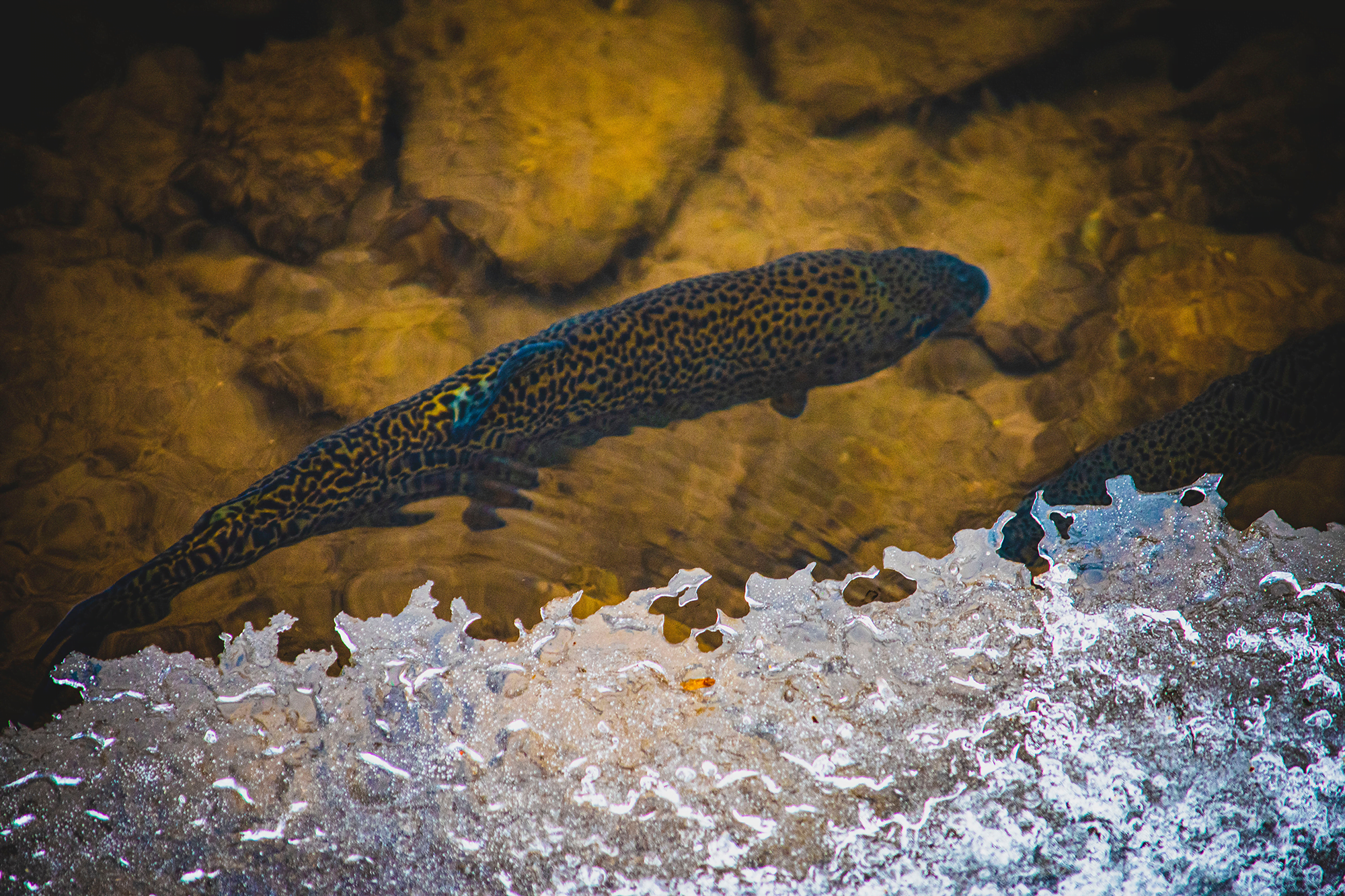
Researchers studying how fishswim have long focused on their tail fins and the flows created there. But a fish’s other fins have important effects, too, as seen in this recent study. Researchers built a CFD simulation based on observations of a swimming rainbow trout, focusing on the flow from its back and tail fins. They found that the vortex created by the back fin stabilizes and strengthens the one generated by the tail. It also played a role in reducing drag on the fish by maintaining the pressure difference across the body. When they tried changing the size and geometry of the fins, the fish’s efficiency suffered, indicating that evolution has already optimized the trout’s fins for swimming efficiency. (Image credits: top – J. Sailer, simulation – J. Guo et al.; research credit: J. Guo et al.; via APS Physics)
Visualization of flow around a digitized rainbow trout.
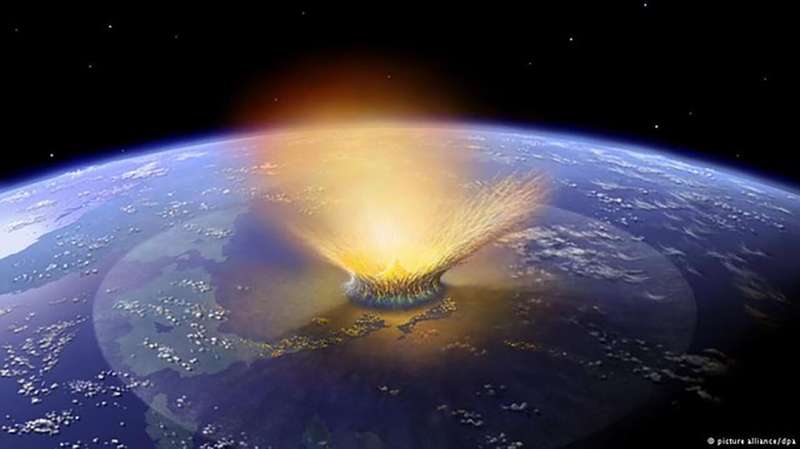
66 million years ago an asteroid struck offshore of what is now Chicxulub near the Yucatán Peninsula in Mexico. The impact and its aftermath are widely credited with a mass extinction that wiped out 75% of plant and animal life on Earth, including non-avian dinosaurs. Since the impact occurred in shallow waters, it also generated a tsunami, one over 30,000 times bigger than any in recorded history.
Snapshot showing the spreading tsunami after the asteroid’s impact. Click on the image to go to NOAA’s website and watch the video.
In this simulation, researchers show how that tsunami spread globally. The initial wave was about a mile high but stretched up to about 2.5 miles as it rushed ashore. Worldwide, every shoreline saw flows at 20 cm/s or higher as the wave hit. In the image above, black areas show the landmasses as they existed at the time, with modern borders shown in white outline. To watch the video, click on the image or head to NOAA’s visualization.
You may wonder how scientists can validate a simulation like this one, which so wildly exceeds any recorded event. One way they judged these results is by looking at the sedimentary records of the seafloor. Their results show flows large enough to scour the seafloor and disrupt any sedimentary records in those areas, and, sure enough, those regions hold no records older than the asteroid’s impact. That alignment between the geological record and the simulation’s highest flow areas helps establish confidence in the results. (Image credit: illustration – SWRI/D. Davis, simulation – NOAA; research credit: M. Range et al.; submitted by Kam-Yung Soh)
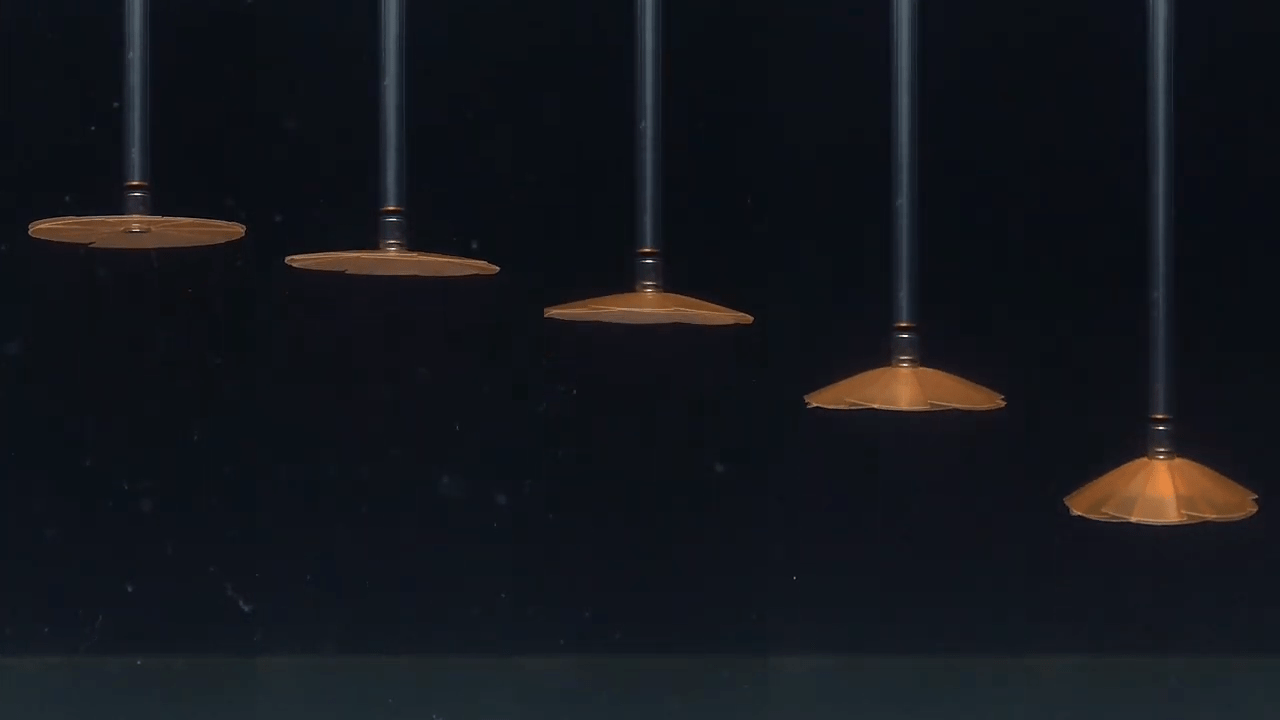
Leaves flutter and bend in the breeze, changing their shape in response to the flow. Here, researchers investigate this behavior using flexible disks pulled through water. The more flexible the disk and the faster the flow, the more cup-like the disk’s final shape. Adding tracer particles to the water allows them to visualize the flow behind the disk. Every disk leaves a donut-shaped vortex ring spinning in its wake, but the more reconfigured the disk, the narrower the vortex. This, ultimately, reduces drag on the disk. That’s why trees in heavy winds streamline their branches and leaves; that flexibility lowers the drag the tree’s roots have to anchor against. (Image and video credit: M. Baskaran et al.)
To make a vortex in the laboratory, researchers typically set a tank on a rotating platform and allow the water to drain out a hole in the center of the tank. In that case, a vortex forms over the drain (like in your bathtub!) and remains centered over the hole. In nature, though, vortices rarely follow such a simple path.
In this experiment, researchers moved the drainage hole so that it is not aligned with the tank’s axis of rotation. Although the vortex forms over the drain (marked by a yellow dot in the lower image), it quickly moves away, following a roughly circular path around the axis until it comes to a stop. Green dye marks fluid from the tank’s bottom boundary layer, which eventually gets entrained up into the vortex. (Image and research credit: R. Munro and M. Foster; via Physics Today)
Timelapse animation showing the development of the vortex. The yellow dot marks the location of the drain.
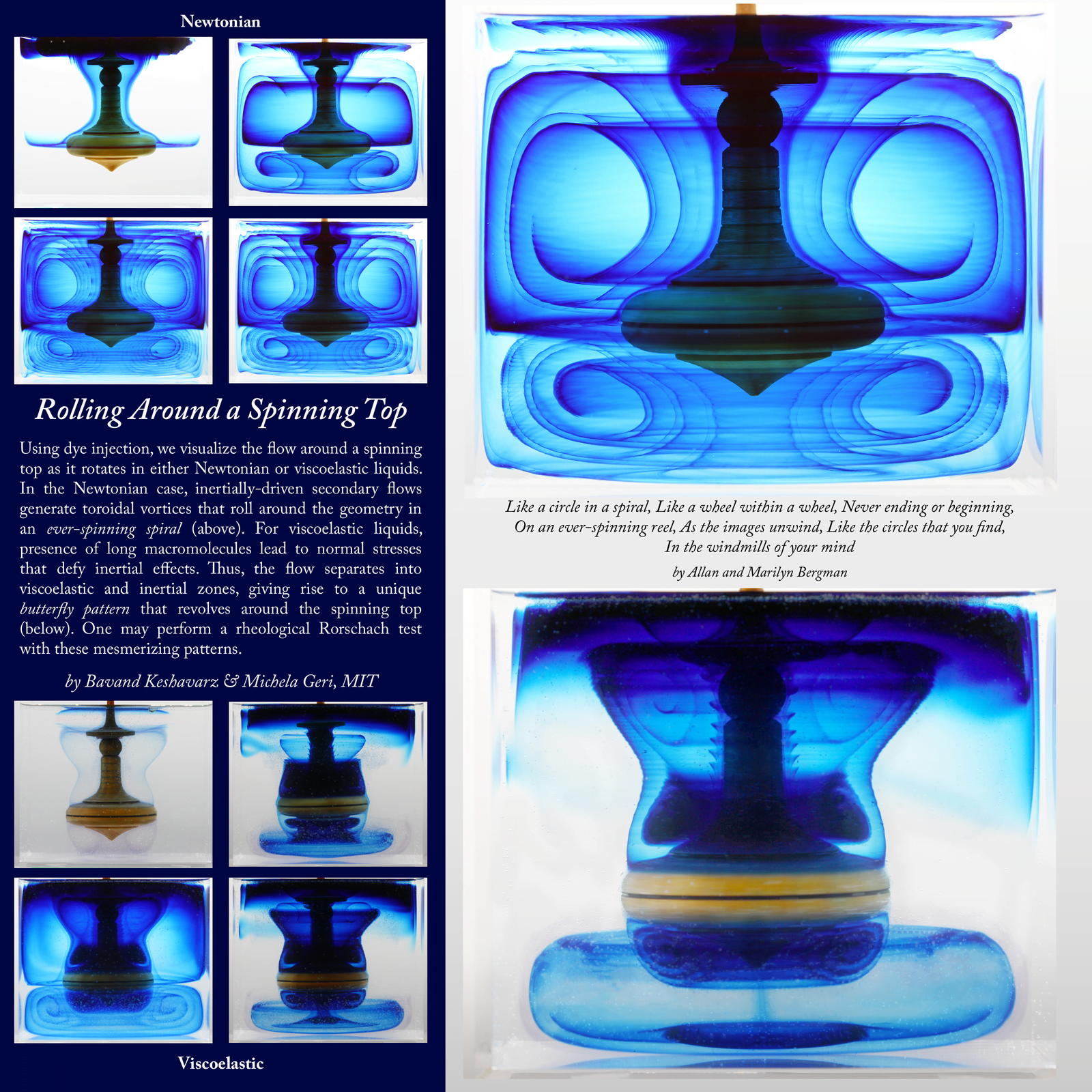
What does the flow look like around a spinning top? Here, researchers used dye to visualize what happens in a Newtonian fluid (like air or water) as well as a viscoelastic fluid. The Newtonian fluid (upper images) divides into two circulating zones, one below the top and one above. They both take the shape of a toroidal, or donut-shaped, vortex, visible here in cross-section.
The long molecules of the viscoelastic fluid lend it elasticity to resist stretching. The result is a very different flow field. Beneath the top, there’s still a toroidal vortex, though it appears tighter. But around the upper part of the top, there’s a butterfly-like region of recirculation! (Image credit: B. Keshavarz and M. Geri)