Search results for: “flow visualization”

  • Order in Chaos

    Order in Chaos

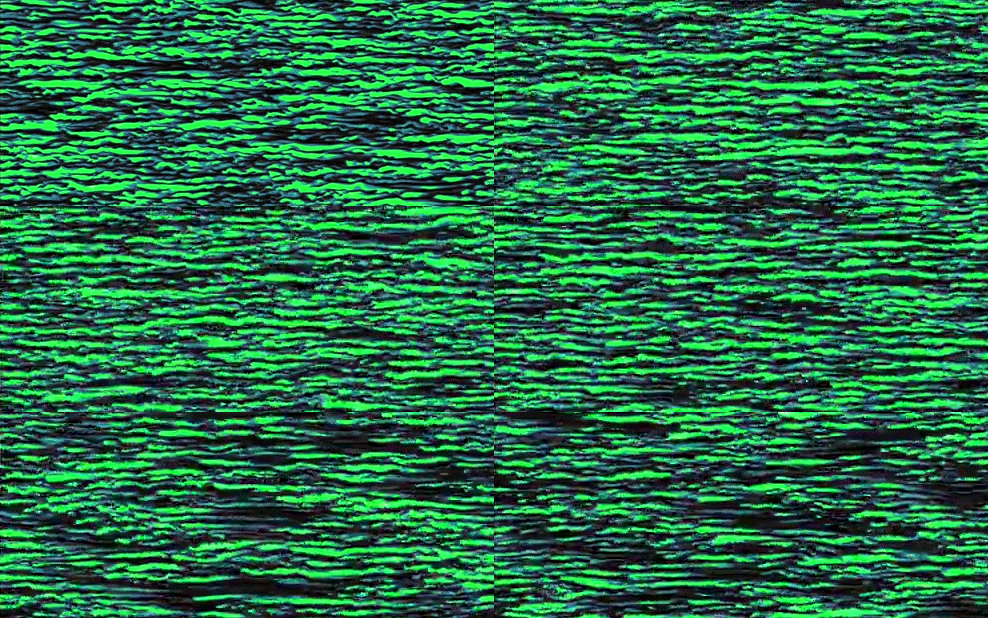
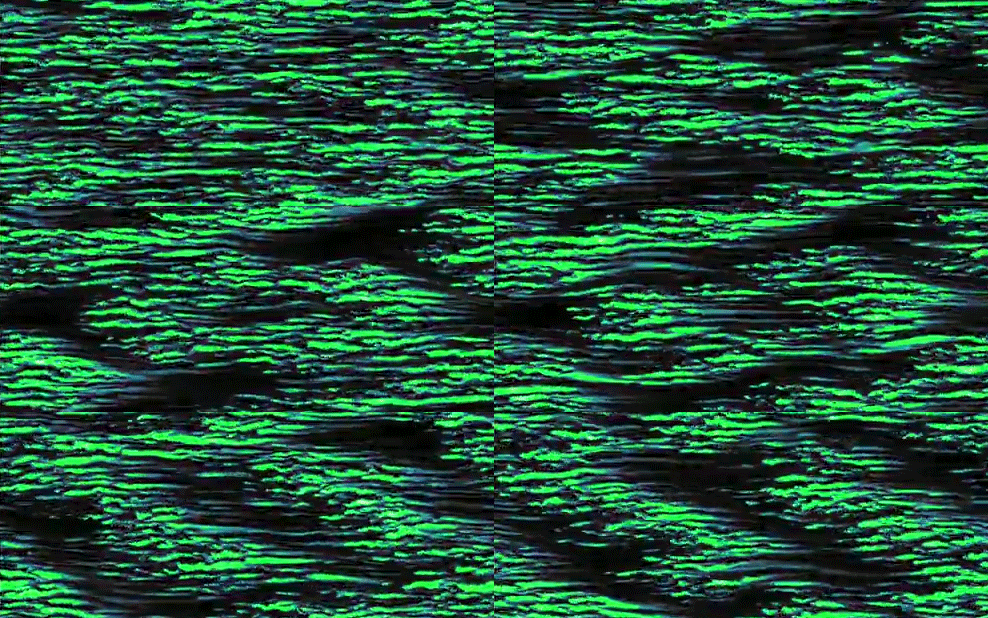
    Although turbulent flow is chaotic, it’s not completely disordered. In fact, order can emerge from turbulence, though exactly how this happens has been a long-enduring mystery. Take the animations above. They show the flow that develops between two plates moving in opposite direction that are separated by a small gap. (The formal name for this is planar Couette flow.) The visualization is taken in a plane at a fixed height between the plates.

    Initially (top), the flow shows narrow bands of turbulence, shown in green, separated by calmer, laminar zones in black. As time passes, these areas of laminar and turbulent flow self-organize, eventually forming diagonal stripes that are much longer than the gap between plates (bottom), the natural length-scale we would expect to see in the flow. Researchers have wondered for years why these distinctive stripes form. What sets their spacing, and why are they along diagonals?

    To answer those questions, researchers explored the full Navier-Stokes equations, searching for equilibrium solutions that resemble the striped patterns seen in experiments and simulation. And for the first time, they’ve found a mathematical solution that matches. What the work shows is that the pattern emerges naturally from the equations; in fact, given the characteristics of the solution, the researchers found that many disturbances should lead to this result, which explains why the pattern appears so frequently. (Image and research credit: F. Reetz et al., source; via phys.org; submitted by Kam-Yung Soh)

  • Powdery Trails

    Powdery Trails

    Because air and water are colorless and transparent, we cannot see most of the flows around us – but they’re always there. In a recent series, photographer Jess Bell has been capturing images of jumping dogs trailing a colorful powder wake. There’s no compositing in the photos. Bell puts powder on the dogs, then photographs them as they jump. The results show the billowing, turbulent wakes left by the dogs. I particularly like how you can see the stream of powder coming from some of the dogs’ ears. For more of Bell’s work, check out her website and Instagram. (Image credit: J. Bell; via PetaPixel and Rakesh R.)

  • Vortices and Ground Effect

    Vortices and Ground Effect

    Though typically unseen, the vortices that swirl from the tips of aircraft wings are powerful. Here you see a Hawker Sea Fury equipped with a smoke system used to visualize the vortices that form at the wingtip as high-pressure air from the bottom of the wing and low-pressure air from the top swirl together. As you can see, the vortices persist in the wake long after the plane passes. The size and strength of the vortices depend on the size and speed of the aircraft; this is why air traffic control requires smaller planes to wait longer to take off or land if there was just a larger aircraft on the runway.

    The other cool thing to note here is how the wingtip vortices move apart from one another in the animation above. In flight, wingtip vortices usually stay roughly parallel to one another, but they drift downward in the aircraft’s wake. Near the ground, though, the vortices cannot move down, so instead ground effect forces them apart from one another, as seen here. (Image and video credit: E. Seguin; via Kelsey C.)

  • Waves

    Waves

    Photographer Ray Collins is known for his striking portraits of waves, some of which I’ve featured on previous occasions. Collins is colorblind, so he focuses heavily on shape and texture in the wave, which produces some stunningly dramatic views of moving water frozen in time. There’s great power and beauty in breaking waves, and researchers are still actively learning just how significant they are to our planet’s cycles. 

    Note the spray blurring the edges of every wave here; these are some of the largest droplets the wave will make. As it crashes forward, the wave traps pockets of air, and, as those bubbles burst, they will create a spray of tinier droplets that carry moisture and salt into the atmosphere to seed clouds and, eventually, rain.

    Collins’ work reminds us both of the ocean’s power and its fragility as it undergoes rapid changes due to humanity’s influence. For more photos as well as a great interview with Collins, check out My Modern Met. (Image credit: R. Collins; via My Modern Met and James H.)

  • Blackwater Rivers

    Blackwater Rivers

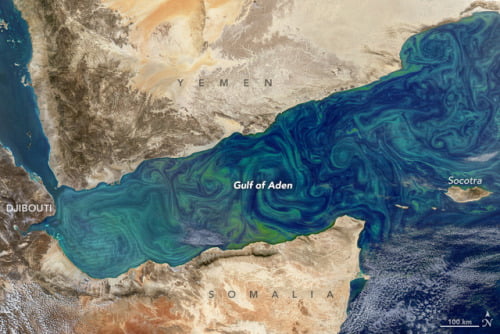
    Blackwater rivers, like the Suwannee River in Florida, carry waters so laden with organic material that they’re dyed a deep, dark brown. For the Suwannee, most of this material comes from the rich peat deposits of the Okefenokee Swamp that lies upstream. As vegetation in the swamp decays, tannins from the plants dissolve into the water, giving it its distinctive color, which the river maintains along its full 400-kilometer journey to the Gulf of Mexico. The dark waters of the river act as a tracer, revealing how the fresh river water mixes with the ocean in the enhanced-color satellite image above. It’s amazing to see how far the river’s influence spreads before delicate wisps of color pierce the darkness. (Image credit: U.S. Geological Survey; via NASA Earth Observatory)

  • Featured Video Play Icon

    “If I Say”

    The new Mumford & Sons single “If I Say” features a fluid-dynamical music video. It’s full of dendritic fingers and flowing colors – likely from combinations of inks, paints, and other fluids. Although the fingers are reminiscent of the viscosity-dependent Saffman-Taylor instability, these appear to be driven by variations in surface tension between the different fluids. That’s a major feature throughout the video; although some of the flow is caused by the syringes depositing fluids, much of it seems to be a Marangoni effect, where flow moves away from areas of low surface tension to ones with higher surface tension. (Video credit: Mumford & Sons; filmed by P. Hofstede; via Katie M.)

  • Featured Video Play Icon

    Inside Hurricane Maria

    In addition to looking outward, NASA constantly monitors our own planet using a suite of satellites. In this video, they visualize data taken by the Global Precipitation Measurement Core Observatory of Hurricane Maria two days before it hit Puerto Rico. Instruments on board the satellite measure both liquid and frozen precipitation, giving scientists – and now the public – a glimpse into the heart of a developing hurricane. Be sure to take a look around; it’s a 360-degree video, and I bet it’s even more spectacular in VR. Having a trove of data like this helps researchers better understand the processes that influence a strengthening hurricane, which ultimately allows them to make better predictions about hurricane behavior in order to save lives. (Video credit: NASA; via Francesco C.)

  • Swirls of Color

    Swirls of Color

    These beautiful swirls show the wake downstream of a thin plate. Here water is flowing from left to right and dye introduced on the plate (upstream and unseen in the photo) curls up into vortices. The vortices in the top row rotate clockwise, while the vortices along the bottom rotate anti-clockwise. This pattern of alternating vortices is extremely common in the wakes of objects and is known as a von Karman vortex street. Similar patterns are seen in soap films, behind cylinders, in the wakes of islands, and behind spaceships.  (Image credit: ONERA, archived here)

  • Featured Video Play Icon

    From Firenado to Water Spout

    Just a few years ago, fire tornadoes were almost fabled because they were so rarely captured on video. Now, with worsening wildfire seasons and cell phone cameras everywhere, there are new videos all the time. This video captures a fire tornado that sets off a water spout as it reaches the river (~1:15 in).

    Neither the fire tornado or the water spout is truly tornadic; instead they are more like dust devils. They are driven by the rising heat of the fire. As cooler, ambient air flows inward to replace the rising air, it brings with it any vorticity it had. And, like an ice skater, the incoming air spins faster as it moves inward. This sets up both the fire tornado and the water spout’s vortices.

    Although this is the first example I’ve seen video of, fire tornadoes have been known to create water spouts before. Lava flowing into the ocean can create whole trains of them. (Video credit: C. & A. Mackie; via Jean H.)

  • Visualizing Aerosols

    Visualizing Aerosols

    Aerosols, micron-sized particles suspended in the atmosphere, impact our weather and air quality. This visualization shows several varieties of aerosol as measured August 23rd, 2018 by satellite. The blue streaks are sea salt suspended in the air; the brightest highlights show three tropical cyclones in the Pacific. Purple marks dust. Strong winds across the Sahara Desert send large plumes of dust wafting eastward. Finally, the red areas show black carbon emissions. Raging wildfires across western North America are releasing large amounts of carbon, but vehicle and factory emissions are also significant sources. (Image credit: NASA; via Katherine G.)