At the microscale, fluid behavior can be quite different than what we witness in everyday life. Mechanisms that have little effect on the macroscale suddenly become extremely important in a channel only a few hundred microns wide. Here, water droplets in oil are steered and controlled using lasers.
Search results for: “droplet”

Dripping into Droplets
The Plateau-Rayleigh instability is one that just about everyone has witnessed. It describes how a liquid jet breaks up into droplets. Notice the waviness in the jet before breakdown. The tiniest curvature in the jet causes an imbalance in the liquid’s pressure due to surface tension. Because the system is unstable, any small changes will become larger, ultimately resulting in the jet breaking into droplets.
Urinal Dynamics Win Ig Nobel Prize
Thirteen years ago, I made a prediction that work on how to avoid urinal splashback would win an Ig Nobel Prize. Today, I am, at last, vindicated. Randy Hurd, Zhao Pan, Tadd Truscott, and Kaveeshan Thurairajah shared the 2026 Ig Nobel Prize in Physics for their work designing a splash-free urinal.
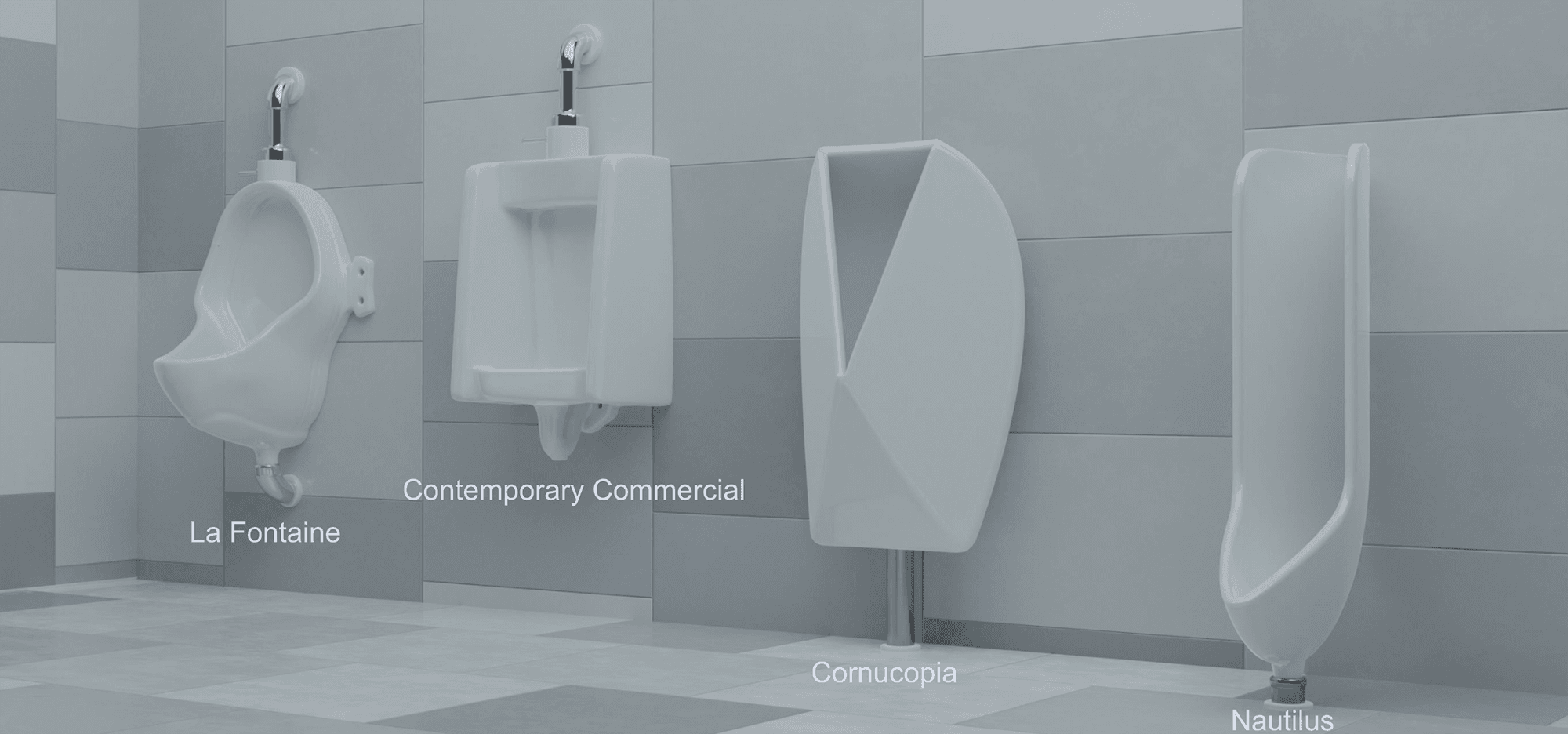
The culmination of this decade-plus of research are two urinal designs, the Cornucopia (“Cornucopeea”) and the Nautilus (“Nauti-Loo”). Both designs minimize splash, in part, through their geometry. As you may have noticed when rinsing dishes, having a stream of droplets hit a surface at a high impact angle creates lots of splash. But at a low impact angle, very little splash occurs. The team took this observation and created designs that minimized impact angle no matter where a user aimed.
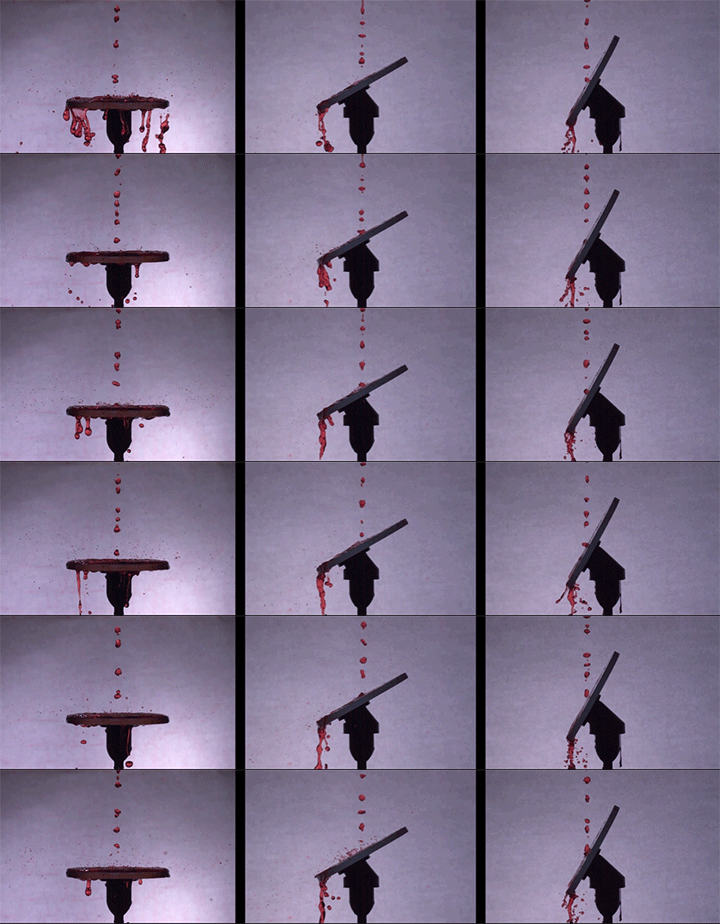
How splashback varies with impact angle. High and medium impact angles (left and middle, respectively) generate a lot of splashing from a stream of impacting droplets. In contrast, below a critical impact angle, the splashing is negligible (right). Naturally, they tested the two new designs, alongside two existing urinal designs, finding that the new urinals reduced splashing by as much as 95% across a range of flow rates and user heights. Although the Cornucopia was the least splashy urinal, the team gave the Nautilus an overall edge because its design is easier to clean and works for children, adults, and wheelchair users.
Considering the estimated 1 million liters of urine contemporary urinals splash across U.S. restrooms daily, the Nautilus could save significant labor and cleaning costs, if implemented. (Image credits: urinals and experiment – K. Thurairajah et al., poster – R. Hurd et al.; research credit: K. Thurairajah et al. and R. Hurd et al.)
P.S. – As indicated, I’ve followed this work for a long time. In addition to this post, we did a webcast (10 years ago, yikes!) that touched on the topic. But my most in-depth coverage of the story is still to appear in print; you’ll get to enjoy the whole tale–stretching all the way back to 2012–in a chapter of my forthcoming book. More on that soon! In the meantime, please enjoy this gem of a scientific poster from the project’s early days in 2013:
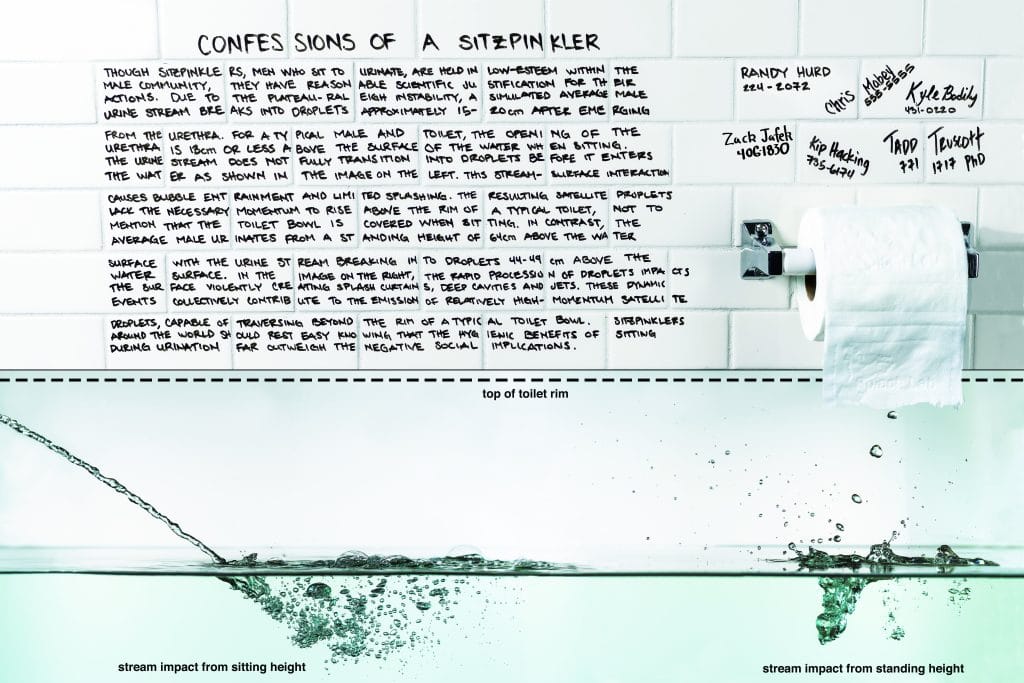
One of the best research posters of all time, designed to look like it’s been written on a tiled bathroom wall. The text reads, “Confessions of a Sitzpinkler. Though Sitzpinklers, men who sit to urinate, are held in low-esteem within the male community, they have reasonable scientific justification for their actions. Due to the Plateau-Rayleigh instability, a simulated average male urine stream breaks into droplets approximately 15-20 cm after emerging from the urethra. For a typical male and toilet, the opening of the urethra is 13 cm or less above the surface of the water when sitting. The urine stream does not fully transition into droplets before it enters the water as shown in the image on the left. This stream-surface interaction causes bubble entrainment and limited splashing. The resulting satellite droplets lack the necessary momentum to rise above the rim of a typical toilet, not to mention that they toilet bowl is covered when sitting.
In contrast, the average male urinates from a standing height of 64 cm above the water surface with the urine stream breaking into droplets 44-49 cm above the water surface. In the image on the right, the rapid procession of droplets impacts the surface violently, creating splash curtains, deep cavities and jets. These dynamic events collectively contribute to the emission of relatively high-momentum satellite droplets, capable of traversing beyond the rim of a typical toilet bowl.
Sitzpinklers around the world should rest easy knowing that the hygienic benefits of sitting during urination far outweigh the negative social implications.”Fediverse Reactions
-
Freezing Via Ice Bridge
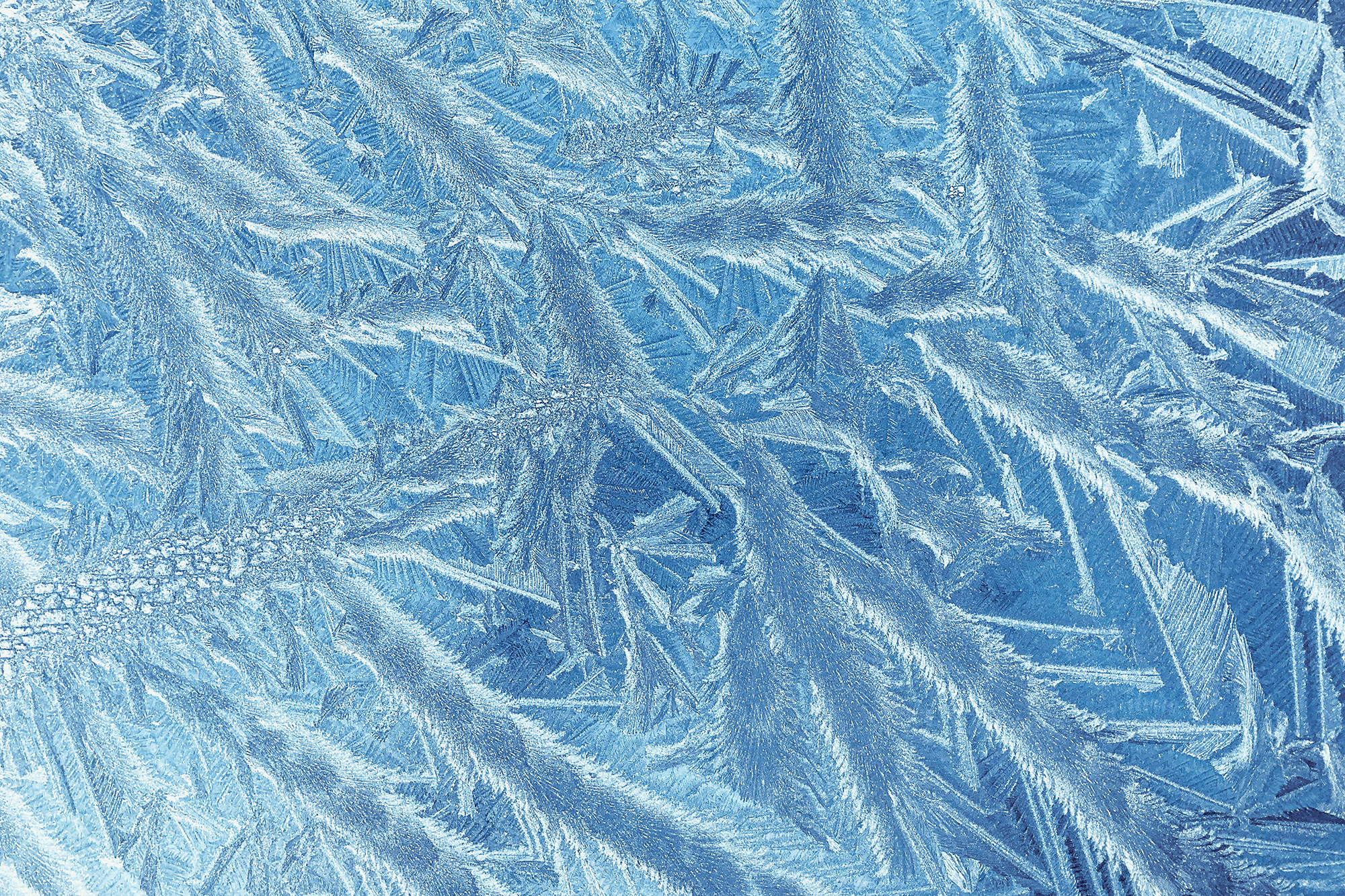
For frost to spread on a surface, individual water droplets freeze and then spread the freezing front to a nearby droplet. Frequently that happens through an ice bridge that connects one droplet to the next. On hydrophilic surfaces, the bridge grows along the surface, slowly connected one droplet to the next and the next until the entire surface is covered in frost. On superhydrophobic surfaces, frost still spreads via ice bridge, but those ice bridges are suspended in the air, cantilevered out from the frozen droplet. You can watch the process in the image below.
The researchers found that frost was later to form and slower to spread on these superhydrophobic surfaces, which could be valuable for applications like the heat exchanger found in heat pumps. Once a heat exchanger’s finned surface is frost-covered, its efficiency plummets. The team suggests that coating these surfaces to be superhydrophobic could help keep them operating efficiently longer in cold and humid conditions. (Image credit: frost – K. Shimizu, experiment – S. Yang et al.; research credit: S. Yang et al.; via Physics World)
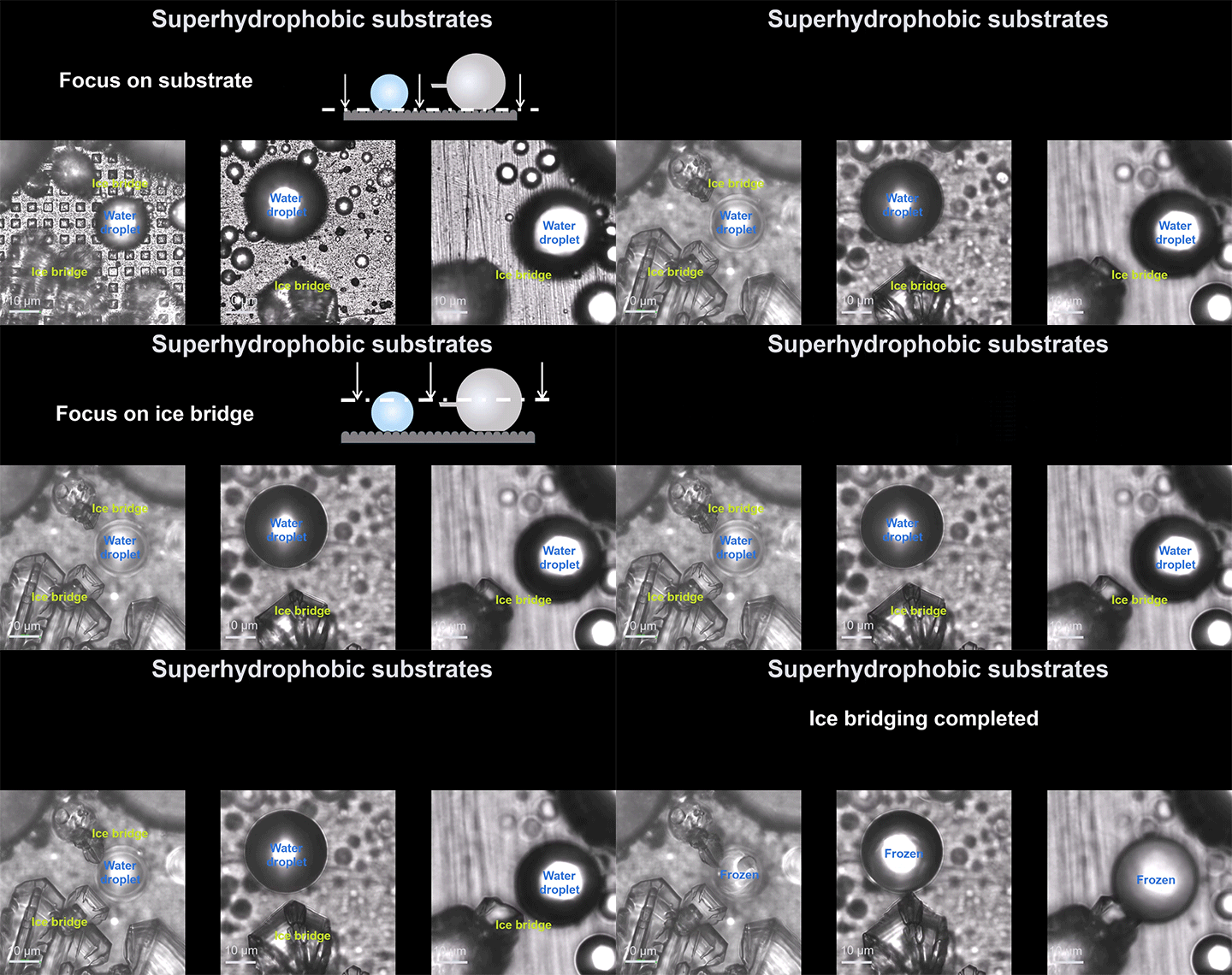
Animation of a suspended ice bridge growing between water droplets on a superhydrophobic surface. Fediverse Reactions
-
Representing Rain’s Microphysics
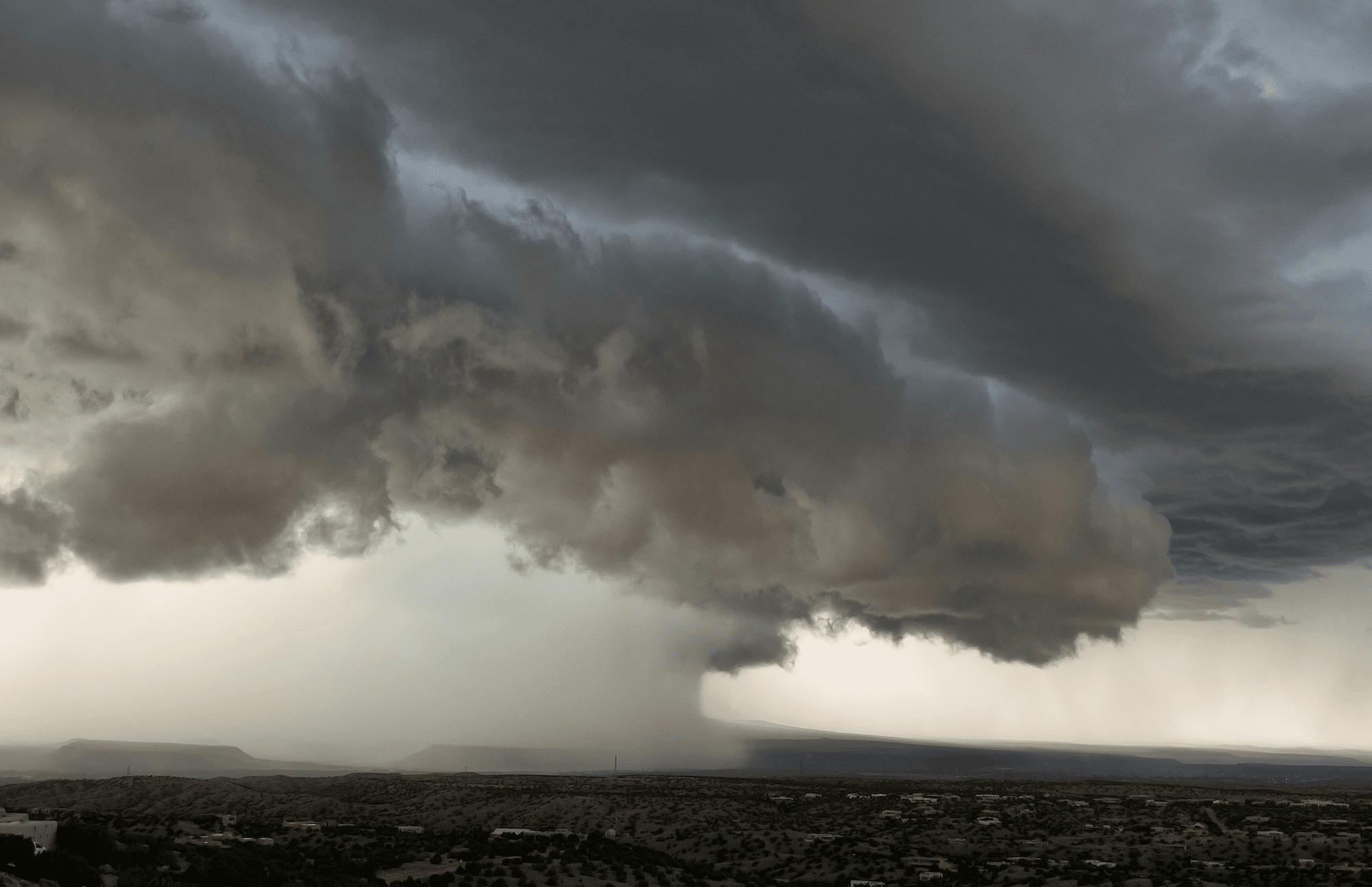
Realistically modeling rainfall remains an extremely difficult problem. To be practical, results have to be on the scale of kilometers; no one is looking to find out whether rain will fall from one specific cloud over their head. But making that prediction depends on physics that happens at the microscale, where droplets tens of microns in size are condensing, colliding, and eventually growing large enough to fall as rain. A new study takes a look at three machine-learning models that could help describe those microscale physics with less computational overhead.
The researchers used three different algorithms, all trained on high-quality simulations of microdroplet physics. The goal here was to represent the complex, nonlinear physics reflected in those results with an algorithm that’s less complicated and less computationally expensive than the methods used to create the training data. The team then tested the trained algorithms to see how they performed in conditions that were different than their training data.
They found that the model with the best performance–in terms of giving more accurate predictions in the test cases–was actually the simplest of the three models. So it may be possible to get reasonable results for rain microphysics from simpler, easier-to-compute algorithms. The team does warn, though, that all of the models need more work before they’d be ready to add to commercial-grade weather prediction software. (Image credit: J. Fowler; research credit: E. de Jong et al.; via Eos)
Fediverse Reactions
-
Capillary Slinkies
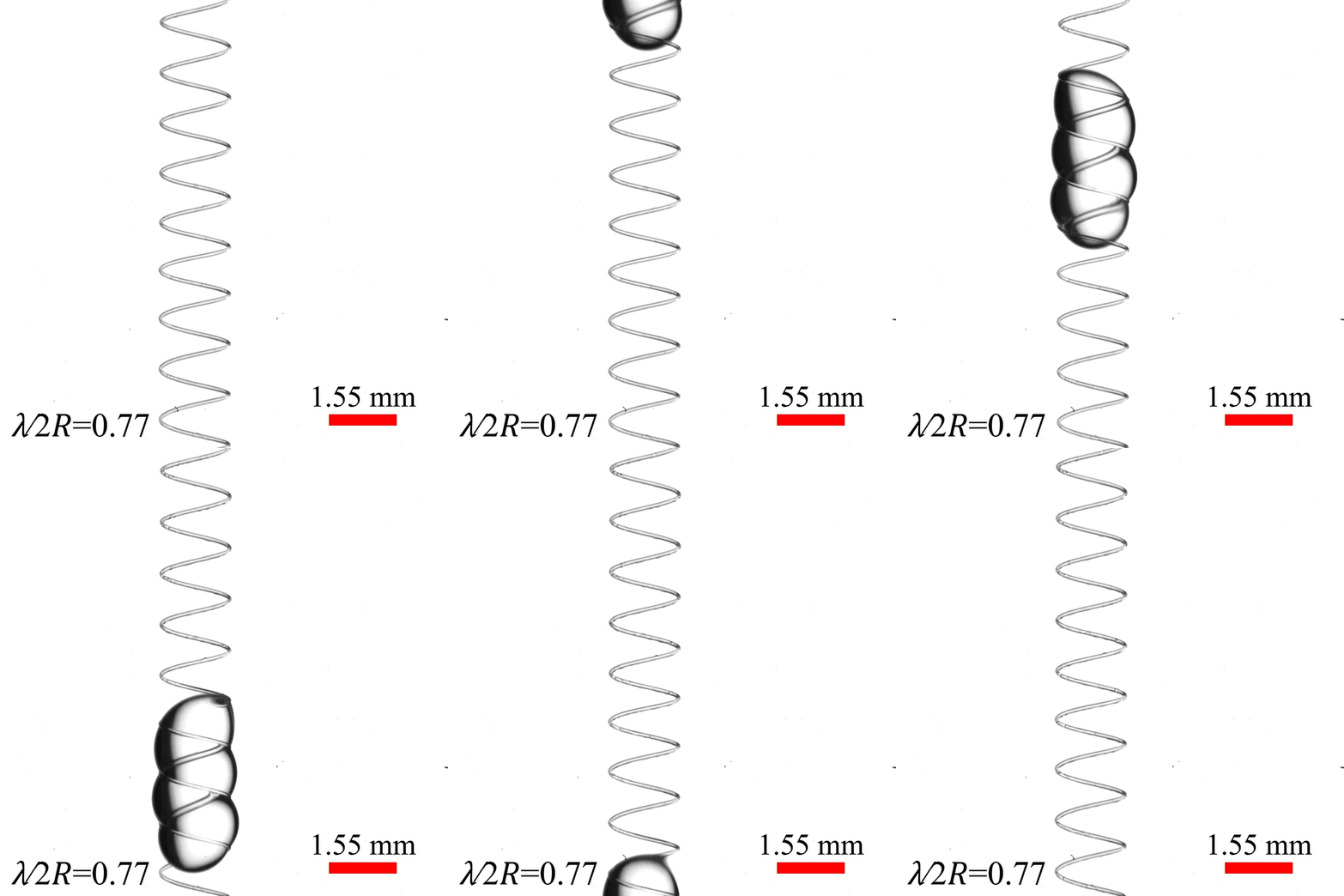
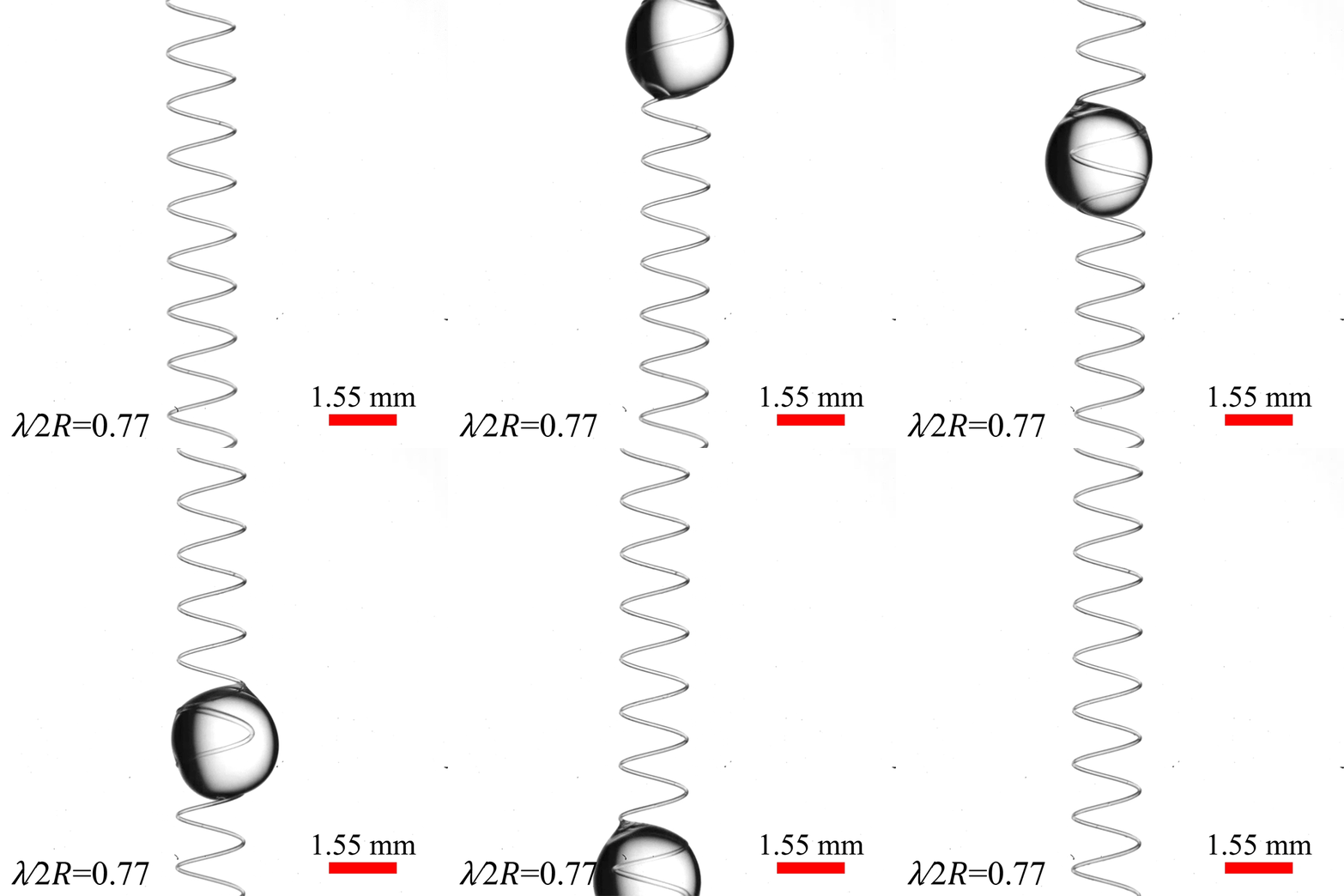
Nature is full of helical fibers, including in plants and bird feathers. In this study, researchers explore how these soft springs react to droplets. When the pitch of the spring (roughly speaking, the spacing between coils) is small, droplets can flow down in a plug (not shown). But as the pitch increases, droplets can take on a caterpillar-like (or, eruciform) shape. These drops descend quickly, in part, the team found, because internal flows within the droplet help it along.
A caterpillar-shaped droplet slides down a soft spring. Other drops maintain a spherical shape as they descend the widely-spaced coils of the spring. These drops tend to spin around the coil as they go, with their center of mass actually moving side-to-side as they descend. (Image and research credit: B. Bhatt and A. Carlson)
A sphere-shaped droplet slides down a soft spring. Fediverse Reactions
-
Levitating By Squeeze Film
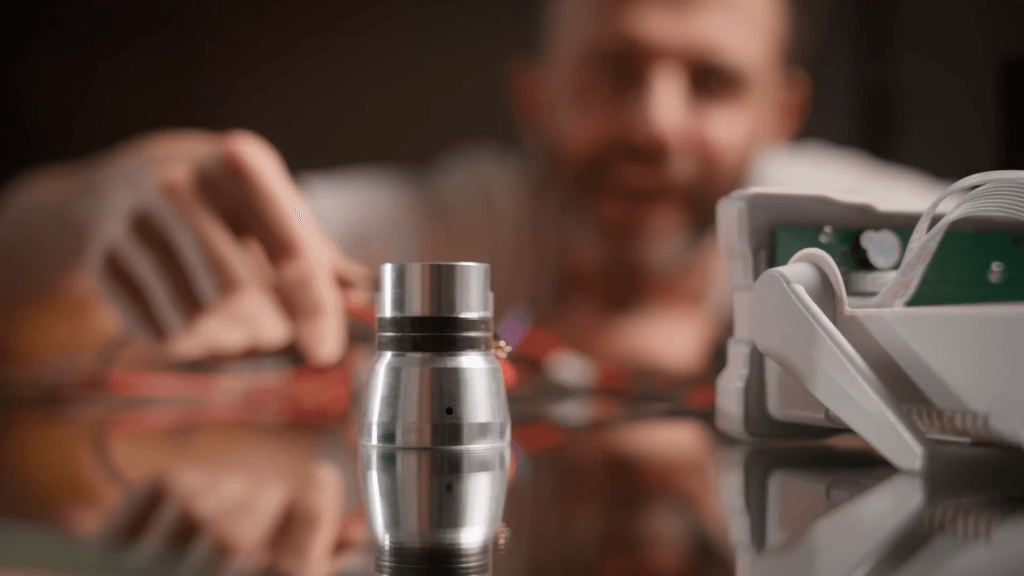
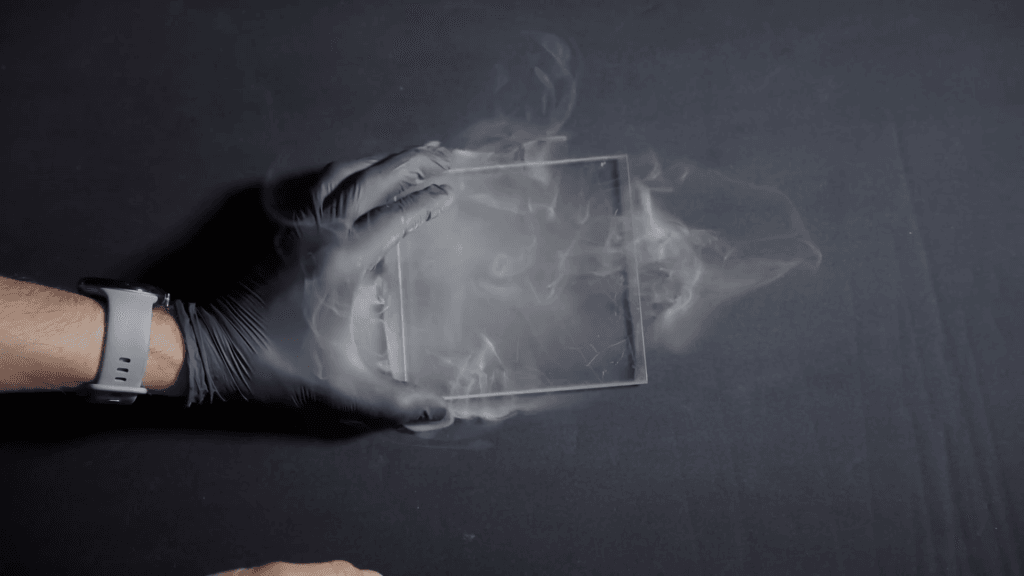
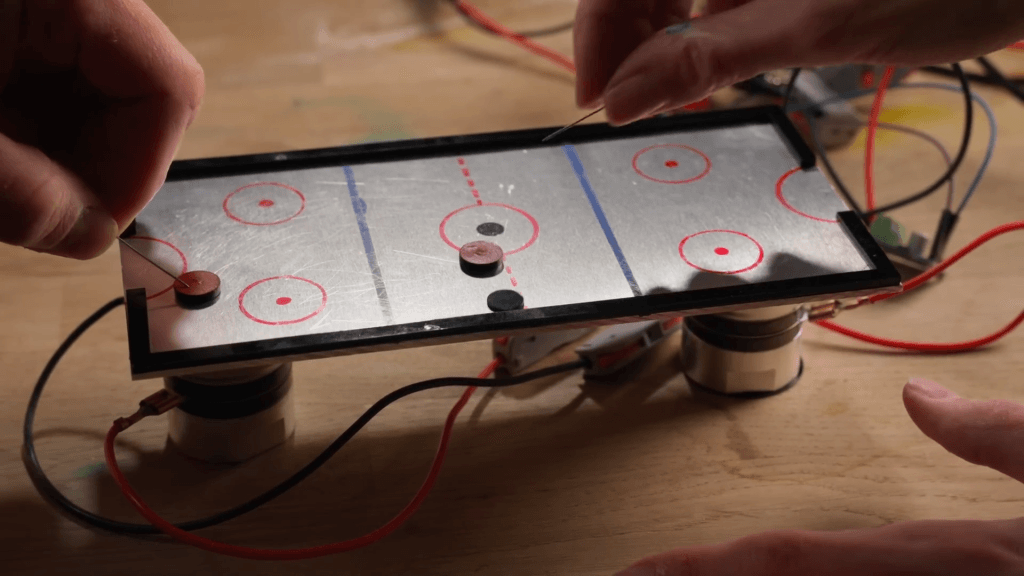
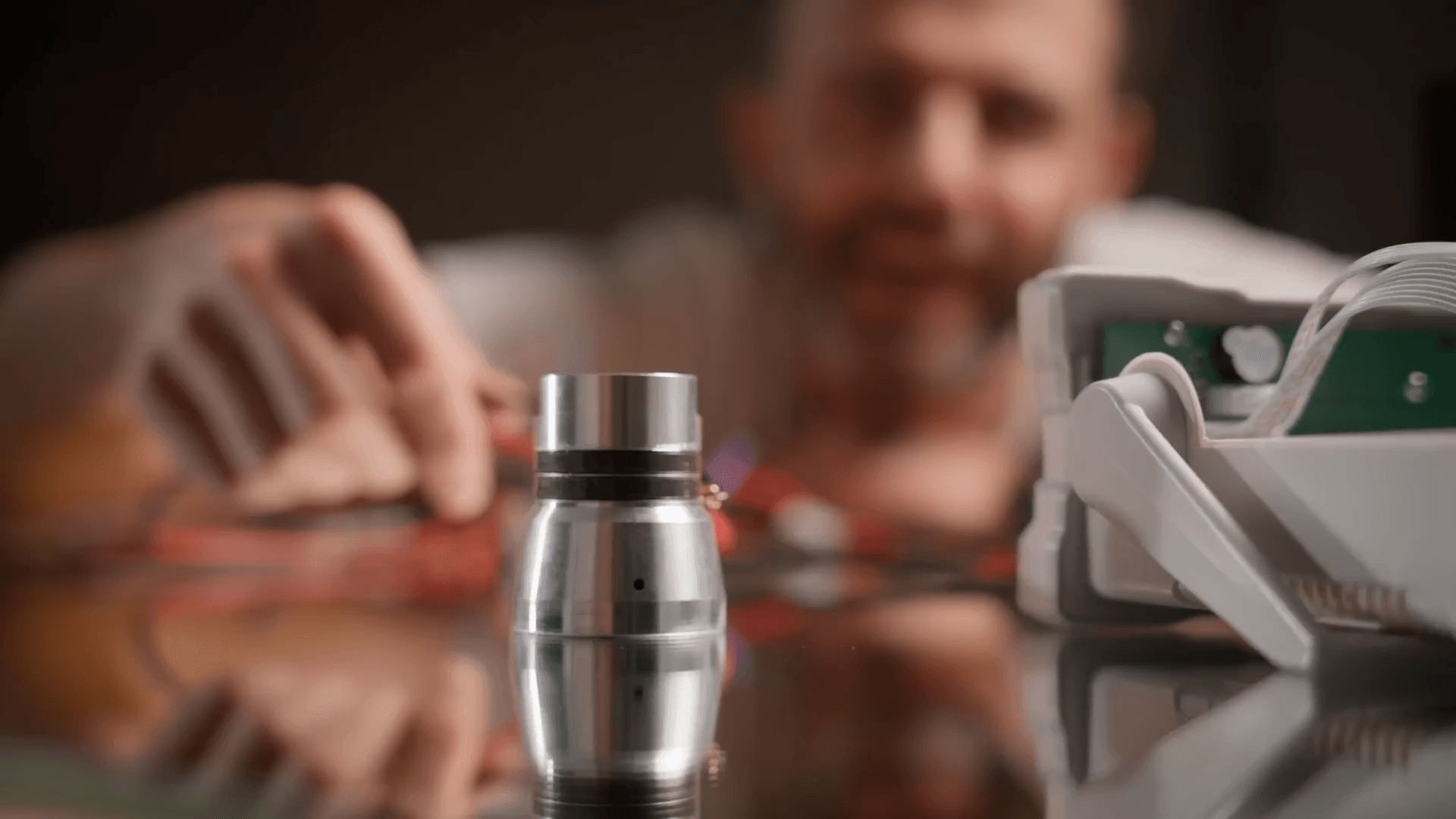
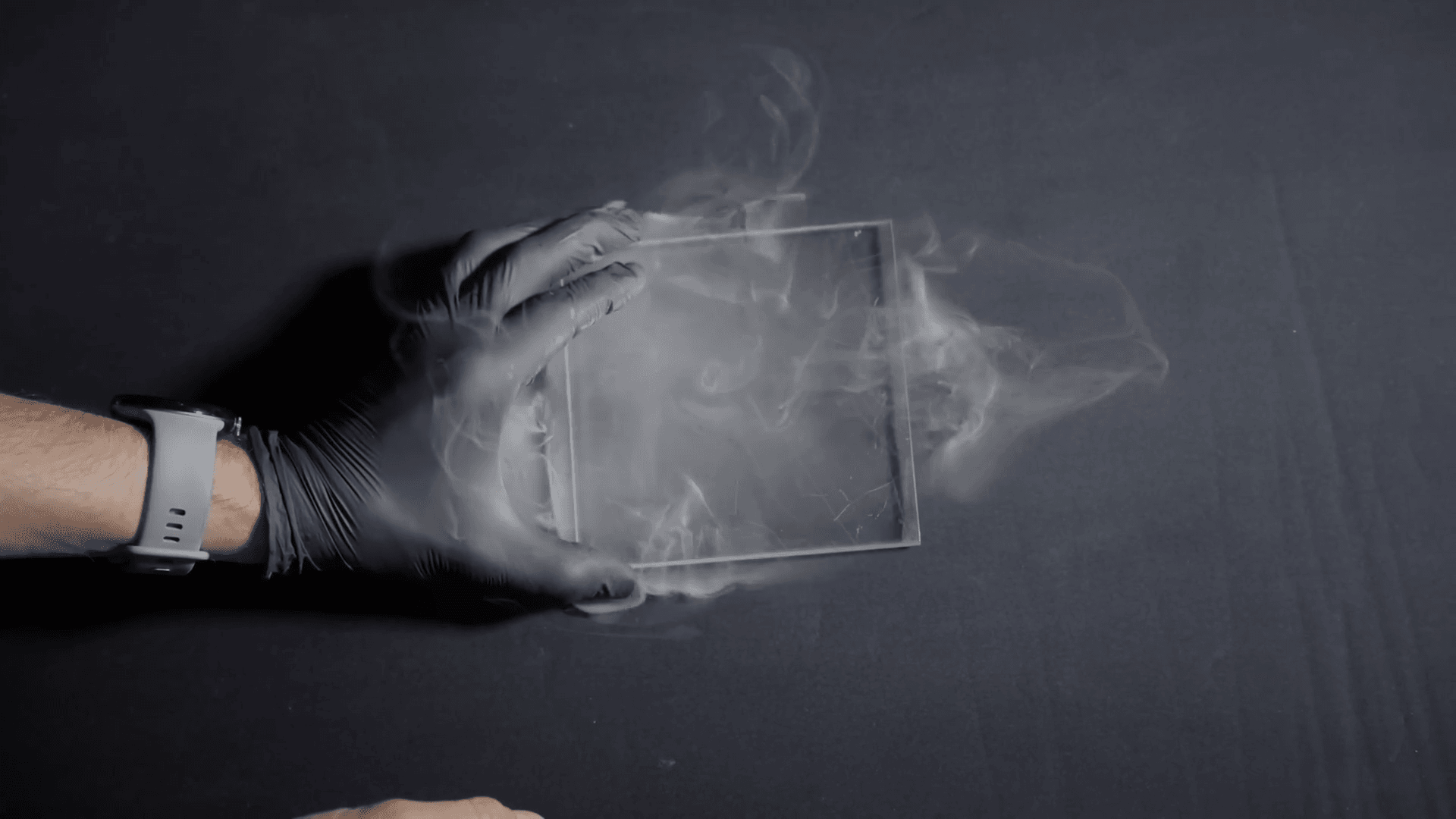
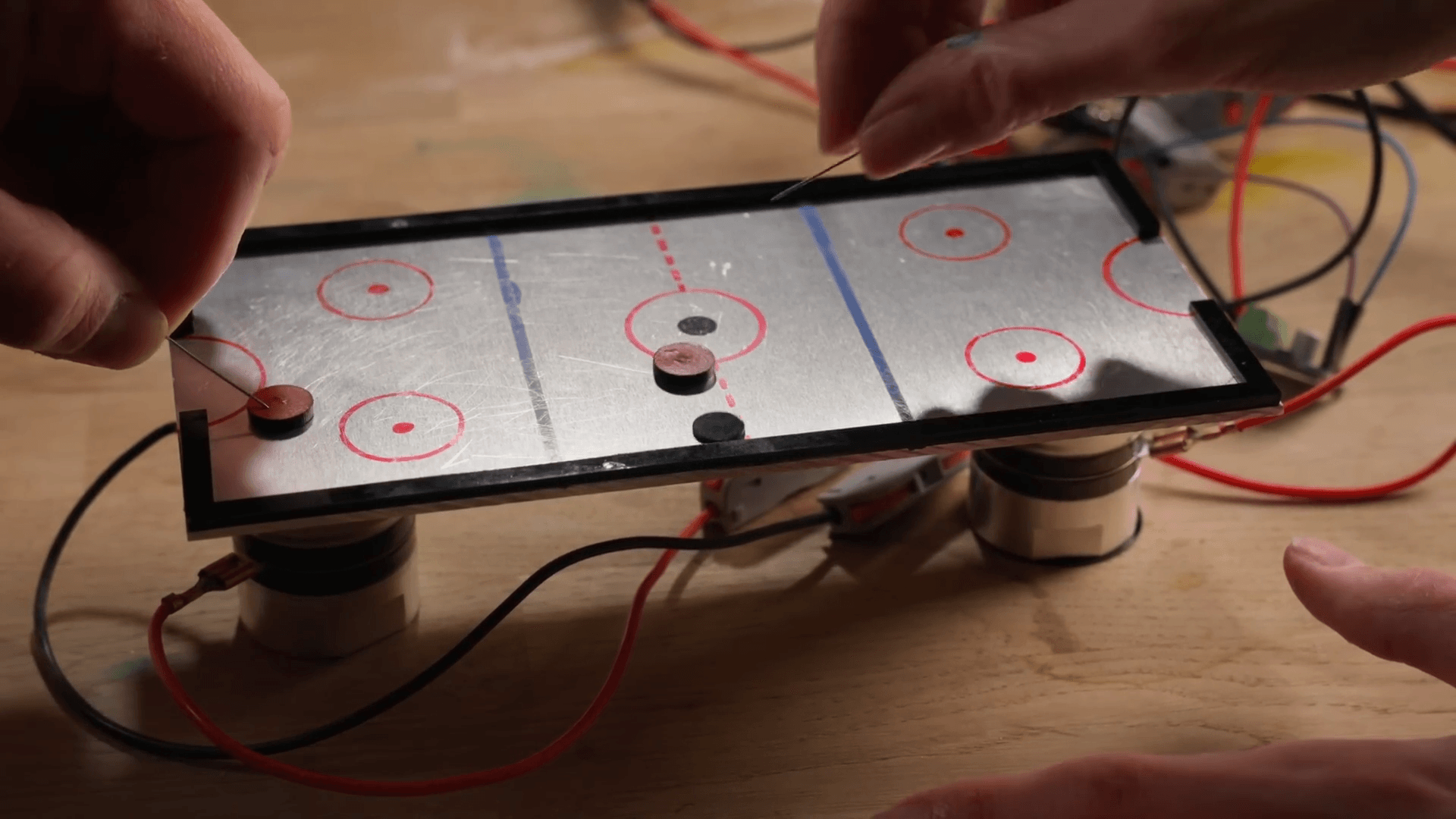
We’ve seen a few different kinds of levitation here over the years, including via acoustic waves, aerodynamics, and Leidenfrost effect. Here, Steve Mould describes something a bit different: a levitation squeeze film driven by ultrasonic transducers. Like a vibrating droplet, the thing keeping surfaces apart here is a thin, lubricating layer of air. The vibration of the ultrasonic transducer squeezes and replenishes the air layer quickly enough that it can keep transducers aloft. Steve even manages to create a miniature airless “air hockey” table with it! (Video and image credit: S. Mould)
Giant Water Balloon to the Face
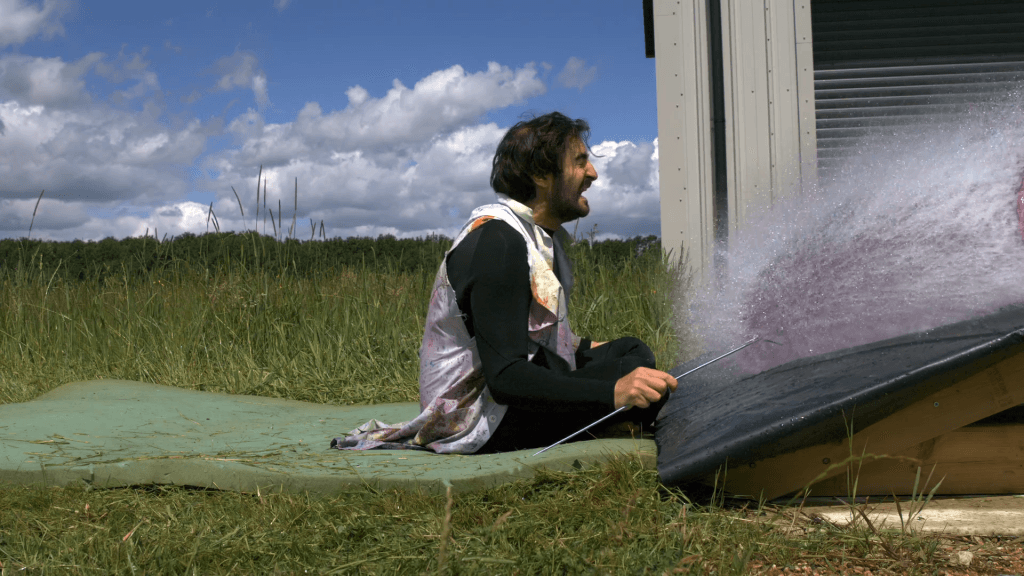
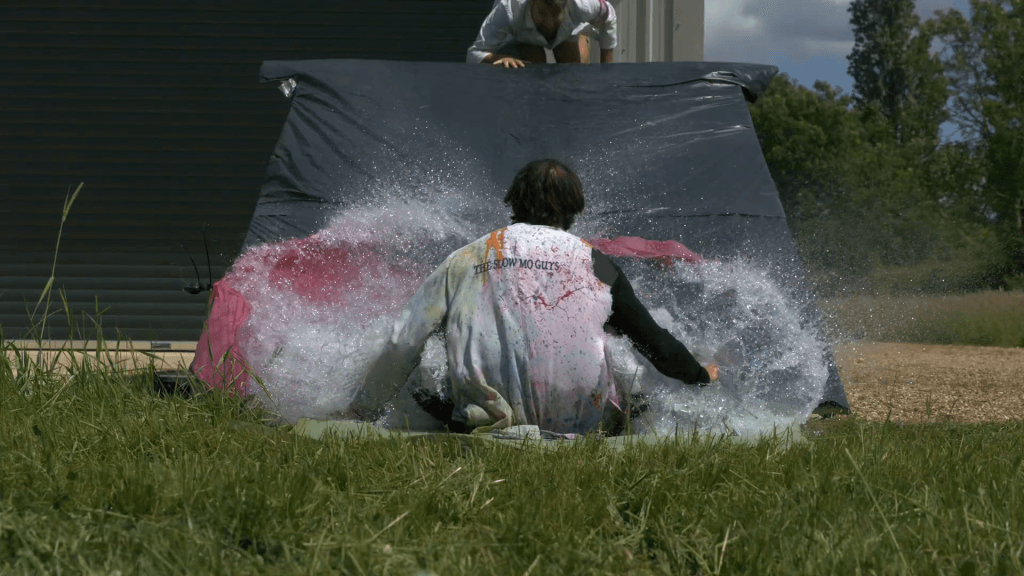
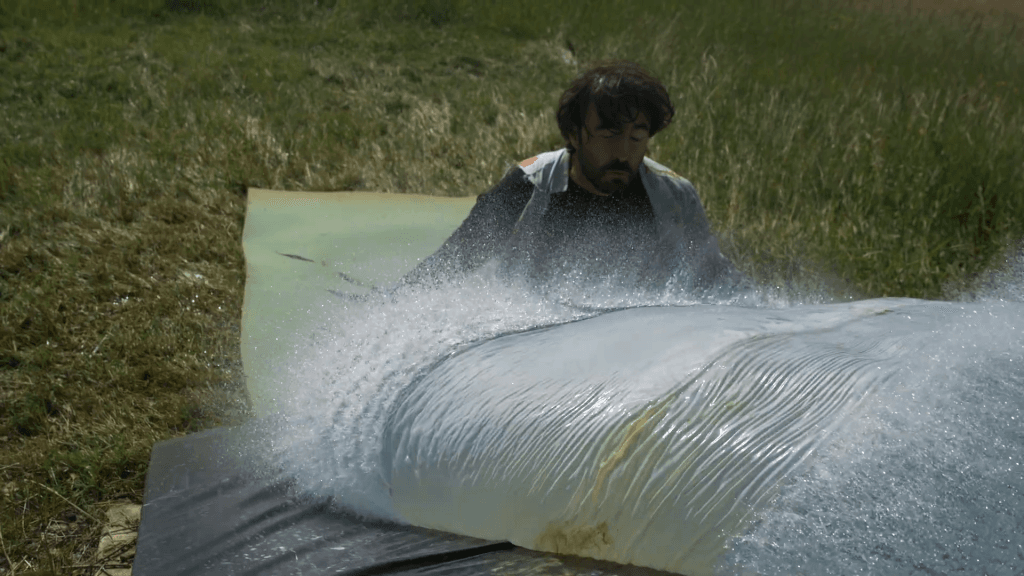
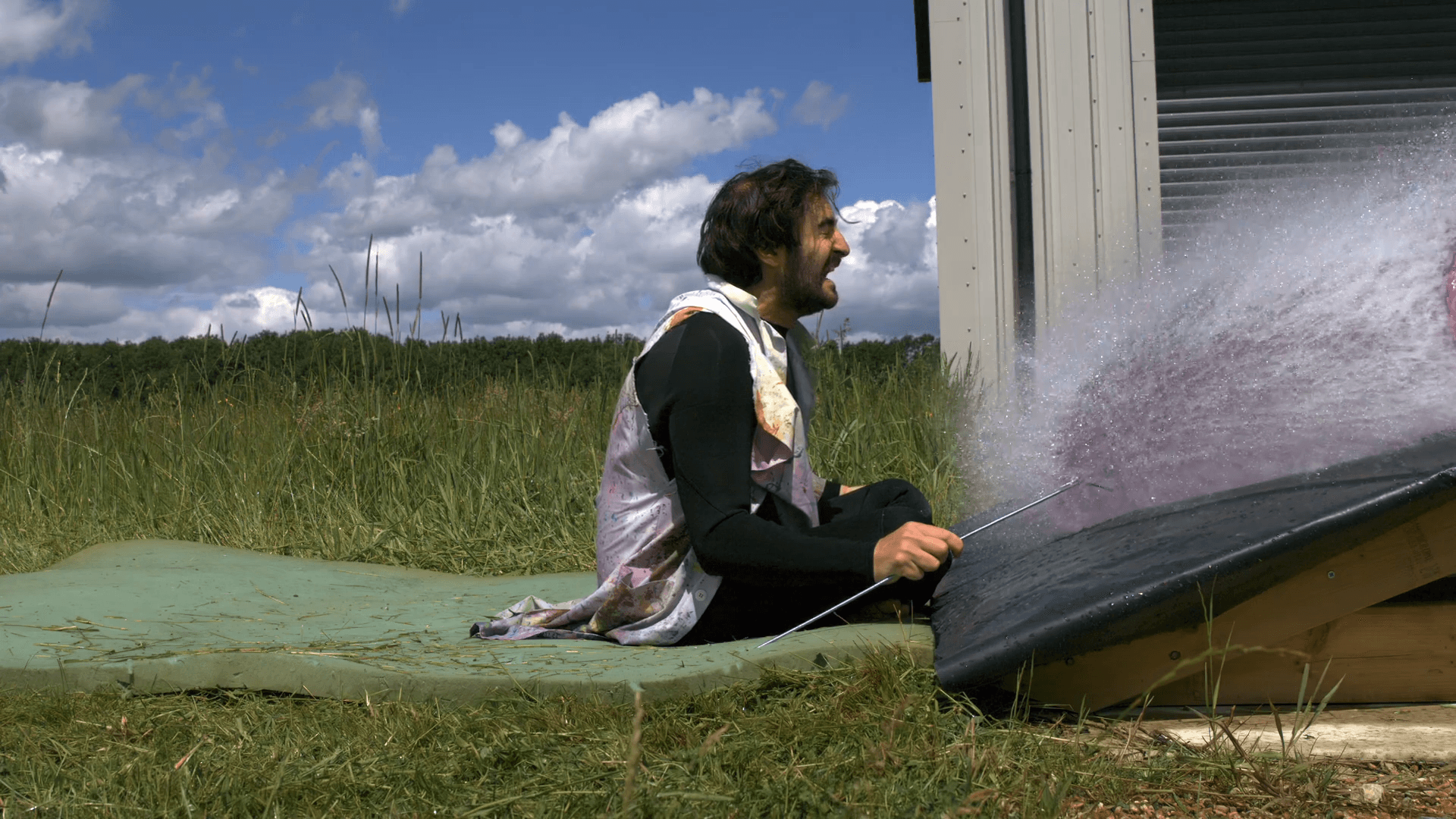
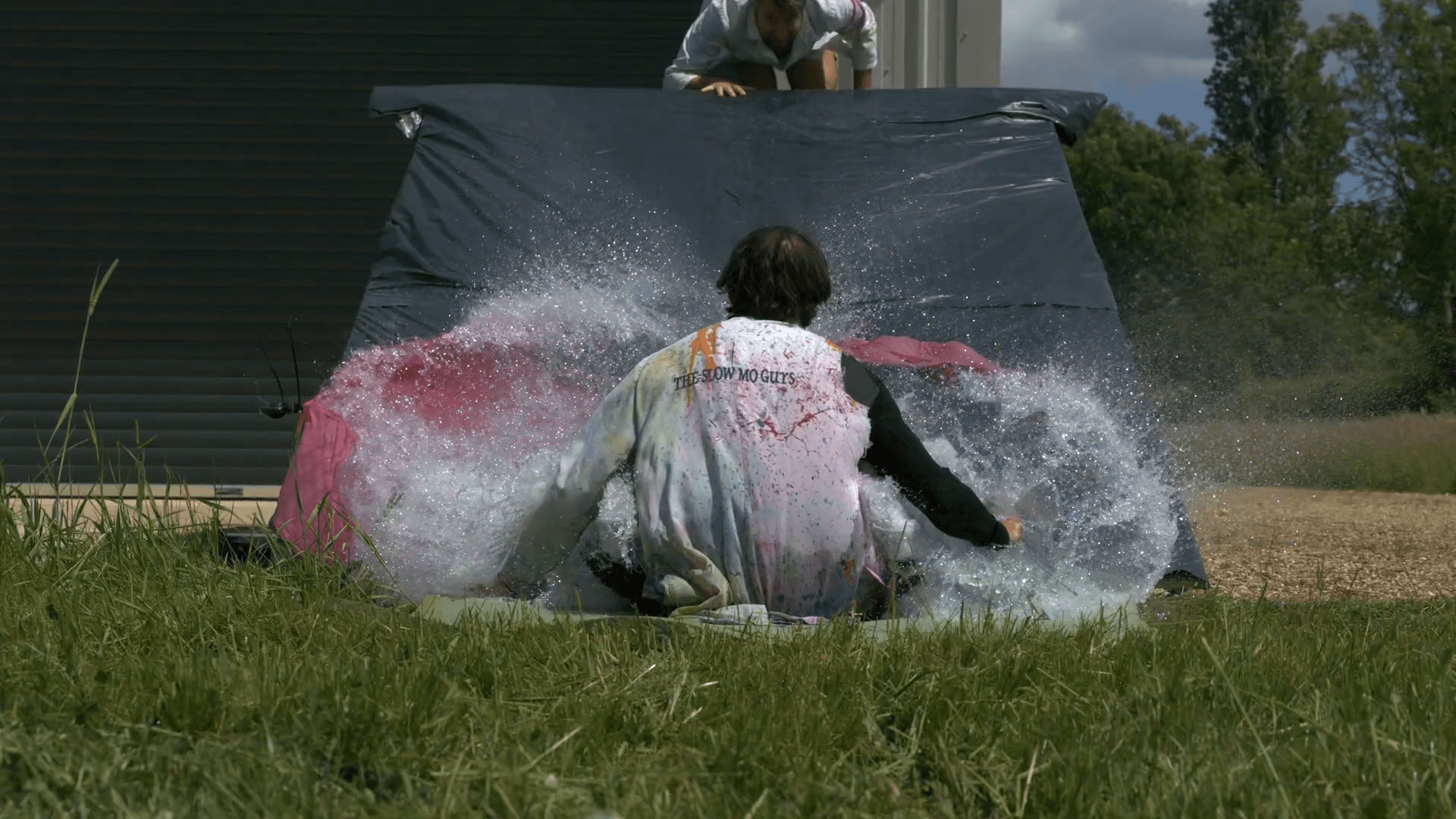
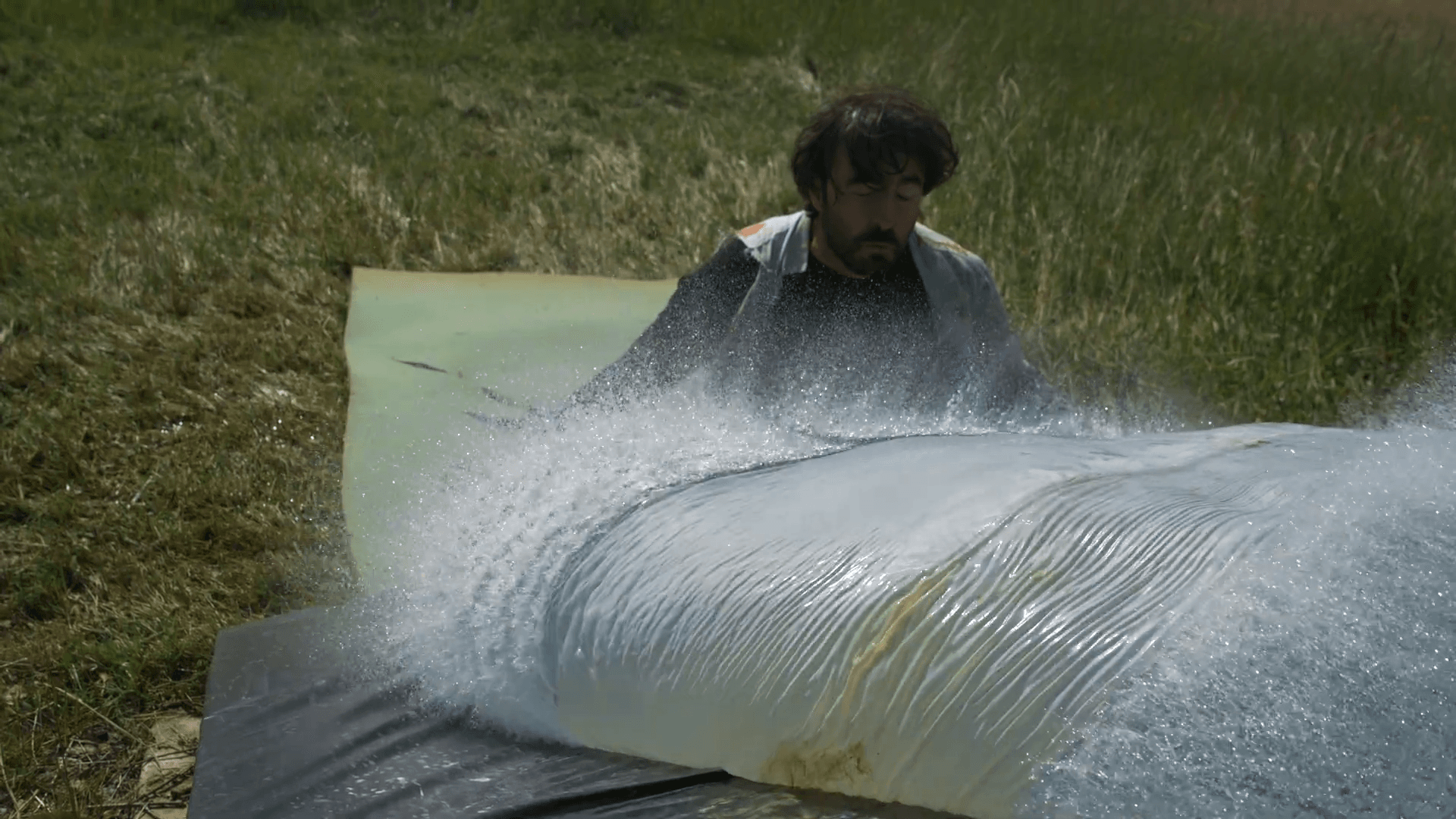
It’s the summertime, so Gav and Dan of the Slow Mo Guys are back to experimenting with giant water balloons. In this video, they send several careening down a slope into Dan’s face. Watching the balloons descend and pop is (unsurprisingly) my favorite part. It’s neat to see how the elasticity of the balloon acts like a beefed-up surface tension to make this enormous blob of water act like an oversized droplet. (Video and image credit: The Slow Mo Guys)
Fediverse Reactions
-
Dropping Oobleck
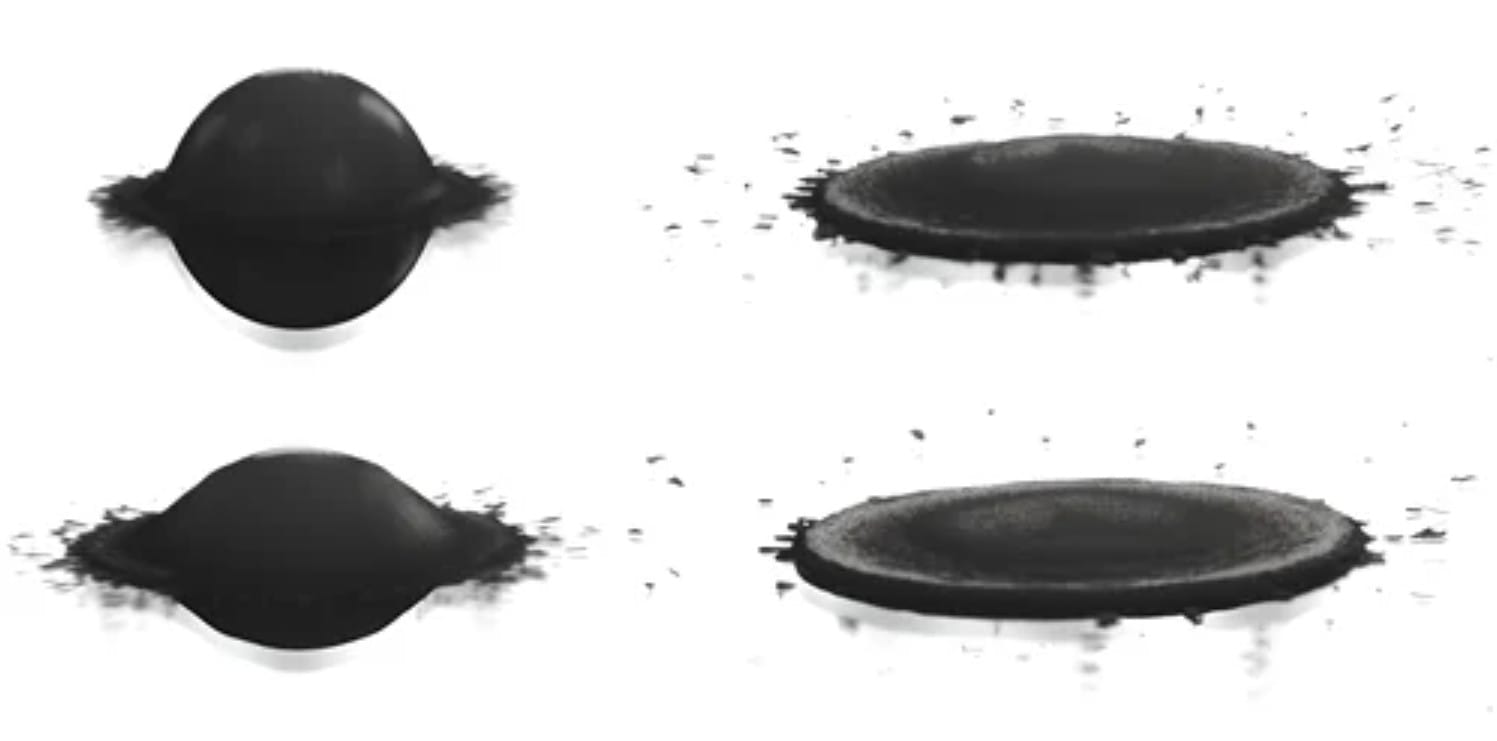
Oobleck is a peculiar substance. Formed from a suspension of cornstarch particles in water, it can flow like a liquid at low shear rates or jam into a solid under impact. Here, researchers explore what happens to a droplet of oobleck impacting a surface. As they expected, the team found that dilute drops could spread like a normal liquid during impact (top), and denser suspensions could impact like a solid would (below). But at the right conditions, they found that cornstarch-rich droplets could show liquid-like behavior at high shear rates and transition to solid-like behavior once the shear rate slowed down. (Image and research credit: A. Mobaseri et al.; via APS)

Shocked Jets
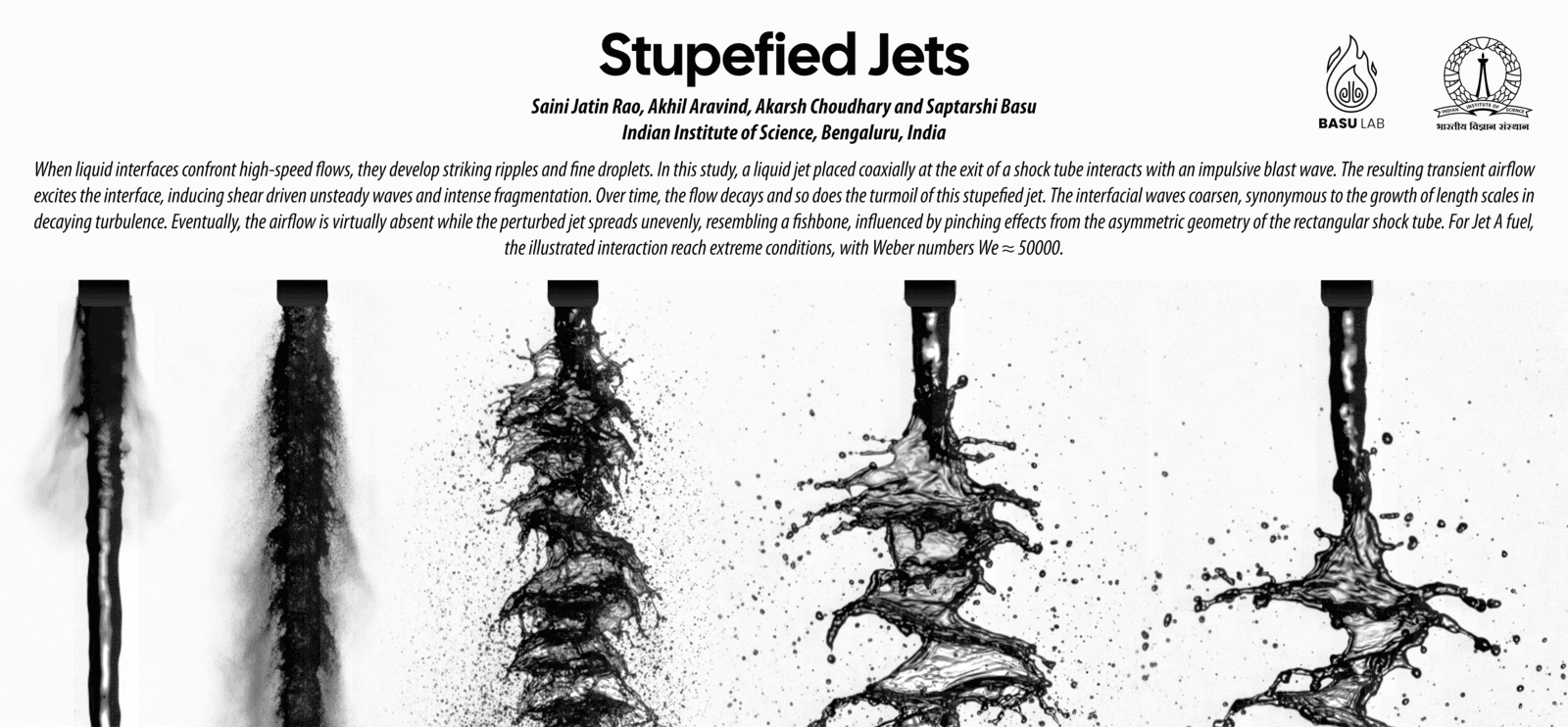
Breaking a jet of liquid into droplets lies at the heart of many industrial processes: spray painting, fuel injection, and asthma inhalers, to name a few. Here, researchers are looking at a different method of breaking up a liquid jet: shooting a shock wave along its length. The poster shows five different snapshots of the jet’s response. There are, variously, mists of fine droplets, wavy distortions of the jet, sheets, ligaments, and droplets of many sizes. (Image credit: S. Rao et al.)
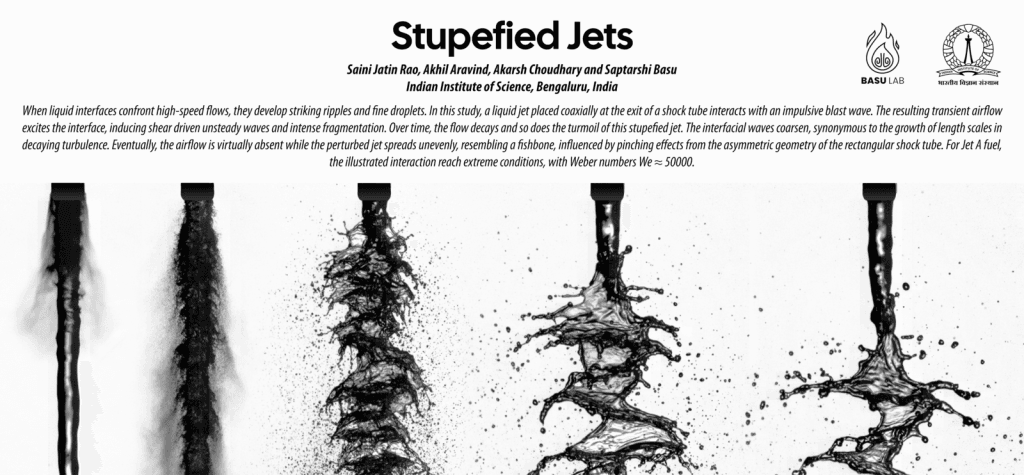
Research poster showing black and white images of liquid jets after a shock wave passed along the length of each jet.