Search results for: “convection”

  • The Undisturbed Waters of Lake Kivu

    The Undisturbed Waters of Lake Kivu

    Deep in Africa lies one of the world’s strangest lakes. Lake Kivu, over 450 meters in depth, is so stratified that its layers never mix. The upper portion of Lake Kivu consists of less-dense fresh water, which sits upon deeper layers of saltier water full of dissolved carbon dioxide and methane pumped into the lake by volcanic activity.

    The lake’s lack of convection means that this deep water simply stays put for thousands of years as it collects gases that remain dissolved only thanks to the immense pressure of the water above. Should that deep water be disturbed — by an earthquake, climate changes, or simply oversaturation — the resulting eruption of carbon dioxide could be deadly for the millions of people living nearby. A similar eruption at smaller Lake Nyos in 1986 asphyxiated about 1,800 people.

    Fortunately, Lake Kivu is well-monitored, so such an upwelling should not catch observers off-guard. Learn more about Lake Kivu’s oddities over at Knowable. (Image and research credit: D. Bouffard and A. Wüest, via Knowable Magazine; submitted by Kam-Yung Soh)

  • Featured Video Play Icon

    “Monsoon 6”

    The stunning power and beauty of our atmosphere comes to life in Mike Olbinski’s latest short film, “Monsoon 6”. Over the years, I’ve probably watched dozens of Olbinski’s videos, yet he still captures sequences that make me exclaim aloud as I watch. In this one, some of my favorites are the microburst at 2:17 and the development of mammatus clouds at 3:20. How mammatus clouds form is still very much an area of active research; I don’t know if Olbinski’s footage sheds light on their formation, but it is supremely awesome to watch! (Image and video credit: M. Olbinski)

  • Ghostly Chandeliers

    Ghostly Chandeliers

    Highlighter ink sinks from the surface of water, like upside-down green mushrooms.

    Under a black light, highlighter fluid creates ghostly trails as it drips through water. The vortices that form and break into this chandelier-like shape are the result of density differences between the ink and water. Since ink is heavier than water, it sinks, but as the two fluids flow past, they shear one another, forming elaborate shapes. Formally, this is known as the Rayleigh-Taylor instability. While you may be most familiar with it from pouring cream into coffee, it’s also a key to mixing in the ocean and the explosions of supernovas. (Image credit: S. Adams et al.; via Flow Vis)

  • 10 Years of FYFD

    10 Years of FYFD

    10 years. 2,590 posts. 21 original videos. 378,000+ followers. Countless hours spent blogging and more than 1,000 journal articles read. When I started FYFD ten years ago as a PhD student, I never imagined the impact the blog would have on my life, my career, or my field. It’s been a wild ride, and I’d like to take a moment today to thank each and every one of you for contributing to this journey, whether it’s by supporting on Patreon, liking a post, sharing content, submitting ideas, leaving a comment, sending an email, or saying hi at an event. FYFD would have petered out long ago if not for your support!

    Ten years seems like a good time for a little retrospective, so I went back through the archive in search of the most popular post (based on Tumblr’s notes) from each of those ten years. Here’s what I found:

    Year 1: The Vortex Street
    Year 2: Wave Clouds Over Alabama
    Year 3: Surface Tension in Action
    Year 4: Why Honeycomb is Hexagonal
    Year 5: Bioluminescence
    Year 6: Self-Pouring Fluids
    Year 7: Watching Radiation
    Year 8: The Swimming of a Dead Fish
    Year 9: Seeing the Song
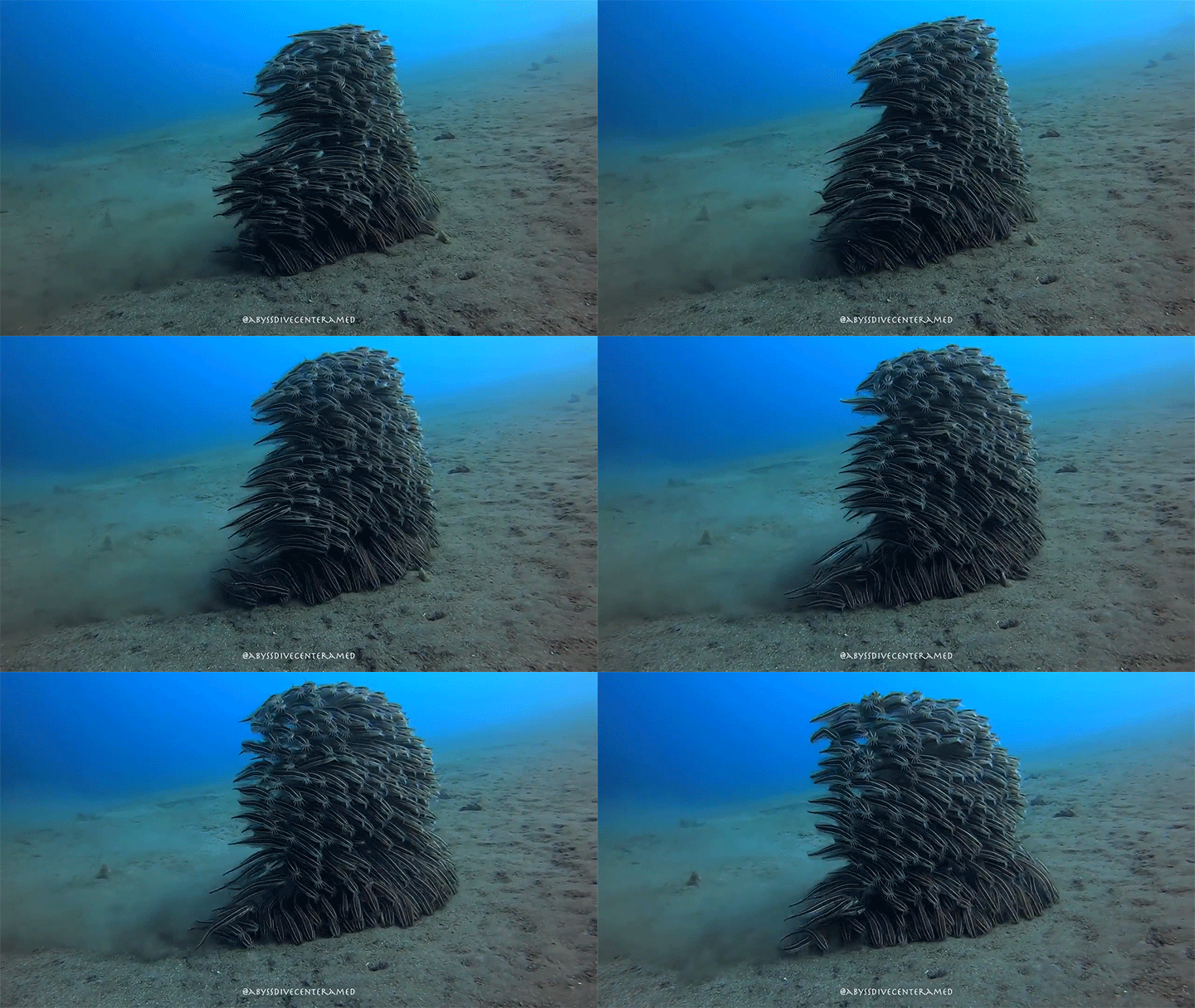
    Year 10: Collective Catfish Convection

    If you’d rather enjoy something random rather than something “popular”, you can always use the shortcut https://fyfluiddynamics.com/random to explore posts in the archive.

    And in case you’re more interested in watching videos, here are the top FYFD videos (by YouTube views):

    (Wow, my editing and production skills have evolved since some of those earlier vids!)

    So what are your favorite FYFD memories and posts? Let me know in the comments! (Image and video credits: N. Sharp)

  • Searching For Solar Neutrinos

    Searching For Solar Neutrinos

    An experiment in Italy has reported new findings confirming a long-standing theory of nuclear fusion in our Sun. The researchers were able to detect neutrinos released by the relatively rare fusion of carbon and nitrogen. But catching those neutrinos took an impressive fluid dynamical feat.

    The Borexino solar-neutrino detector is essentially an enormous nylon balloon, filled with liquid hydrocarbons, immersed in water, and buried beneath a kilometer of rock. Most neutrinos fly through this milieu unhindered, but a few collide with hydrocarbon molecules, creating streaks of light picked up by the detector.

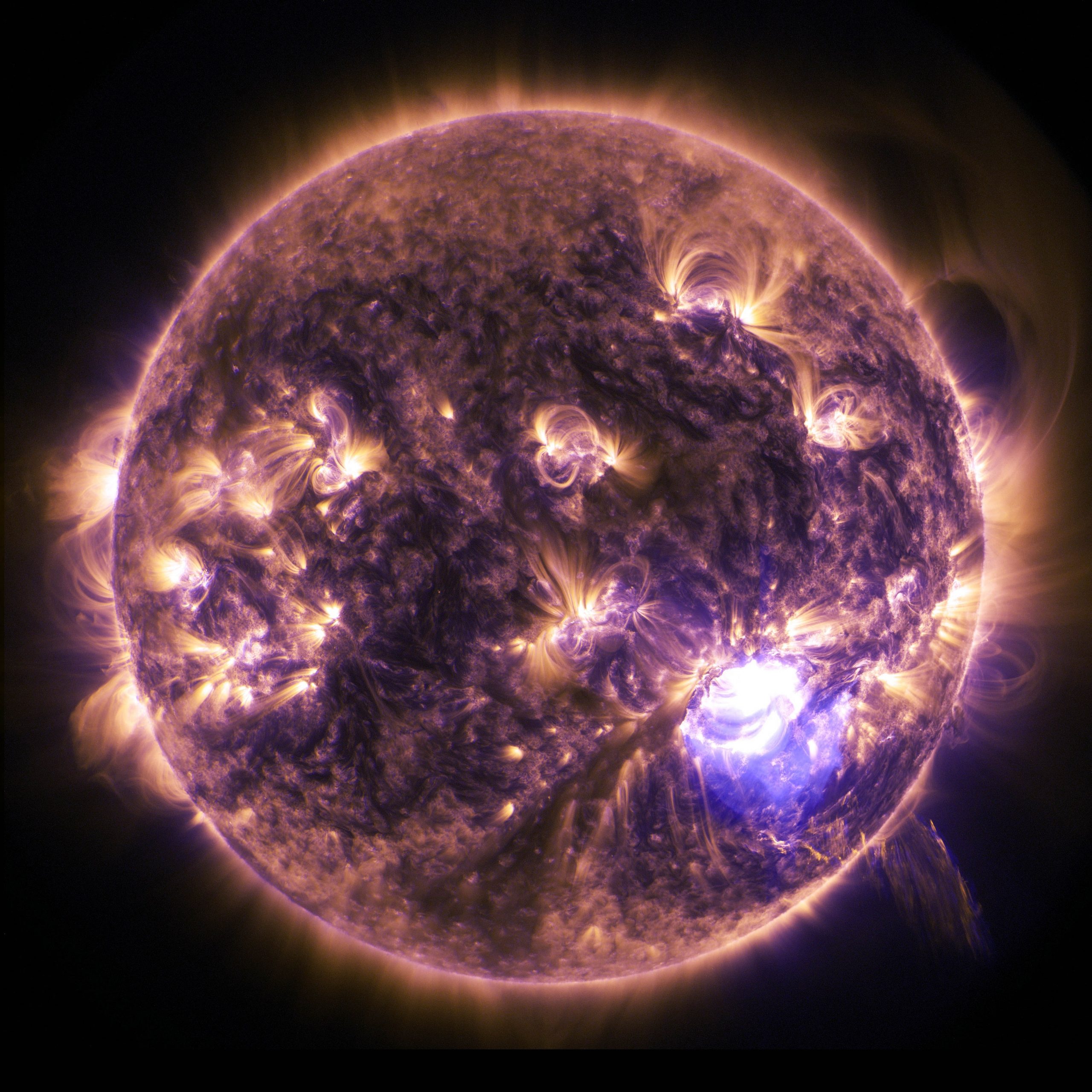
    The challenge in distinguishing solar carbon-nitrogen neutrinos comes from an isotope in the balloon’s nylon lining, which slowly leaks into the detector. The noise caused by the leaking isotope is easily confused with the true solar signal. To tamp down on that noise level, the researchers took elaborate steps to ensure that all 278 tonnes of liquid in the detector remained at exactly the same temperature, thereby eliminating convection in the detector. With only molecular diffusion to move the noisy isotopes, the researchers held the liquid incredibly still. One team member described the fluid as moving only tenths of a centimeter a month! (Image credit: NASA SDO; via Nature; submitted by Kam-Yung Soh)

  • New Details on the Sun’s Surface

    New Details on the Sun’s Surface

    As part of its shakedown, the new Inouye Solar Telescope has captured the surface of the sun in stunning new detail. Seen here are some of the sun’s turbulent convection cells, each about the size of the state of Texas. Hot plasma rises in the center of each cell, cools, and then sinks near the dark edges. Also visible within these dark borders are bright spots thought to mark magnetic fields capable of channeling energy out into the corona. Researchers hope the new telescope will help them uncover the physics behind these processes. (Image and video credit: Inouye Solar Telescope)

    Convection cells on the sun.

    Editor’s note: Like several other telescopes located in Hawai’i, the Inouye Solar Telescope was built against the wishes of many native Hawaiians. Although FYFD supports scientific progress, it is my personal belief that scientific advances should not come at the expense of indigenous populations. I strongly urge my scientific colleagues to listen to and work alongside those with concerns about future facilities.

  • Jupiter in Infrared

    Jupiter in Infrared

    This stunning new image of Jupiter in infrared is part of a data set combining measurements from ground- and space-based observatories. The glowing Jovian orb seen here is a composite of some of the sharpest images captured by the Gemini North Telescope’s Near-Infrared Imager from its perch on Mauna Kea. The brightest areas correspond to warmer temperatures over thinner, hazier clouds, whereas the dark areas mark towering, thick clouds.

    The ground-based images — and observations from Hubble — were timed to coincide with passes from the Juno spacecraft. This combination of infrared, visible light, and radio wave observations gives scientists an unprecedented look at Jovian atmospheric processes. It revealed, for example, that lightning measured by Juno deep inside Jupiter’s atmosphere corresponded to convective storm cores visible to the other imagers. The combination of observations allowed the researchers to reconstruct the structure of these Jovian storms in a way that no single instrument could reveal. No doubt planetary scientists will learn lots more about Jovian convection from the data set. (Image credit: Jupiter – International Gemini Observatory/NOIRLab/NSF/AURA, M.H. Wong (UC Berkeley)/Gizmodo, illustration – NASA, ESA, M.H. Wong (UC Berkeley), and A. James and M.W. Carruthers (STScI); research credit: M. Wong et al.; via Gizmodo)

  • Featured Video Play Icon

    The Birth of a Liquor

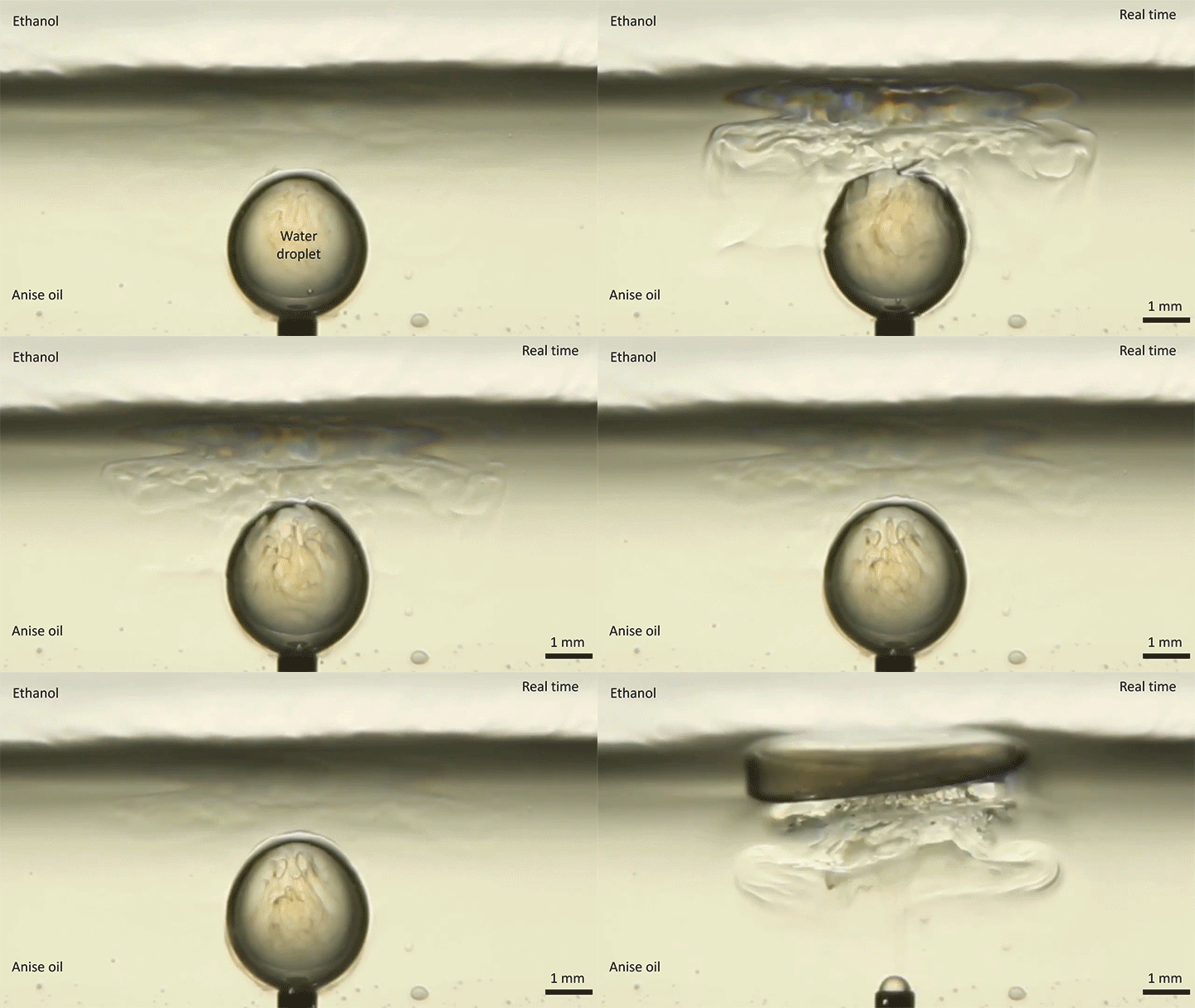
    A water droplet immersed in a mixture of anise oil and ethanol displays some pretty complicated dynamics. Its behavior is driven, in part, by the variable miscibility of the three liquids. Water and ethanol are fully miscible, anise oil and ethanol are only partially miscible, and anise oil and water are completely immiscible. These varying levels of miscibility set up a lot of variations in surface tension along and around the droplet, which drives its stretching and eventual jump.

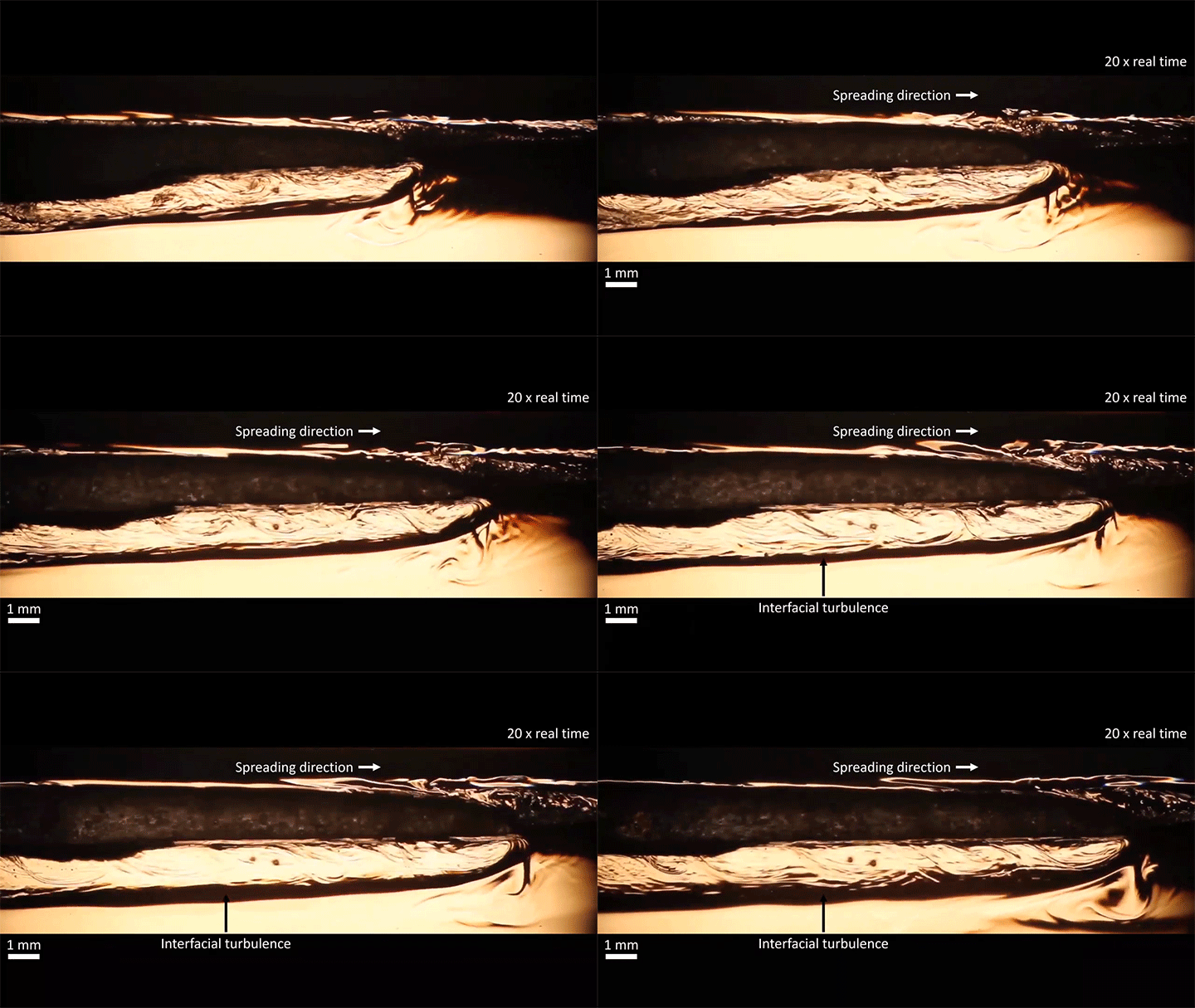
    Once detached, the droplet takes on a flattened, lens-like shape that continues to spread. That spreading is driven by the mixing of ethanol and water, which generates heat and, thus, convection around the drop. This not only spreads the droplet, it causes turbulent behavior along the drop’s interface. (Image and video credit: S. Yamanidouzisorkhabi et al.)

  • Featured Video Play Icon

    Sunlight Is Older Than You Think

    Joe Hanson over at “It’s Okay to Be Smart” has a great video on the random walk photons have to make to escape the core of the sun and other stars. Because the high-energy photons born in the star’s core have to bounce their way out rather than flying in a straight line, those photons can spend thousands of years escaping the sun. After that, the eight-and-a-half minute trip to Earth is nothing.

    But there’s a key element missing in this explanation: convection! That radiative random walk photons do doesn’t last all the way from the core of the sun to its surface. From a depth of about 200,000 km onward, the dominant mode of transport in the sun is convection, actual fluid motion that carries heat and light much faster than simple molecular diffusion, or Brownian motion, does. That’s why the surface of the sun shines with convection cells similar to the ones you’ll see in your skillet when heating a layer of oil.

    Fluid motion beyond molecular diffusion is also a big part of the other flows Joe describes in the video. If you had to wait on Brownian motion in order to smell your morning coffee, it would be cold long before you knew it was there! (Video and image credit: It’s Okay to Be Smart; sun surface image credit: Big Bear Solar Observatory/NJIT)

  • Levitation Without Boiling

    Levitation Without Boiling

    One way to levitate droplets is to place them on a surface heated much higher than the droplet’s boiling point. This creates the Leidenfrost effect, where a droplet levitates on a thin layer of its own evaporating vapor. In this study, the situation is quite different.

    Although the underlying pool of liquid — here, silicone oil — is heated, its temperature is well below the boiling point of the water droplet. But the droplet still levitates over the pool, thanks to an air layer fed by convection. Aluminum powder in the oil reveals large-scale convection in the pool; note how the oil moves radially toward the droplet. That movement drags the air in contact with the oil with it, which forms the vapor layer keeping the droplet aloft.

    One side effect of this convection-driven levitation is that the droplet hovers over the coldest point in the oil. That fact suggests that users can manipulate the droplet’s motion by tuning the underlying heating. (Image and research credit: E. Mogilevskiy)