Vibrating particles or granular materials can produce many fluid-like behaviors. In this video, researchers demonstrate how a granular gas made up of particles of two sizes behaves at different conditions. By tweaking the amplitude of the vibration, they alter how the particles cluster in a divided container. At large vibrational amplitudes, the particles behave much like a gas–energetic and spread out. At lower amplitudes, though, the particle density and the number of particle collisions increases. Each collision dissipates some of a particle’s energy; more collisions means less energy available to escape. As a result, the particles cluster, forming an attractor that draws in additional particles over time. (Video credit: R. Mikkelson et al.)
Search results for: “art”

Rebounding Off Dry Ice
Droplet rebound is frequently associated with superhydrophobic surfaces but can also be generated by very large temperature differences. For very hot substrates, a thin layer of the drop vaporizes on contact via the Leidenfrost effect and helps a drop rebound by preventing it from wetting the surface. This video shows almost the opposite: a water droplet hitting solid carbon dioxide (-79 degrees C). Upon contact, the solid carbon dioxide sublimates, creating a thin layer of gas that separates the droplet from the surface. You can also see the vortex ring that accompanies the drop’s impact. Water vapor near the carbon dioxide surface has condensed into tiny airborne droplets that act as tracer particles that reveal the vortex’s formation and the rebounding droplet’s wake. (Video credit: C. Antonini et al.; Research paper)
Navigating the Interface
Walking on water may be the stuff of legend at human scales, but it’s a fact of everyday life for many smaller species. Waxy, hydrophobic coatings typically make such insects’ points of contact (feet, legs, etc.) water-repellent, and their light weight can be supported by surface tension. Navigating the interface between air and water is more complicated, though, and these creatures have evolved several mechanisms to help. Some, like water striders, use appendages they insert below the surface for propulsion. At 0:49 in the montage above, you can see flow visualization of the vortices generated by a stroke. Other insects release a chemical in their wake that lowers the local surface tension and drives them away via the Marangoni effect. For more, see here and especially this Physics Today article. (Video credit: D. Hu and J. Bush)

Fluids Round-up – 11 August 2013
Time for another fluids round-up! Here are your links:
- Back in January 1919, a five-story-high metal tank full of molasses broke and released a wave of viscous non-Newtonian fluid through Boston’s North End. Scientific American examines the physics of the Great Molasses Flood, including how to swim in molasses. If you can imagine what it’s like to swim in molasses, you’ll know something of the struggle microbes experience to move through any fluid. They also discusses some of the strange ways tiny creatures swim.
- In sandy desert environments, helicopter blades can light up the night with so-called helicopter halos. The effect is similar to what causes sparks from a grinding wheel. Learn more about this Kopp-Etchells effect.
- Check out this ominous footage of a tornadic cell passing through Colorado last week.
- If you want more of a science-y look to your drinkware, you should check out the Periodic TableWare collection over on Kickstarter.
- Finally, wingsuits really take the idea of gliding flight to some crazy extremes. Check out this video of in-flight footage. Watch for the guy’s wingtip vortices at 3:16 (screencap above)! (submitted by Jason C)
(Photo credit: Squirrel)
Contaminants Flowing Uphill
Here’s an example of some baffling fluid dynamics. Researchers have found that, when pouring a fluid from one container into a lower one containing a fluid with floating particulates, it’s possible for the floating particles to travel upstream against gravity and the flow. The phenomenon is driven by surface tension. The particulates floating in the lower container decrease the fluid’s surface tension relative to the pure fluid pouring in from above. This creates a gradient in surface tension that, via the Marangoni effect, drives a small flow upstream, in the direction of the greater surface tension. In the video above, this flow takes the form of two recirculating vortices in the pouring channel, oriented such that their upstream velocities run along the outside of the channel. Occasionally this flow draws particulates up the waterfall and into the recirculating zones, creating upstream contamination. We reported this previously, but the researchers have now released videos demonstrating the effect, including in pipettes and a water flume. Usually it’s taken for granted that matter cannot move upstream, so this could be a game-changer, especially at small scales where surface tension already dominates. For more, see their paper. (Video credit: S. Bianchini et al.)

Bouncing in Lockstep
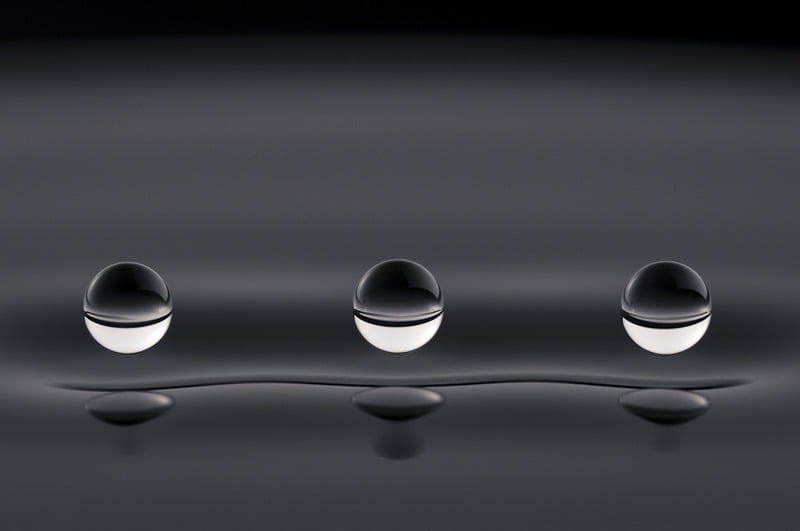
Droplets of silicone oil bounce on a pool of the same thanks to the vibration provided by a loudspeaker. Each droplet’s bounce causes ripples in the pool and the interference between these ripples fixes the droplets in lockstep with one another. As long as the vibration continues to feed the thin layer of air that separates the droplets from the pool during each bounce and no impurities break the surface tension at the interface, the droplets will bounce indefinitely on their liquid trampoline. Such systems can be used to observe quantum-mechanical behavior like wave-particle duality on a macro-scale. (Photo credit: A. Labuda and J. Belina)
Flow Over a Delta Wing
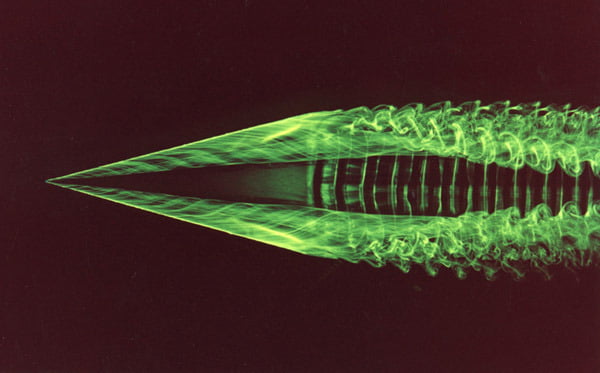
Fluorescent dye illuminated by laser light shows the formation and structure of vortices on a delta wing. A vortex rolls up along each leading edge, helping to generate lift on the triangular wing. As the vortices leave the wing, their structure becomes even more complicated, full of lacy wisps of vorticity that interact. Note how, by the right side of the photo, the vortices are beginning to draw closer together. This is an early part of the large-wavelength Crow instability. Much further downstream, the two vortices will reconnect and break down into a series of large rings. (Photo credit: G. Miller and C. Williamson)
Self-Assembling Ferrofluids
Ferrofluids–colloidal suspensions made up of ferromagnetic nanoparticles and a carrier liquid–are known for their interesting and sometimes bizarre behaviors due to magnetic fields. The video above shows how, when subjected to an increasing magnetic field, a single droplet of a ferrofluid on a superhydrophobic surface will split into several droplets. The process is called static self-assembly, and it results from the ferrofluid seeking a minimum energy state relative to the force supplied by the magnetic field. Change the magnetic field and the droplets shift to the next energy minimum. But what happens when you change the magnetic field continuously and too quickly for the droplets to respond? A whole different set of structures and behaviors are observed (video link). This is dynamic self-assembly, a different ordered state only achieved when the ferrofluid is forceably kept away from the energy minima seen in the first video. For more, see the additional videos and the original paper. (Video credit: J. Timonen et al.; via io9)
Instability: Dense Over Light
Here on Earth, placing a dense layer of fluid atop a less dense layer is unstable. Specifically, the situation causes the interface between the two fluids to break down in what is known as the Rayleigh-Taylor instability.The video above shows a 2D numerical simulation of this breakdown, with the darker, denser fluid on top. The waviness of the initial interface provides a perturbation–a small disturbance–which grows in time. The two fluids spiral into one another in a fractal-like mushroom pattern. The continued motion of the dense fluid downward and the lighter fluid upward mixes the entire volume toward a uniform equilibrium. For those interested in the numerical methods used, check out the original video page. (Video credit: Thunabrain)
Brownian Motion
Have you ever noticed how motes of dust seem to dance around even in still air? The reason they do is because all the atoms and molecules in the air have a certain amount of random motion and all those tiny random motions result in collisions on the dust particles that shift them around. The technical term for this is Brownian motion, named for botanist Robert Brown who noticed through his microscope that particles of pollen floating on water moved constantly under no apparent force. The video above demonstrates the effect in 2D with vibrating brass particles representing atoms and a polystyrene ball as the pollen. Alternatively, you can see Brownian motion in the movement of nanoparticles in water. Although most areas of fluid dynamics do not explicitly consider the random motions of all these particles, the concept is fundamental to the nature of pressure and temperature, both of which are important quantities in fluid dynamics. (Video credit: Sixty Symbols; topic requested by just-a-random-nerd)