Search results for: “art”

  • Molasses Flood Press

    Molasses Flood Press

    My Molasses Flood project has gotten a bunch of press since my presentation earlier this week, including in the New York Times, the Associated Press, New Scientist, and on CBC’s “As It Happens”. There’s more links to recent articles on the revamped About page – I’ll continue filling out the “FYFD in the News” section sometime after the holiday weekend!

    I also just want to take a moment to thank all of you for your continued interest and support. I couldn’t keep this up without you! (Image credit: Associated Press)

  • Are Cats a Fluid?

    Are Cats a Fluid?

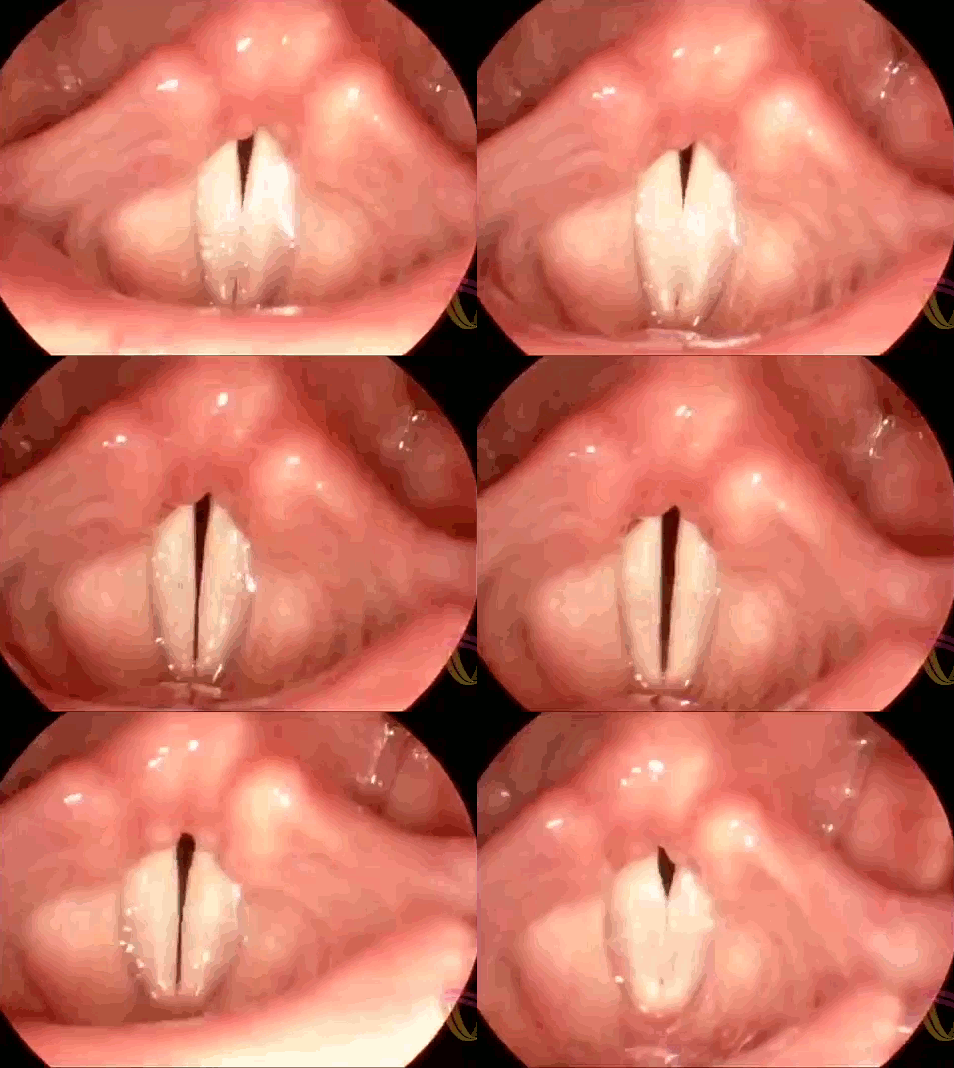
    Are cats a fluid? It’s a question that has inspired many a meme. There are a few common definitions as to what makes a fluid. One is that a fluid changes its shape to that of its container. Another more technical definition is that a fluid deforms continuously under shear forces. But the real picture is messier than these seemingly simple definitions allow for. On the Improbable Research podcast, I tackle the question of whether cats are a solid or a fluid and what fluid dynamics–specifically, the subject of rheology–has to teach us about the topic. Give it a listen! (Original image credits: Huffington Postimgur; research credit: M. A. Fardin, pdf – article begins on page 16)

    Post-Thanksgiving bonus: Today is the traditional Science Friday broadcast of this year’s (abridged) Ig Nobel Prize ceremony. Check your local NPR station for broadcast times or listen to it on their website. You’ll hear me deliver a 24/7 lecture on the subject of “Fluid Dynamics” (and you may find me cropping up elsewhere, too). Alternatively, you can check out the full ceremony video on YouTube.

  • Starfish Vortices

    Starfish Vortices

    Starfish larvae, like other microorganisms, use tiny hair-like cilia to move the fluid around them. By beating these cilia in opposite directions on different parts of their bodies, the larvae create vortices, as seen in the flow visualization above. The starfish larvae don’t use these vortices for swimming – to swim, you’d want to push all the fluid in the same direction. Instead the vortices help the larvae feed. The more vortices they create, the more it stirs the fluid around them and draws in algae from far away. The larvae actually switch gears regularly, using few vortices when they want to swim and more when they want to eat. Check out the full video below to see the full explanation and more beautiful footage.  (Image/video credit: W. Gilpin et al.)

  • Featured Video Play Icon

    APS DFD 2016

    It’s the time of year again for the American Physical Society Division of Fluid Dynamics meeting! Tomorrow I’ll fly to Portland, OR for three days of non-stop fluid dynamics. This year I’ll be giving two talks:

    Sunday, November 20th, 3:23pm, Room B117: F*** Yeah Fluid Dynamics: Inisde the science communication process

    Monday, November 21st, 6:01pm, Room E147-148: “In a sea of sticky molasses”: The physics of the Boston Molasses Flood

    The latter talk is part of an ongoing project exploring the fluid dynamics of the Boston Molasses Flood of 1919. Since you’ll be hearing more about the project in the coming weeks and months, I’m sharing a sneak peek video I originally made for my Patreon patrons. If you’re interested in following the project’s progress, you may want to become an FYFD patron – otherwise, rest assured that you will see the final results eventually 🙂

    I hope to see some of you in Portland, but if you can’t make it, I encourage you to follow the meeting on social media with !

    (Video credit: N. Sharp/FYFD)

  • Featured Video Play Icon

    The Blue Whirl

    We wrote earlier this year about the discovery of a new type of fire whirl – the blue whirl – but now the authors have published video of the blue whirl in action! The blue whirl was discovered while investigating the use of fire whirls to more efficiently burn off oil spilled atop water. A tightly spinning yellow fire whirl produces less soot than a non-vortex burn; the blue whirl is even more efficient, producing little to no soot at all. Much remains to be learned about this new type of fire vortex, but in the meantime, enjoy some high-speed video of the blue whirl, particularly from 1:50 onward. (Video credit: M. Gollner et al.)

  • Featured Video Play Icon

    Bouncing Droplets

    Droplets bouncing on a pool form a beautiful and fascinating system, as recently featured by Physics Girl, Veritasium, and Smarter Every Day. The Lutetium Project – a consortium of French physics, graphic design, and music students – have their own take on the subject with beautiful short videos constructed from experimental research footage. With simple text explanations and lovely original music, they combine science, art, and outreach brilliantly. Also check out their quantum walker video and be sure to subscribe to their channel (in English or French) for more!  (Video credit: The Lutetium Project; submitted by @g_durey)

  • Featured Video Play Icon

    Colors in Macro

    Milk, acrylic paints, soap, and oil – all relatively common fluids, but together they form beautiful mixtures worth leaning in to enjoy. Variations in surface tension between the liquids cause much of the motion we see. Soap, in particular, has a low surface tension, which causes nearby colors to get pulled away by areas with higher surface tension, behavior also known as the Marangoni effect. Adding oil creates some immiscibility and lets you appreciate both the coalescence and fragmentation of the fluids. And finally, there’s one of my favorite sequences, where bubbles start popping in slow motion. As the bubble film ruptures, fluid pulls away, breaking into ligaments and then a spray of droplets as the bubble disintegrates. (Video credit: Macro Room; via Gizmodo)

  • Fingering Under Elastic

    Fingering Under Elastic

    Take a couple panes of glass and stick a viscous fluid in between them; you’ve now constructed what fluid dynamicists call a Hele-Shaw cell. If you inject a low-viscosity fluid, like air, into the cell, you’ll get a beautiful finger-like pattern like the one shown on the left. If you change one of the walls to an elastic sheet, though, things get a bit different. The flexibility of the wall allows the upper surface to inflate as air gets pushed in. This can suppress the usual viscous fingers, as seen in the center animation. However, if you push the air in quickly, as in the right animation, the sudden inflation can wrinkle the elastic sheet. In this case, the wrinkles are the dominant influence, causing the the fluid to finger – but in an entirely different way than before! (Image credit: D. Pihler-Puzovic et al., sources 1, 2, 3; see also)

  • Featured Video Play Icon

    Avoiding Coalescence

    If you watch closely as you go about your day, you may notice drops of water sometimes bounce off a pool of water instead of coalescing. Fluid dynamicists have been fascinated by this behavior since the 1800s, but it was Couder et al. who explained that these droplets can bounce indefinitely as long as the thin air layer separating the drop and pool is refreshed by vibrating the pool. In this video, Destin teams up with astronaut Don Pettit to film the phenomenon in beautiful high-speed. My favorite part of the video starts around 8:18, where Destin shows Don’s experiments with this effect in microgravity. It turns out that the cello produces just the right frequencies to create a cascade of bouncing water droplets, much like a Tibetan singing bowl turned back on itself! (Video credit: Smarter Every Day; submitted by Destin and effyeahjoebiden)

  • Swirling Pollen

    Swirling Pollen

    This photo captures the chaotic mixing present in a simple puddle. Pine pollen strewn across the puddle’s surface acts as tracer particles, revealing some of the motion of the underlying water. As wind blows across the puddle, it moves the water through the formation of ripples and by shearing the surface. That deformation on the top of the puddle will cause further motion beneath the surface. With time and changing wind direction, the resulting pattern of flow can be very complex! (Photo credit: K. Jensen, original)