
Most people are familiar with the propeller-like shape of conventional wind turbines. These turbines can be more than 100m tall and can generate several megawatts apiece, but placing them in arrays requires a lot of open space because flow downstream of one turbine will interfere with the efficiency of the next. Vertical axis wind turbines (VAWT), like those shown in the photo above, are smaller and produce a fraction of the power of their larger horizontal-axis counterparts, but VAWTs can be placed much closer together. In fact, putting them in closely spaced arrays can actually increase their output through flow synergies. Researchers hope that eventually VAWT arrays will be able to produce significantly more power per land area than conventional wind turbines. (Image credit: Texas A&M Corpus Christi)
Search results for: “art”
Breaking the Wave Speed Limit
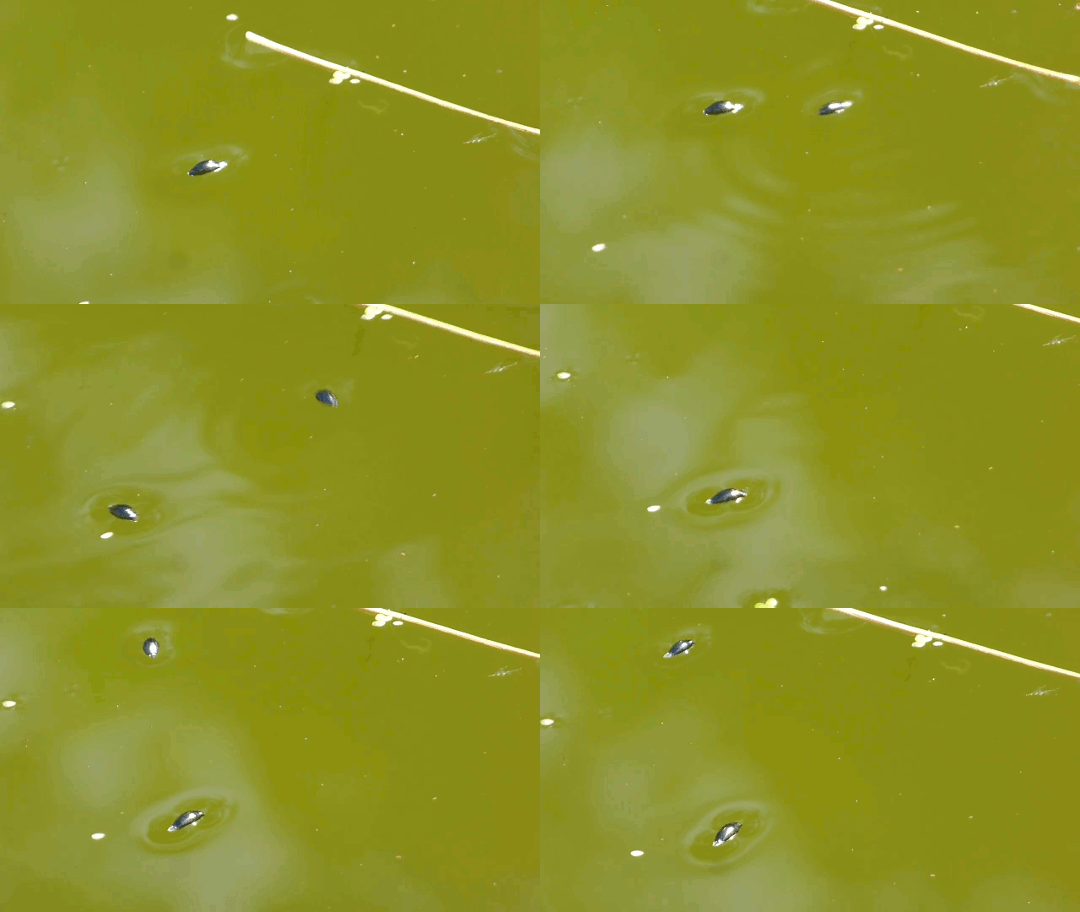
Whirligig beetles are small surface swimming insects. As they race across the water surface, they create both visible and unnoticeable waves on the water. These waves are the result of both surface tension and gravity. Typically, it’s the wavelength of the gravity waves that limit a swimmer or boat’s speed. When the wavelength of the gravity waves a swimmer creates meets the size of the swimmer, the waves generated ahead of the swimmer start to reinforce the waves forming at the back of the swimmer. This traps the swimmer (or boat) in a trough between its bow and stern waves and limits the max speed of the swimmer since overcoming this critical hull speed requires excessive amounts of power.
The tiny whirligig beetle overcomes this natural speed limit cleverly. It is smaller than the shortest possible gravity wave in water. Thus, it can never be trapped between its bow and stern waves! This allows the tiny swimmer to zip across the water’s surface at speeds above 0.5 m/s. That’s over 30 beetle body lengths per second! (Image credit: H. L. Drake, source; research credit: V. Tucker; submitted by Marc A.)

How Jet Engines Work
Jet engines are a major part of aviation today, and this great video from the new LIB LAB project breaks down how jet engines operate. It focuses especially on the subject of combustion, in which fuel-air mixtures are burned to generate power and thrust. By breaking fuels down into simpler compounds, jet engines are able to accelerate exhaust gases, which creates thrust. They even provide instructions for an effervescence-driven bubble rocket so that kids can (safely!) experiment with propulsion at home. (Video credit: LIB LAB/Corvallis-Benton County Public Library)
Supporting Bubbles
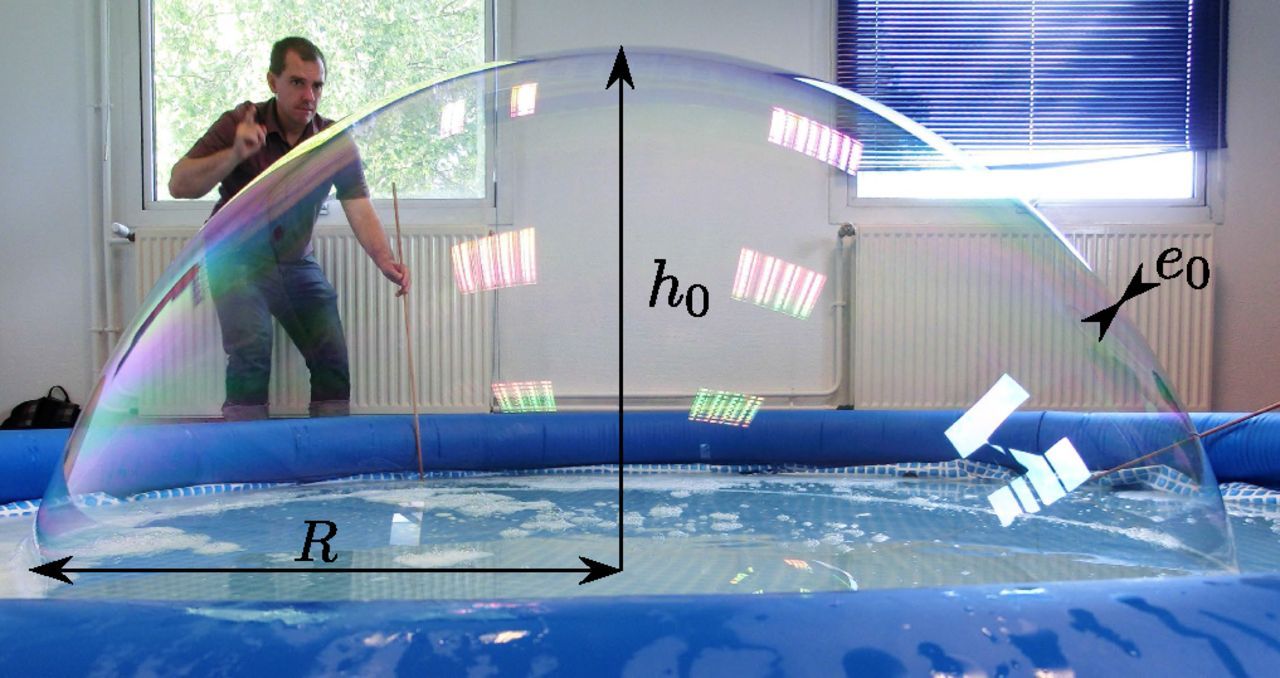
Surface tension holds small droplets in a partial sphere known as a spherical cap. But when droplets become larger, they flatten out into puddles due to the influence of gravity. In contrast, soap bubbles remain spherical to much larger sizes. The bubble pictured above, for example, is more than 1 meter in radius and nearly 1 meter in height.
There is a maximum height for a soap bubble, though, and it’s set by the physical chemistry of the surfactants used in the soap. To support itself, the bubble requires a difference in surface tension between the top and bottom of the bubble. A higher surface tension is necessary at the top of the bubble to help prevent fluid from draining away. The difference in surface tension between the top and bottom of the bubble can never be greater than the difference in surface tension between pure water and the soap mixture – thus those values set a maximum height for a bubble. The researchers found their bubbles maxed out at a height of about 2 meters, consistent with their theoretical predictions. (Image credit: C. Cohen et al.; via freshphotons)
Spillways
Extensive rains in California have brought an unusual sight to Lake Berryessa – an overflowing spillway. The upper photo, taken in 2010, shows the concrete structure of the spillway’s entrance, known as a bellmouth – or, in the words of locals, a glory hole. When the water level rises above the concrete, water begins to cascade down the spillway to relieve flooding.
The flow is rather mesmerizing and beautifully laminar until it’s fallen many feet down the hole. This is intentional on the part of the designers – at least the laminar part. It means that the flow velocity at the entrance is slow, so that animals (or trespassing people) nearby are not going to get sucked down the spillway a la Charybdis. Nevertheless, the spillway does make quick work of excess water. The New York Times reported that on February 21st about two million gallons (7.5 million liters) of water a minute flowed down the spillway. (Image credits: J. Brooks; T. Van Hoosear; video credit: Lake Berryessa News; submitted by Zach B.)


An Octopus’ Handshake
Cephalopods, especially octopuses, are fascinating creatures. At sea level, an octopus can generate an impressive pressure differential of 1 to 2 atmospheres with each of its suckers. That incredible grip is possible thanks to fluid dynamics. An octopus’s sucker consists of two main parts: the ring-shaped infundibulum on the outer surface and the inner, cup-shaped acetabulum. When the infundibulum makes contact with a surface, it creates a water-tight seal. The octopus then contracts radial muscles along the acetabulum. This expands the inner chamber. The water trapped in the acetabulum now has to take up a greater volume, causing the pressure to drop and creating suction. To let go, the octopus simply relaxes the radial muscles or contracts circular ones to reduce the chamber volume and release the suction. (Video credit: Deep Look)

Vortex Impact

When a vortex ring impacts a solid wall (or a mirrored vortex ring), it expands and quickly breaks up. The animations above show something a little different: what happens when a vortex ring hits a water-air interface. As seen in the side view (top image), the vortex starts to expand, but its shear at the interface generates a stream of smaller vortices that disrupt the larger vortex. (They even look like a little string of Kelvin-Helmholtz vortices!) When viewed from above (bottom image), the vortex ring impact and breakdown look even more complicated. Mushroom-like structures get spat out the sides as those secondary vortices form, and the entire structure quickly breaks up into utter turbulence. There’s some remarkable visual similarities between this situation and some we’ve seen before, like a sphere meeting a wall and drop hitting a pool. (Image credit: A. Benusiglio et al., source)
Venusian Waves
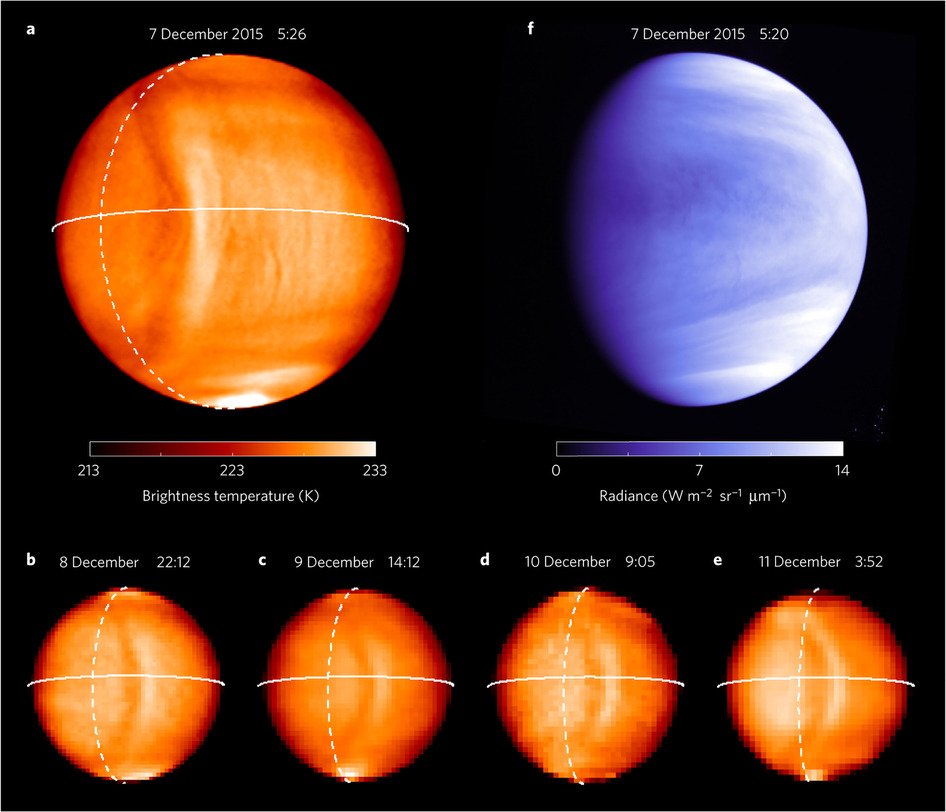
Despite its proximity, Venus remains largely mysterious, thanks to its cloudy atmosphere and incredible harsh conditions. A recent study using data from the Japanese satellite Akatsuki revealed an enormous bow-shaped wave in the Venusian atmosphere. The wave appeared at an altitude of about 65 km and stretched more than 10,000 km long, across both the northern and southern hemispheres. Although surface winds on Venus are believed to be small due to its incredibly slow rotation, winds higher in the atmosphere are much faster – so it was strange to observe this wave sitting essentially stationary for five days of observation.
When the scientists mapped the location of wave relative to the surface, they found it was sitting over the Aphrodite Terra highlands, suggesting that this structure is a gravity wave generated by winds interacting with the topography. Similar, albeit smaller, gravity waves are often observed on Earth near mountains. The finding raises questions about our understanding of Venusian atmospheric dynamics and exactly how disturbances from surface winds could create enormous structures so high in the atmosphere. (Image credit: T. Fukuhara et al.; h/t to SciShow Space)
Creating Clouds
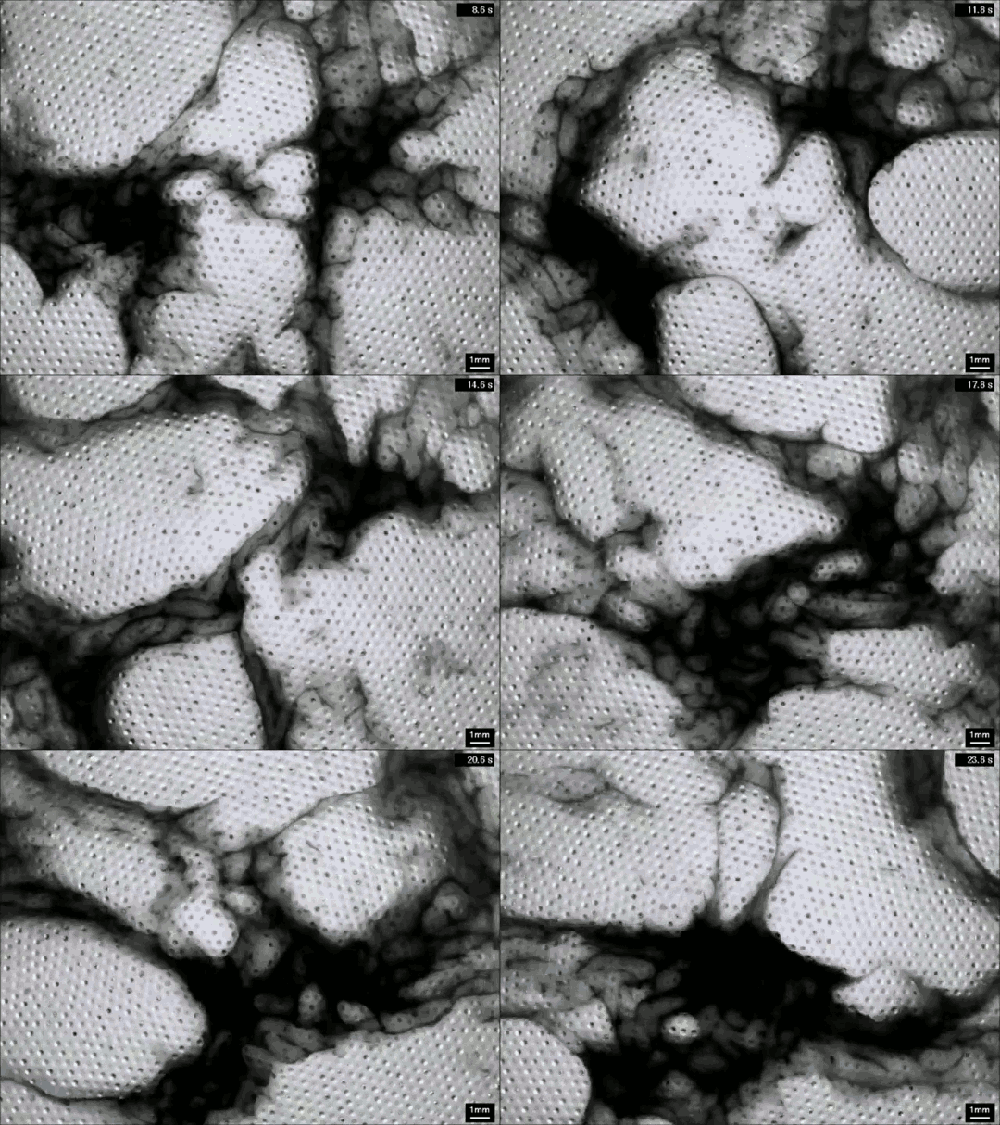
What you see here is the formation of clouds and rain – but it’s not quite what you’re used to seeing outside. This is an experiment using a mixture of sulfur hexafluoride and helium to create clouds in a laboratory. Everything is contained in a cell between two transparent plates. Liquid sulfur hexafluoride takes up about half of the cell, and when the lower plate is heated, that liquid begins evaporating and rising in the bright regions. When it reaches the cooled top plate, the liquid condenses into droplets inside the dimples on the plate, eventually growing large enough to fall back as rain. The dark wisps you see are areas where cold sulfur hexafluoride is sinking, much like in the water clouds we are used to. Setups like this one allow scientists to study the effects of turbulence on cloud physics and the formation of droplets. (Image credit: E. Bodenschatz et al., source)
Boston-area folks! I’ll be taking part in the Improbable Research show Saturday evening at 8 pm at the Sheraton Boston. Come hear about the Boston Molasses Flood and other bizarre research!
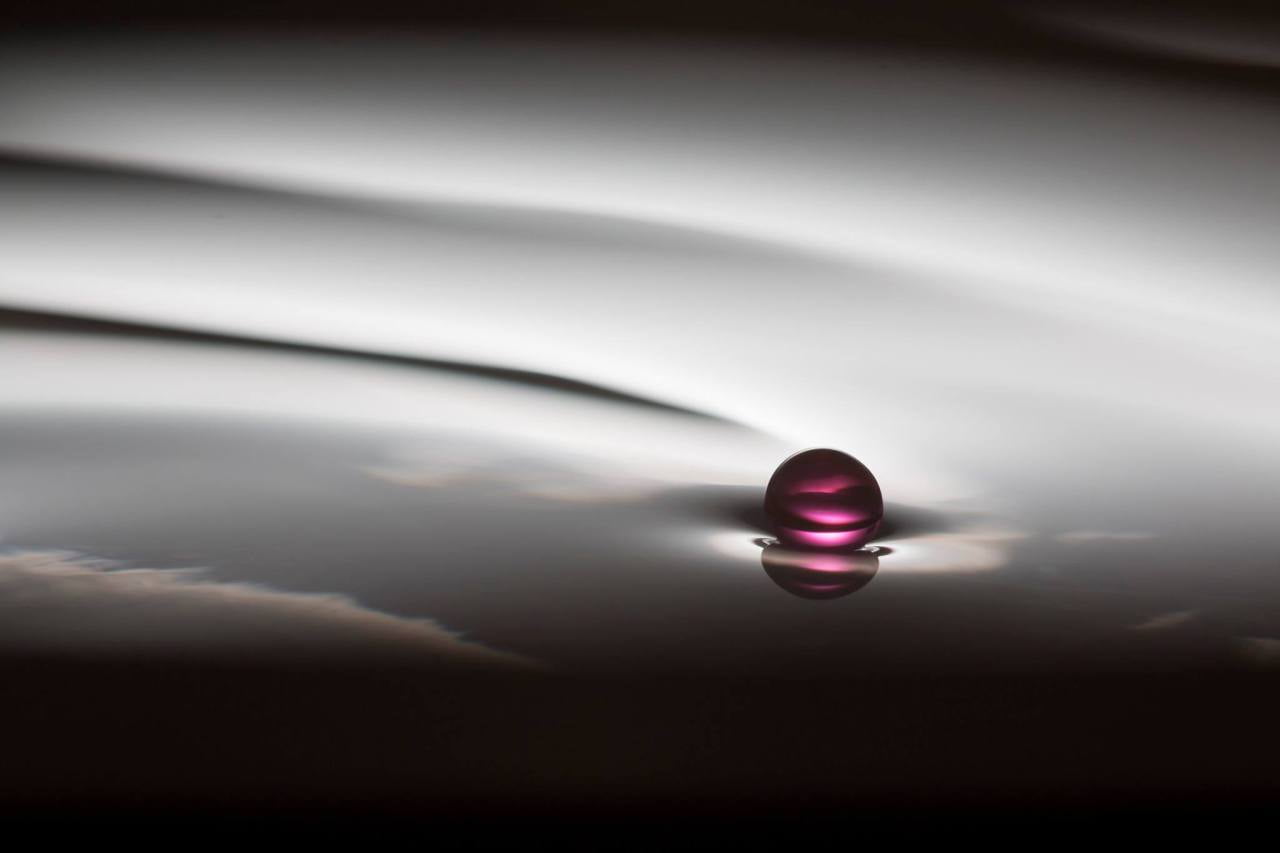
Leidenfrost Atop a Fluid
Leidenfrost droplets typically hover on a thin layer of vapor above a surface that is much hotter than the boiling point of the liquid. Such drops move almost frictionlessly across these surfaces and can even propel themselves. The question of how hot is hot enough to produce the Leidenfrost effect is still being debated, but recent research suggests that the answer may depend strongly on surface roughness.
To test the role of surface roughness, one group tested drops of ethanol atop a heated pool of silicone oil, as pictured above. Ethanol’s boiling point is 78 degrees Celsius, and the researchers found they could hold the ethanol drop in a Leidenfrost state by heating the pool to 79 degrees Celsius – only 1 degree above ethanol’s boiling point! Thanks to surface tension, a liquid surface is essentially molecularly smooth. The fact that solid surfaces require much higher temperatures before the Leidenfrost effect is observed indicates that even the slightest roughness can have a large impact on the Leidenfrost temperature. (Image credit: F. Cavagnon; research credit: L. Maquet et al., pdf)
Heads-up for Boston-area folks! I’ll be taking part this Saturday evening in the Improbable Research show at the AAAS conference. The show is free and open to the public but fills up quickly, so be sure to come early for a seat.