The motions of Earth’s atmosphere move more than just air and moisture. As seen in this animation built from NASA satellite data, the atmosphere also transports large amounts of small solid particles, or aerosols, such as dust. Each year the wind carries millions of tons of Saharan dust across the Atlantic, depositing much of it in the Amazon basin. This provides much needed nutrients like phosphorus to plants and animals in the Amazon; check out this video from the Brain Scoop to see what happens in areas that don’t receive these nutrients. Dust is only one of many sources for atmospheric aerosols, though. Sea salt, volcanic eruptions, and pollution are others. All of these aerosols serve as potential nucleation sites for raindrops or snowflakes, and their transport all around the globe by atmospheric winds means that seemingly local effects–like a regional drought or increased pollution in developing countries–can have global effects. (Video credit: NASA Goddard; submitted by entropy-perturbation)
Search results for: “art”

Martian Dust Devil
This photo from the Mars Reconnaissance Orbiter stares almost straight down a dust devil on Mars. Like their earthbound brethren, Martian dust devils form when the surface is heated by the sun, causing warm air to rise. The rising air causes a low pressure area that the surrounding air flows into. Any rotational motion of the air intensifies as it is entrained. This is a consequence of conservation of angular momentum. Just as a spinning ice skater spins faster when he pulls his arms in, the vorticity of the inward-flowing air increases, forming a vortex. In addition to dust devils, this same physical mechanism applies to waterspouts and fire tornadoes, although the heating source for those is different. (Photo credit: NASA; via APOD)

The Earth in Infrared
The motions of Earth’s atmosphere are often invisible to the human eye, but fortunately, we’ve built tools to reveal them. This timelapse video shows the Earth in infrared light, first from a satellite view centered on the Pacific Ocean and second from a satellite centered on Central America. The water vapor in clouds is an excellent insulator, so clouds appear dark in this video. Warmer areas look brighter. The large-scale motion of the atmosphere and the wind bands that cut east and west across the world are apparent in the first half of the video, largely because they are not being interrupted by any land masses. In the second half of the video, the western coast of South America is intermittently visible. This is because the Andes Mountains disrupt air flow, pushing warm, moist air upward and causing it to condense into the dark-colored clouds that recirculate over the Amazon. Look further south along the coast and you’ll see the Atacama Desert flashing white each day as it heats up. (Video credit: J. Tyrwhitt-Drake/NASA; submitted by entropy-perturbation)

Frisbee Physics, Part 2
Yesterday we discussed some of the basic mechanics of a frisbee in flight. Although frisbees do generate lift similarly to a wing, they do have some unique features. You’ve probably noticed, for example, that the top surface of a frisbee has several raised concentric rings. These are not simply decoration! Instead the rings disrupt airflow at the surface of the frisbee. This actually creates a narrow region of separated flow, visible in region B on the left oil-flow image. Airflow reattaches to the frisbee in the image after the second black arc, and the boundary layer along region C remains turbulent and attached for the remaining length of the frisbee. Keeping the boundary layer attached over the top surface ensures low pressure so that the disk has plenty of lift and remains aerodynamically stable in flight. A smooth frisbee would be much harder to throw accurately because its flight would be very sensitive to angle of attack and likely to stall. (Image credits: J. Potts and W. Crowther; recommended papers by: V. Morrison and R. Lorentz)

Nautilus Article
Spend an hour watching the clouds roll overhead and no two of them will be the same. The complexity and dynamic motion of turbulence make these flows fascinating, even mesmerizing, to watch. Humans are a pattern-seeking species. We like to seek order in apparent chaos, and this, perhaps, is what makes turbulence such a captivating subject for scientists and artists alike.
Nicole Sharp, “The Beautiful Unpredictability of Coffee, Clouds, and Fire”
Something a little different today. I have a guest post over at Nautilus about looking for patterns in turbulence. Go check it out!
Martian Barchans
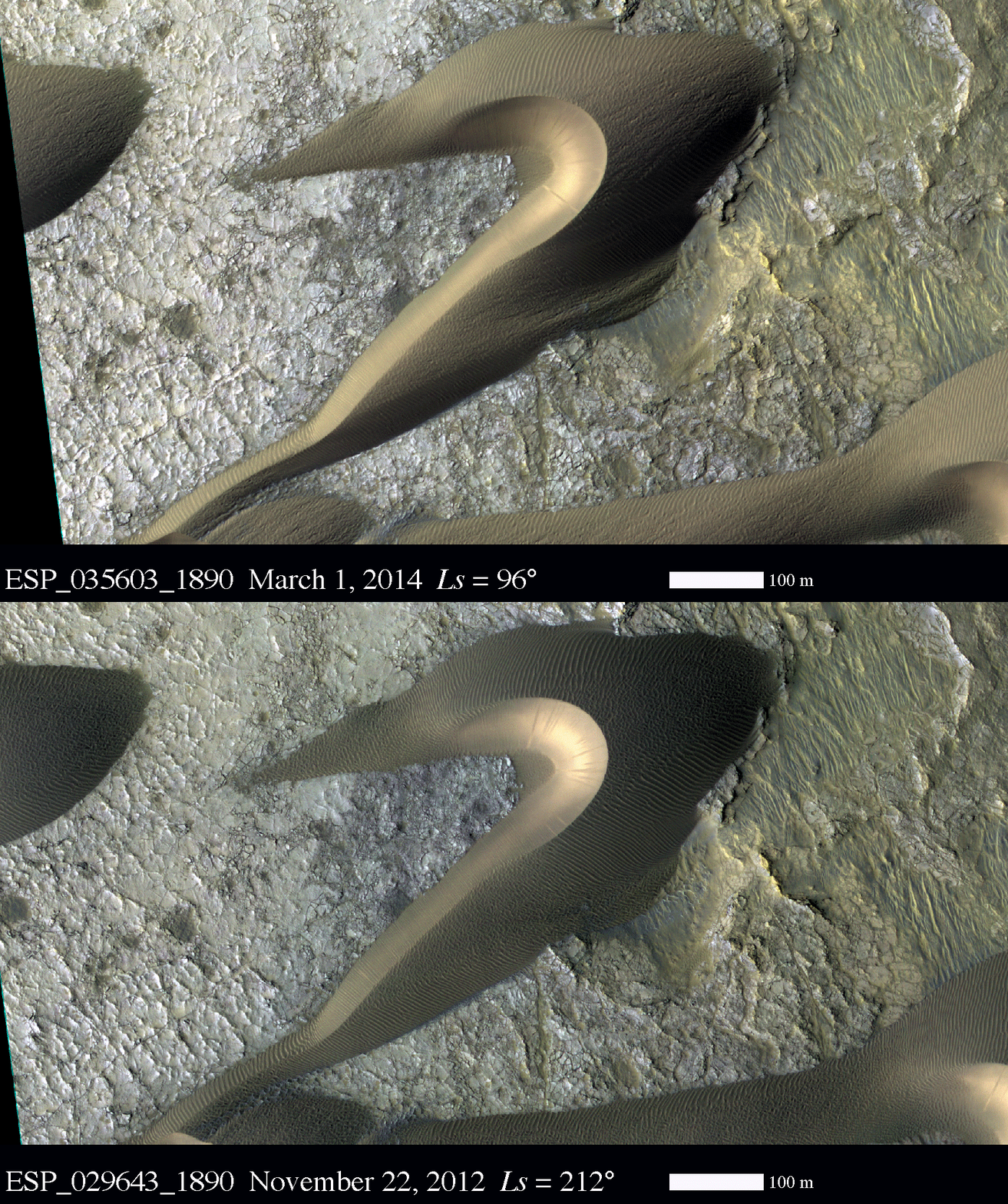
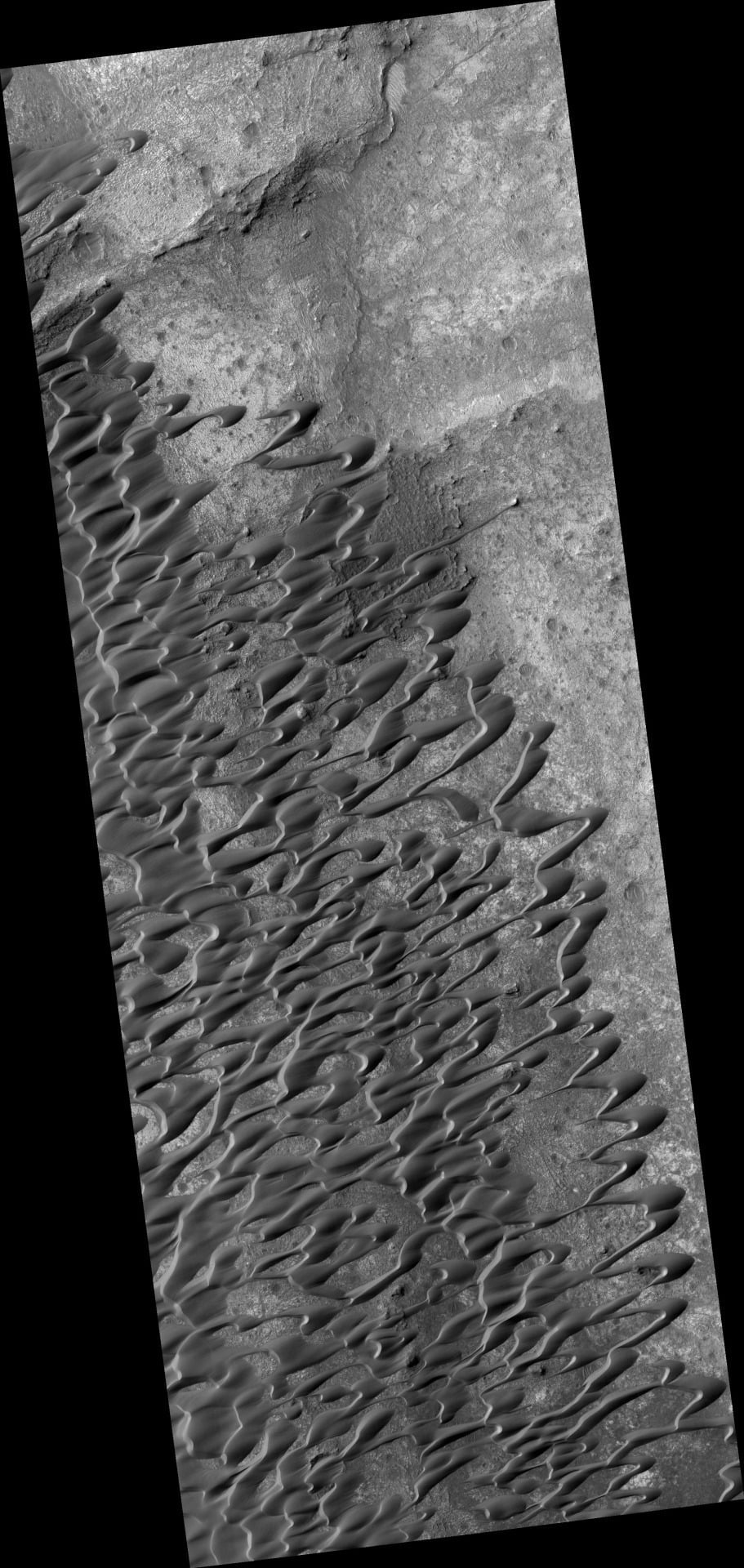
Dunes are a fascinating interplay between fluid and granular flow. This satellite photo shows a dune field on Mars, Nili Patera. The dominant direction of wind flow is from the upper right, pushing the dunes themselves slowly toward the left. Many of the dunes along the edge are barchans, crescent-shaped dunes with a long, gradual slope facing the wind and a steeper leeward side. As the wind blows, it erodes the sand on the windward slope and deposits it on the leeward side. This is how the dune migrates. Check out this close-up of a barchan to see the changes in its ripples and shape over the past couple months. (Photo credit: NASA/JPL/Univ. of Arizona)
Sochi 2014: Ski Jump, Part 2
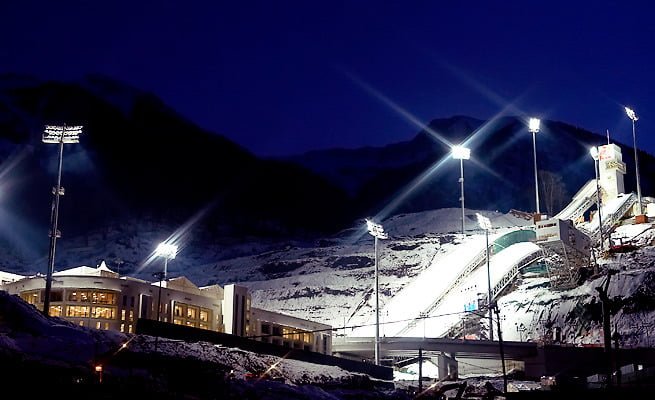
Yesterday we talked about the technique ski jumpers use to fly farther. Generating lift without too much drag is the key to a good jump. But jumpers are subject to ever-changing wind conditions, and those can help or hurt them. Unlike most sports, in ski jumping a headwind is desirable. This is because the added relative air velocity increases the jumper’s lift and helps them fly farther. A tailwind, on the other hand, saps their speed. Since 2009, ski jumping competitions have included a wind compensation factor that tries to account for these effects. Wind velocity is measured at five points along the jumper’s flight path and the tangential (i.e. head- or tailwind) components are weighted and averaged. The weighting factors seem to be individual to each hill – not all hills are built with the same profile. This average tangential wind speed is then a linear variable in an equation for wind factor. The goal of the wind factor is as much to make the competition run smoothly as it is to increase fairness. The trouble is that the wind speed effect is non-linear; in other words, a headwind does not help a jumper as much as a tailwind can hurt them. In one simulation study, researchers found a 3 m/s headwind carried jumpers 17.4 m further while a tailwind of the same magnitude shortened the jump by 29.1 m. The wind differences in competition may not be as drastic, but truly evening the playing field may require a more complicated compensation system. (Photo credit: B. Martin/Sports Illustrated)
FYFD is celebrating the Games with a look at fluid dynamics in the Winter Olympics. Check out our previous posts on the aerodynamics of speed skating, why ice is slippery and how lugers slide so fast.
Start Your Rocket Engine
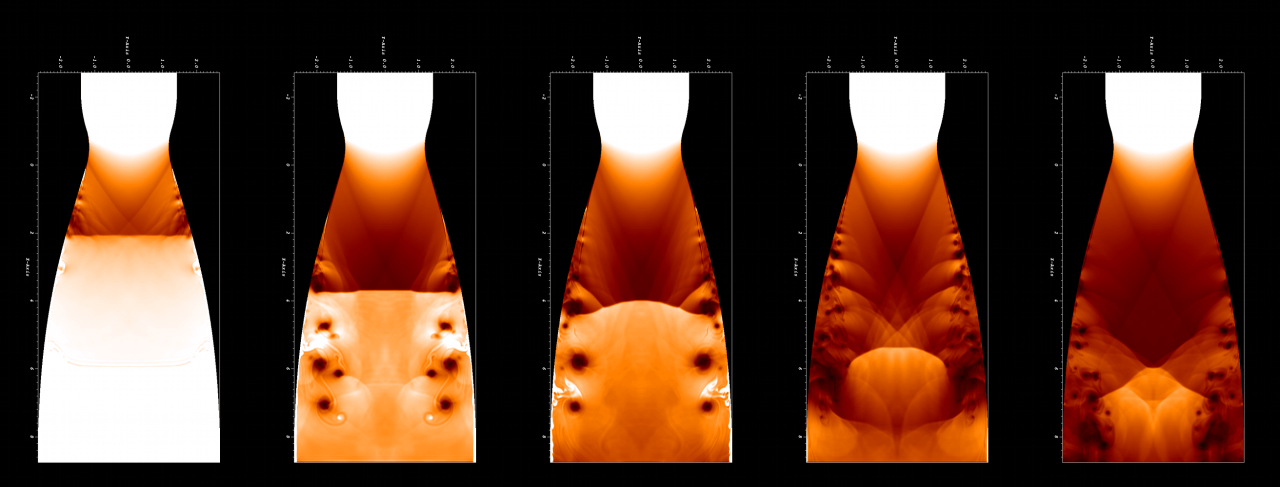
When supersonic flow is achieved through a wind tunnel or rocket nozzle, the flow is said to have “started”. For this to happen, a shock wave must pass through, leaving supersonic flow in its wake. The series of images above show a shock wave passing through an ideal rocket nozzle contour. Flow is from the top to bottom. As the shock wave passes through the nozzle expansion, its interaction with the walls causes flow separation at the wall. This flow separation artificially narrows the rocket nozzle (see images on right), which hampers the acceleration of the air to its designed Mach number. It also causes turbulence and pressure fluctuations that can impact performance. (Image credit: B. Olson et al.)
Particle-Tracking in Granular Flows
One of the challenges of experimental fluid dynamics is gathering sufficient data in environments that can be fast-changing, visually dense, and sometimes harsh. Ideally, researchers want to gather as much data–velocities, temperatures, pressures–at as many points as possible and do so without disturbing the flow with a probe. No technique can provide everything, and thus new diagnostics are always under development. This video shows a new particle tracking method developed for fluidized granular flows where the high concentration of particles makes other techniques unsuitable. Such flows are often seen in industrial applications in chemical processing, pharmaceuticals, and powder transport. Interestingly, the technique can also be used in particle-seeded fluid flows like those normally studied with particle image velocimetry (PIV). (Video credit: F. Shaffer and B. Gopalan; submitted by @ASoutolglesias)

Fluidic Public Art by Charles Sowers
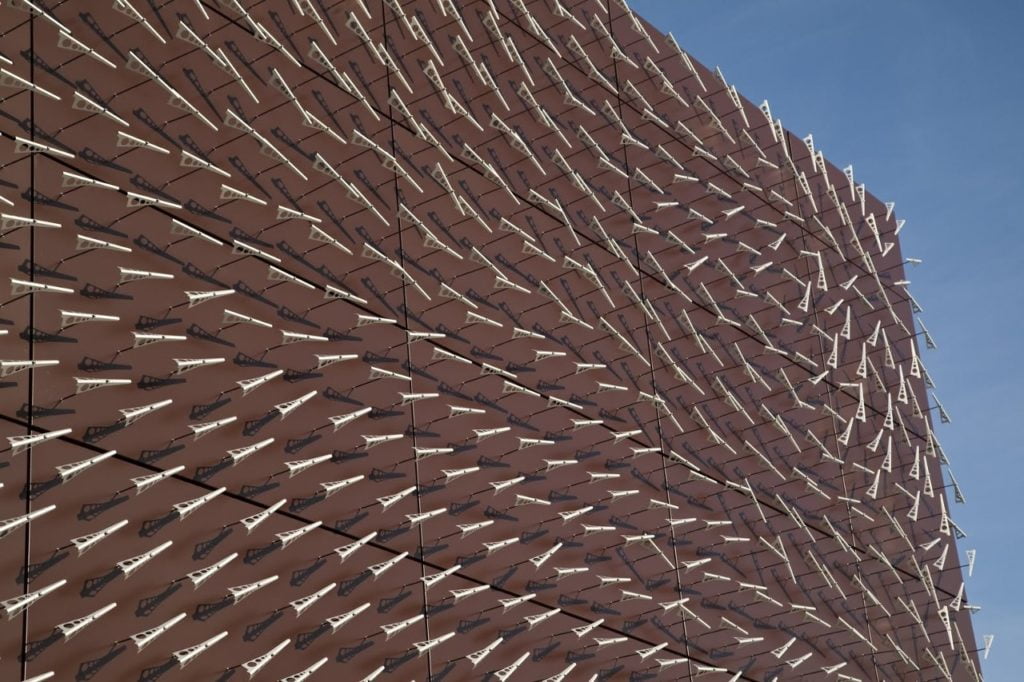


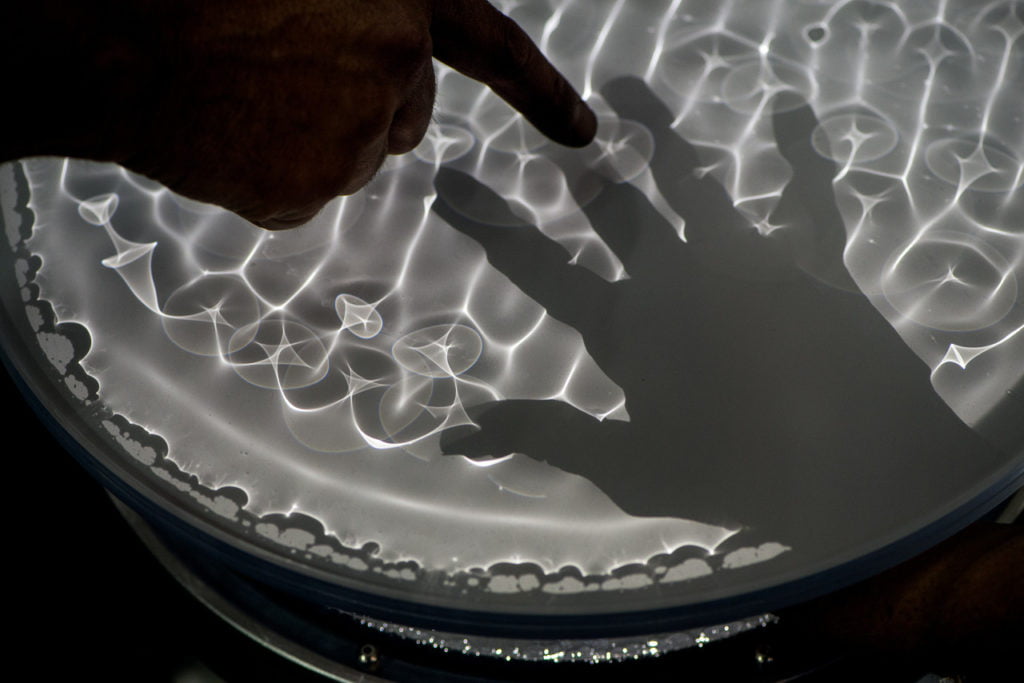


Artist Charles Sowers creates exhibits and public art focused on illuminating natural phenomenon that might otherwise go unnoticed, and much of his work features fluid dynamics directly or indirectly. “Windswept” and “Wave Wall” are both outdoor exhibits that show undulations and vortices corresponding to local wind flow. Other pieces explore ferrofluids through magnetic mazes or feature foggy turbulence. My own favorite, “Drip Chamber”, oozes with viscous fluids whose dripping forms patterns reminiscent of convection cells. Be sure to check out his website for videos of the exhibits in action. (Photo credits: Charles Sowers; submitted by rreis)