Search results for: “art”

  • Featured Video Play Icon

    Bubble Art

    Everyone loves soap bubbles, and bubble artist Melody Yang reveals how to make some pretty awesome ones in this video for Wired. The surface tension of bubbles makes them naturally seek a shape that minimizes their surface area relative to the volume they contain. For a single bubble, that’s a sphere. But once you start joining multiple bubbles, as Yang demonstrates, that minimal surface area can change, even to something unexpected like a cube.

    Bubbles also have an impressive ability to self-heal. As long as whatever passes through them is wet – whether it’s a hand, a straw, or even a ball bearing – the soap film will probably heal itself rather than break. This is a key feature for many of Yang’s tricks, including the impressive planetary bubble. (Video credit: Wired; image credits: Wired/Colossal; via Colossal)

  • Building Smart Swimmers

    Building Smart Swimmers

    Scientists have long wondered whether the schooling of fish is driven by hydrodynamic benefits, but the complexity of their environment makes unraveling this complex motion difficult. A recent study uses a different tactic, combining direct numerical simulation of the fluid dynamics with techniques from artificial intelligence and machine learning to build and train autonomous, smart swimmers.

    The authors use a technique called deep reinforcement learning to train the swimmers. Essentially, the swimmer being trained is able to observe a few variables, like its relative position to the lead swimmer and what its own last several actions have been – similar to the observations a real fish could make. During training, the lead swimmer keeps a steady pace and position, and the follower, through trial and error, learns how to follow the leader in such a way that it maximizes its reward. That reward is set by the researchers; in this case, one set of fish was rewarded for keeping a set distance from their leader, one intended to keep them in a position that was usually beneficial hydrodynamically. Another set of fish was rewarded for finding the most energy-efficient method for following.

    Once trained, the smart swimmers were set loose behind a leader able to make random decisions. Above you can see the efficiency-seeker chasing this leader. Impressively, even though this smart swimmer had the option to go it alone (and had never followed such a dynamic leader), it does an excellent job of keeping to the leader’s wake. Compare it with real swimmers and there’s a definite similarity in their behavior, which suggests the technique may be capturing some of an actual fish’s intuition. (Image and research credit: S. Verma et al., source; thanks to Mark W. for assistance)

  • Featured Video Play Icon

    Martian Bees, Canopies, and Dandelion Seeds

    The latest FYFD/JFM video is out! May brings us a look at the incredible flight of dandelion seeds, numerical simulations that reveal the flow above forest canopies, and a look at bee-inspired flapping wing robots being developed for exploring Mars! Learn about all this in the video below, and, if you’ve missed other videos in the series, you can catch up here. (Image and video credit: N. Sharp and T. Crawford)

  • Martian Mantle Convection

    Martian Mantle Convection

    Over geological timescales – on the order of millions of years – even hard substances like rock can flow like a fluid. Heat from the Earth’s core drives convection inside our mantle, and that fluid motion ultimately drives the plate tectonics we experience here at the surface. But most other planetary bodies, including those with mantle convection similar to ours, don’t have a surface that shifts like our tectonic plates. Mars and Venus, for example, have solid, unmoving surfaces. The images above provide a peek at what goes on beneath. The upper image shows a simulation of mantle convection inside Mars over millions of years. The lower image is a timelapse of dye convecting through a layer of glucose syrup being heated from below. Notice how both examples show evidence of convective cells and plumes that help circulate warm fluid up and colder fluid downward. (Image credit: Mars simulation – C. Hüttig et al, source; N. Tosi et al., source; submitted by Nicola T.)

  • Featured Video Play Icon

    Under Pressure, Part 2

    Our adventures with pressure continue after the trip to the aquarium. To see just how much pressure we could generate with height, A.J. and I teamed up with the Corvallis Fire Department to recreate an experiment attributed to 17th-century French physicist Blaise Pascal. In Pascal’s experiment, he (supposedly) used a column of water to burst a wooden barrel. In ours, we use a ladder truck to make a 30-meter column of water burst a glass carboy! We also got a little help from our friends at the Lutetium Project to introduce you to Pascal and his work. (Thanks, Guillaume!) We’ll tell you more about Pascal and his contributions in an upcoming video, so stay tuned. (Video and image credit: A. Fillo and N. Sharp)

  • Catching Particles with Sound

    Catching Particles with Sound

    Acoustic levitation traps particles using specially shaped sound waves, but, thus far, it’s only been useful for small particles. One common method of trapping forms the sound waves into a vortex-like shape. Particles in one of these acoustic vortices will spin rapidly, become unstable, and get ejected from the vortex if they’re larger than about half the wavelength of sound used. Recently, though, researchers have stabilized much larger particles by trapping them between two acoustic vortices with opposite spins. The researchers alternate between the two vortices so that each can counteract the other in order to hold the particle in the center of the trap. The new technique has enabled them to trap particles up to 4 times larger than those in previous experiments. (Image and research credit: A. Marzo et al., source; via Science)

  • Flow Inside the Heart

    Flow Inside the Heart

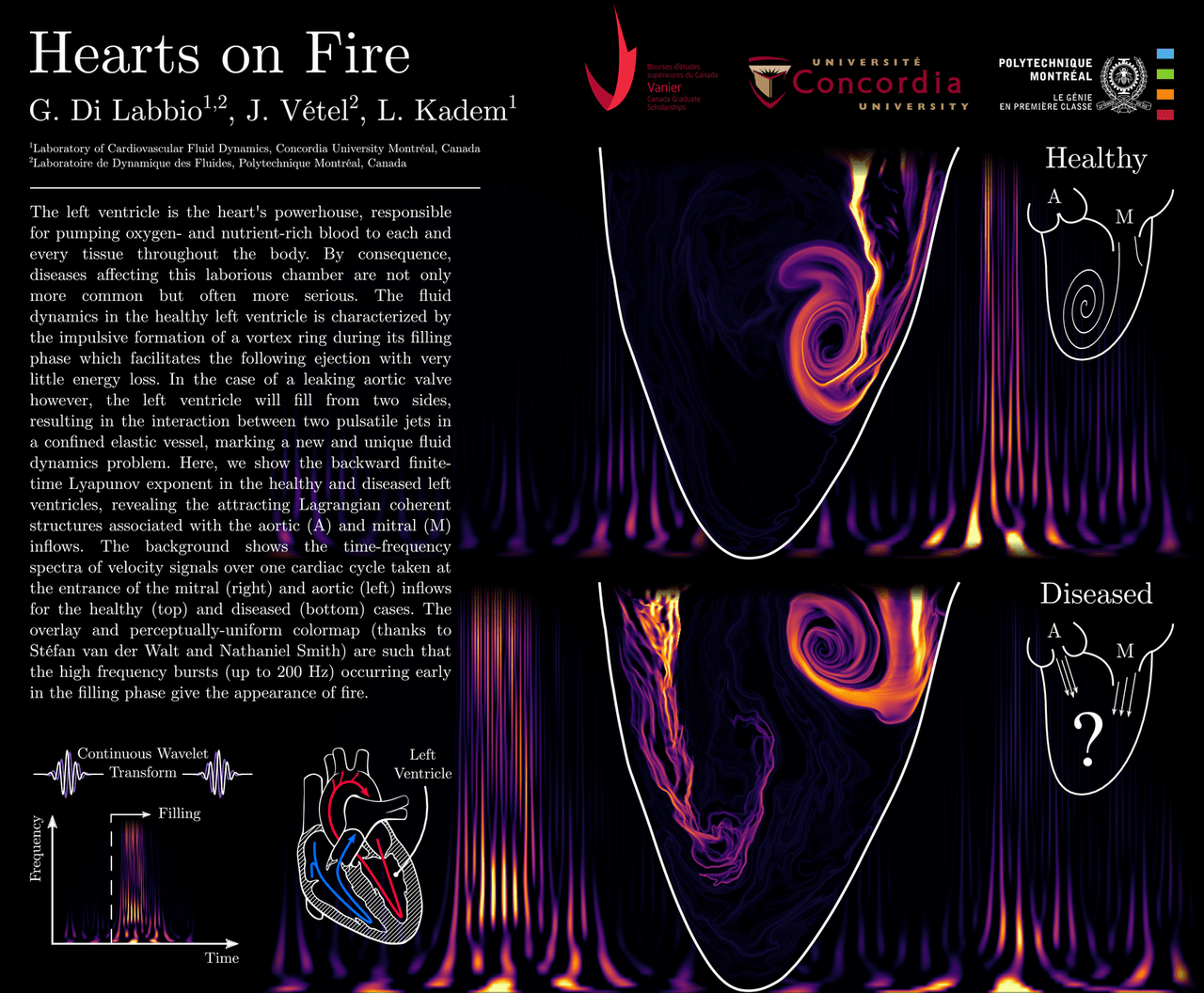
    Inside each of us is a remarkable and constant flow, driven by a muscle that’s always at work. As blood circulates through our bodies, it goes through a surprisingly varied journey. In the heart, as seen above, blood flow is very unsteady and quite turbulent, due to the beating pulse of the heart. As valves open and close and the muscle walls constrict and relax, the rushing blood moves in eddy-filled spurts. In the outer reaches of our capillaries, however, the nature of the flow is quite different. Thanks to smaller vessel sizes and other factors, capillary blood flow is much steadier and more laminar. Viscosity becomes more important, as do the non-Newtonian properties of components in our blood. (Image credit: mushin111/YouTube, source; via Science; submitted by Gary N.)

  • Peering Between Particles

    Peering Between Particles

    Turbulence is not the only way to mix fluids. Even a steady, laminar flow can be an effective mixer if geometry lends a hand. Above, two dyes, fluorescein (green) and rhodamine (red), are injected into a porous flow through packed spheres. The flow runs from bottom to top in both images. Seeing the flow in such a crowded geometry is challenging. Here researchers used spheres with an index of refraction that matches water – that helps them avoid refraction that would prevent them from looking through spheres to the flow on the other side. They also lit a narrow plane of the flow using a laser sheet to isolate it. Together, this allowed the researchers to track the mixing of the two initially separate streaks of dye as they randomly mix in the spaces between spheres. (Image and research credit: M. Kree and E. Villermaux)

  • Featured Video Play Icon

    Inside Earth’s Core

    Without our magnetic field, life as we know it could not exist on Earth. Instead, our atmosphere would be stripped away and the surface would be bombarded by charged particles in the solar wind. Relatively little is known about the dynamo process that governs our magnetic field, though it’s thought to be the result of liquid iron moving in the Earth’s outer core. The video above shows a slice of a recent 3D simulation of this liquid iron segment of our core. The colors show variations in the temperature, revealing vigorous convection in the core. This motion, combined with the spinning of the Earth, is the likely source of our magnetic field. Researchers hope that simulations like these can help us understand features we observe in our magnetic field – like local variations in field strength and the pole reversals in our geological record. (Video credit: N. Schaeffer et al.; CNRS via Gizmodo)

  • Featured Video Play Icon

    Simulating the Earth

    Computational fluid dynamics and supercomputing are increasingly powerful tools for tracking and understanding the complex dynamics of our planet. The videos above and below are NASA visualizations of carbon dioxide in Earth’s atmosphere over the course of a full year. They are constructed by taking real-world measurements of atmospheric conditions and carbon emissions and feeding them into a computational model that simulates the physics of our planet’s oceans and atmosphere. The result is a visualization of where and how carbon dioxide moves around our planet.

    There are distinctive patterns that emerge in a visualization like this. Because the Northern Hemisphere contains more landmass and more countries emitting carbon, it contains the highest concentrations of carbon dioxide, but winds move those emissions far from their source. As seasons change and plants begin photosynthesizing in the Northern Hemisphere, concentrations of carbon dioxide decrease as plants take it up. When the seasons change again, that carbon is re-released.

    These visualizations underscore the fact that these carbon emissions impact everyone on our planet–nature does not recognize political borders–and so we share a joint responsibility in whatever actions we take. (Video credit: NASA Goddard; h/t to Chris for the second vid)