Category: Research

  • You’re Drunk, Toadlet

    You’re Drunk, Toadlet

    Most frogs and toads are excellent jumpers, taking off and landing with a control and grace that rivals elite athletes. Not so for the pumpkin toadlet. These species have become so miniaturized that the structures of their inner ears are too narrow for the fluid flow that helps frogs (and humans!) orient themselves in space. So while the toadlet certainly can jump, it careens through the air drunkenly and lands in any old direction. It’s hard not to laugh at their belly flops, somersaults, and straight-up head-first crashes. Fortunately, being so small, these landings don’t seem to hurt the toadlets, but one imagines they’re unpleasant nevertheless. Left to their own devices, the pumpkin toadlet prefers walking, slowly, like a chameleon; it might be the only way to stay within the limits of its inner ear. (Image credits: top – S. Kikuchi, others – R. Essner, Jr. et al.; research credit: R. Essner, Jr. et al.; via The Atlantic; submitted by Kam-Yung Soh)

  • Listening to the Sizzle

    Listening to the Sizzle

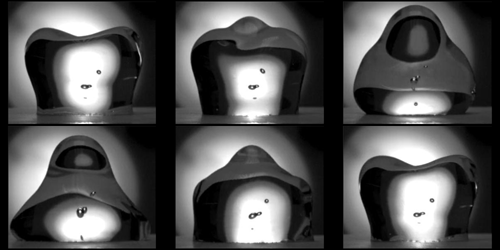
    The sizzle of frying food is familiar to many a cook, and that sound actually conveys a surprising amount of information. In this study, researchers suspended water droplets in hot oil and observed their behavior, both with high-speed video and with microphones. They found that these vaporizing drops created three types of cavities in the oil: an exploding cavity that breaks the surface, an elongated cavity that remains submerged, and an oscillating cavity that breaks up well below the surface. All three cavities flung oil droplets upward, and all three were acoustically distinct from one another. That means, as the authors suggest, that it might be possible to measure the aerosol droplets generated during frying simply by listening! (Image credit: fries – W. Dharma, others – A. Kiyama et al.; research credit: A. Kiyama et al.; via Cosmos; submitted by Kam-Yung Soh)

  • Extreme Weather

    Extreme Weather

    Many of the exoplanets we’ve observed so far are extreme environments. WASP-121b is known as a hot Jupiter, a gas giant so close to its star that it orbits in just 30 hours. The exoplanet is tidally-locked to its star, meaning that one side always faces toward the star and the other faces away. This constant sunlight makes the daytime side of the planet hot enough to vaporize metals. A recent study combined observations of the exoplanet with numerical simulations to model both the daytime and nighttime atmosphere of the exoplanet. The results are pretty wild. The authors found evidence of 18,000 km/h winds that blow hot gases from the dayside to the nightside, where temperatures cool enough for some metals — primarily corundum — to rain out of the atmosphere. Given the trace amounts of other elements available in the atmosphere, the authors posit that the nightside of the planet may have rainfall of liquid rubies and sapphires. (Image credit: NASA/ESA; research credit: T. Mikal-Evans et al.; via Physics World)

  • Sonic Booms and Urban Canyons

    Sonic Booms and Urban Canyons

    In the days of the Concorde — thus far the world’s only supersonic passenger jet — noise complaints from residents kept the aircraft from faster-than-sound travel except over the open ocean. With many pursuing a new generation of civil supersonic aircraft, researchers are looking at how those sonic booms could interact with those of us on the ground.

    In this study, researchers simulated the shock waves from aircraft interacting with single and multiple buildings on the ground. They found that the presence of a building increases the perceived sound level of the boom by about 7 dB at the most. But the most interesting results are what happens between multiple buildings.

    If the street between buildings is wide enough, they each act independently, as if they were single buildings. But for narrower streets, the acoustics waves reflect and diffract between the buildings, creating a resonance that makes the acoustic echoes last longer. The effect is especially pronounced for a sonic boom traveling across a series of buildings, which mimics the layout of a dense city full of urban canyons. (Image credit: Concorde – M. Rochette, simulation – D. Dragna et al.; research credit: D. Dragna et al.)

    Acoustic waves reflect and propagate through 2D urban canyons with widths of 10 meters (top), 20 meters (middle), and 30 meters (bottom).
    Acoustic waves reflect and propagate through 2D urban canyons with widths of 10 meters (top), 20 meters (middle), and 30 meters (bottom).
  • Swimming in Complex Fluids

    Swimming in Complex Fluids

    Bacteria like E. coli swim using flagella, helical filaments attached to biological motors on their bodies. By rotating the flagella, the bacterium generates thrust that propels it forward. Oddly, though, researchers observed decades ago that bacteria actually travel faster through complex fluids — like those with polymers or particles in them — than they do through simple fluids like water. A new study using colloids — small particles suspended in a liquid — shows why.

    The researchers compared bacteria swimming through polymer-filled fluids and colloidal fluids and found strong overlap both qualitatively and quantitatively. They observed, for example, that bacteria swim in straighter lines — they wobble less — in complex fluids. The reason, according to the authors, is the hydrodynamic influence of the added materials. Essentially, when a bacterium swims near a colloid or piece of polymer, the particle exerts a torque on the microswimmer that reduces its wobble and enhances its speed. (Image credit: Cheng Research Group; research credit: S. Kamdar et al.; via Physics World)

  • Mapping Yellowstone Underground

    Mapping Yellowstone Underground

    Yellowstone National Park is filled with geysers, hot springs, and mudpots — all geophysical features driven by the underground movement of water heated by the underlying volcano. But what does that underground plumbing look like? To find out, a team of researchers flew a 25-m diameter electromagnetic loop over portions of the park; they used the electromagnetic feedback induced in the loop to roughly map the subsurface features of the park.

    To their surprise, they found that deep hydrothermal vents in Yellowstone lie in discrete locations; previously, geologists assumed the vents were more widespread. With a better sense of what lies beneath, park officials will be able to build new infrastructure in areas better protected from one of the park’s biggest hazards: hydrothermal explosions caused by a buildup of pressure underground. (Image credits: top – I. Shturma, map – C. Finn et al.; research credit: C. Finn et al.; via Physics World)

    Editor’s Note: This article was written and scheduled prior to the historic flooding in Yellowstone in June 2022.

    Geophysical map of Yellowstone's Upper Geyser Basin, including Old Faithful.
    Geophysical map of Yellowstone’s Upper Geyser Basin, including Old Faithful.
  • Inside a Champagne Pop

    Inside a Champagne Pop

    When the cork pops on a bottle of champagne, the physics is akin to that of a missile launch in more ways than one. In this study, researchers used computational fluid dynamics to closely examine the gases that escape behind the cork. They identified three phases to the flow. In the first, the exhaust gases form a crown-shaped expansion region, complete with shock diamonds. Once the cork has moved far enough downstream, the axial flow accelerates to supersonic speeds and a bow shock forms behind the cork. Finally, the pressure in the bottle drops low enough that supersonic conditions cannot be maintained and the flow becomes subsonic. (Image credit: top – Kindel Media, simulation – A. Benidar et al.; research credit: A. Benidar et al.; via Ars Technica; submitted by Kam-Yung Soh)

    A numerical simulation showing the ejection of a champagne cork from a bottle. The colors indicate the speed of gases escaping from the bottle.
    A numerical simulation showing the ejection of a champagne cork from a bottle. The colors indicate the speed of gases escaping from the bottle.
  • Spinning Off-Axis

    Spinning Off-Axis

    To make a vortex in the laboratory, researchers typically set a tank on a rotating platform and allow the water to drain out a hole in the center of the tank. In that case, a vortex forms over the drain (like in your bathtub!) and remains centered over the hole. In nature, though, vortices rarely follow such a simple path.

    In this experiment, researchers moved the drainage hole so that it is not aligned with the tank’s axis of rotation. Although the vortex forms over the drain (marked by a yellow dot in the lower image), it quickly moves away, following a roughly circular path around the axis until it comes to a stop. Green dye marks fluid from the tank’s bottom boundary layer, which eventually gets entrained up into the vortex. (Image and research credit: R. Munro and M. Foster; via Physics Today)

    Timelapse animation showing the development of the vortex. The yellow dot marks the location of the drain.
    Timelapse animation showing the development of the vortex. The yellow dot marks the location of the drain.

  • Featured Video Play Icon

    Stably Jammed

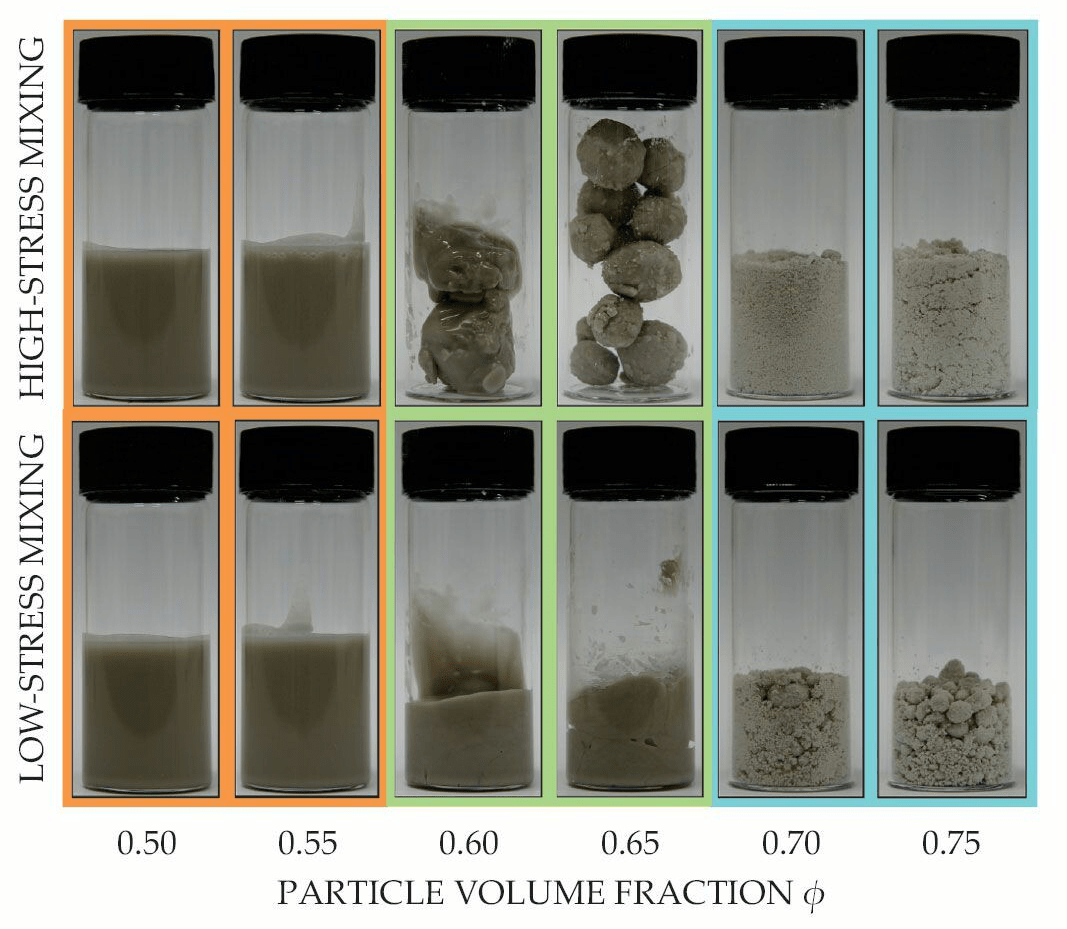
    Granular materials like sand, gravel, and medications can become a rigid mass when squeezed or sheared. Even with a relatively loose packing, these materials can jam together to act like a solid if the contacts between grains no longer allow particles to shift or rotate. In this video, researchers explore how stable these jammed states are by repeatedly shearing the mixture and observing how it changes.

    Most of the videos are set up as a triptych, where all three panels show the same material. On the left, you see a simple view showing the position of each particle. In the middle, the disks are viewed through polarized filters, so that the material looks brightest where it is stressed. This view lets us see the force chains that run through the material. On the right, UV-sensitive ink on each marker glows to show any rotation particles experience.

    In the first sample, repeated shearing slowly unjams the mixture and allows it to shift and flow once more. We see this from the decreasing brightness in the middle panel. The slow fade to black means that the force chain network has disappeared entirely. In contrast, the second sample ultimately reaches an “ultra-stable” jammed state, in which further shear cycles cause no change to the network. Once again, this is easiest to observe in the middle image, where the bright force network stops changing after 2,000 cycles or so. (Image and video credit: Y. Zhao et al., research pre-print)

  • Asperitas Formation

    Asperitas Formation

    In 2017, the World Meteorological Organization named a new cloud type: the wave-like asperitas cloud. How these rare and distinctive clouds form is still a matter of debate, but this new study suggests that they need conditions similar to those that produce mammatus clouds, plus some added shear.

    Using direct numerical simulations, the authors studied a moisture-filled cloud layer sitting above drier ambient air. Without shear, large droplets in this cloud layer slowly settle downward. As the droplets evaporate, they cool the area just below the cloud, changing the density and creating a Rayleigh-Taylor-like instability. This is one proposed mechanism for mammatus clouds, which have bulbous shapes that sink down from the cloud.

    When they added shear to the simulation, the authors found that instead of mammatus clouds, they observed asperitas ones. But the amount of shear had to be just right. Too little shear produced mammatus clouds; too much and the shear smeared out the sinking lobes before they could form asperitas waves. (Image credit: A. Beatson; research credit: S. Ravichandran and R. Govindarajan)