Category: Research

  • Asperitas Formation

    Asperitas Formation

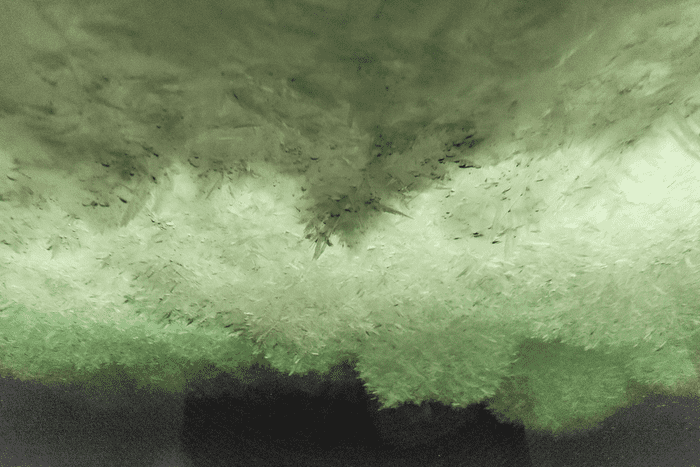
    In 2017, the World Meteorological Organization named a new cloud type: the wave-like asperitas cloud. How these rare and distinctive clouds form is still a matter of debate, but this new study suggests that they need conditions similar to those that produce mammatus clouds, plus some added shear.

    Using direct numerical simulations, the authors studied a moisture-filled cloud layer sitting above drier ambient air. Without shear, large droplets in this cloud layer slowly settle downward. As the droplets evaporate, they cool the area just below the cloud, changing the density and creating a Rayleigh-Taylor-like instability. This is one proposed mechanism for mammatus clouds, which have bulbous shapes that sink down from the cloud.

    When they added shear to the simulation, the authors found that instead of mammatus clouds, they observed asperitas ones. But the amount of shear had to be just right. Too little shear produced mammatus clouds; too much and the shear smeared out the sinking lobes before they could form asperitas waves. (Image credit: A. Beatson; research credit: S. Ravichandran and R. Govindarajan)

  • When Seeing a Flow Changes It

    When Seeing a Flow Changes It

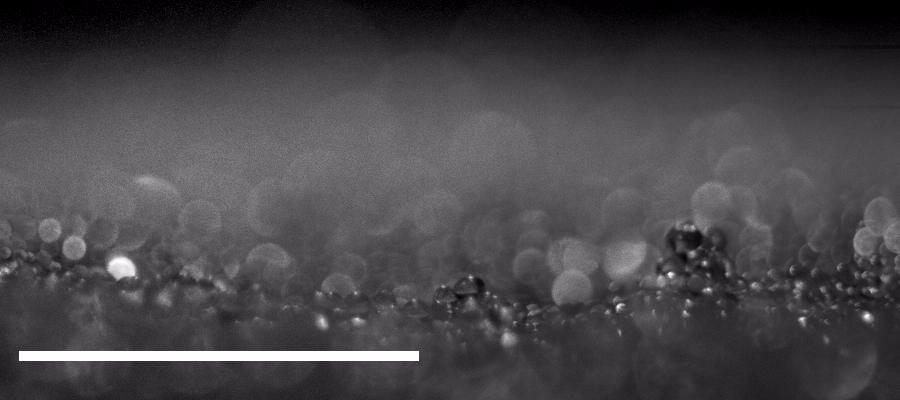
    Adding dye to a flow is a common technique for visualization. After all, many flows in fluids like air and water are invisible to our bare eyes. But for some classes of flows — especially those driven by variations in surface tension — adding dye can have unforeseen effects. A recent study shows how true this is for bursting Marangoni droplets, where evaporation and alcohol concentration can pull a water-alcohol droplet apart.

    Composite series of photos showing the effect of increased dye concentration on Marangoni bursting.
    As more dye is added to the experiment, the daughter droplets grow larger and more ligaments form. In the first three images, a dashed black line has been added to show the location of the droplet rim.

    Without dye, it’s nearly impossible to see the phenomenon since the refractive indices of the two component liquids are so close. But the researchers found that, as they added more methyl blue dye, it did more than increase the contrast in the flow. It changed the flow, making the droplets larger and creating ligaments between them. They believe that the dye’s own surface tension creates local gradients that alter the flow. It’s a reminder that experimentalists have to be careful to consider how our efforts to measure and observe a flow can change it. (Image credit: top – The Lutetium Project, bottom – C. Seyfert and A. Marin with modification; research credit: C. Seyfert and A. Marin)

  • Featured Video Play Icon

    Contactless Bending

    Using electromagnetism, researchers are bending and shaping soft liquid wires even against gravity. The team used galinstan — an alloy of gallium, indium, and tin that remains liquid at room temperature. On its own, galinstan has a high surface tension and forms droplets. But with a voltage applied, that surface tension is suppressed, making the liquid form a long, thin, still-liquid wire. Adding a magnetic field allowed the researchers to manipulate the falling stream of liquid, even levitating loops of the metal against the force of gravity! (Image, video, and research credit: Y. He et al.; via Cosmos; submitted by Kam-Yung Soh)

  • Mimicking Asteroids

    Mimicking Asteroids

    In nature, objects like asteroids, black holes, and atomic nuclei can get distorted when spinning rapidly. Researchers are exploring these objects using a new model platform: particle rafts levitated by sound. The individual particles are less than a millimeter wide and tend to clump together due to the scattering of sound waves off neighboring particles. This effect provides a cohesive force — similar to surface tension or the effects of gravity — that draws the particles together. With the right frequency, the sound waves can also make the granular rafts spin, setting up a tug-of-war between cohesion and centrifugal force.

    Using sound waves for levitation, particles slowly rise and clump together. Particles are approximately 190 micrometers each, and the video is drastically slowed down from real-time.

    As the rafts spin, they distort, pull apart, and come back together. Interestingly, the cohesive force a raft experiences increases with the raft’s size. That makes the attractive force unlike surface tension (which is the same whether you have a bucket of water or a lake) and more like gravity (which is stronger with more material.) Because of this size dependence, the team hopes their granular rafts could be a new way to study the formation of rubble-pile asteroids and similarly granular systems.

    As the raft’s rotation increases, it’s pulled apart by centrifugal forces, but the pieces later reconnect. Video is slowed down by a factor of 60.

    (Video, image, and research credit: M. Lim et al.; via APS Physics)

  • Moving By (Intestinal) Wave

    Moving By (Intestinal) Wave

    A word of warning: today’s post includes visuals of digestion taking place in (non-human) embryonic intestines.

    Our bodies rely on waves driven by muscle contractions to move both fluids and solids, whether through the esophagus, the ureter, the fallopian tubes, or the intestines. In areas where mixing is unnecessary, those waves move in a single direction, transporting the contents one-way. But in the intestines, mixing is critical to enhancing nutrient absorption, so mammal intestines have wave trains that move both forwards and backwards.

    The majority of waves move downstream, carrying waste toward its exit (Images 1 and 2). But occasionally, upstream waves collide with their downstream counterparts to force material together, both mixing and delaying progress in order to allow better nutrient uptake along the intestinal walls (Image 3). (Image credits: top – S. Bughdaryan, others – R. Amedzrovi Agbesi and N. Chavalier; research credit: R. Amedzrovi Agbesi and N. Chavalier; via APS Physics)

  • Perching Aerodynamics

    Perching Aerodynamics

    When birds come in for a landing, they pitch back and heave their wings as they come to a stop in a perching maneuver. Some birds, researchers noticed, partially fold their wings during the move, creating what’s known as a swept wing. Curious as to the effect of this sweep, the team recreated the wing motion of a perching bird using two flat plates — one rectangular and one swept — and measured the flow around them during the maneuver. They found that the swept wing had greater lift, thanks to a spanwise flow inherent to swept wings that helped stabilize the leading-edge vortex. (Image credit: D. George; research credit: D. Adhikari et al.; via APS Physics)

  • Measuring Drag

    Measuring Drag

    After a noticeable rise in the prevalence of home runs beginning in 2015, Major League Baseball commissioned a report that found the increase was caused by a small 3% reduction in drag on the league’s baseballs. When such small differences have a big effect on the game, it’s important to be able to measure a baseball’s drag in flight accurately.

    In the past, that measurement has often been done in a wind tunnel, but the mounting mechanisms used there result in drag measurements that are a little higher than what’s seen from video tracking in actual games. Now researchers have developed a new free-flight method for measuring a baseball’s drag. The drag measurements from their new method are lower than those for wind-tunnel-mounted baseballs and in better agreement with video-based methods. The authors’ method should be adaptable to other sports like cricket and tennis, which will hopefully provide new insight into the subtleties of their aerodynamics. (Image credit: T. Park; research credit: L. Smith and A. Sciacchitano; via Ars Technica; submitted by Kam-Yung Soh)

  • Acidic Aerosols

    Acidic Aerosols

    As ocean waves crash, they generate aerosols — tiny liquid and solid particulates — that interact with the atmosphere. Curious about the chemistry of these tiny drops, researchers set out to measure their acidity. That’s easier said than done. Over time, aerosol droplets acidify as they interact with acidic gases in the atmosphere and capturing fresh aerosols in the field is next to impossible.

    To tackle these challenges, researchers instead moved the aerosols to the laboratory, filling a wave channel with seawater and agitating it to generate aerosols they could then measure. They found that the smallest aerosols become a million times more acidic than the bulk ocean in only two minutes! Find out more about their experiment and its implications over at Physics Today. (Image credit: E. Jepsen; research credit: K. Angle et al.)

  • Dripping Impact

    Dripping Impact

    How does water drip, drip, dripping onto stones erode a crater? Water is so much more deformable that it seems impossible for it to wear harder materials away, even over thousands of impacts. To investigate this, a team of researchers developed a new measurement technique: high-speed stress microscopy. In the process, they found that water owes its incredible erosive power to three factors: 1) The drop’s impact creates surface shock waves along the material, which helps increase erosive power; 2) After the shock wave passes, a decompression wave in the material helps loosen surface matter; and 3) The spreading drop sends a non-uniform wave of stress across the material that simultaneously presses and scrubs at the surface. Together, these factors enable simple, repetitive droplet impacts to wear away at hard surfaces. (Image credit: cottonbro; research credit: T. Sun et al.; via Cosmos; submitted by Kam-Yung Soh)

  • Coalescence Symmetry

    Coalescence Symmetry

    When droplets coalesce, they perform a wiggly dance, gyrating as the capillary waves on their surface interfere. When the droplets have matching surface tensions, like the two water droplets in the animation on the lower left, the coalescence dance is symmetric. But for differing droplets, like the water and ethanol droplets merging on the lower right, coalescence is decidedly asymmetric.

    The asymmetry arises from the droplets’ different surface tensions. The size and speed of the capillary waves that form on a droplet depend on surface tension, so droplets of different liquids have inherently different capillary waves. During merger, the interference of these capillary waves causes the asymmetry we see. (Image credit: top – enfantnocta, coalescence – M. Hack et al.; research credit: M. Hack et al.)