This timelapse video shows the formation and steady-state behavior of a buoyancy-driven plume created by a chemical reaction. As the plume accelerates upward, it develops a head, which in some cases detaches from the plume in the form of a vortex ring. A new head then develops before also detaching and accelerating upwards. (Video credit: M. Rogers)
Category: Research

Visualizing Ocean Currents
Researchers used computational models of ocean currents to produce this video visualizing worldwide ocean surface currents from June 2005 through December 2007. Dark patterns under the ocean are representative of ocean depths and have been exaggerated to 40x; land topography is exaggerated to 20x. Notice the wide variety of behaviors exhibited in the simulation: some regions experience strong recirculation and eddy production, while others remain relatively calm and unmoving. Occasionally strong currents sweep long lines across the open waters, carrying with them warmth and nutrients that encourage phytoplankton blooms and other forms of ocean life. (Video credit: NASA; submitted by Jason S)
How Dams Affect Rivers
This video shows how the installation of a dam can affect river flow and sediment transport. Before the dam is added, the flow is shallow and the sediment transport is uniform. The installation of the dam creates deep subcritical flow upstream and supercritical flow downstream. This means that wave information–like ripples–can propagate upstream on the subcritical side; on the supercritical side, the wave velocity is lower than the flow velocity and ripples cannot propagate upstream. This is analogous to sub- and supersonic flow in air. The critical flow over the dam is analogous to a shock wave. The lower velocity upstream of the dam is unable to carry sediment downstream and transport essentially ceases until the sediment builds up to a height where the depth of the water above the dam is roughly equal to that below the dam and sediment transport resumes, scouring the downstream supercritical section. Around 0:40, a gate is closed on the downstream side (off frame), creating a hydraulic jump. In the final section of the video, after sediment has built up on both sides of the dam, the downstream gate is re-opened and the jump reforms as sediment is blown out below the dam. (Video credit: Little River Research and Design, with funding from the Missouri Department of Natural Resources)
Swirling Fluids
In this video, researchers investigate swirling fluids by studying the shapes of the free surface between air and the liquid. As parameters like the diameter of the glass, initial (unperturbed) height of the liquid, and angular velocity of the rotation change, the surface of the liquid displays different modal behaviors, seen in the photos on the lower left of the video. By non-dimensionalizing the physical parameters of the system (students: think Buckingham pi theorem), they are able to replicate the shape of the free surface by matching a Froude number and dimensionless depth and offset. Such similitude between fluids under different conditions is key to understanding the underlying physics. (Video credit: M. Reclari et al; submitted by co-author M. Farhat)
Particle Patterning
Here a container filled with a suspension of neutrally buoyant polystyrene beads and fluid is rotated. As the container rotates, a thin layer of fluid and bunches of particles get drawn up onto the wall by capillary forces capable of holding the particles in place even if the container stops rotating. The density and patterning of the particles on the wall depends on the container’s rotation speed and the volume fraction of particles. (Video credit: J. Kao and A. Hosoi)

Colliding Jets


Two jets colliding can form a chain-like fluid structure. With increasing flow rate, the rim of the chains becomes wavy and unstable, forming a fishbone structure where droplets extend outward from the fluid sheet via tiny ligaments. Eventually, the droplets break off in a pattern as beautiful as it is consistent. (Photo credits: A. Hasha and J. Bush)
The Floating Water Bridge
The interaction of electric fields and fluids can lead to some unexpected results. Here we see the formation of a water bridge formed between two beakers of demineralized water across which a large voltage difference (~15kV) is applied. The bridge is stable for separation distances up to about 2 cm. In order to achieve this feat, the water is overcoming two destabilizing forces: gravity, which bends the bridge, and capillary action, which makes the liquid bridge thin until it breaks into droplets. According to the authors, both forces are countered by induced polarization forces at interface; in short, the electrical field around the liquid causes the positive and negative charges in the liquid to separate, thereby polarizing the liquid. This separation of charges then creates normal stresses along the surface of the water that oppose the gravitational and capillary forces trying to break the bridge. (Video credit: A. Marin and D. Lohse)
Mackerel vs. Eel: Who Swam It Better?
Which matters more, form or function? This simulation sets out to answer that question by comparing the swimming motion of eels and mackerels. Eels have longer, more rounded body shapes and swim in an undulatory fashion with their whole body, whereas mackerels have shorter bodies with a more elliptical cross-section and primarily move their tails when swimming. The simulation separates body type from swimming motion by creating virtual races between fishes of the same body type using the two forms of swimming. Eels swim at moderate Reynolds numbers where viscous and inertial effects are reasonably balanced. Under those conditions, eel-like swimming was faster, even with a mackerel’s body type. At the higher Reynolds numbers where mackerels usually swim, inertial forces domination and the racing fish moved faster if they swam like a mackerel, even with the body of an eel. The results suggest that the swimming motion matters more in each Reynolds number range than the shape of the swimmer. This is a neat way that simulation can answer questions we cannot test with an experiment! (Video credit: I. Borazjani and F. Sotiropoulos)

Flying Squid
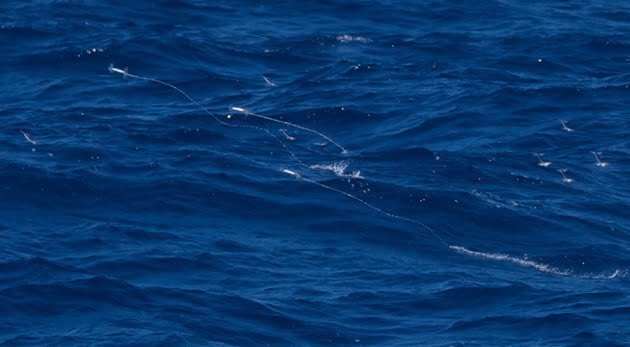
Ever seen a squid fly? Not many have, but the behavior may be more common than you think. Thanks to a set of photos from an amateur photographer, scientists have managed to estimate the velocity and acceleration of squid as they propel themselves out of the water by squirting a jet behind them. Researchers found that their speeds in air are roughly five times that in water, thanks to decreased drag. Previously it was thought that the flying behavior might be linked to escaping predators, but some now suggest that it enables migration over long distances by saving energy.
The Gobbling Drop
A little polymer goes a long way when it comes to changing a fluid’s behavior. Normally, a falling jet of fluid will develop waviness and be driven by surface tension and the Plateau-Rayleigh instability to break up into a stream of droplets. We see this at our water faucets all the time. But when traces of a polymer are dissolved in water, the behavior is much different. The viscoelasticity of the polymer chains creates a force that opposes the thinning effects caused by surface tension. So, instead of thinning to the point of breaking into droplets, a drop is able to climb back up the jet until it reaches a critical mass where it reverses direction, accelerates downward due to gravity and eventually breaks off the jet. Then the whole process begins again with a new terminal drop. (Video credit: C. Clasen et al)