Underwater explosions often behave non-intuitively. Here researchers explore the effects of surface explosions by setting off charges at the air/water interface. Initially, an unconfined explosion’s blast wave expands a cavity radially into the water. This cavity collapses back toward the surface from the bottom up, ultimately resulting in a free jet that rebounds above the water level. Confined explosions behave very differently, expanding down the glass tube containing them in a one-dimensional fashion. The cavity never extends beyond the end of the glass tube, likely due to hydrostatic pressure. (Video credit: Adrien Benusiglio, David Quéré, Christophe Clanet)
Category: Research

Flapping Elastic Straws
One of the interesting challenges in fluid dynamics is the coupling of aerodynamic forces with structural forces. This could be the result of external flow, as with aeroelastic flutter on aircraft or architecture, or internal flow, as with the video above. Here researchers blow air through compliant cylindrical shells–think of a straw made of an elastic solid like latex–and observe the vibrations that result. Depending on the flow rate and material properties, different vibrational modes can be activated. The first mode behaves much like a garden hose that’s not being held; it vibrates wildly back-and-forth. The second mode wobbles the mouth of the shell open and closed, whereas the third mode forms three “flaps” that vibrate inward and outward. Each of these modes behaves very differently, and, for practical applications, it’s important for engineers to be able to predict, control, and account for these kinds of structural behaviors under aerodynamic loading. (Video credit: P. Zimoch et al.)
The Evolution of Icicles
The time-lapse video above shows the growth of icicles of various compositions under laboratory conditions. Many icicles in nature exhibit a rippling effect in their shape, which some theories attribute to an effect of lower surface tension in some liquids. Here researchers show the icicle growth of three liquids: pure distilled water, and water with two concentrations of dissolved salt. They found that lowering the surface tension of the freezing liquid with non-ionic surfactants (i.e. not salt) did not produce ripples, but that dissolved ionic impurities like salt strongly affected the growth of ripples. They posit that this may be due to constitutional supercooling, in which growth of the solid-liquid interface is destabilized by the preferential concentration of impurities near the interface. (Video credit: A. S. Chen and S. Morris)
Hot Items Sink Faster
This combined video shows the fall of a heated centimeter-sized steel sphere through water. From left to right, the sphere is at 25 degrees C (left), 110 degrees C (middle), and 180 degrees C, demonstrating how the Leidenfrost effect–which vaporizes the water in immediate contact with the sphere–can substantially reduce the drag on a submerged object. In the middle video, the vaporization of the water around the sphere is sporadic and incomplete, only slightly reducing the sphere’s drag relative to the room temperature case. The much hotter sphere on the right, however, has a complete layer of vapor surrounding it, allowing it to travel through a gas rather than the denser liquid. (Video credit: I. Vakarelski and S. Thoroddsen; from a review by D. Quere)

Shedding Vortices
The von Karman vortex street of shed vortices that form the wake of a stationary cylinder are a classic image of fluid dynamics. Here we see a very different wake structure, also made up of vortices shed from a cylindrical body. This wake is formed by two identical cylinders, each rotating at the same rotational rate. Their directions of rotation are such that the cylinder surfaces in between the two cylinders move opposite the flow direction (i.e. top cylinder clockwise, bottom anti-clockwise). This results in a symmetric wake, but the symmetry can easily be broken by shifting the rotation rates out of phase. (Photo credit: S. Kumar and B. Gonzalez)
Sloshing in a Bouncing Sphere
The sloshing of liquids inside solids is usually presented as a difficulty to overcome, as with the transport of tanks, the motion of fuel in satellites, or even the problem of walking with a full cup of coffee. But liquids also make a very effective damper, as in the case of a bouncing ball partially filled with liquid. Here we see high-speed video of the liquid’s motion inside the ball as it bounces and rebounds. Part of the ball’s kinetic energy at rebound is transferred into the fluid jet, reducing that available for the ball to transfer into potential energy. (Video credit: BYU Splash Lab)

Antarctic Ice Flows

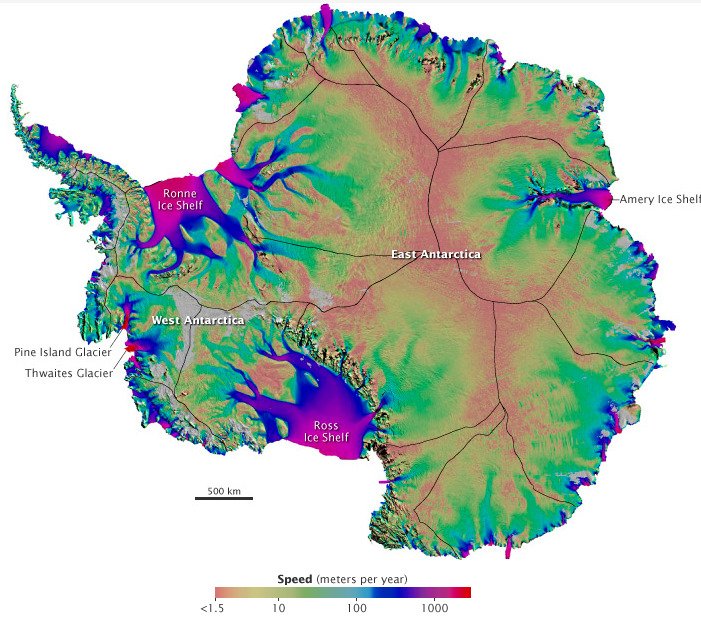
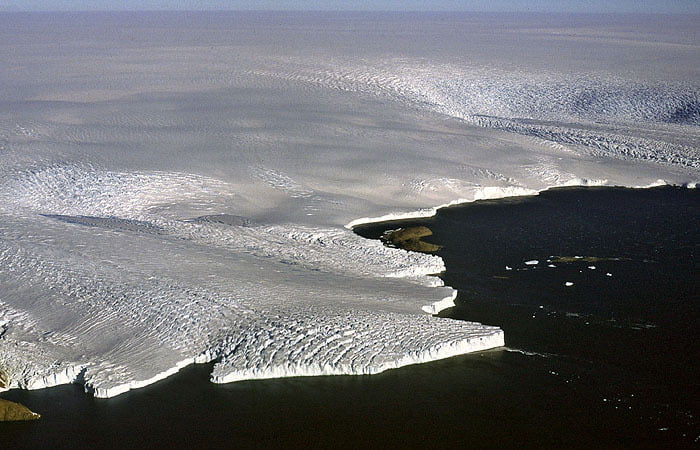
Even frozen ice moves and flows, though too slowly to see with the naked eye. By combining satellite imagery from NASA, JAXA, CSA, and ESA, researchers were able to map the flow of ice across Antarctica, discovering ice streams (shown in blue and purple above) that can move hundreds of meters a year. The dynamics of this motion are still poorly understood, with theoretical advances underway. These ice sheets sit atop bedrock that is itself below sea level. A thin layer of water exists between the ice sheet and the bedrock, acting as a lubricant and allowing the ice to slide against the bedrock. To see animations of Antarctic ice flow, see this compilation film. (Photo credits: E. Rignot/NASA JPL/UC Irvine #; M. J. Hambrey #)
Countertop Fliers
In this video, researcher Leif Ristroph and his colleagues have used a clever way to simulate flapping flight, not by actuating their fliers but by oscillating the flow. The flow is driven by a speaker, which causes the air above it to move up and down. Using straws to simulate the honeycomb flow conditioners often used in wind tunnels helps smooth flow. The end result is a great table-top set-up for testing and refining miniature flier designs. The best fliers stay aloft thanks to asymmetry in the streamwise direction; when the air moves upward, the flier catches the air, maximizing drag so that it is carried upward. When the flow reverses, however, the shape of the flier is more streamlined, so the drag is reduced, helping the flier stay aloft. (Video credit: Science Friday/Leif Ristroph et al.)

Bouncing and Break-Up
In the collage above, successive frames showing the bouncing and break-up of liquid droplets impacting a solid inclined surface coated with a thin layer of high-viscosity fluid have been superposed. This allows one to see the trajectory and deformation of the original droplet as well as its daughter droplets. The impacts vary by Weber number, a dimensionless parameter used to compare the effects of a droplet’s inertia to its surface tension. A larger Weber number indicates inertial dominance, and the Weber number increases from 1.7 in (a) to 15.3 in (d). In the case of (a), the impact of the droplet is such that the droplet does not merge with the layer of fluid on the surface, so the complete droplet rebounds. In cases (b)-(d), there is partial merger between the initial droplet and the fluid layer. The impact flattens the original droplet into a pancake-like layer, which rebounds in a Worthington jet before ejecting several smaller droplets. For more, see Gilet and Bush 2012. (Photo credit: T. Gilet and J. W. M. Bush)
Champagne Science
Today many a glass of champagne will be raised in honor of the end of one year and the beginning of a new. This French wine, known for its bubbly effervescence, is full of fascinating physics. During secondary fermentation of champagne, yeast in the wine consume sugars and excrete carbon dioxide gas, which dissolves in the liquid. Since the bottle containing the wine is corked, this increases the pressure inside the bottle, and this pressure is released when the cork is popped. Once champagne is in the glass, the dissolved carbon dioxide will form bubbles on flaws in the glass, which may be due to dust, scratches, or even intentional marks from manufacturing. These bubbles rise to the surface, expanding as they do so because the hydrodynamic pressure of the surrounding wine decreases with decreasing depth. At the surface, the bubbles burst, creating tiny crowns that collapse into Worthington jets, which can propel droplets upward to be felt by the drinker. For more on the physics of champagne, check out Gerard Liger-Belair’s book Uncorked: The Science of Champagne and/or Patrick Hunt’s analysis. Happy New Year! (Video credit: AFP/Gerard Liger-Belair)