Watching a snowflake grow seems almost magical–the six-sided shape, the symmetry, the way every arm of it grows simultaneously. But it’s science that guides the snowflake, not magic. Snowflakes are ice crystals; their six-sided shape comes from how water molecules fit together. The elaborate structures and branches in a snowflake are the result of the exact temperature and humidity conditions when that part of the snowflake formed. The crystals look symmetric and seem to grow identical arms simultaneously because the temperature and humidity conditions are the same around the tiny forming crystals. And the old adage that no two snowflakes are alike doesn’t hold either. If you can control the conditions well enough, you can grow identical-twin snowflakes! (Video credit: K. Libbrecht)
Category: Phenomena

Resonating with the Windows Down
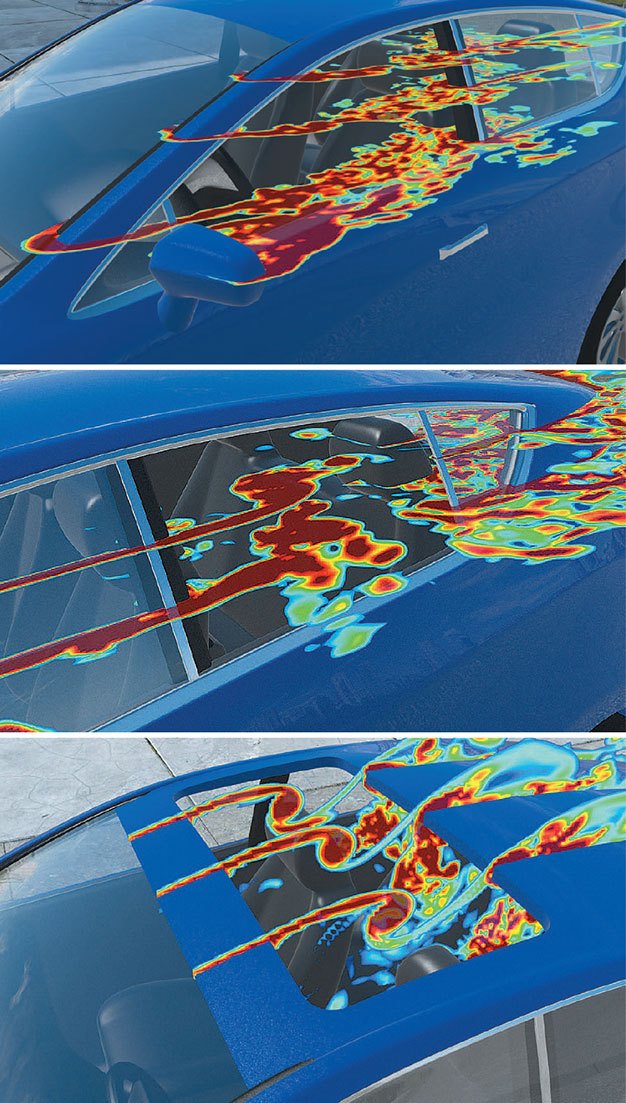
Ever roll down your window a bit while driving and immediately hear a terrible, rhythmic noise? That awful whum-whum-whum is–oddly enough–an example of the same physics that allows you to make an open bottle whistle by blowing over it. Fluid dynamicists call it Helmholtz resonance. Air flowing over the bottle neck or around the car makes the air inside the container vibrate with a frequency that depends on the bottle or car’s characteristics. That vibration generates noise that we hear as a hum or whistle for a bottle or a lower frequency whum-whum for a car window.
The images above show flow past different open windows on a car. Air flow remains relatively steady past the side-view mirror and front window of a modern car, so the noise from opening the front window is not usually too bad. But flow separation and reconnection near the rear window of a car creates very unsteady airflow there which exacerbates this resonance issue. This is why lowering the rear window usually causes more noise. Fortunately, the solution is relatively simple: open more than one window and it disrupts the resonance! (Image credit: Car and Driver; submitted by Simon H.)

CYGNSS


Yesterday marked the launch of a new constellation of eight microsatellites, the Cyclone Global Navigation Satellite System (CYGNSS), designed to monitor hurricanes in Earth’s tropics. The constellation will provide unprecedented capability to monitor conditions inside hurricanes–information that will hopefully help scientists improve hurricane prediction models. Each CYGNSS microsat monitors GPS signals that it receives from the GPS satellite system and from the reflection of that signal off the Earth. By comparing these signals, the satellites can determine wave heights in the ocean, and from that wave information, they can measure surface wind speeds. By peering inside the hurricane as it forms and travels, scientists hope they will be better able to estimate not only a hurricane’s path but how strong it will be when it makes landfall. (Image credits: NASA)

The Sound of a Balloon Popping
The pop of an overfilled balloon is enough to make anyone jump, but you’ve probably never seen it like this. The photo above uses an optical technique known as schlieren photography that reveals changes in density of a transparent gas like air. The shredded rubber of the balloon is still visible in black, and around the balloon there’s an expanding spherical shock wave. It’s the sudden release of energy when the balloon ruptures and the gas inside begins to expand that causes the shock wave. Notice, though, that the gas from the balloon is still clearly visible and balloon-shaped–much like a water balloon that’s just popped. From that clear delineation, I would say that this balloon was filled with a different gas than air–otherwise the density shouldn’t be different enough to make the interior gas distinguishable. (Image credit: G. Settles)

Ink Drops Spreading
Ink drops atop a layer of glycerol spread in a beautiful fan of blue and white. The ink’s motion is the result of two processes: molecular diffusion and the Marangoni effect. Molecular diffusion is the mixing that occurs due to the random background motion of molecules. Since glycerol is a very viscous liquid, the ink is quite slow to spread in this manner.
The second factor, the Marangoni effect, is driven by differences in surface tension. The ink and glycerol have different surface tensions, and the exact values depend on concentration. Notice how the ink drops spread fastest from areas where the ink is densely concentrated. This tells us that the ink’s surface tension is lower than the glycerol’s. As a result, the glycerol’s higher surface tension tends to pull ink toward it. As the ink spreads and its concentration decreases relative to the glycerol, the ink-glycerol mixture’s surface tension increases. Since the difference between the surface tension of the mixture and the pure glycerol is not as large, the Marangoni force is reduced and the spreading slows. (Image credit: C. Kalelkar, source)


Jovian Poles


NASA’s Juno mission has been revealing a side of Jupiter we’ve never seen before. We all recognize the familiar stripes of the planet’s cloud bands, but its poles are entirely different. Unlike Saturn with its hexagonal polar vortex, Jupiter’s poles are a swirling tapestry of turbulent vortices – full of features that citizen scientists are helping to reveal. All of the images in this post were created by citizen scientists helping to process raw images from Juno, and you can contribute, too! The Juno mission solicits input from the public on where and what should be imaged, in addition to providing raw images individuals can process and repost. Check it out at the JunoCam website and become part of the science! (Image credits: All images – NASA/SwRI/MSSS + R. Tkachenko, Orion76; A. Mai)

Linear Dunes
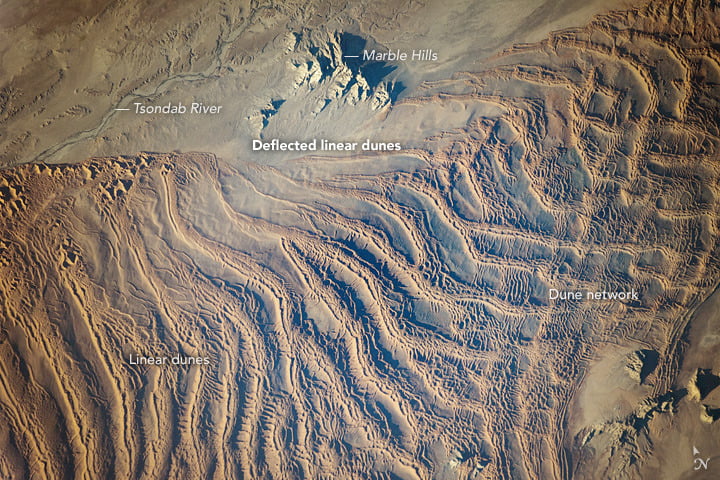
The Namib desert of southern Africa is home to some of the most stunning dunes on Earth. They are primarily linear dunes, which form parallel to the winds that form them. On the left side of the image, the dunes are aligned north-to-south along the direction of the southerly winds that blow through this area. Toward the center of the image, however, the dunes are deflected by strong seasonal winds blowing from the east. On the far right, the dunes break from a linear pattern to one with rectangular criss-crossings. This is a mixture of old and new dunes, evidence that the dominant direction of the wind has shifted over time. (Image credit: NASA Earth Observatory)

Meandering Colorado

Sometimes the meandering of a river is best seen from above. Because of the way water moves to negotiate a bend in the river, any curvature of a river will get carved into a more extreme curve over time. Eventually the river’s course becomes so exaggerated that a loop can bend almost back on itself. At this point, the river often pinches off the bend and shortens its course, as the Colorado River did several thousand years ago with the abandoned meander labeled The Rincon near the bottom of this satellite photo. Left to its own devices, the Colorado would eventually cut away the loop west of Lake Powell, too. (Image credit: NASA/Expedition 47; via NASA Earth Observatory)

Buzzing Straws
Many woodwind instruments owe their sound to the vibration caused when air moves past parts of them. As Nick Moore demonstrates in this video, you can create a simple version of this effect with a slit drinking straw. The buzzing the straw produces when air passes through is a sort of aeroelasticity – it’s a combination of aerodynamic and structural forces that drive the behavior. Low pressure created by the fast-moving flow tends to draw the straw together, but once flow is stopped, the elasticity of the straw makes it rebound open, allowing air to flow again. Even more elaborate vibrations are possible when the straw is elastic. (Video credit: N. Moore)

Are Cats a Fluid?
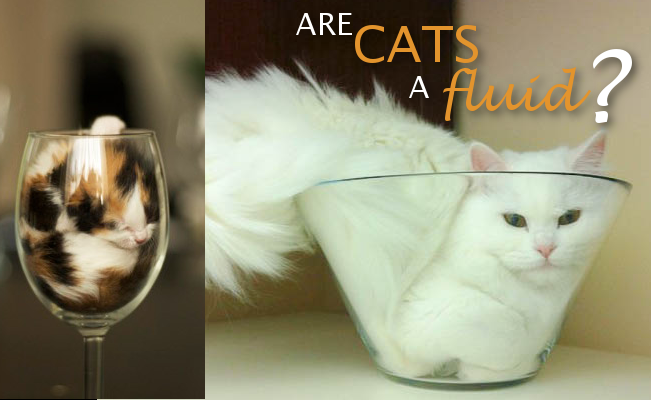
Are cats a fluid? It’s a question that has inspired many a meme. There are a few common definitions as to what makes a fluid. One is that a fluid changes its shape to that of its container. Another more technical definition is that a fluid deforms continuously under shear forces. But the real picture is messier than these seemingly simple definitions allow for. On the Improbable Research podcast, I tackle the question of whether cats are a solid or a fluid and what fluid dynamics–specifically, the subject of rheology–has to teach us about the topic. Give it a listen! (Original image credits: Huffington Post; imgur; research credit: M. A. Fardin, pdf – article begins on page 16)
Post-Thanksgiving bonus: Today is the traditional Science Friday broadcast of this year’s (abridged) Ig Nobel Prize ceremony. Check your local NPR station for broadcast times or listen to it on their website. You’ll hear me deliver a 24/7 lecture on the subject of “Fluid Dynamics” (and you may find me cropping up elsewhere, too). Alternatively, you can check out the full ceremony video on YouTube.