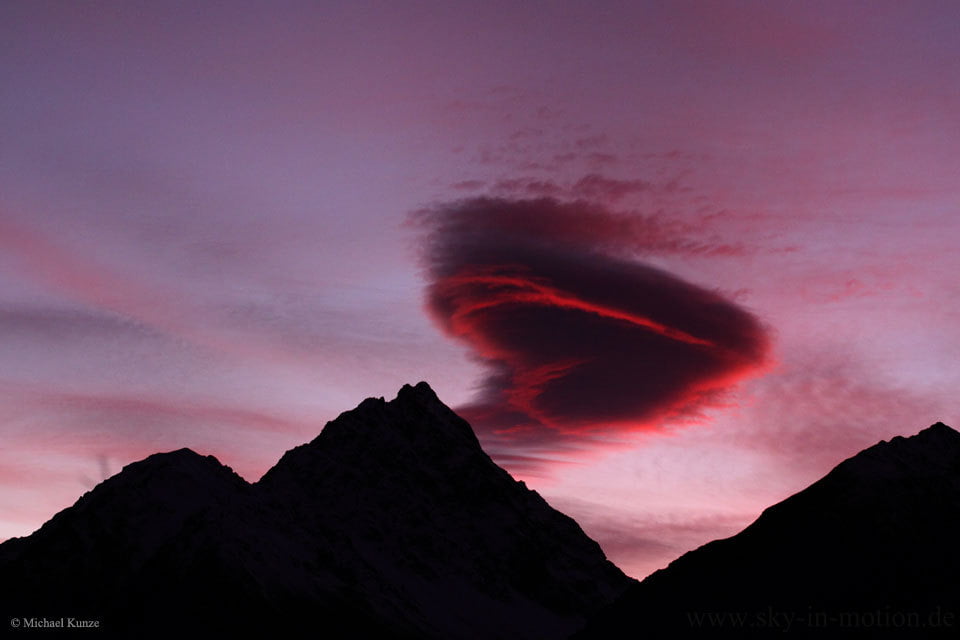
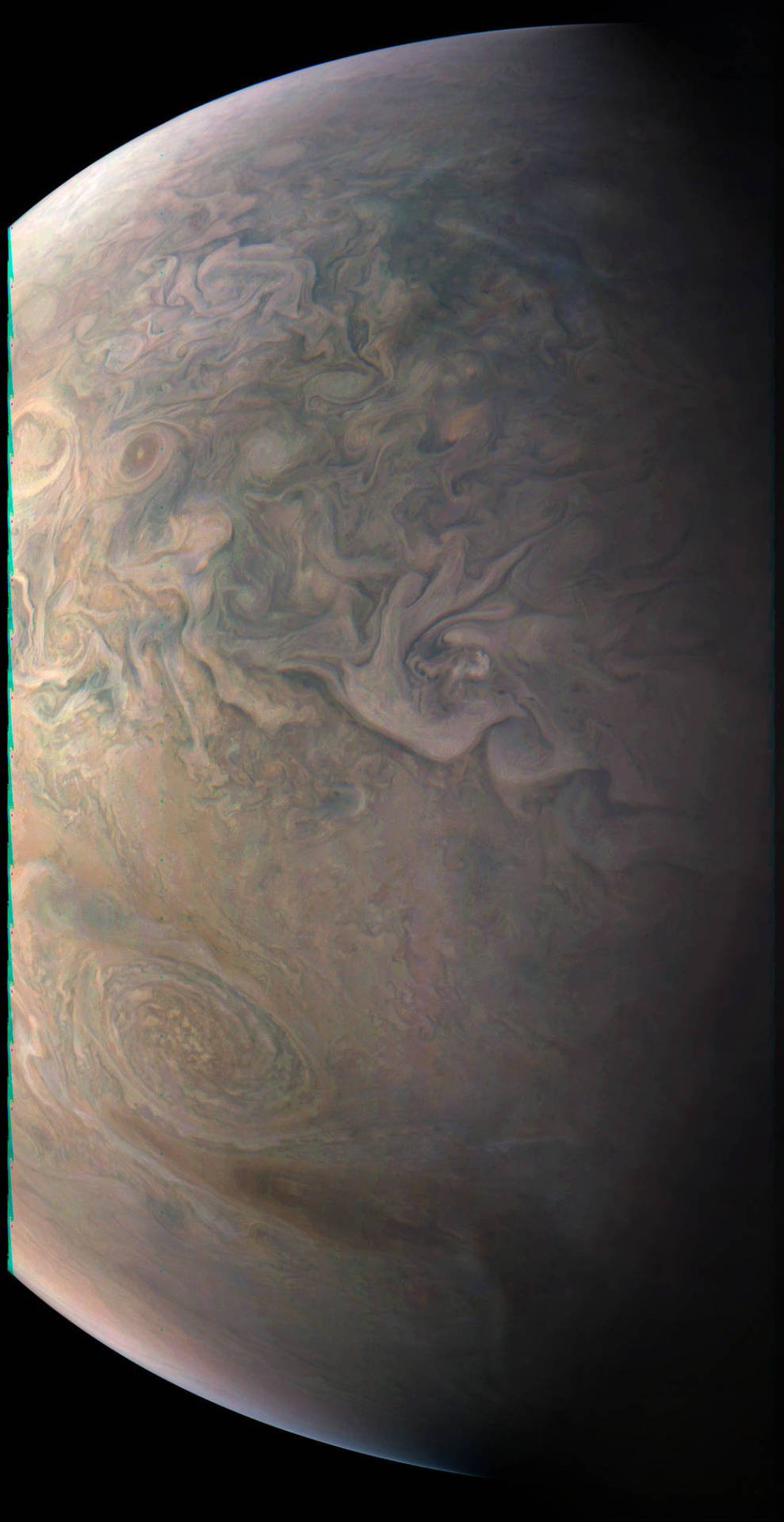
It may look like an oil slick, but the photo above actually shows the clouds of Saturn. The false-color composite image reveals the gas giant in infrared, at wavelengths longer than those visible to the human eye. NASA uses this infrared photography to identify different chemical compositions in Saturn’s atmosphere based on how they reflect sunlight. You can see an example of how they construct these images here. This detail shot appears to show cloud bands of different compositions mixing. You can see hints of shear instabilities forming along the edges where the light and dark bands meet. (Image credit: NASA; via Gizmodo)
Category: Phenomena

Bouncing Droplets
Droplets bouncing on a pool form a beautiful and fascinating system, as recently featured by Physics Girl, Veritasium, and Smarter Every Day. The Lutetium Project – a consortium of French physics, graphic design, and music students – have their own take on the subject with beautiful short videos constructed from experimental research footage. With simple text explanations and lovely original music, they combine science, art, and outreach brilliantly. Also check out their quantum walker video and be sure to subscribe to their channel (in English or French) for more! (Video credit: The Lutetium Project; submitted by @g_durey)

Avoiding Coalescence
If you watch closely as you go about your day, you may notice drops of water sometimes bounce off a pool of water instead of coalescing. Fluid dynamicists have been fascinated by this behavior since the 1800s, but it was Couder et al. who explained that these droplets can bounce indefinitely as long as the thin air layer separating the drop and pool is refreshed by vibrating the pool. In this video, Destin teams up with astronaut Don Pettit to film the phenomenon in beautiful high-speed. My favorite part of the video starts around 8:18, where Destin shows Don’s experiments with this effect in microgravity. It turns out that the cello produces just the right frequencies to create a cascade of bouncing water droplets, much like a Tibetan singing bowl turned back on itself! (Video credit: Smarter Every Day; submitted by Destin and effyeahjoebiden)

Living Fluid Dynamics
This short film for the 2016 Gallery of Fluid Motion features Montana State University students experiencing fluid dynamics in the classroom and in their daily lives. As in her previous film (which we deconstructed), Shanon Reckinger aims to illustrate some of our everyday interactions with fluids. This time identifying individual phenomena is left as an exercise for the viewer, but there are hints hidden in the classroom scenes. How many can you catch? I’ve labeled some of the ones I noticed in the tags. (Video credit: S. Reckinger et al.)

Crow Instability
Watching airplane contrails overhead, you may have noticed them transform into a daisy chain of distorted rings. This is an effect known as the Crow instability. The contrails themselves are the airplane’s wingtip vortices, made visible by water vapor condensed out of the engine exhaust. These two initially parallel vortex lines spin in opposite directions. A slight crosswind can disturb the initially straight lines, causing them to become wavy. This waviness increases over time until the vortex lines almost touch. Then the vortices pinch off and reconnect into a line of vortex rings that slowly dissipate. Be sure to check out the full-resolution version of this animation for maximum effect. (Image credit: J. Hertzberg, source)

Supercritical
Supercritical fluids are neither a gas nor a liquid. The video above shows a tube of pressurized xenon, initially below its boiling point of approximately ~16 deg C. As the temperature is raised, you see the meniscus that marks the liquid xenon disappear. At this point, the xenon has transitioned into the supercritical state. It takes up the entire tube – like a gas – but it is still capable of dissolving materials – like a liquid. At the same time, though, the xenon has no surface tension because there’s no liquid/vapor interface. Toward the end of the video, the temperature gets reduced and the xenon condenses back into a liquid state. Supercritical fluids can be used in a wide variety of industrial applications, including in decaffeination, dry cleaning, and refrigeration. (Video credit: wwwperiodictableru)

Pelican Surfing
Birds can be incredibly clever about using their surroundings to enhance their flight. Pelicans will even surf! As a line of waves rolls toward shore, it pushes a small updraft ahead of it – just like a line of mountains creates a windy updraft. Pelicans save energy by riding the updraft just like a surfer would ride the swell. Once the wave breaks, the air and water become turbulent and less useful, so the pelican cuts away to find his next ride. (Image and submission credit: N. Yarvin, source)

Fluorescein Ghosts
Fluorescein is a popular chemical for flow visualization, and, as this video from Shanks FX demonstrates, it’s not hard to extract from highlighters if you’d like to experiment with it yourself. Fluorescein can also be purchased in powder form, but it’s typically rendered into a dye before use. When dripped into water, it can leave behind ghostly glowing wakes. Happy Halloween! (Video credit: Shanks FX)
In other news, I am back from my vacation! Thanks again to Claire from Brilliant Botany for looking out for everything while I was gone. – Nicole

Reflecting in a Stream

Total internal reflection traps three lasers in a stream of falling water. When light tries to pass from the water – a material with a high refractive index – to the air – which has a lower index of fraction – it can only do so if its angle of incidence is smaller than the critical angle. Here, the light impacts the water-air boundary at a large angle and rather than refracting across the interface – like the distorted view of a straw in a glass of water – the laser light is completely reflected. Instead of escaping, the laser light is trapped, becoming a ribbon of light that swirls inside the water stream until the light is diffused. (Image credits: L. Yarnell et al.; F. Batrack et al.)

The Pythagorean Cup
According to legend, Pythagoras invented a cup to prevent his students from drinking too greedily. If they overfilled the cup, it would immediately drain out all the fluid. The trick works thanks to a U-shaped tube in the center of the cup. As long as the liquid level is below the highest point in the U-tube, only the entrance side of the tube will be filled. As soon as the liquid level in the cup is higher, the weight of all that fluid forces liquid up and around the bend. This kicks off a siphoning effect that pulls all the fluid out. Coincidentally, this is the same way that toilet flushing works! Pulling the handle releases extra water into the bowl that raises the fluid level higher than the highest point in a U-bend. That establishes a siphon, which (provided nothing has clogged the pipe), empties the toilet bowl. (Video credit: Periodic Videos)