
Here’s a fun demonstration of the effects of surface tension. If a loop of thread is dropped onto a soap film, as shown above, popping the soap film inside the thread will pull the thread into a circle. This is because the surface tension of the soap film outside the thread is reacting to the sudden loss of the balancing force exerted by surface tension inside the thread loop. Surface tension arises from intermolecular forces in a fluid. Because those forces are in balance except along the interface of a fluid–where the fluid molecules are not completely surrounded by identical molecules–there is a net force exerted at the surface.
Category: Phenomena

London 2012: Discus Physics


Like the javelin, the discus throw is an athletic event dating back to the ancient Olympics. Competitors are limited to a 2.5 m circle from which they throw, leading to the sometimes elaborate forms used by athletes to generate a large velocity and angular momentum upon release. The flight of the discus is significantly dependent on aerodynamics, as the discus flies at an angle of attack. Spin helps stabilize its flight both dynamically and by creating a turbulent boundary layer along the surface which helps prevent separation and stall. Unlike many other events, a headwind is actually advantageous in the discus throw because it increases the relative velocity between the airflow and the discus, thereby increasing lift. The headwind also increases the drag force on the discus, but research shows the benefits of the increased lift outweigh the effects of increased drag, so much so that a discus flies further in air than it would in a vacuum. (Photo credits: P Kopczynski, Wiki Commons, EPA/K Okten)
FYFD is celebrating the Olympics by featuring the fluid dynamics of sports. Check out our previous posts, including why corner kicks swerve, what makes a pool fast, how an arrow flies, and how divers avoid splash.

London 2012: Soccer Aerodynamics
Corner kicks and free kicks are tough to defend in football (soccer for Americans) because the ball’s trajectory can curve in a non-intuitive fashion. Known as the Magnus effect, the fluid dynamics around a spinning ball cause this curvature in the flight path. When an object spins while moving through the fluid, it drags the air near the surface with it. On one side of the spinning ball, the motion opposes the direction of freestream airflow, causing a lower relative velocity, and on the opposite side, the spin adds to the airflow, creating a higher velocity. According to Bernoulli’s principle, this causes a lower pressure on the side of the ball spinning with the flow and a higher pressure on other side. This difference in pressure results in a force acting perpendicular to the direction of travel, causing the unexpected curvature in the football’s path. In the case of the corner kick above, the player kicks the ball from the right side, imparting an anti-clockwise spin when viewed from above. As the ball travels past the goal, air is moving faster over the side nearest the goal and slower on the opposite side. The difference in velocities, and thus pressures, creates the sideways force that drives the ball into the goal even without touching another player. The same effect is used in many other sports to complicate play and confuse opponents. In tennis and volleyball, for example, topspin is used to make the ball drop quickly after passing the net.
ETA: Check out this other great example of a free kick sent in by reader amphinomos.
FYFD is celebrating the Olympics by featuring the fluid dynamics of sport. Check out some of our previous posts including the flight of a javelin, how divers reduce splash, and what makes a racing hull fast.

London 2012: Javelin Physics


Few Olympic events can boast as long as history as the javelin. Though the event has existed since the ancient Olympics, humans and our ancestors have been throwing spears for hundreds of millennia. But today’s javelin, oddly enough, is designed so that it cannot be thrown as far as those that came before. After a world record throw in 1984 that nearly reached the edge of the track, the sport’s governing body authorized new rules that shifted the weight of the javelin forward, causing the center of mass of the javelin to lie in front of its center of pressure. This causes the javelin to tip forward in flight, ensuring it will land nose down. Simultaneously, they made changes to the nose of the javelin to reduce its lift during flight, resulting in a javelin that flies only 90% of the previous distance. Since then manufacturers have introduced other innovations to try to increase the javelin’s flight, such as a roughened tail to prevent flow separation, only to later have these changes banned. (Photo credits: Getty Images, Zeenews)
FYFD is celebrating the Olympics by featuring the fluid dynamics of sport. Check out some of our previous posts, including what makes a pool fast, how divers reduce splash, how cyclists get “aero”, and how rowers overcome drag.

London 2012: Rowing Physics


In rowing, as in any water sport, drag comes in three varieties: skin friction, form (or pressure) drag, and wave drag. Skin friction comes from the friction between the hull and water causing the boat to drag water with it as it moves. This can be mitigated with the right materials and surface finish but will never be completely negligible. In fact, the racing shells used in rowing are unusual for boats because skin friction is their major source of resistance. This is because form drag, caused by the shape of the boat cutting through the water, and wave drag, the energy lost due to the waves that form along the hull, are small in racing shells due to their long, narrow, and streamlined shape. Because skin friction dominates among the three types of drag, the force a rower overcomes to move the boat is proportional to the hull’s velocity squared, and the power required to do so is proportional to the hull’s velocity cubed. This means that it is more efficient for rowers to keep a constant hull speed throughout a race than it is to start slow and speed up or start fast and slow down because the work (power x time) needed to keep a constant speed is smaller. For more on the physics of rowing, check out Anu Dudhia’s excellent website or this video from Physics of Life. (Photo credits: Ecouterre, AP)
FYFD is celebrating the Olympics by featuring the fluid dynamics of sport. Check out some of our previous posts, including what makes a pool fast, how divers reduce splash, and the aerodynamics of badminton.
London 2012: Running Aerodynamics
Running is not an event typically associated with aerodynamics, though any runner will tell you that a headwind can slow them down. For comparison, a swimmer on world record pace sees 40 to 50 times the drag force of a runner over the same distance. But despite the relatively small influence of drag on a runner, there are measurable effects due to wind and altitude when races are judged by hundredths of a second. Given this, it comes as no surprise that researchers (and presumably manufacturers) are starting to considering how to optimize aerodynamics in running. The video above describes results of a study on running shoes that suggests modest savings may be derived from shoes with dimpled surfaces, much like a golf ball. Socks, on the other hand, don’t show any aerodynamic savings from special surfaces. Of course, the bulk of a runner’s drag comes from their hair and clothing; this is, in part, why runners wear form fitting clothes. While there may be some aerodynamic savings to be had, I don’t think we’ll see world records falling like crazy in Rio because of the latest new shoes.
FYFD is celebrating the Olympics by featuring the fluid dynamics of sport. Check out our previous posts on how the Olympic torch works, what makes a pool fast, the aerodynamics of archery, the science of badminton, how cyclists get “aero”, and how divers reduce splash.

London 2012: Diving Physics


Divers twist and spin gracefully in the air, but the highest marks come when they enter the water with little to no splash. This rip entry–named after paper-ripping sound characteristic of such a dive–is possible thanks to fluid dynamics. Any time a solid object enters a still liquid, it tears a cavity into the liquid. The smaller this cavity is, the less the liquid will rebound and splash when the cavity gets refilled. In diving, achieving a small splash requires a couple items. First, the diver will grab his hands over his head to form a flat surface. This will create the initial small cavity through which his body follows. When entering, the diver will keep his body straight and rigid, with arms pressed against his head; this adds stability to keep the diver from letting the force of striking the water at 35 mph affect his body’s form and create splash. Finally, the perfect dive enters vertical to the water surface. This ensures that all of the diver’s body finds its way into that cavity created by the hands without striking any undisturbed water. Once under the water, divers often extend their arms to generate enough drag to slow down quickly. All in all, the rip entry minimizes the cavity size and thus the splash, adding a great exclamation point to a beautiful dive. (Photo credits: Associated Press, Adam Pretty/Getty Images, Nigel Wade, Jed Jacobsohn)
FYFD is celebrating the Olympics by featuring the fluid dynamics of sport. Check out our previous posts on how the Olympic torch works, what makes a pool fast, the aerodynamics of archery, the science of badminton, and how cyclists “get aero”.

London 2012: Cycling Physics


In no discipline of cycling is more emphasis placed on fluid dynamics than in the individual time trial. This event, a solo race against the clock, leaves riders no place to hide from the aerodynamic drag that makes up 70% or more of the resistance riders overcome when pedaling. Time trial bikes are designed for low drag and light weight over maneuverability, using airfoil-like shapes in the fork and frame to direct airflow around the bike and rider without separation, which creates an area of low pressure in the wake that increases drag. Riders maintain a position stretched out over the front wheel of the bike, with their arms close together. This position reduces the frontal area exposed to the flow, which is proportional to the drag a rider experiences.
Special helmets, some with strangely streamlined curves, are used to direct airflow over the rider’s head and straight along his or her back. Both helmets and skinsuits are starting to feature areas of dimpling or raised texturing. These function in much the same way as a golf ball; the texture causes the boundary layer, the thin layer of air near a surface, to become turbulent. A turbulent boundary layer is less susceptible to separating from the surface, ultimately leading to lower drag than would be observed if the boundary layer remained laminar. Wheels, skinsuits, gloves, shoe covers, and even the location of the brakes on the bike are all tweaked to reduce drag. In an event that can be decided by hundredths of a second between riders, every gram of drag counts. (Photo credits: Stefano Rellandini, POC Sports, Reuters, Paul Starkey, Louis Garneau)
FYFD is celebrating the Olympics by featuring the fluid dynamics of sports. Check out our previous posts on how the Olympic torch works, what makes a pool fast, the aerodynamics of archery, and the science of badminton.

London 2012: Badminton Physics
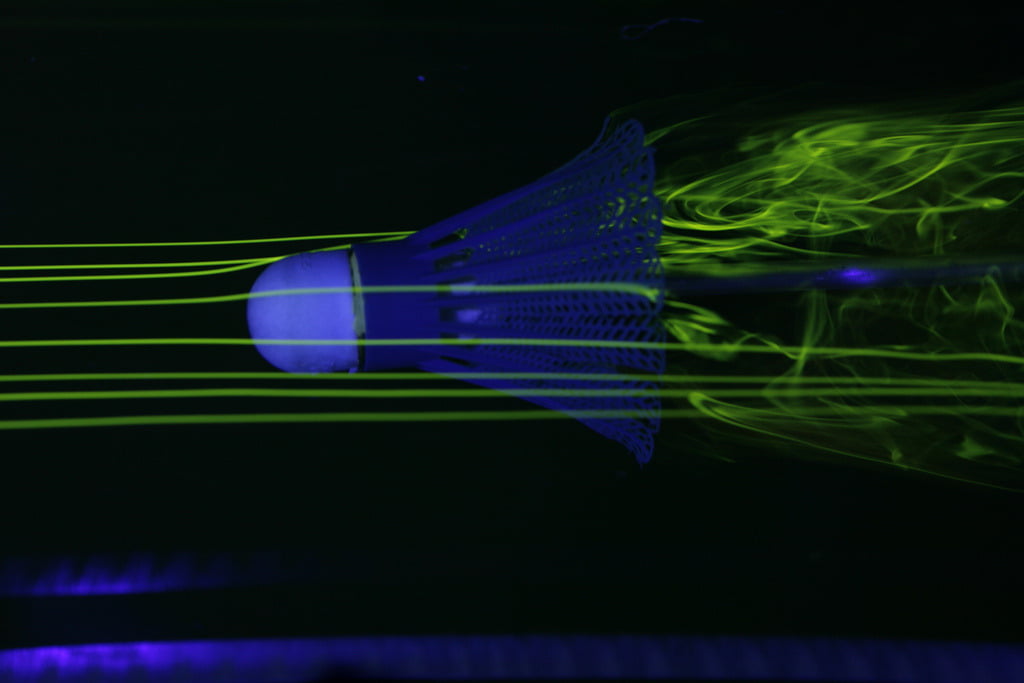
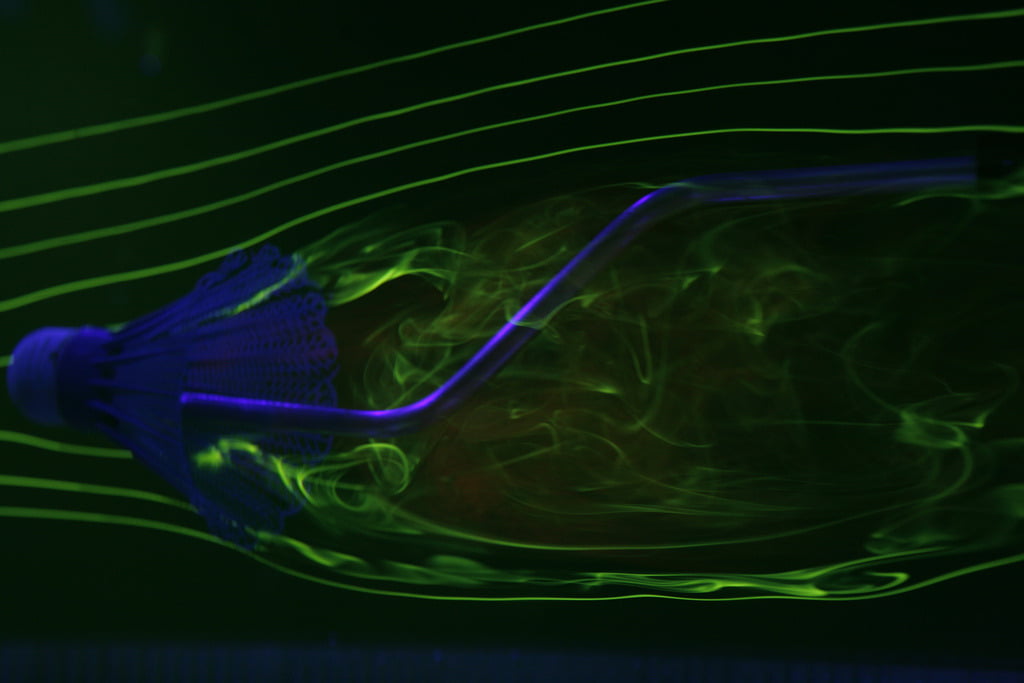
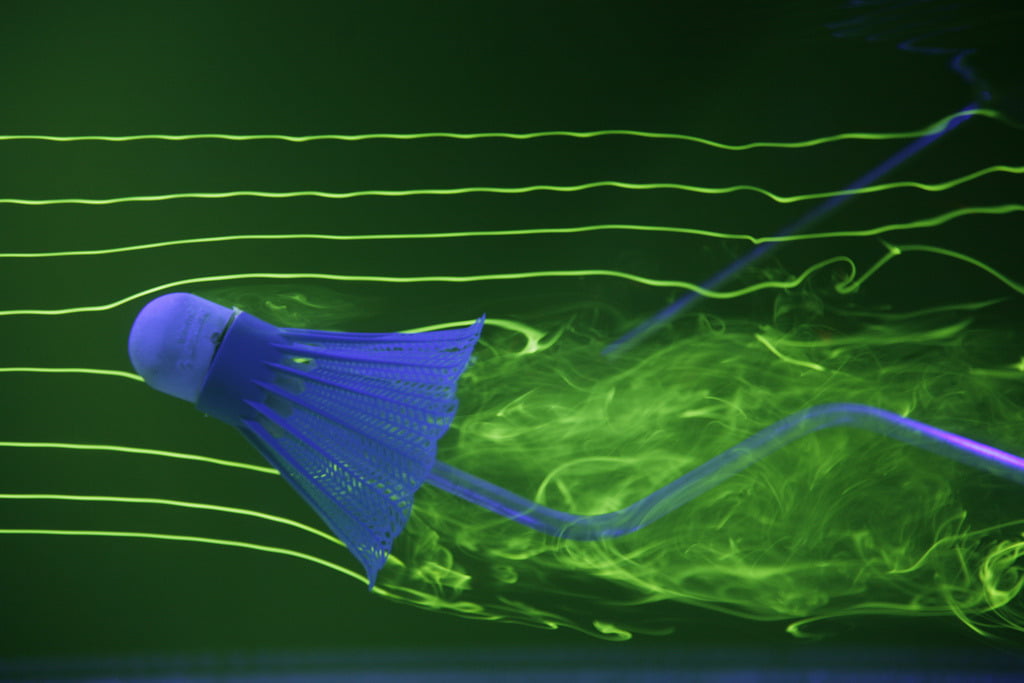
Unlike most racket sports, badminton uses a projectile that is nothing like a sphere. The unusual shape of the shuttlecock not only creates substantial drag in comparison to a ball but increases the complexity of its flight path. The heavy head of the shuttlecock creates a moment that stabilizes its flight, ensuring that the head always points in the direction of travel. The skirt, traditionally made of feathers though many today are plastic, is responsible for the aerodynamic forces that make the shuttlecock’s behavior so interesting.
Measuring the drag coefficient of the shuttlecock, modeling its trajectory and behavior in the four common badminton shots, and even attempting computational fluid dynamics of the shuttlecock are all on-going research problems in sports engineering. (Photo credit: Rob Bulmahn)
FYFD is celebrating the Olympics with the fluid dynamics of sports. Check out our previous posts on how the Olympic torch works, what makes a pool fast, and the aerodynamics of archery.
London 2012: Archery Physics
Archery is one of the oldest Olympic sports, but the physics involved are remarkably complex. Even looking only at the flight of the arrow, the problem is hardly simple. The heavy point of the arrow makes it front-heavy, and the fletches on the back of the arrow provide additional surface area on which air can act. This means that the center of mass of the arrow–where gravity acts–is further forward than the center of pressure–where aerodynamic forces act. This results in the aerodynamic forces helping to stabilize the flight of the arrow. To see why this is important, try throwing a dart fletching first!
When an arrow is fired from a bow, as in the high speed video above, the sudden impetus of force from the bowstring causes the arrow to flex and vibrate as it is fired. The aerodynamic forces generated by the fletches straighten the arrow’s flight, helping it reach the intended target accurately. Some fletching is designed to make the arrow spin; this can further improve accuracy but comes at the cost of speed since some of the arrow’s initial kinetic energy must be converted to rotation. For more, check out Archery Report, which features some great articles on the physics of archery and even has CFD comparing arrow tips. Mark Leach also has some great information on tuning a bow, which, if done properly, allows one to accurately shoot unfletched arrows.
FYFD is celebrating the Olympics by looking at the fluid dynamics of sports. Check out our previous posts on how the Olympic torch works and what makes a pool fast.