For the right flow speeds and incidence angles, a jet of Newtonian fluid can bounce off the surface of a bath of the same fluid. This is shown in the photo above with a laser incorporated in the jet to show its integrity throughout the bounce. The walls of the jet direct the laser much the way an optical fiber does. The jet stays separated from the bath by a thin layer of air, which is constantly replenished by the air being entrained by the flowing jet. The rebound is a result of the surface tension of the bath providing force for the bounce. (Photo credit: T. Lockhart et al.)
Category: Phenomena

Simulating Floods
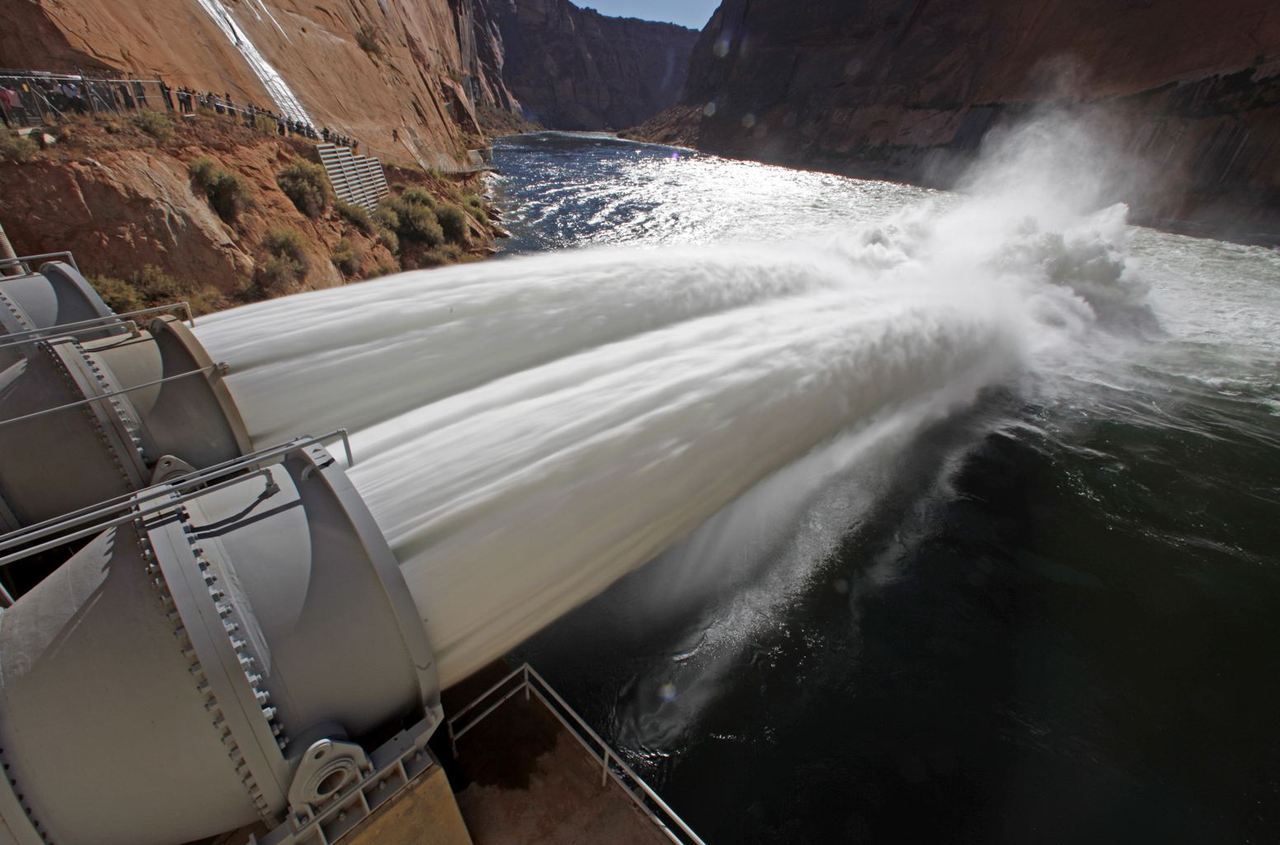
Last week officials opened the Glen Canyon Dam’s bypass tubes to release a simulated flood on the Colorado River, which runs through the Grand Canyon. This is the first of several planned “high-flows” intended to imitate the positive effects of natural floods on the area. Officials hope the increased water flow will help deposit sediment along the Grand Canyon’s walls at heights unreachable at the lower water levels. This sediment transport should help restore the natural sandbars and beaches that serve as breeding grounds for native fish. The floods will also clear vegetation from the riverside camping spots utilized by tourists. (Photo credit: Reuters/Bob Strong; submitted by Bobby E.)

Spray Starch
High speed video of of spray starch from a can. Once the initial transients die down, a cone-shaped annular sheet forms. Disturbances propagate in the sheet, tearing it into filaments that break down into droplets. Beautiful complexity hidden in a simple everyday device. (Video credit: John Savage)
Cavitation in a Bottle
Sudden changes in the pressure or temperature in a liquid can create bubbles in a process known as cavitation. Underwater explosions are just one of the ways to induce cavitation in a liquid. As identified in the above video, the shock waves traveling through the liquid force a change in pressure that creates bubbles. When these bubbles collapse, the container is subjected to an enormous oscillation in pressure, which often results in damage. The same phenomenon is responsible for damage on boat propellers as well as this beer bottle smashing trick. Check out these other high-speed videos of cavitation in a bottle: (Video credit: Destin/Smarter Every Day; submitted by Juan S.)

Those Funny Fins on Airplane Wings
Ever look out an airplane’s window and wondered why a row of little fins runs along the upper side of the wing? These vortex generators help prevent a wing from stalling at high angle of attack by keeping flow attached to the surface. Airflow over the vanes creates a tip vortex that transports the higher-momentum fluid from the freestream closer to the wing’s surface, increasing the momentum in the boundary layer. As a result of this momentum exchange, the boundary layer remains attached over a greater chordwise distance. This also increases the effectiveness of trailing-edge control surfaces, like ailerons, on the wing. (Photo credit: Mark Jones Jr.)
Relighting a Candle
When a candle is blown out, a buoyant plume of unburned fuel/air mixture continues to rise for several seconds. By bringing a combustion source close to the plume, the mixture can ignite and flames will propagate back down to the candle wick to reignite it. Watch the slow motion replay near the end of the video and you can actually see the flame front propagate downward. (Video credit: G. Casavan, University of Colorado)

Rocket Exhaust
A fiery jet of exhaust remains amid plumes of smoke as a Soyuz rocket lifts off from Baikonur Cosmodrome bound for the International Space Station. The lengthscales of such turbulence range from tens of meters to only millimeters, highlighting the incredible difficulty of accurately capturing and describing the fluid motion of a practical engineering problem. (Photo credit: NASA/Carla Cioffi; via Visual Science)
Microgravity Water Balloons
When a water balloon pops in microgravity, waves propagate from the initial point of contact and the final point of contact (where the balloon skin peels away). As these waves come inward toward one another, the water is compressed from its original potato-like shape into a pancake-like one. In most cases, surface tension will provide a damping force on this oscillatory motion, eventually making the water into a sphere. On Earth, in contrast, a water balloon seems to hold its shape after popping. This is because the effect of gravity on the water is much larger than the effect of the propagating waves. This is one reason that it is useful to have a laboratory in space! Without a microgravity environment, it is much harder to study and observe secondary and tertiary-order forces on a physical event. (Video credit: Don Pettit, Science Off The Sphere)
Magnus Force
Physics students are often taught to ignore the effects of air on a projectile, but such effects are not always negligible. This video features several great examples of the Magnus effect, which occurs when a spinning object moves through a fluid. The Magnus force acts perpendicular to the spin axis and is generated by pressure imbalances in the fluid near the object’s surface. On one side of the spinning object, fluid is dragged with the spin, staying attached to the object for longer than if it weren’t spinning. On the other side, however, the fluid is quickly stopped by the spin acting in the direction opposite to the fluid motion. The pressure will be higher on the side where the fluid stagnates and lower on the side where the flow stays attached, thereby generating a force acting from high-to-low, just like with lift on an airfoil. Sports players use this effect all the time: pitchers throw curveballs, volleyball and tennis players use topspin to drive a ball downward past the net, and golfers use backspin to keep a golf ball flying farther. (Video credit: Veritasium)

Vapor Cone
This stunning National Geographic photo contest winner shows an F-15 banking at an airshow and a array of great fluid dynamics. A vapor cloud has formed over the wings of the plane due to the acceleration of air over the top of the plane. The acceleration has dropped the local pressure enough that the moisture of the air condenses. Some of this condensation has been caught by the wingtip vortices, highlighting those as well. Finally, the twin exhausts have a wake full of shock diamonds, formed by a series of shock waves and expansion fans that adjust the exhaust’s pressure to match that of the ambient atmosphere. (Photo credit: Darryl Skinner/National Geographic; via In Focus; submitted by jshoer)