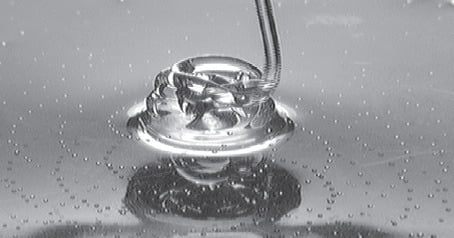
Anyone who has drizzled honey or another viscous fluid onto a surface is familiar with the rope-like coiling behavior of some liquids. But did you know that same instability can create spirals of bubbles like in this photo? Such behavior is only seen for a narrow range of parameters within the gravitational regime of liquid coiling. As the liquid falls, the center of coiling precesses along its own circle with a frequency much smaller than that of the coiling itself. This means that new coils do not fall exactly on top of old ones, trapping air bubbles between them. As the pile of coils collapses under gravity, the bubbles are carried outward, creating beautiful spiral patterns. (Photo credit: M. Habibi et al.)
Category: Phenomena

Flapping Flags
Sometimes structural forces and aerodynamic forces combine to produce instabilities. One of the most common and familiar examples of this, a flag flapping in the breeze, remains extremely complex to analyze and describe. The flexibility of the flag, and its small but finite resistance to bending, combine with the variability of air flow around the flag to create a fascinating dance of effects. This same aeroelastic flutter can create disastrous results for structures and aircraft. For more on the flapping flag, see Argentina and Mahadevan (2004). (Video credit: S. Morris)

The Red Crown
A drop of red dye falls into a thin layer of milk, forming a crown splash. Notice the pale edges of the droplets at the rim of the crown; this is milk that has been entrained by the original drop. The rim and satellite droplets surrounding the splash are formed due to surface tension effects, chiefly the Plateau-Rayleigh instability–the same effect responsible for breaking a falling column of liquid into droplets like in a leaking faucet. The instability will have a most unstable wavelength that determines the number of satellite droplets formed. (Photo credit: W. van Hoeve et al., University of Twente)
Spin-Up
With the Oscars just over, it seems like a good time for some movie-trailer-style fluid dynamics. This video shows a rotating water tank from the perspective of a camera rotating with the tank at 10 rpm. Initially, the tank and its contents are at rest. When the tank begins spinning, the fluid inside responds. Pink potassium permanganate crystals at the bottom of the tank show fluid motion as they dissolve, and food coloring is spread on the water’s surface to show motion there. Fluid near the edge of the tank reaches the tank’s rotational velocity fastest, due to friction with the wall, while fluid near the center of the tank takes longer to spin up to speed. This creates the spiral-galaxy-like shape in the dye. Eventually viscosity will transmit the effects of the wall’s motion even into the center of the tank. (Video credit: UCLA Spinlab)
Etna’s Eruption
After some rumblings in recent weeks, Italy’s Mt. Etna erupted overnight on February 19th, sending fountains of lava shooting into the dark. This impressive video from Klaus Dorschfeldt, a videographer for Italy’s National Institute for Geophysics and Vulcanology, shows the nighttime eruption, including the dark, turbulent outline of a pyroclastic flow of rock and hot gases escaping down the mountainside. Such flows can be devastating in their effect as they rush and spread down the mountain, flattening, burning, or engulfing everything in their path. When Mt. Vesuvius erupted in 79 A.D., it was the pyroclastic flow that buried the towns of Pompeii and Herculaneum. (Video credit: Klaus Dorschfeldt; via io9)

Fishbones
When two liquid jets collide, they can form an array of shapes ranging from a chain-like stream or a liquid sheet to a fishbone-type structure of periodic droplets. This series of images show the collision of two viscoelastic jets–in which polymer additives give the fluids elasticity properties unlike those of familiar Newtonian fluids like water. The jet velocities increase with each image, changing the behavior from a fluid chain (a and b); to a fishbone structure (c and d); to a smooth liquid sheet (e); to a fluttering sheet (f and g); to a disintegrating ruffled sheet (h), and finally a violently flapping sheet (i and j). The behavior of such jets is of particular interest in problems of atomization, where it can be desirable to break an incoming stream of liquid up into droplets as quickly as possible. (Photo credit: S. Jung et al.)
Laser-Induced Fluorescence
As demonstrated in the video above, lasers can be used to excite molecules into a higher energy state, which will decay via the emission of photons, causing the medium to glow. This laser-induced fluorescence is utilized in several techniques for measurements in fluid dynamics, including planar laser-induced fluorescence (PLIF) and molecular tagging velocimetry (MTV). In these techniques a flow is usually seeded with a fluorescing material–nitric oxide is popular for super- and hypersonic flows–and then lasers are used to excite a slice of the flow field. The resulting fluorescence can be used for both qualitative and quantitative flow measurements. Here are a couple of examples, one in low-Reynolds number flow and one in combustion. (Video credit: L. Martin et al./UC Berkeley)
Jump in a Lake
Ever wonder what would happen if every person on earth jumped into a lake at the same time? Wonder no more! Physicist Rhett Allain breaks it down over at Dot Physics.
The 9th Pitch Drop is Coming
Remember that 83-year-old pitch drop experiment designed to measure the viscosity of pitch? Well, rumor has it that the ninth drop is due to fall at any time. Will you catch it on the webcam?
Iceberg Calving
When sections of glaciers break off to create icebergs, scientists call it calving. Usually large sections of ice will break off and immediately capsize, with an energy equivalent to up to 40 kilotons of TNT. These large events are sufficient to cause measurable seismic signals. How hydrodynamic forces impact the contact and pressure forces between the calving iceberg and the glacier are still being researched, though recent laboratory experiments and numerical models suggest that hydrodynamics substantially increase these forces. The video above shows one of the largest calving events ever caught on camera, and the scale of the process is just stunning. (Video credit: Chasing Ice; additional information from J. C. Burton et al. 2012; submitted by jshoer)


