When a stream of liquid falls, a surface tension effect called the Plateau-Rayleigh instability causes small variations in the jet’s radius to grow until the liquid breaks into droplets. For a kitchen faucet, this instability acts quickly, breaking the stream into drops within a few centimeters. But for more viscous fluids, like honey, jets can reach as many as ten meters in length before breaking up. New research shows that, while viscosity does not play a role in stretching and shaping the jet as it falls–that’s primarily gravity’s doing–it plays a key role in the way perturbations to the jet grow. Viscosity can delay or inhibit those small variations in the jet’s diameter, preventing their growth due to the Plateau-Rayleigh instability. In this respect, viscosity is a stabilizing influence on the flow. (Photo credit: Harsha K R; via Flow Visualization)
Category: Phenomena

Egg-Spinning Fun
If you have any leftover hard-boiled eggs, you can recreate this bit of fluid dynamical fun. Spin the egg through a puddle of milk, and you’ll find that the egg draws liquid up from the puddle and flights it out in a series of jets. As the egg spins, it drags the milk it touches with it. Points closer to the egg’s equator have a higher velocity because they travel a larger distance with each rotation. This variation in velocities creates a favorable pressure gradient that draws milk up the sides of the egg as it spins, creating a simple pump. To see the effect in action check out this Science Friday video or the BYU Splash Lab’s Easter-themed video. (Photo credit: BYU Splash Lab)

Saturn’s Great White Spot
We’ve touched a couple times on Saturnian storms, but this NASA video gives a great overview of the Great White Spot, a storm that appeared in late 2010. Gauging the fluid dynamics of gas giants like Saturn and Jupiter is difficult, in large part because we can see only the outermost portion of the atmosphere. Numerous theories and models have been suggested to explain features and dynamics that we observe, but much of the overall behavior remains a subject of debate among planetary scientists. (Video credit: NASA Goddard)

Lava in Action
We’ve touched on volcanoes and the fluid dynamics of lava a couple of times here at FYFD, but over at Wired volcanologist Erik Klemetti has some wonderful photos and videos he took while visiting an active lava flow in Hawaii along with great explanations of the flow shapes and processes. Above we see him using a rock hammer to remove a sample from an active flow. Klemetti describes the lava’s behavior as taffy-like – extremely viscous and stretchy but prone to break like a plastic. Be sure to check out his posts! (Photo credit: E. Klemetti; submitted by @FlexMonkey)

Lift on a Paper Plane
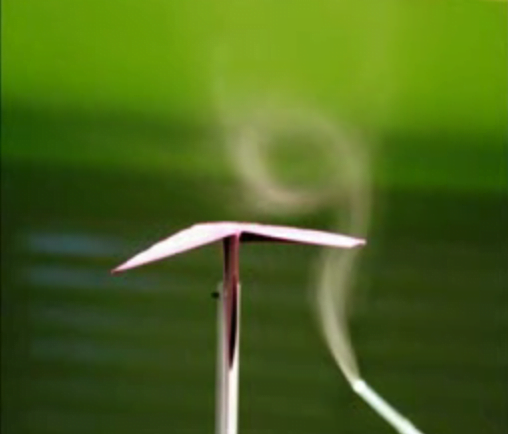
In this still image from a student experiment, smoke visualization shows the formation of a vortex over the wing of a paper airplane during a wind tunnel test. This wing vortex is mirrored on the opposite wing, though there is no smoke to show it. At high angle of attack, the delta-wing shape of the traditional paper air plane creates these vortices on the upper surface, which helps generate the lift necessary to keep the plane aloft. (Photo credit: A. Lindholdt, R. Frausing, C. Rechter, and S. Rytman)
Mixing While Laminar
Although turbulent flows are known for their mixing efficiency, in manufacturing there can often be a need to mix laminar fluid streams without the increased shear stress of a turbulent flow. This can be particularly important for polymeric liquids, where too much shear stress could damage the polymer chains. One possibility is using a static mixer, such as the one demonstrated in this video, which, when placed in pipe flow, will deflect the pipe’s contents in such a way as to produce efficient mixing over a short distance. Here two streams of high-viscosity epoxy are mixed through such a static mixer, hardened, and then ground to show the mixing at each level of the static mixer. (Video credit: Sulzer)

Frozen Methane Bubbles
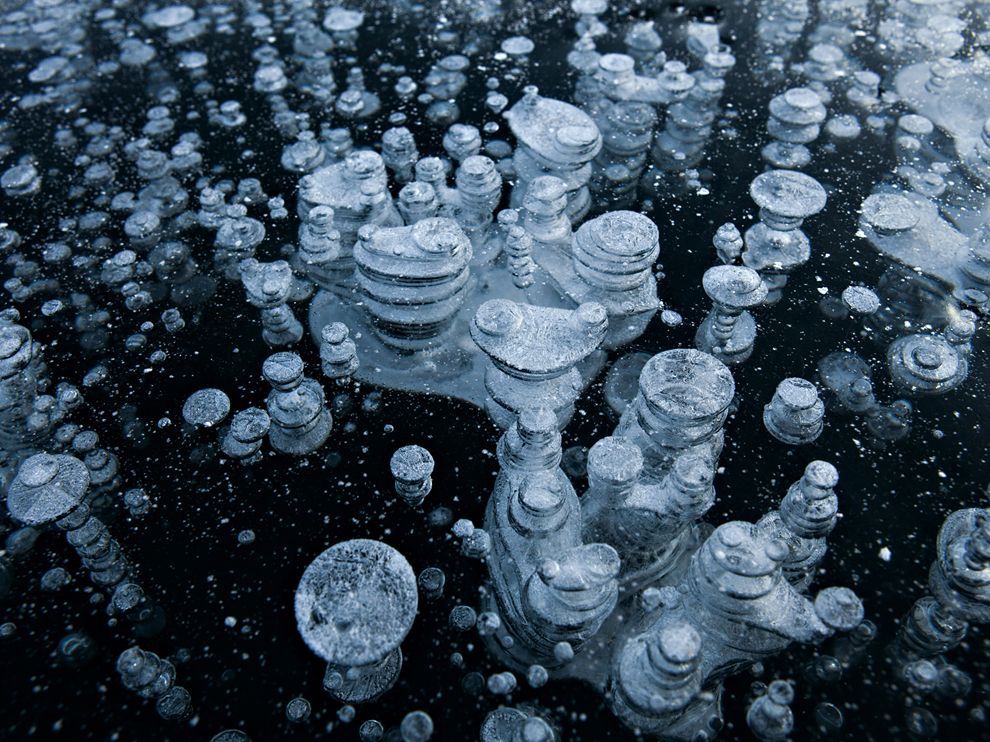
As the Arctic warms, methane that was previously trapped by permafrost rises from the muddy bottom of lakes to escape into the atmosphere. Here the first clear ice of the fall has trapped the rising methane bubbles, allowing scientists an opportunity to estimate the amount of methane being released. When spring arrives and the lakes melt, the methane will rise again. (Photo credit: M. Thiessen/National Geographic)
Inside a Blender
The fluid dynamics of a commercial-quality blender amount to a lot more than just stirring. Here high-speed video shows how the blender’s moving blades create a suction effect that pulls contents down through the middle of the blender, then flings them outward. This motion creates large shear stresses, which help break up the food, as well as turbulence that can mix it. But if you watch carefully, you’ll also see tiny bubbles spinning off the blades. These bubbles, formed by the pressure drop of fluid accelerated over the arms of the blades, are cavitation bubbles. When they collapse, or implode, they create localized shock waves that further break up the blender’s contents. This same effect is responsible for damage to boat propellers and lets you destroy glass bottles. (Video credit: ChefSteps; via Wired; submitted by jshoer)

Shock Waves in Flight
Schlieren photography allows visualization of density gradients, such as the sharp ones created by shock waves off this T-38 aircraft flying at Mach 1.1 around 13,000 ft. Although shock waves are relatively weak at this low supersonic Mach number, they persist, as seen in the image, at significant distances from the craft. The sonic boom associated with the passage of such a vehicle overhead is due to the pressure change across a shock wave. The higher the altitude of the supersonic craft, the less intense its shock wave, and thus sonic boom, will be by the time it reaches ground level. (Photo credit: NASA)
Making Metal Water-Repellent
Chemical treatments can be used to render metals hydrophobic, causing water to bead on the surface rather than spreading to wet it. Treating the surface by immersing it in boiling water before applying the chemicals creates a nanoscale texture that accentuates the hydrophobicity. Even on a common metal like aluminum, this combination of texturing and chemical treatment leads to superhydrophobic behavior. Here the technique is demonstrated by spraying water droplets on a piece of treated aluminum. (Video credit: B. Rosenberg et al.; submitted by D. Quinn)