UCLA Spinlab has another great video demonstrating the effects of rotation on a fluid. In a non-rotating fluid, flow over an obstacle is typically three-dimensional, with flow moving over as well as around the object. But in a steadily rotating fluid, as shown in the latter half of the video, the flow only moves around the obstacle, not over it. This non-intuitive behavior is part of the Taylor-Proudman theorem, which shows that flow around an obstacle in a rapidly rotating fluid will be two-dimensional and confined to planes perpendicular to the axis of rotation. (For the mathematically-inclined, Wikipedia does have a short derivation.) This 2D flow creates what are called Taylor columns over the obstacle. The Taylor column is like an imaginary extension of the original obstacle, turning the puck into a tall cylinder, and it’s real enough to flow, which diverts around it as though the column were there. (Video credit: UCLA Spinlab)
Category: Phenomena

Transonic Flow
In the transonic speed regime the overall speed of an airplane is less than Mach 1 but some parts of the flow around the aircraft break the speed of sound. The photo above shows a schlieren photograph of flow over an airfoil at transonic speeds. The nearly vertical lines are shock waves on the upper and lower surfaces of the airfoil. Although the freestream speed in the tunnel is less than Mach 1 upstream of the airfoil, air accelerates over the curved surface of airfoil and locally exceeds the speed of sound. When that supersonic flow cannot be sustained, a shock wave occurs; flow to the right of the shock wave is once again subsonic. It’s also worth noting the bright white turbulent flow along the upper surface of the airfoil after the shock. This is the boundary layer, which can often separate from the wing in transonic flows, causing a marked increase in drag and decrease in lift. Most commercial airliners operate at transonic Mach numbers and their geometry is specifically designed to mitigate some of the challenges of this speed regime. (Image credit: NASA; via D. Baals and W. Corliss)

Volcanic Vortex
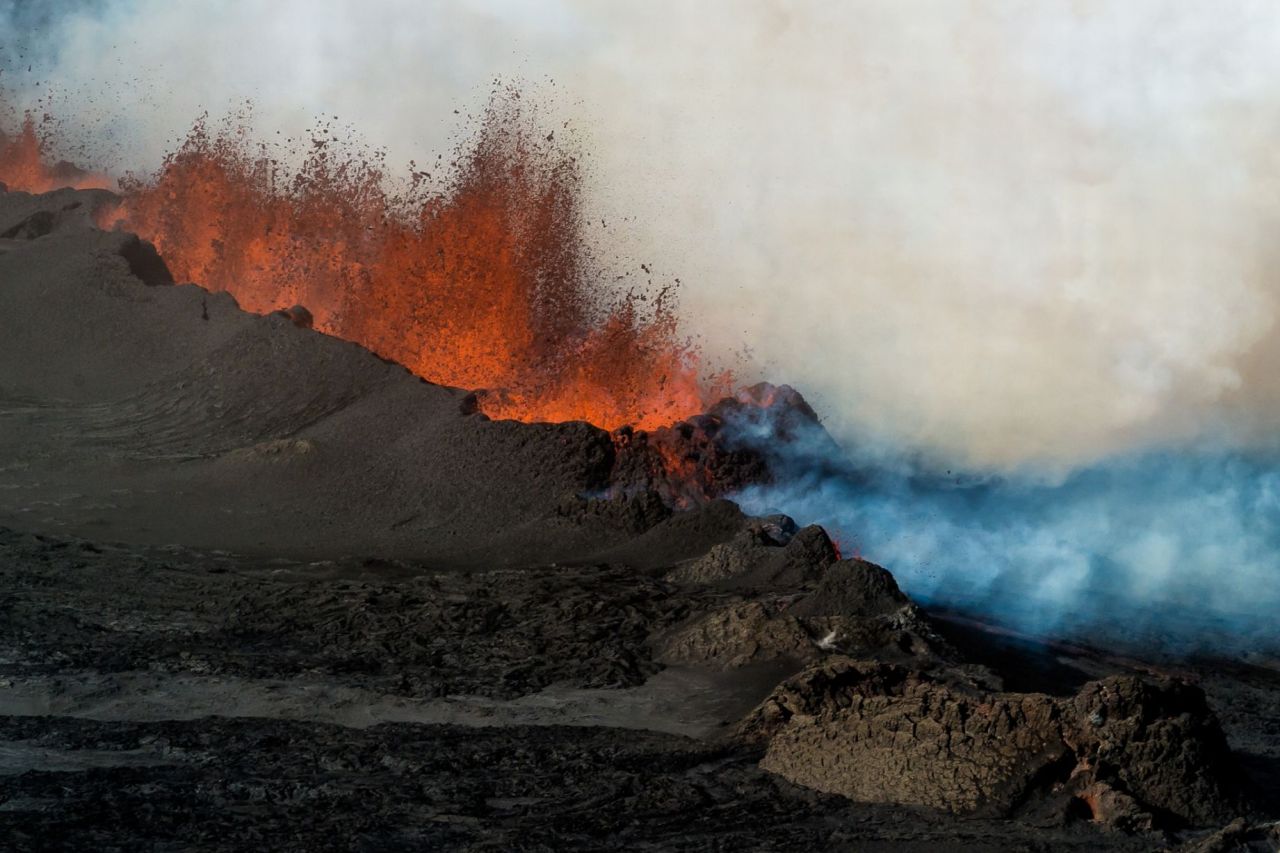
This infrared image shows a kilometer-high volcanic vortex swirling over the Bardarbunga eruption. The bright red at the bottom is lava escaping the fissure, whereas the yellow and white regions show rising hot gases. Although the vortex looks similar to a tornado, it is actually more like a dust devil or a so-called fire tornado. All three of these vortices are driven by a heat source near the ground that generates buoyant updrafts of air. As the hot gases rise, cooler air flows in to replace them. Any small vorticity in that ambient air gets amplified as it’s drawn to the center, the same way an ice skater spins faster when she pulls her arms in. With the right conditions, a vortex can form. Unlike a harmless dust devil, though, this vortex is likely filled with sulphur dioxide and volcanic ash and would pose a serious hazard to aviation. (Image credit: Nicarnica Aviation; source video; via io9)

Crow Instability
Behind airplanes in flight, water vapor from the engine exhaust will sometimes condense in the wingtip vortices, thereby forming visible contrails. The two initially parallel vortex lines are unstable and any small perturbation to them–a slight crosswind, for example–will cause an instability known as the Crow instability. The contrails become wavy, with the amplitude of the wave growing exponentially in time due to interactions between the two vortices. Eventually, the vortex lines can touch and pinch off into vortex rings. The effect is also quite noticeable when smoke generators are used on a plane, and there are some great examples in this air show video between 3:41:00 and 3:44:00. (Video credit: M. Landy-Gyebnar; h/t to Urs)

Lava Physics
Lava is rather fascinating as a fluid. Lava flow regimes range from extremely viscous creeping flows all the way to moderately turbulent channel flow. Lava itself also has a widely varying rheology, with its bulk properties like viscosity and its response to deformation changing strongly with temperature and composition. As lava cools, instabilities form in the fluid, causing the folding, coiling, branching, swirling, and fracturing associated with different types and classes of lava. (Image credit: E. Guddman, via Mirror)
The Physics of Sneezing
Sneezing can be a major factor in the spread of some illnesses. Not only does sneezing spew out a cloud of tiny pathogen-bearing droplets, but it also releases a warm, moist jet of air. Flows like this that combine both liquid and gas phases are called multiphase flows, and they can be a challenge to study because of the interactions between the phases. For example, the buoyancy of the air jet helps keep smaller droplets aloft, allowing them to travel further or even get picked up and spread by environmental systems. Researchers hope that studying the fluid dynamics and mathematics of these turbulent multiphase clouds will help predict and control the spread of pathogens. Check out the Bourouiba research group for more. (Video credit: Science Friday)

Bioluminescence
In the dark of the ocean, some animals have evolved to use bioluminescence as a defense. In the animation above, an ostracod, one of the tiny crustaceans seen flitting near the top of the tank, has just been swallowed by a cardinal fish. When threatened, the ostracod ejects two chemicals, luciferin and luciferase, which, when combined, emit light. Because the glow would draw undesirable attention to the cardinal fish, it spits out the ostracod and the glowing liquid and flees. Check out the full video clip over at BBC News. Other crustaceans, including several species of shrimp, also spit out bioluminescent fluids defensively. (Image credit: BBC, source video; via @amyleerobinson)
Soap Film Physics
Soap films consist predominantly of water, yet their thin, virtually two-dimensional nature is impossible for water alone to achieve. The small amount of added soap acts as a surfactant, lowering the surface tension of the fluid and preventing it from bursting into droplets. When forming a film, the soap molecules align themselves along the outer surfaces of the film, with their hydrophilic heads among the water molecules and their hydrophobic tails oriented outward. For the most part, the water molecules stay sandwiched between the surfactant layers, forming a film only about as thick as the wavelength of visible light. In fact, the psychedelic colors of a soap film are directly related to the film’s thickness with the black regions being the thinnest. The video above shows a horizontal soap film at the microscopic scale and some of the dynamics exist therein. (Video credit: J. Hart)

ALS Ice Bucket Challenge


When fluid dynamicists get into the ALS ice bucket challenge, they give it a good fluidsy twist. Here are some selections, including lots of high speed video and an infrared video. Check out all those liquid sheets breaking up. Links to the full videos are below. (Image credits: Ewoldt Research Group, source video; TAMU NAL, source video; BYU Splash Lab, source videos 1, 2, 3, 4)
Death Valley’s Roaming Rocks


The mystery of the roaming rocks of Death Valley’s Racetrack Playa may be at an end. Since their discovery in the 1940s, researchers have speculated about what conditions on the playa could cause 15+ kg rocks to slide tens or hundreds of meters across the dry lakebed. But the rare nature of the movement and the remoteness of the location had prevented direct observation of the phenomenon until last December when a research team caught the rocks in motion (see the timelapse animation above or the source video). Winter rain and snow had created a shallow ice-encrusted pond across the playa by the time the researchers arrived to check their previously installed equipment. Late one sunny morning, the melting ice, only millimeters thick, cracked into plates tens of meters wide and began to move under the light breeze (~4-5 m/s). Despite its windowpane-like thickness, the ice pushed GPS-instrumented rocks up to hundreds of meters at speeds of 2-5 m/min. It took just the right mix of conditions–sun, wind, snow, and water–but the two ice-shoving instances the team observed go a long way toward explaining the sailing rocks. (Image credits: R. Norris et al.; J. Norris, source video; NASA Goddard; via Discover and SciAm)