Supercooling is the process of lowering a fluid’s temperature below its freezing point without the fluid becoming solid. Though this may sound bizarre, it’s an effect you can recreate easily in your refrigerator, as detailed in the video above. Supercooling shows up in nature as well, particularly with water droplets at high altitudes. If a plane flies through supercooled water droplets, it can create icing problems on the aircraft’s wings. Alternatively, flying through supercooled water vapor can cause a hole-punch cloud to form when the vapor flash-freezes into snow. (Video credit: SciShow)
Category: Phenomena

Piazza del Popolo
The lions of the fountain in Rome’s Piazza del Popolo eject a turbulent sheet of water. Random fluctuations in the water sheet cause holes to form. Driven by surface tension, these holes grow and merge, leaving behind ligaments of water which quickly break up into a spray of unevenly-sized drops. (Image credit: E. Villermaux)
Coalescence in Microgravity
Microgravity is a wonderful playground for fluid dynamics. Here astronaut Reid Wiseman demonstrates the interplay of forces involved in coalescence. When smaller droplets hit with insufficient force, they bounce off the water sphere. But if they hit hard enough to overcome surface tension, they coalesce with the sphere. I think the space station needs a high-speed video camera; I’d like to see this behavior at a few thousand frames per second! (Video credit: R. Wiseman/NASA)

The Airbag’s Inflation
Airbags have become a standard safety feature for automobiles. As the Slow Mo Guys demonstrate in the video above, the bags inflate incredibly quickly–less than 1/25th of a second! The incredible speed of the system’s deployment is what keeps the car’s occupants from slamming into the hard surfaces of the wheel or dashboard. But this only works if the passenger is far enough away that the airbag is inflated before they contact it. Because the bag inflates so quickly, it does so with enormous force, like the airbag in the video flinging the glass of water. When a car registers a crash, it sparks the ignitor of a solid-propellant inflator, initiating a chemical reaction that produces the nitrogen gas that fills the airbag. This is essentially the same process as a solid-propellant rocket. (Video credit: The Slow Mo Guys)

Barchan Dunes

Crescent-shaped barchan dunes are common on both Earth (top image) and Mars (bottom image). They form in areas where the wind comes predominantly from one direction. As the wind blows, it deposits sand on the gently sloping windward face of the dune. The leeward face of the dune is steeper; its shape is set by the sand’s angle of repose–essentially the steepest angle the sand can maintain without an avalanche. Barchan dunes are very mobile, moving between one and a hundred meters per year. They have also been seen moving through one another or moving along in formation. (Image credits: Google Earth, NASA/JPL/University of Arizona)
Inside a Water Blob
This new video from the Space Station shows once again that astronauts have the most fun job on–or off–the planet. In it, the Expedition 40 crew members submerge a GoPro camera in a microgravity water blob. Here on Earth, we’re used to surface tension being a minor or secondary force with most fluids we experience daily. This is because gravity often provides the overwhelming effect. But in microgravity, those effects are absent, and forces like surface tension and adhesion dominate water’s behavior. This both why the crew can make such a large water sphere hold together, and why one astronaut eventually gets his hands stuck in the sphere. (Video credit: NASA; submitted by jshoer)

Von Karman Vortex Streets
The wake of a cylinder is a series of alternating vortices shed as the flow moves past. This distinctive pattern is known as a von Karman vortex street. The speed of the flow and the size of the cylinder determine how often vortices are shed. Incredibly, this pattern appears at scales ranging from the laboratory demo all the way to the wakes of islands. Von Karman vortex streets can even be seen from space. (Image credit: R. Gontijo and W. Cerqueira, source video)

Iridescent Clouds
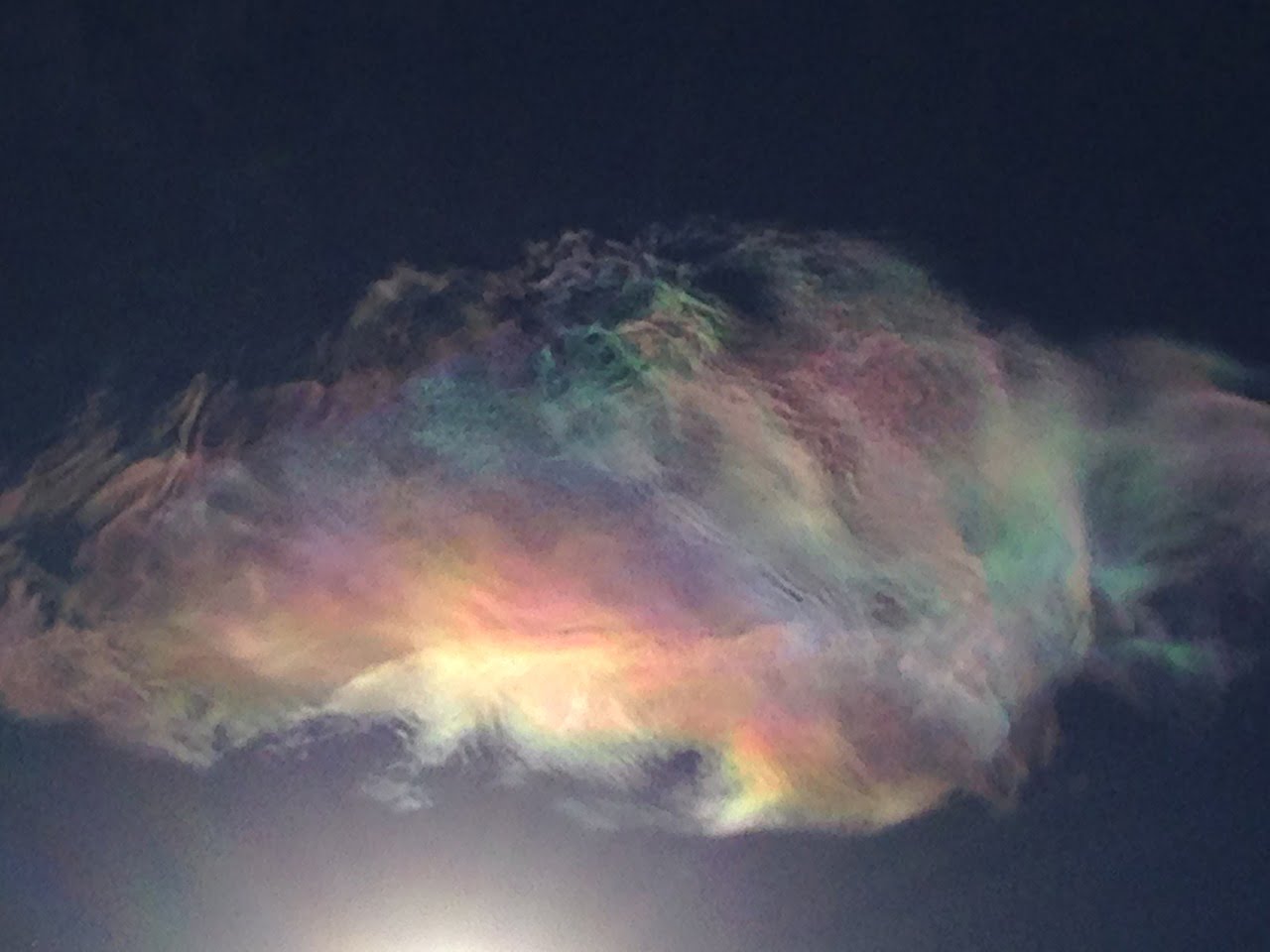
Look up at the clouds on the right day and you may catch a glimpse of a rainbow-like phenomenon known as cloud iridescence. These colors occur when sunlight is diffracted through small water droplets or ice crystals. For the effect to be apparent, the cloud must be optically thin, meaning that most of the rays of sunlight must pass through only a single droplet or ice crystal. This means the effect is usually visible only near the edges of clouds or as new clouds are forming. You can see more photos of the phenomenon here, and there’s a great video where cloud iridescence makes an appearance during a rocket launch in this previous entry. (Photo credit and submission: C. Havlin)
The Hidden Complexities of the Simple Match
Striking a match and blowing it out seems rather simple to the naked eye. But with high-speed video and schlieren photography, the act takes on new complexity. Schlieren photography is an optical technique that is incredibly sensitive to changes in density, which makes it a prime choice for visualizing flows with temperatures variations or shock waves. Here it shows the hot gases generated as the match is lit. Once the match ignites, the flow calms somewhat into a gently rising plume of exhaust and hot air. When someone enters the frame to blow out the match, the frame rate increases to capture what happens next. The flow field around the match becomes very complex as the air and flame interact. The range of length scales in the flow increases, from scales of several centimeters down to those less than a millimeter. This complexity and range of sizes is a hallmark of turbulence. (Video credit: V. Miller et al.)

Momentary Crown
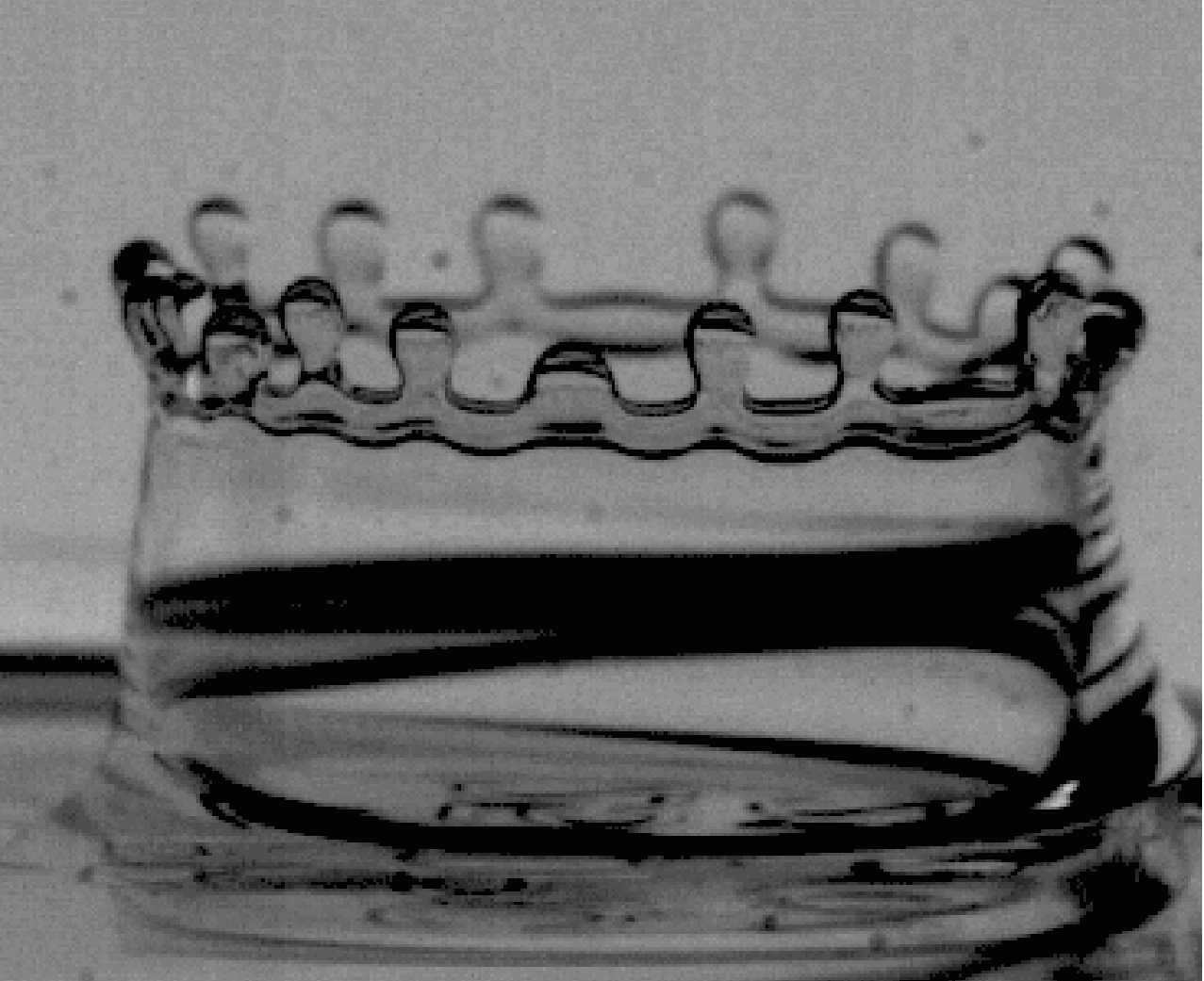
When a drop falls on a liquid film, its impact drives a thin liquid sheet called the ejecta upward and outward from the point of impact. Within milliseconds, tiny perturbations develop in the ejecta and begin growing exponentially. These become the distinctive spikes of the crown. The momentum from the impact drives the ejecta and spikes further outward until it overcomes surface tension’s ability to hold the liquid crown together. Tiny droplets escape the crown before the ejecta comes crashing down. The whole process takes only a few hundred milliseconds from start to finish. (Photo credit: S. Jung et al.)